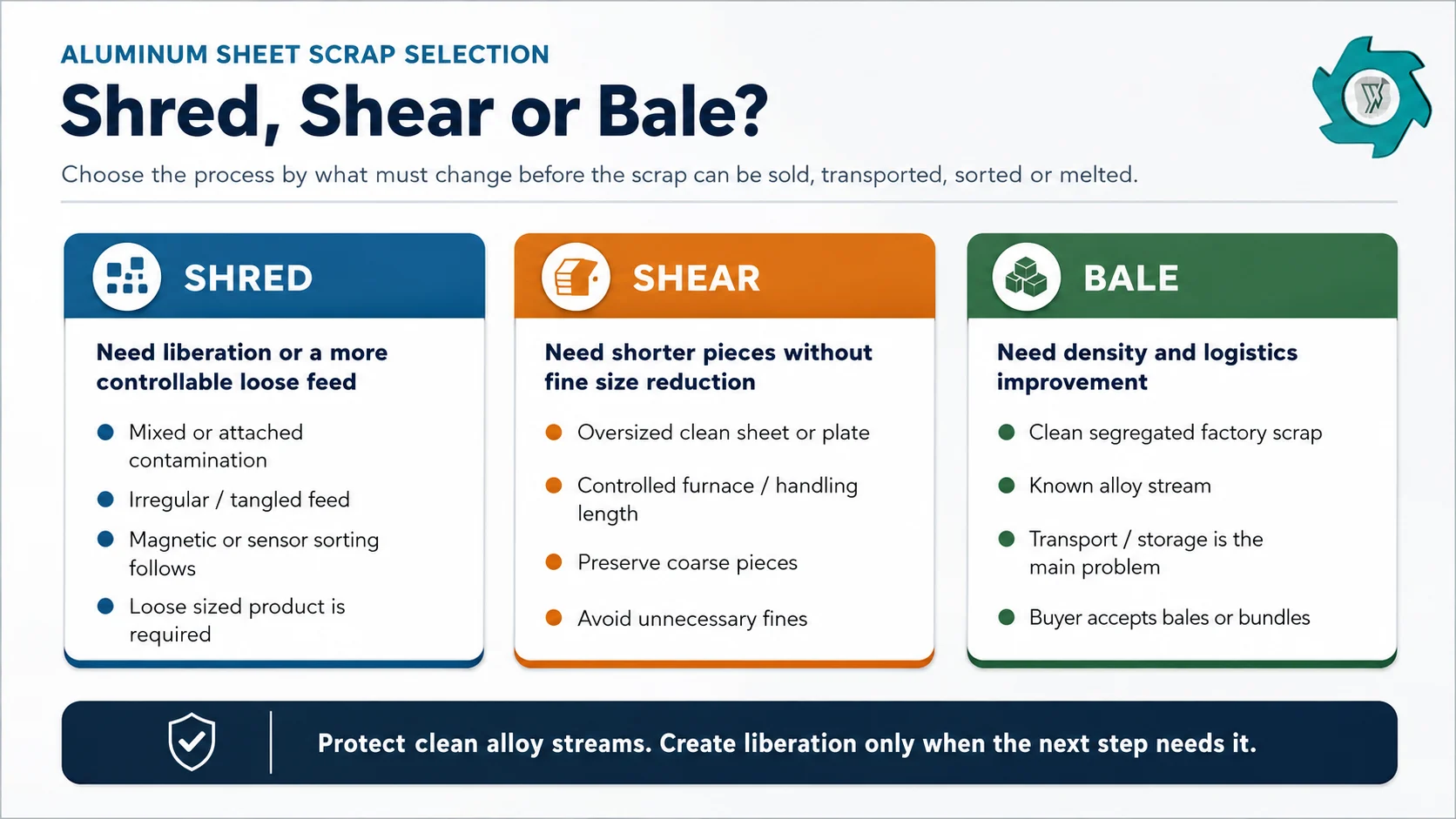
Aluminum sheet scrap is one of the easiest materials to over-process. Clean stamping offcuts can be valuable precisely because their alloy and origin are known. If the real problem is only storage volume, a baler may be enough. If the sheets are too large for the furnace or handling system, a shear can shorten them without turning them into small fragments. Shredding earns its place when the feed must be opened, liberated or converted into a controlled loose stream before separation.
Selection rule:bale when density is the main problem, shear when length or piece size is the main problem, and shred when liberation, irregular feeding or downstream sorting is the main problem. The right route is the shortest route that produces a saleable or furnace-acceptable product.
Do not start with machine type. Start with the physical change the scrap still needs.
Why sheet scrap deserves its own equipment decision
The broader scrap aluminum recycling line has to cover profiles, wheels, castings, mixed aluminum, cans, foil and machining chips. Sheet scrap is narrower. Its value often comes from being relatively clean, flat and identifiable. That changes the economics.
New production scrap is a good example. Stamping skeletons, trimmed edges, rejected panels and rolling-mill sheet can often be traced to a known alloy family. Published aluminum-recycling literature treats known-pedigree manufacturing scrap as especially valuable because it can be returned to a compatible alloy stream rather than diluted into general mixed scrap.[1] Once two clean alloy streams are shredded into one common bunker, no downstream magnet can restore that lost segregation.
There is also no universal furnace rule that says aluminum must be shredded. U.S. EPA guidance for secondary aluminum operations describes both high-density bales and dry shredded scrap as possible furnace charge forms.[2]
First classify the incoming sheet scrap
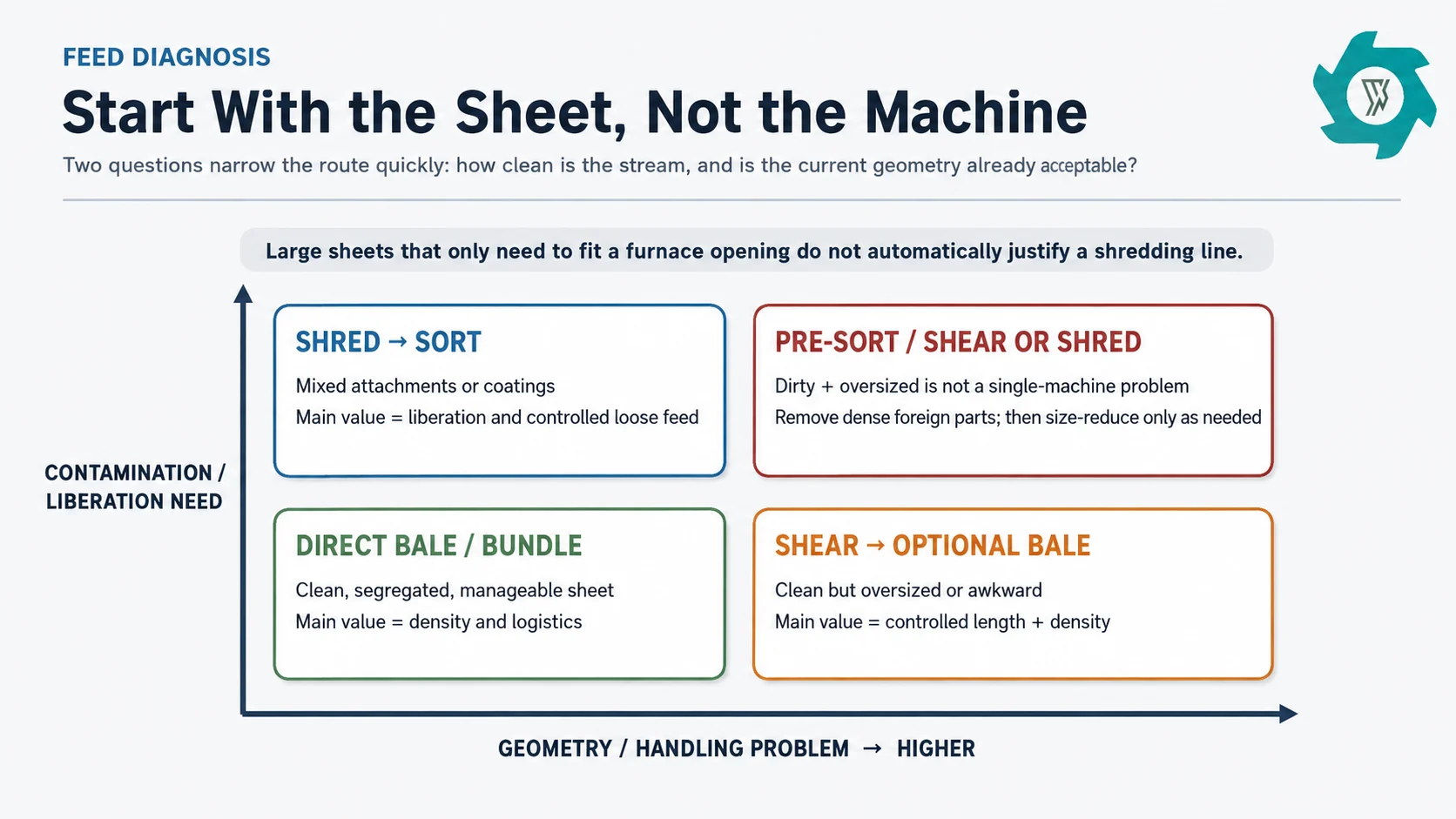
A flat stack of 3 mm clean offcuts behaves very differently from springy stamping skeletons, coated siding, thin mixed panels or large plate sections. Before discussing motor power or bale dimensions, separate the feed into a few practical categories.
Feed condition
What usually matters most
Likely first route to evaluate
Clean, segregated stamping offcuts
Preserve alloy identity; reduce storage and transport volume
Direct baling or bundling
Large clean sheets or plate-like offcuts
Piece length, safe handling, furnace opening
Shearing, then optional baling
Tangled skeletons and irregular trim
Stable feeding and controllable piece form
Shear or low-speed shredder, depending on size and downstream need
Mixed sheet with screws, brackets or steel backing
Liberation before magnetic removal
Shredding followed by magnetic separation
Painted, laminated or composite sheet
Coatings, non-metal content, dust and buyer specification
Pre-sort; shred only if separation is required
Very light gauge sheet or foil
Bulk-volume feeding, windage and fines
Controlled compaction/baling; dedicated route if contaminated
Cleanliness and geometry usually narrow the equipment decision faster than a nominal tons-per-hour target.
Choose a baler when density is the real problem
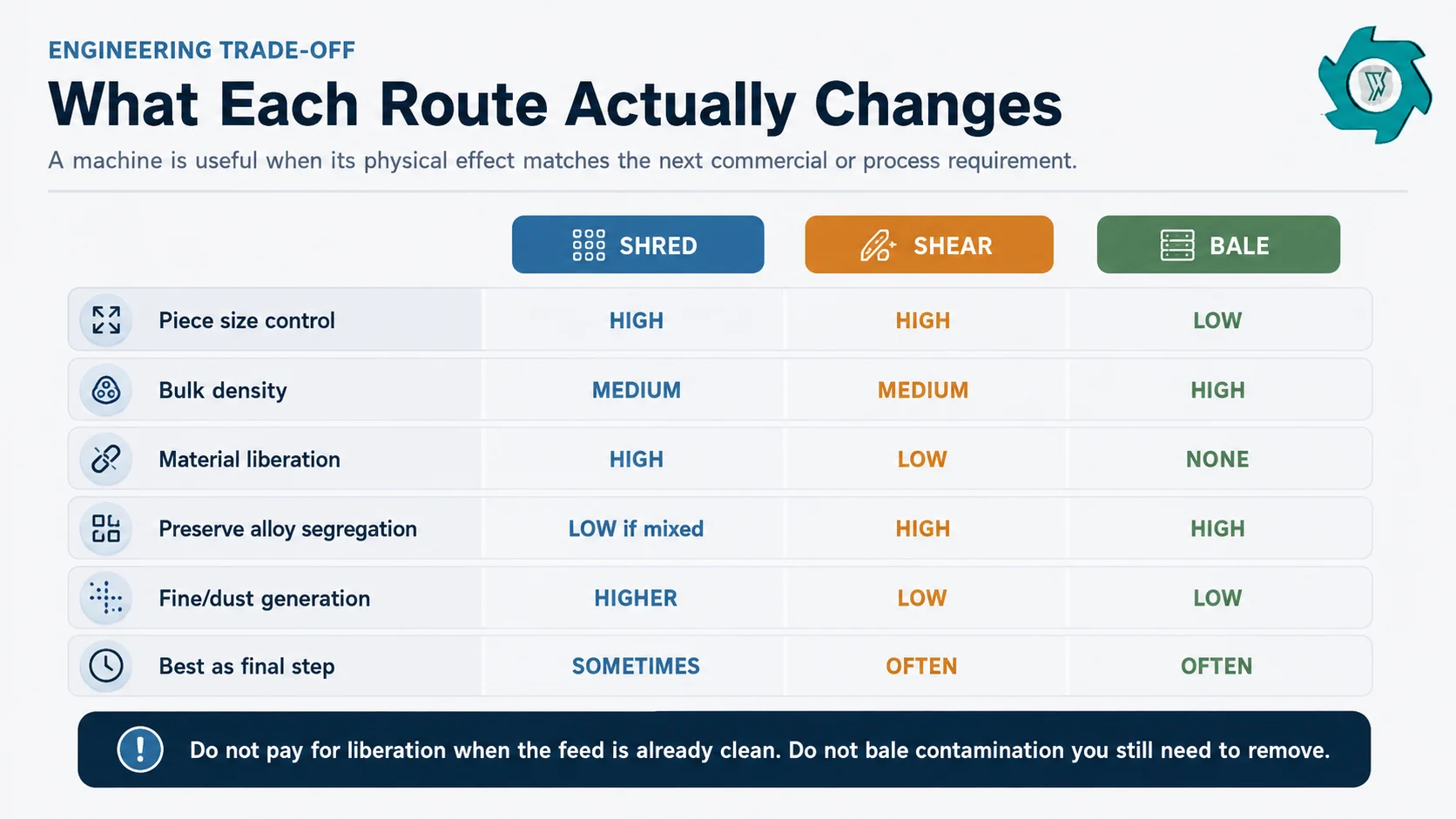
A baler does not clean aluminum. It does not liberate steel from an aluminum panel, and it does not create a controlled loose particle size. What it does well is convert low-density, awkward scrap into a compact form that is easier to store, load, ship and sometimes charge.
The material is already segregated, the buyer already knows what it is, and there is no reason to spend energy breaking it into smaller pieces simply to compress it again later. One current U.S. sheet-scrap receiving specification, for example, accepts bundled sheet within its own defined packaging and size limits.[3]
Direct baling is strongest when
the scrap is clean and its alloy stream is known;
sheet dimensions already fit the baler chamber or can be safely loaded;
there is little attached steel, plastic, rubber or insulation to remove;
the buyer accepts bales, bundles or compacted sheet;
transport, warehouse space or loader handling is the main cost problem.
What a baler can hide
Compression makes a pile look uniform. That can be useful for logistics and dangerous for quality control. Oil, steel brackets, plastic sheet, trapped packaging and mixed alloys are harder to inspect once they are buried in a dense bale. If contamination is still an unresolved issue, baling should normally come after inspection and sorting, not before.
A trading yard may want stable, stackable packages. A furnace may have a maximum charge opening or a specific charging practice. A secondary processor may want the bale reopened and sorted later. Those are different outputs even if they all begin with the same clean sheet scrap.
Choose a shear when size is wrong but the material is already clean
Shearing solves a simpler problem than shredding: the pieces are too long, too wide or too awkward, but there is no strong reason to reduce them to small fragments. A scrap shear typically combines compaction with a guillotine-style cutting action. Industrial shear suppliers describe the process as pre-compaction followed by controlled cutting into manageable output.[4]
That is useful for large sheet, plate-like offcuts, stacked production scrap and other material that needs a controlled length for furnace charging or yard handling. The key benefit is not “more processing.” It is controlled coarse processing. You keep a relatively large piece while eliminating the dimensions that cause the real problem.
Shearing often makes sense when
clean sheets are larger than the furnace, container, charging box or downstream conveyor can accept;
the plant wants coarse cut pieces rather than a loose shredded fraction;
alloy segregation should be preserved;
fine particles would add dust, oxidation or housekeeping without helping separation;
the material is too awkward for direct baling but does not need liberation.
Do not size a shear from sheet thickness alone
The cutting head sees the material after loading and compression, not as one perfect coupon. A quotation should therefore include the largest normal sheet dimensions, thickness range, number of layers that can enter together, whether the material folds or springs back, and any thicker edge sections or attachments. A clean 2 mm sheet and a compressed stack of many 2 mm sheets are not the same cutting event.
During a trial, watch the complete cycle. Loading time, compaction, cutting, pusher movement and discharge all contribute to shift output. A high cutting force does not guarantee high net tons per shift if the loader spends most of the time arranging slippery flat material in the box.
Choose a shredder when the sheet has to be opened for separation
Shredding becomes a stronger choice when the current form prevents the next step from working. Large mixed panels can cover the hopper opening and feed in surges. Stamping skeletons can interlock. Attached steel remains inaccessible to a magnet until the aluminum is torn away from it. Laminated or assembled sheet may need to be opened before screening or other sorting.
A low-speed double shaft shredder is commonly used for this kind of primary reduction because it can bite, tear and shear irregular material into a more controllable feed. The target should still be defined by the downstream process. If magnetic separation works after one coarse pass, there is little value in continuing to grind the aluminum smaller.
Shredding adds value when it creates liberation
A magnet can only remove ferrous material that has been physically exposed. If a steel bracket is still trapped inside a folded panel, the separator sees one composite object. After the panel is opened, the steel may report cleanly to the magnetic stream. This is the same logic behind the EPA description of mechanical cleaning: breaking aluminum-bearing scrap into smaller pieces can improve downstream iron removal.[5]
Shredding also creates new costs
Once the material becomes smaller and lighter, conveyors, screens and dust systems have more work to do. More aggressive reduction creates more edges and potentially more fines. That matters with aluminum because fine metal dust can present a serious combustible-dust hazard; OSHA specifically treats metal dusts, including aluminum forms, as a distinct hazard category that requires proper assessment and control.[6]
Shredding, shearing and baling change different physical properties. Select the effect you actually need.
A practical decision tree for plant owners
Is the scrap clean and segregated by known source or alloy? If yes, protect that segregation. Do not mix it simply because one machine can process everything.
Does the buyer or furnace already accept the current piece form? If yes, direct baling, bundling or even no mechanical processing may be the best answer.
Is the only problem that sheets are too large? Evaluate a shear before a shredder.
Is steel or non-metal material still attached? Decide whether pre-sorting can remove it. If not, shredding may be needed to create liberation.
Does downstream sorting require a controlled loose size range? Shredding and screening become more relevant.
Will the final material be baled anyway? If yes, ask what the shredding stage adds before paying for both machines.
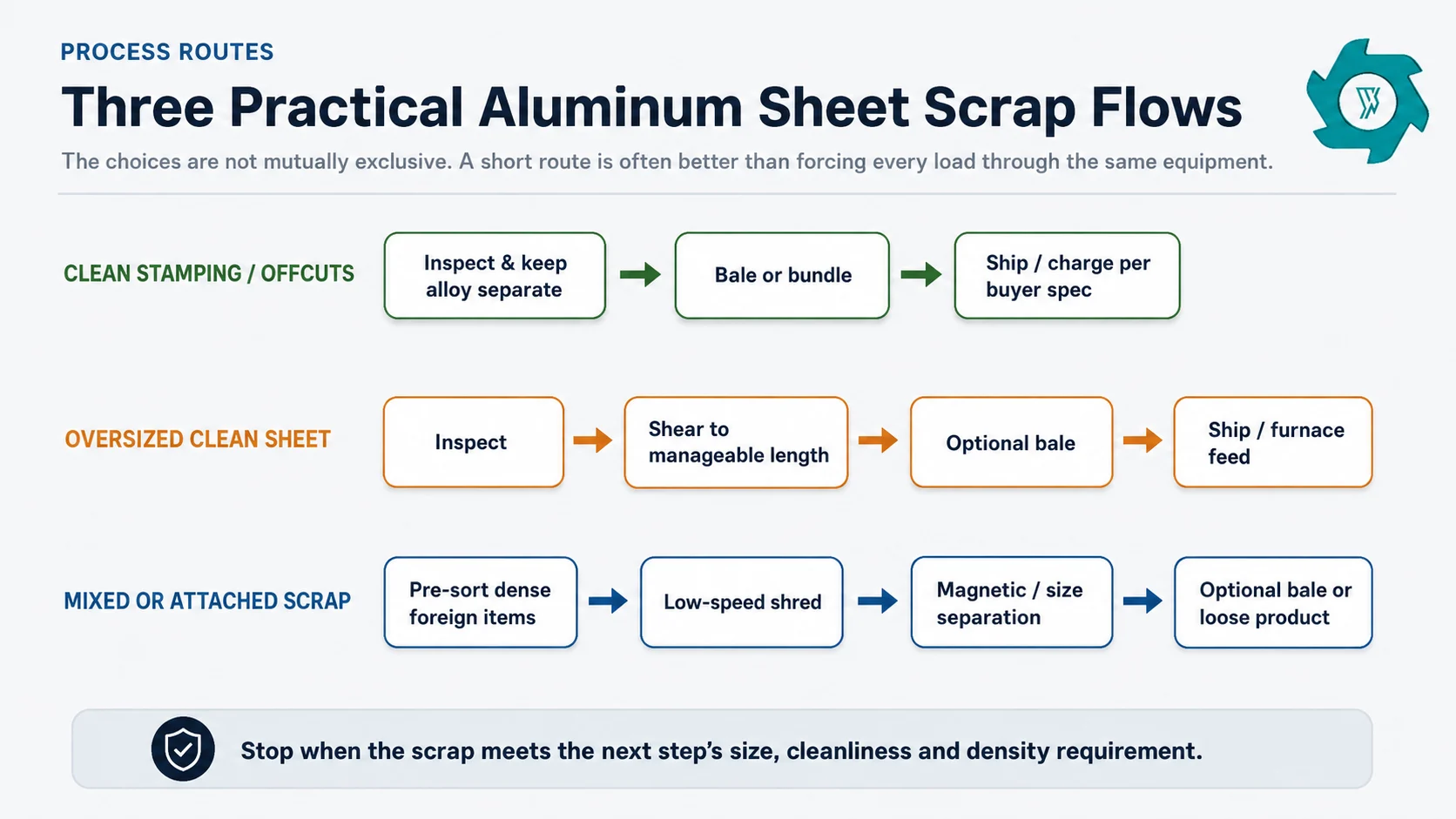
The routes can be combined
The three machine types are not competing answers in every project. A plant may shear large clean sheets first and then bale the cut pieces. Another may shred mixed sheet, remove steel magnetically, and compact the cleaned aluminum for transport. A third may bale clean stamping skeletons directly while sending only the contaminated reject stream to a shredder.
The lowest-cost line is often the one that gives different feed grades different routes instead of forcing everything through one machine sequence.
Capacity should be measured at the accepted output
Sheet scrap can make machine capacity look better or worse depending on where the stopwatch starts. Loose thin material occupies a lot of volume. A loader may be the bottleneck before the baler or shear reaches its hydraulic limit. Large flat sheets may feed a shredder in bursts even when cutter torque is not the limiting factor.
If the plant sells bales, measure accepted bales per shift from representative incoming scrap. If the plant sells magnetically cleaned shredded aluminum, measure saleable aluminum leaving the separation line, not just gross material leaving the shredder. If the furnace needs cut sheet, measure conforming cut output after normal loading and discharge delays.
Track the interruptions that do not appear on a nameplate
loader waiting and material rearrangement;
bridging or rafting at the feed opening;
manual removal of oversize or dense foreign parts;
shredder reversals and jam clearing;
shear blade inspection and scrap repositioning;
baler tie, discharge or bale-handling delays;
magnet cleaning and downstream conveyor overload;
housekeeping time caused by fines.
Common selection mistakes
1. Shredding clean sheet because “more processing means higher value”
Not necessarily. Clean known-alloy scrap may already have value because it is clean and known.
2. Buying a baler before confirming bale acceptance
Bale size, density, tie method and contamination limits can be receiver-specific.
3. Using a shear to solve contamination
A shear changes length. It may expose some attachments, but it is not a separation system. If steel, plastic or laminated layers are the real value problem, the process needs inspection, liberation and sorting logic.
4. Specifying only “tons per hour”
Two tons of thin loose stamping skeletons and two tons of compact plate do not present the same loading volume, cycle time or feed stability. Always pair capacity with representative geometry and material form.
5. Testing with hand-picked easy pieces
A proper trial should include these materials: nested skeletons, broad flat sheets, common thickness changes and the contamination that really arrives.
What to verify in a material test
Route
Measure during the test
What “good” means
Baling
Feed cycle, bale integrity, density consistency, handling, hidden contamination
Stable bales that meet the receiver’s form and quality requirement
Shearing
Loading cycle, cut length, material rebound, blade condition, discharge
Consistent manageable pieces without excessive operator intervention
Enough liberation and size control for the next separator or sale specification
For a combined line, weigh every meaningful output stream. A clean-looking aluminum pile is not enough if valuable aluminum is leaving with the ferrous or residue stream.
RFQ data that will get you a better recommendation
photos and video of normal incoming sheet scrap;
largest common length and width, plus thickness range;
whether the material is loose, stacked, bundled or tangled;
whether alloy/source segregation must be preserved;
percentage and type of attached steel, plastic, rubber, coatings or oil;
required accepted tons per hour and operating hours per shift;
buyer or furnace limits for piece size, bale size, density or contamination;
available loading method, workshop space and power supply;
whether magnetic separation, screening or further sorting is planned.
Need to Choose Between Shredding, Shearing and Baling?
Send representative sheet-scrap photos, maximum dimensions, thickness range, contamination, required output form and target capacity. The equipment review should first decide what processing can be removed from the line—not just what can be added.
Frequently Asked Questions
Should clean aluminum sheet scrap be shredded before baling?
Usually not. If the sheet is clean and segregated, shredding can add power, wear, dust and handling without creating extra value. Bale directly unless size reduction or liberation solves a defined problem.
When is a scrap shear better than a shredder for aluminum sheet?
A shear is often the better fit when clean sheet or plate is simply too large for safe handling, transport or furnace charging. It shortens the material while keeping a coarse product and normally creates fewer fines than aggressive shredding.
When does aluminum sheet scrap need shredding?
Shredding becomes useful when mixed sheet, attached steel, plastic, rubber, coatings or tangled geometry must be opened into a controllable loose stream before magnetic separation, screening or other sorting.
Can baling hide contamination in aluminum scrap?
Yes. A dense bale can make internal contamination difficult to inspect. For mixed or uncertain feed, sort and verify the material before compression rather than using the baler to make a poor stream look uniform.
What should be included in a sheet-scrap equipment test?
Use representative feed and record sustained throughput, feeding interruptions, output size, bale or cut stability, contamination remaining in the product, fines generation and whether the output actually meets the buyer or furnace specification.
David focuses on industrial shredding and recycling equipment,including material evaluation,shredder selection,process configuration,and recycling line planning.
Speak To Our Shredder Machine Expert
Get in touch with our nice team today to get a price estimate for a shredder machine.

 English



 Fast Delivery
 Reliable
 Certified
 Experienced