





A factory acceptance test for a refrigerator shredder should turn the supplier’s performance claims into a clear, witnessed record. The test should focus on a few practical questions: whether the agreed prepared cabinets can be processed at the required rate, how the machine responds to a difficult-but-normal unit, how often reversals and stops occur, at what point an event should be classified as a true jam, and whether the discharge meets the specified size and transfer conditions for the next stage.
A short demonstration cannot answer those questions. A credible FAT fixes the feed boundary, the weighing points, the time basis, the event definitions, the sampling point and the acceptance limits before the first cabinet enters the machine. It then keeps the same boundary through the test. That discipline is what prevents a nominal tonnes-per-hour figure, a tidy discharge photo or a claim of “no jams” from hiding the operating conditions that produced the result.
For buyers evaluating shredder performance within a waste refrigerator recycling line, FAT should provide clear evidence that the shredder can process the agreed feed, achieve the required output condition and operate reliably with the connected upstream and downstream interfaces. The focus is on verifying the shredder package under defined test conditions before shipment or final acceptance.
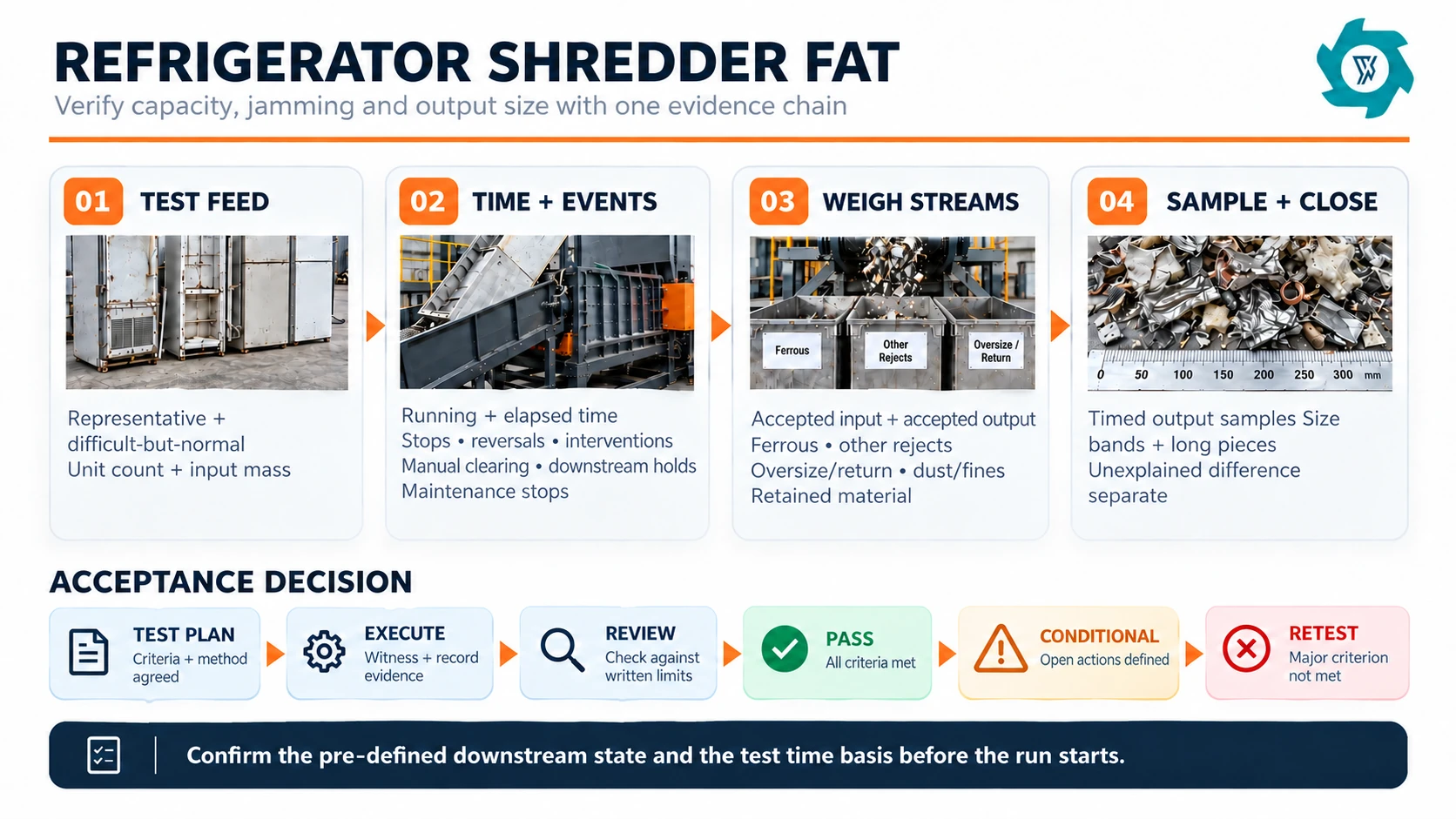
Start by freezing the FAT boundary
The most common acceptance-test dispute is not a mechanical failure. It is a boundary change. The quotation may assume fully depolluted domestic cabinets, the factory may test lighter display cases, the capacity calculation may exclude feed pauses, and the output sample may be taken only after an extra downstream machine that was not included in the original guarantee. All four changes can make the result look better without proving the purchased duty.
Before FAT, write one reference case and attach it to the test protocol. Use the same prepared-cabinet definition used when the machine was selected. The dedicated refrigerator shredder sizing guide explains how cabinet dimensions, mass, orientation and cadence affect machine selection; the FAT does not need to repeat that analysis. It only needs to identify the agreed normal mix, the difficult-but-normal feed and any maximum-envelope cabinet that will be tested separately.
For U.S. projects, the feed condition must also respect the upstream refrigerant boundary. EPA’s Section 608 safe-disposal guidance places refrigerant-recovery responsibilities on the disposal chain and specifically addresses appliances such as household refrigerators and freezers that may enter the waste stream with charge intact.[1] A shredder FAT is not a substitute for that recovery procedure. Test material should arrive in the prepared state defined for mechanical processing.
Minimum pre-test data pack
A practical data pack includes cabinet ID or class, prepared condition, dimensions for the test outliers, unit mass where available, loading orientation, total unit count, total input mass, photos of the test lot and the agreed exclusions.
Do not hide the difficult cabinets in a footnote. Mark them. If a reinforced base, side-by-side body or unusually wide unit causes repeated recovery events, the log should identify it. Conversely, if a maximum-envelope refrigerator is outside the routine production mix, test its feedability separately so one extreme cabinet does not distort the normal capacity result.
Capacity verification: use the same clock for input and output
Capacity disputes usually start with a number that has no time definition. “Two tonnes per hour” may mean cutting time only, conveyor-on time, a short peak interval or the complete elapsed production window. For a buyer, the useful measure is the amount of accepted material processed across a declared test period while the agreed process condition is maintained.
Record both running time and elapsed time. Running time shows how long the machine was actively operating. Elapsed time shows the complete defined FAT window. The difference is not noise. It contains the events that determine whether the line can support a real shift target: feed starvation, automatic reversal cycles, downstream holds, maintenance stops, operator interventions and manual clearing.
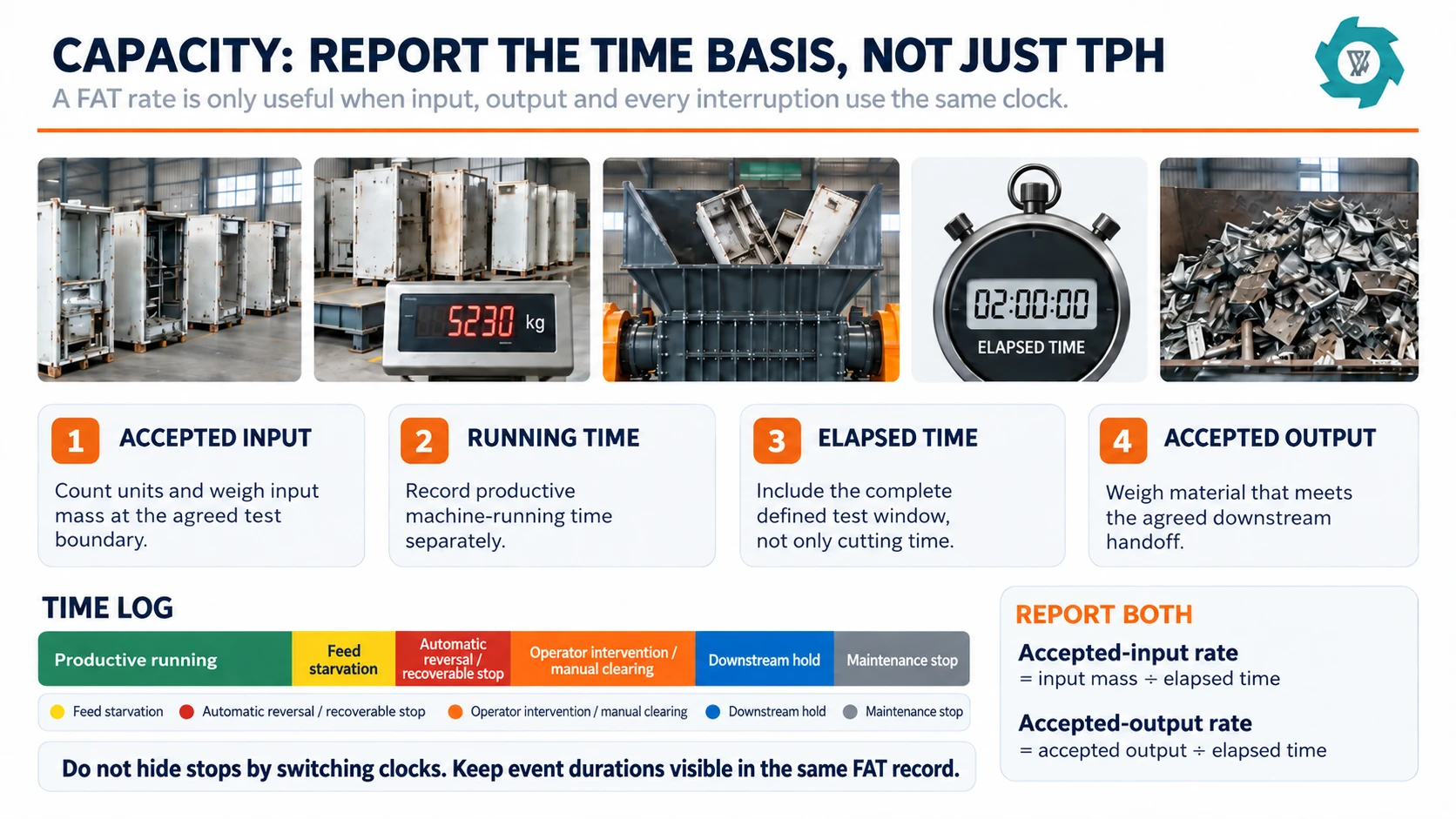
Report two rates, not one
The FAT record should report an accepted-input rate and an accepted-output rate. Accepted input is the mass that actually entered the agreed test boundary. Accepted output is the mass that reached the agreed handoff condition. Reporting both is especially useful when material remains in the chamber, is removed as an oversize return, is rejected from the test boundary or is still in transit when the clock stops.
Use one unit system throughout the article and FAT sheet. For U.S. projects, a supplier may quote tons per hour, but the test should state whether that means U.S. short tons or metric tonnes. If the project specification is metric, keep the FAT calculation in kilograms and metric tonnes so the arithmetic cannot silently change units.
Do not erase “normal inconvenience” from the test
If operators have to slow the feed, reposition a cabinet, pause for a downstream conveyor, clean a transfer point or restart after a protective trip, record it. The purpose is not to punish every interruption. It is to identify which interruptions belong to the machine, which belong to feed presentation, which belong to downstream availability and which are part of the agreed operating routine. Once the categories are visible, buyer and supplier can decide whether the result meets the written duty.
A 10-minute burst can look excellent while a 60-minute test exposes repeated recovery cycles, material accumulation or output that the next conveyor cannot accept. The FAT duration should be long enough to include multiple cabinets from the normal mix and at least the difficult-but-normal units specified in the test plan.
Jamming verification: define the event before you count it
“Jam” is often used for several different conditions. A low-speed shredder may automatically stop, reverse, reposition the load and continue forward cutting without operator action. That is an operating event, but it is not the same as a non-recovering jam that requires access, manual clearing or another intervention outside the normal automatic cycle. Likewise, a downstream full conveyor can stop the shredder even when the cutting chamber itself is clear.
The existing refrigerator shredder feed-problems guide diagnoses bridging, overload, reversal and jamming as operating conditions. During FAT, the job is different: use fixed event definitions and count what actually happened.
Use five event classes
Automatic reverse: the protection logic reverses and the machine returns to stable forward cutting without operator access. Record the count and duration.
Recoverable stop: the machine stops but restarts through the normal control sequence without manual clearing. Record the cause if known.
Non-recovering jam: normal automatic recovery fails and the machine requires operator intervention, manual clearing or another exceptional action.
Feed starvation: no material is available at the inlet. It affects elapsed capacity but should not be blamed on the cutting chamber.
Downstream hold or maintenance stop: the next stage is unavailable or the test is deliberately paused for inspection/service. These durations should remain in the event log even when they are excluded from a narrower machine-only diagnostic calculation.
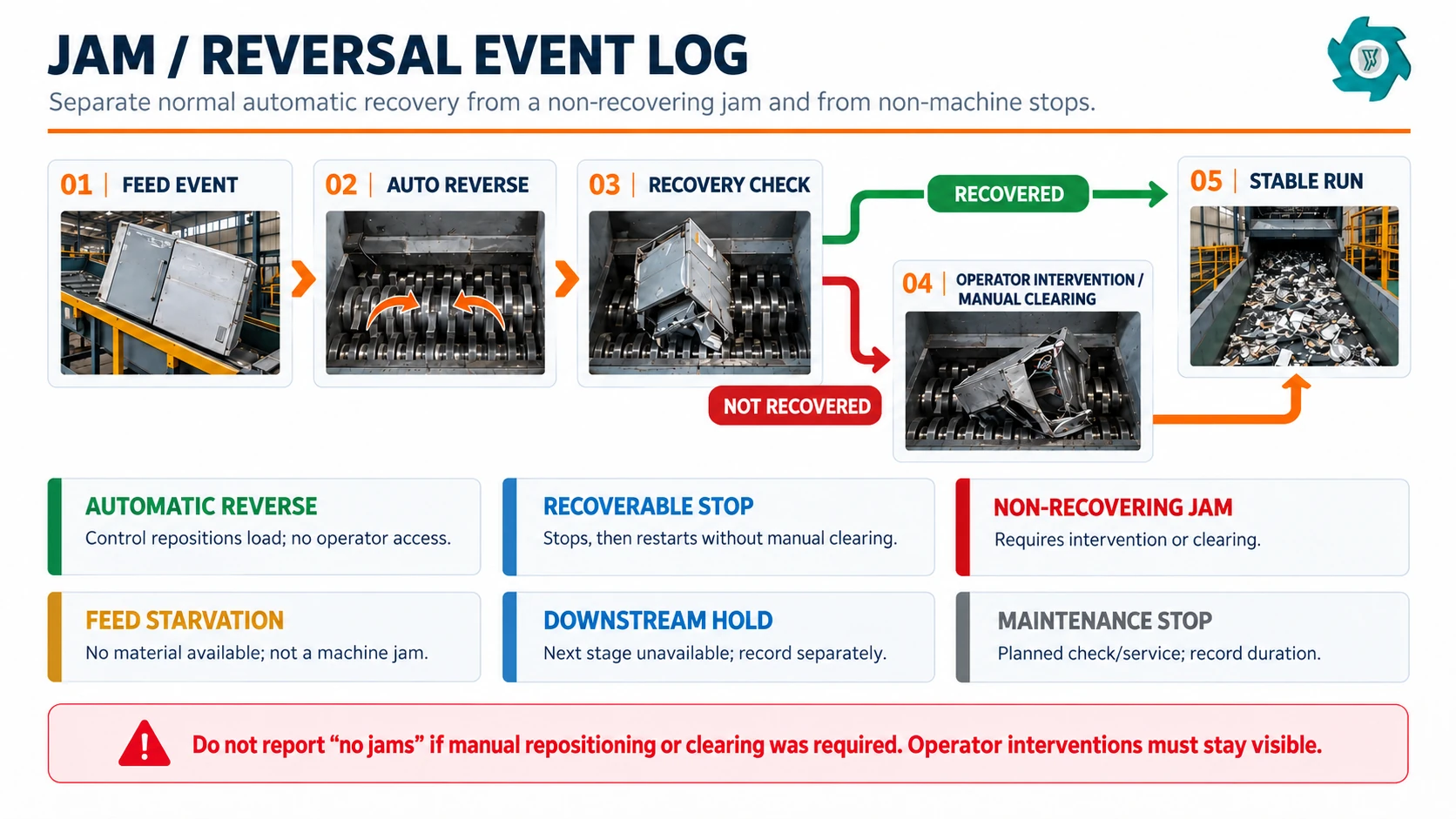
Manual clearing changes the acceptance record
If clearing requires an employee to remove or bypass a guard, or place any part of the body into a point-of-operation or associated danger zone, the activity may fall within hazardous-energy-control requirements for servicing and maintenance. OSHA 29 CFR 1910.147 covers servicing and maintenance where unexpected energization or stored energy could injure employees and specifically includes cleaning and unjamming in its servicing definition.[2] It also requires control of stored or residual energy and verification of isolation before covered work begins.[3] Machine guarding requirements separately address exposure to points of operation, ingoing nip points and rotating parts.[4]
Record the event, the cabinet, the time lost, whether the machine recovered automatically, and what action restored stable production. If a correction is made during FAT—control setting, feed presentation, cutter clearance or downstream interface—mark the change and run the affected criterion again. Otherwise the final result mixes two configurations.
Output-size verification: sample a distribution, not a photograph
A FAT should not turn output size into another generic shredder lesson. The process effects of particle size are already covered in the refrigerator shredder output-size guide. Here the question is narrower: how does a buyer verify that the tested discharge meets the output condition written into the purchase agreement?
First, define the sampling point. “At the shredder outlet” is often too vague when a line has a discharge conveyor, recirculation path, secondary liberation stage or transfer to a separator. State the exact point and keep it unchanged. Second, define the sampling timing. Incremental samples taken through stable operation are stronger evidence than one scoop selected after the run.
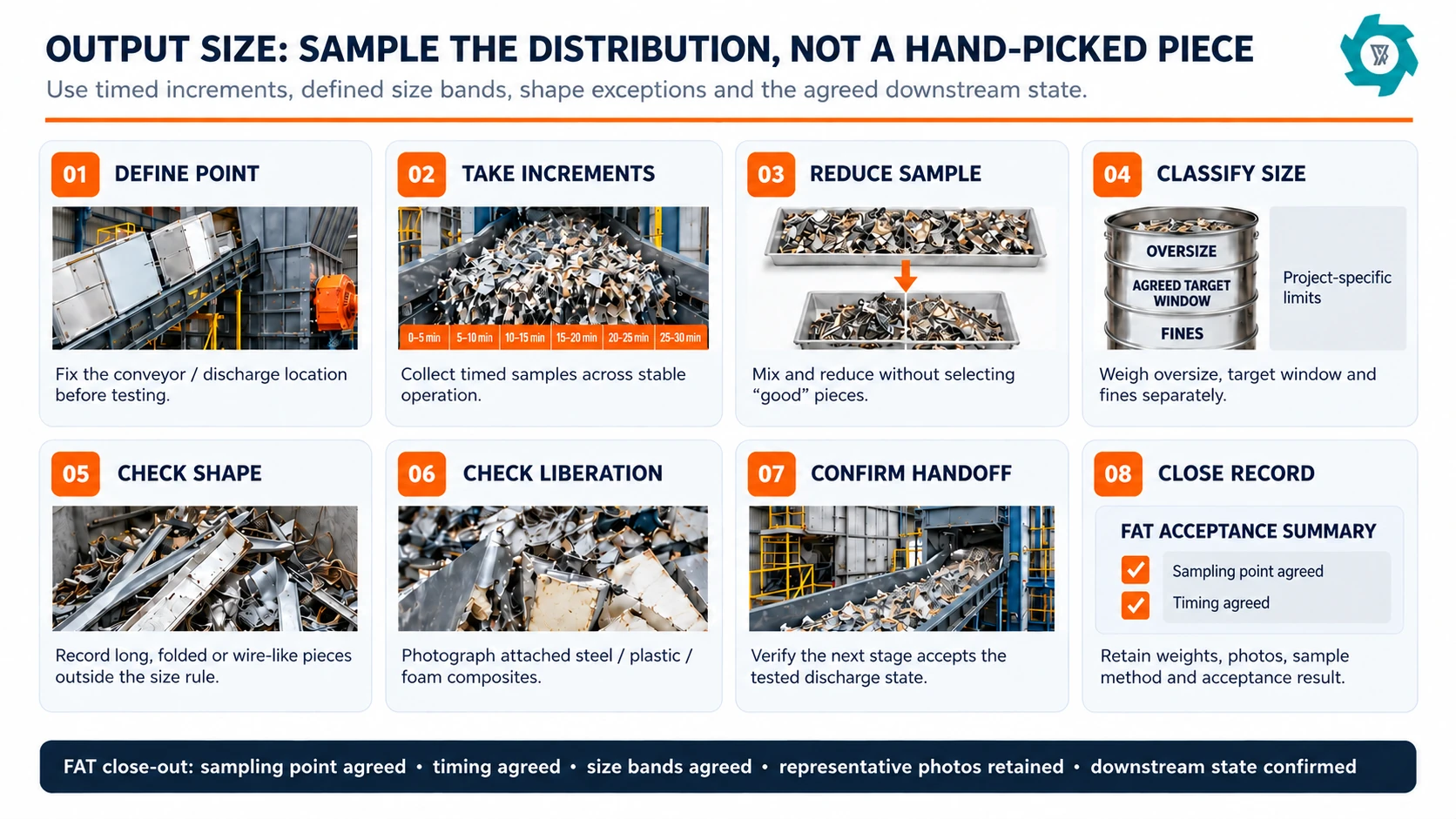
Write size bands before the test
A stronger FAT criterion uses project-specific bands: an upper oversize band, the intended operating window and a lower fines band. The exact boundaries depend on the downstream process, so do not copy the example from another plant. The buyer and supplier should agree how the sample will be reduced, screened or otherwise classified, then weigh each band separately.
Also define shape exceptions. Long wire, narrow steel strips, folded sheet and partially opened cabinet sections can pass one dimensional check yet still wrap, bridge or present poorly to the next machine. Record them separately when they matter to the interface. The same applies to attached composites. A piece may sit inside the target size band but still carry steel, plastic liner and foam together. Size alone does not prove the handoff condition.
Keep the downstream state fixed
The discharge should be judged in the same downstream state specified before the run. If the contract requires the primary shredder only to open cabinets for a secondary liberation stage, do not reject it for failing to make a final clean fraction. If the purchased package includes a secondary stage and a controlled feed to separation, then the FAT must verify that broader handoff. The refrigerator shredder machine selection guide is useful for defining those equipment roles before the order; FAT should only verify the role actually purchased.
Retain representative photos of oversize, long pieces and attached composites. If the buyer later sees a different output state at site, the FAT record provides a visual reference as well as a numerical one.
Close the FAT with a mass balance
Capacity, jamming and output size should converge in one close-out sheet. A test that reports input rate but does not reconcile material can hide retained mass. A test that reports output size but not operating events can hide the repeated stops required to produce that sample. A test that says “all material processed” without separate weights makes it impossible to see where metal, residue, oversize or fines actually went.
Weigh accepted input and accepted output separately. Then, where they exist inside the agreed boundary, weigh ferrous output, other rejects, oversize or return material, dust or fines and retained material. State any unexplained mass difference separately. Do not merge unexplained difference into retained material and do not combine ferrous with “rejects.” Where accepted output is subsequently divided into downstream product streams, treat those stream weights as components of accepted output rather than adding them to it again. Define every mass-balance line so the same material is not counted twice.
For a machine-only FAT, some downstream product streams may not exist. Do not invent them. Mark them as outside the boundary and still close the mass balance for the material that is inside the test. For a package FAT that includes separation, weigh and sample the agreed downstream products as well, especially when their condition is part of the acceptance promise.
Why accepted input and accepted output must stay separate
Imagine that 5,000 kg enters the FAT boundary and the machine produces 4,650 kg of accepted discharge by the end of the clock. Another 220 kg remains in the chamber or transfer path, 80 kg is isolated as oversize return and 30 kg is collected as fines; 20 kg is still unexplained. Calling the test “5 tonnes processed” would hide the production state. The accepted-output rate shows what actually reached the handoff. The mass balance shows why it differs from input.
This distinction is also useful during supplier comparison. The refrigerator shredder quotation-comparison guide recommends making capacity and scope comparable before purchase. FAT is where those definitions should stop being spreadsheet assumptions and become measured evidence.
Write pass, conditional and retest rules before the factory run
A FAT should not end with a meeting where everyone decides what the criteria “really meant.” Each major item should have a predefined acceptance result. A pass means the criterion is met with the agreed feed and method. Conditional acceptance means a limited issue is understood, the corrective action is defined, and the open item does not invalidate the rest of the evidence. Retest means a major criterion was not met or a change was made that materially affects the result.
Typical retest triggers include failure to sustain the agreed elapsed-time capacity, repeated non-recovering jams on compliant feed, routine manual clearing that was not part of the quoted duty, output outside the agreed size bands, a downstream handoff that cannot accept the discharge, or a mass balance that cannot be reconciled within the agreed tolerance. The exact thresholds are project-specific. What matters is that they exist before the run.
| FAT item | Record during test | Acceptance question |
|---|---|---|
| Test feed | Cabinet IDs/classes, prepared condition, unit count, input mass, difficult-but-normal units | Was the agreed material actually tested? |
| Capacity | Running time, elapsed time, accepted input, accepted output | Did the test meet the specified rate on the declared time basis? |
| Events | Stops, reversals, operator interventions, manual clearing, downstream holds, maintenance stops | Was stable production achieved without hiding interruptions? |
| Output size | Sampling point, timed increments, size bands, long/folded pieces, representative photos | Did the discharge meet the agreed size and shape criteria? |
| Mass balance | Accepted input/output, ferrous, other rejects, oversize/return, dust/fines, retained, unexplained difference | Can the material movement be reconciled? |
| Closure | Pass/conditional/retest, open actions, responsible party, retest method | Is shipment release supported by evidence? |
Common FAT practices that produce weak evidence
Testing only easy cabinets
A smooth batch of light, similar units may prove the machine can run, but it does not prove the agreed operating envelope. Include representative feed and the difficult-but-normal cabinets defined before the test.
Switching from elapsed time to running time after a stoppage
If the contract target is an elapsed production rate, changing clocks after the fact inflates capacity. Keep both clocks and report both. If the buyer wants a machine-only diagnostic rate as a secondary number, label it clearly.
Calling every reversal a jam—or no reversal a success
Automatic reversal can be normal protection. The more useful question is whether the machine recovers, how often the event occurs, how long stable forward operation lasts afterward, and whether the event pattern prevents the target production duty.
Taking one “good” output sample
Hand-picking a neat discharge sample proves very little. Use timed increments at the agreed sampling point. Keep oversize, fines, long pieces and attached composites visible instead of removing them before the buyer sees the result.
Stopping the FAT before the material clears the boundary
A clock that ends while significant material is still retained or in transit can overstate accepted output. Define the end condition in advance and weigh retained material separately if it remains inside the boundary.
Changing settings without resetting the evidence
Optimization during FAT is normal. Mixing pre-change and post-change results is not. Mark the change, identify which criteria it affects and repeat the relevant run or sample so the final record corresponds to one known configuration.
What should happen after FAT?
FAT confirms performance under the factory test boundary. Site acceptance still has a different purpose. Installation geometry, local power quality, site conveyors, actual receiving practices, dust and foam systems, operator routines and the customer’s real cabinet mix can change the result after commissioning. The FAT record should therefore travel with the machine as the baseline for SAT.
Before shipment release, close open actions, identify any conditional items, attach the final event log and weights, retain the representative output photos, and freeze the configuration that passed. If the supplier later changes cutters, control logic, drive settings or a critical interface, record that change so the commissioning team knows whether the FAT baseline still applies.
Buyer takeaway
A strong refrigerator shredder FAT is not complicated because it has dozens of measurements. It is strong because a small number of measurements share one boundary. The same representative test feed supports the capacity result, the event log, the output-size sample and the mass balance. Running time and elapsed time are both visible. Automatic reversals are not confused with non-recovering jams. Manual clearing is never hidden. Accepted input and accepted output are reported separately. Output size is based on timed samples rather than a selected photograph. The close-out sheet states exactly what passed, what remains open and what must be retested.
That evidence gives the buyer something far more useful than “machine test successful.” It shows whether the quoted refrigerator shredder can perform the agreed duty with the agreed feed and produce the agreed handoff under conditions that another engineer can review later.
Frequently Asked Questions
What should a refrigerator shredder FAT prove?
It should prove that the agreed prepared refrigerator mix can be processed at the required elapsed-time rate, with operating events recorded transparently, and that the discharge meets the agreed output-size and downstream-handoff criteria. The FAT should use representative and difficult-but-normal cabinets rather than a hand-picked easy batch.
How should capacity be measured during the FAT?
Record unit count and input mass, running time and elapsed time, then report accepted-input rate and accepted-output rate against the same elapsed-time basis. Feed starvation, automatic reversals, downstream holds, maintenance stops, operator interventions and manual clearing should remain visible.
Does an automatic reversal count as a jam?
An automatic reversal can be a normal protection and recovery event. The FAT should distinguish automatic recovery, recoverable stops, non-recovering jams, downstream holds and feed starvation. A non-recovering jam is a stronger failure signal because it requires operator intervention, manual clearing or another action outside the normal automatic cycle.
How should output size be checked during a refrigerator shredder FAT?
Agree the sampling point and timing before the run, collect incremental samples across stable operation, reduce the combined sample without hand-picking, and weigh the agreed size bands separately. Long or folded pieces and attached steel-plastic-foam composites should be recorded separately when they matter to the next process.
What should be weighed at FAT close-out?
Weigh accepted input and accepted output separately, then weigh ferrous output, other rejects, oversize or return material if present, dust or fines and retained material, and state any unexplained mass difference separately. The downstream condition and test time basis should be agreed before the run.
Engineering References
- U.S. EPA — Stationary Refrigeration Safe Disposal Requirements. Section 608 safe-disposal responsibilities and refrigerant recovery for appliances entering the waste stream.
- OSHA 29 CFR 1910.147 — The Control of Hazardous Energy (Lockout/Tagout). Scope and definitions covering servicing, cleaning and unjamming.
- OSHA 29 CFR 1910.147(d). Application of energy control, stored-energy control and verification of isolation.
- OSHA 29 CFR 1910.212 — General Requirements for All Machines. Guarding requirements for points of operation, ingoing nip points and rotating parts.
Need a refrigerator shredder FAT plan tied to your quotation?
Send the prepared cabinet mix, expected unit and mass rate, target output condition, downstream handoff and the acceptance limits you want witnessed. The test plan can then be built around the same operating boundary used for the equipment proposal.