How to Compare Refrigerator Shredder Quotations: Specs Buyers Should Check
Compare the Basis Before You Compare the Price
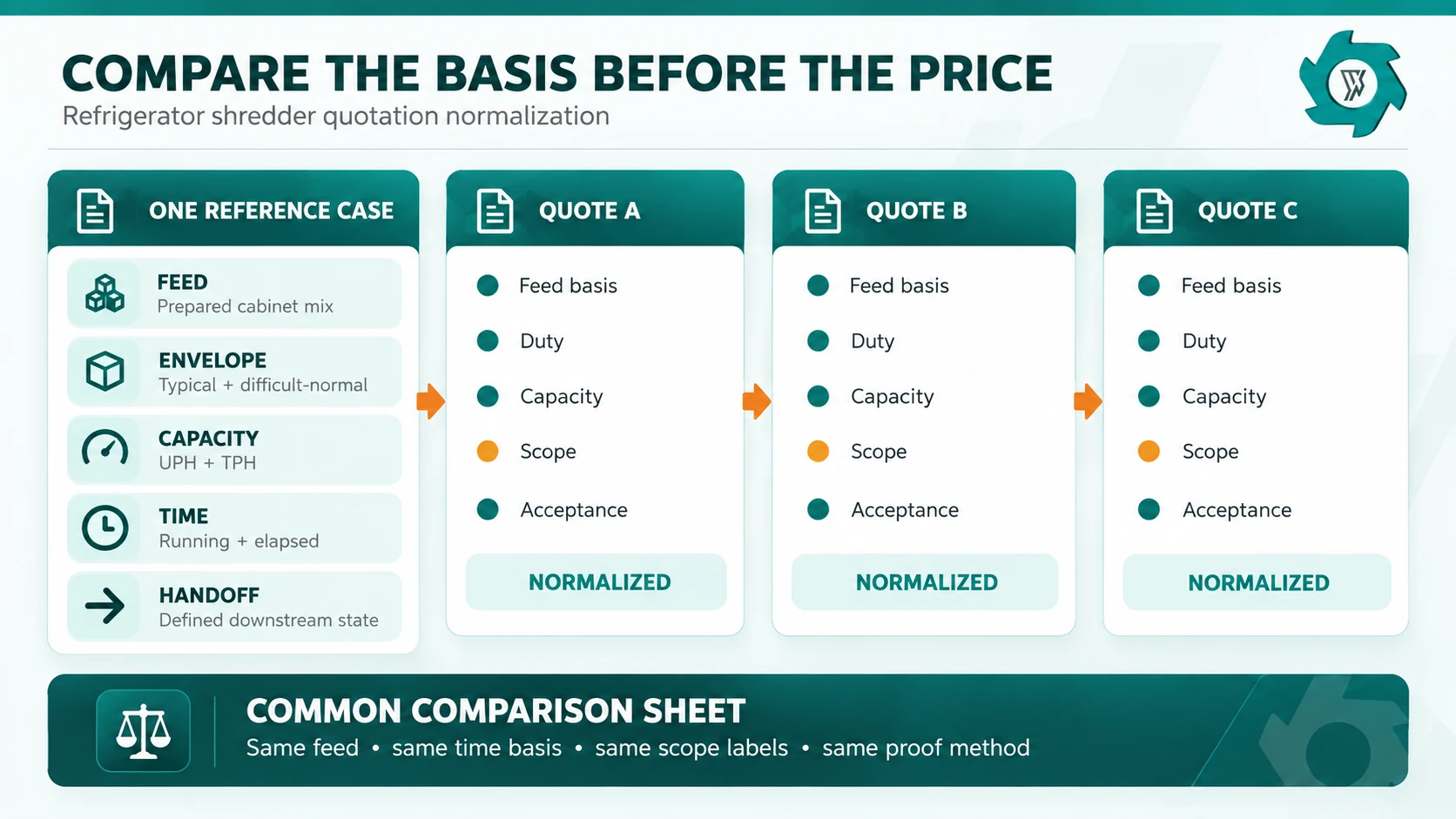
Two refrigerator shredder quotes may look almost the same on the first page. Chamber size, motor power, and stated capacity can all be close, while the actual supply scope is quite different. Before comparing prices, put the quotations on the same operating basis. Use the same prepared feed, the same way of measuring capacity, the same discharge requirement, and the same site conditions. Check what equipment is included and how performance will be accepted as well. Once those points line up, the price comparison starts to mean something.
Figure 1. A quotation is comparable only after the feed, duty, supply boundary and proof method are put on the same basis.
Start by Freezing One Reference Case
The fastest way to lose control of a multi-supplier RFQ is to let every bidder define the project in its own language. One supplier imagines fully depolluted domestic cabinets. Another assumes the compressor is still attached. A third includes secondary liberation and air separation in its throughput statement. The spreadsheet may still show three numbers under “capacity,” but they are not measuring the same process.
Write one reference case before reading the offers. For a refrigerator project, it should name the appliance families, preparation condition, typical and difficult-but-normal cabinet dimensions, prepared mass range, loading method, shift target and downstream handoff. U.S. projects also need a clear upstream disposal boundary: EPA explains that appliance recycling normally involves refrigerant recovery and removal of hazardous components before evacuated appliances are shredded.[1] The final disposer also has specific responsibilities for ensuring refrigerant recovery or maintaining the required verification when equipment arrives without its charge.[2]
The complete waste refrigerator recycling line provides the process context for this boundary. For quotation comparison, however, the key is not to re-design the whole plant in the bid table. It is to state exactly where the quoted machine or package starts and where it ends.
Reference-case fields that should not move between bidders
Approved appliance classes and prohibited items.
Exact preparation state at the shredder inlet.
Typical, difficult-but-normal and maximum accepted cabinet envelope.
Average prepared mass and a declared upper-bound mass.
Loading method, permitted orientation and upstream metering assumption.
Target units per elapsed hour and tonnes per elapsed hour.
Required handoff to the next conveyor, crusher or separation stage.
Site voltage, available footprint, clear height and interface responsibilities.
Normalize the Quotation Into Eight Comparable Blocks
Do not compare two supplier PDFs line by line. Rebuild them into a buyer-controlled sheet. Start by translating each offer into the eight summary blocks below. The sections that follow expand those blocks into the detailed checks needed before a quotation is accepted. The supplier can use any model name it wants; your comparison sheet should use the function the equipment performs.
Which claims become measurable pass/conditional/fail criteria?
1. Feed Specification: The Most Important Line in the Quote
For bulky appliance shredding, the feed definition controls almost everything that follows. A cabinet that is 100 mm wider than the supplier expected can change presentation to the cutters. A compressor left attached can change shock loading. Glass, loose metal shelves or undeclared white goods can change both risk and cutting duty. The quotation should therefore repeat the reference feed in plain language.
Ask the supplier to mark three boundaries separately: normal compliant feed, difficult-but-normal feed, and out-of-scope feed. The difficult-but-normal group is especially useful because it gives the FAT something realistic to challenge. If the machine is only demonstrated with easy, empty cabinets, the test has not proved the quotation against the part of the feed that is most likely to create reversals, bridging or intervention.
When the basic machine family is still being chosen, the refrigerator shredder selection and specification guide is the better place to compare shaft arrangements and mechanical roles. In this quotation review, keep the question narrower: did every bidder price against the same inlet condition?
2. Capacity: Refuse a Throughput Number Without a Time Basis
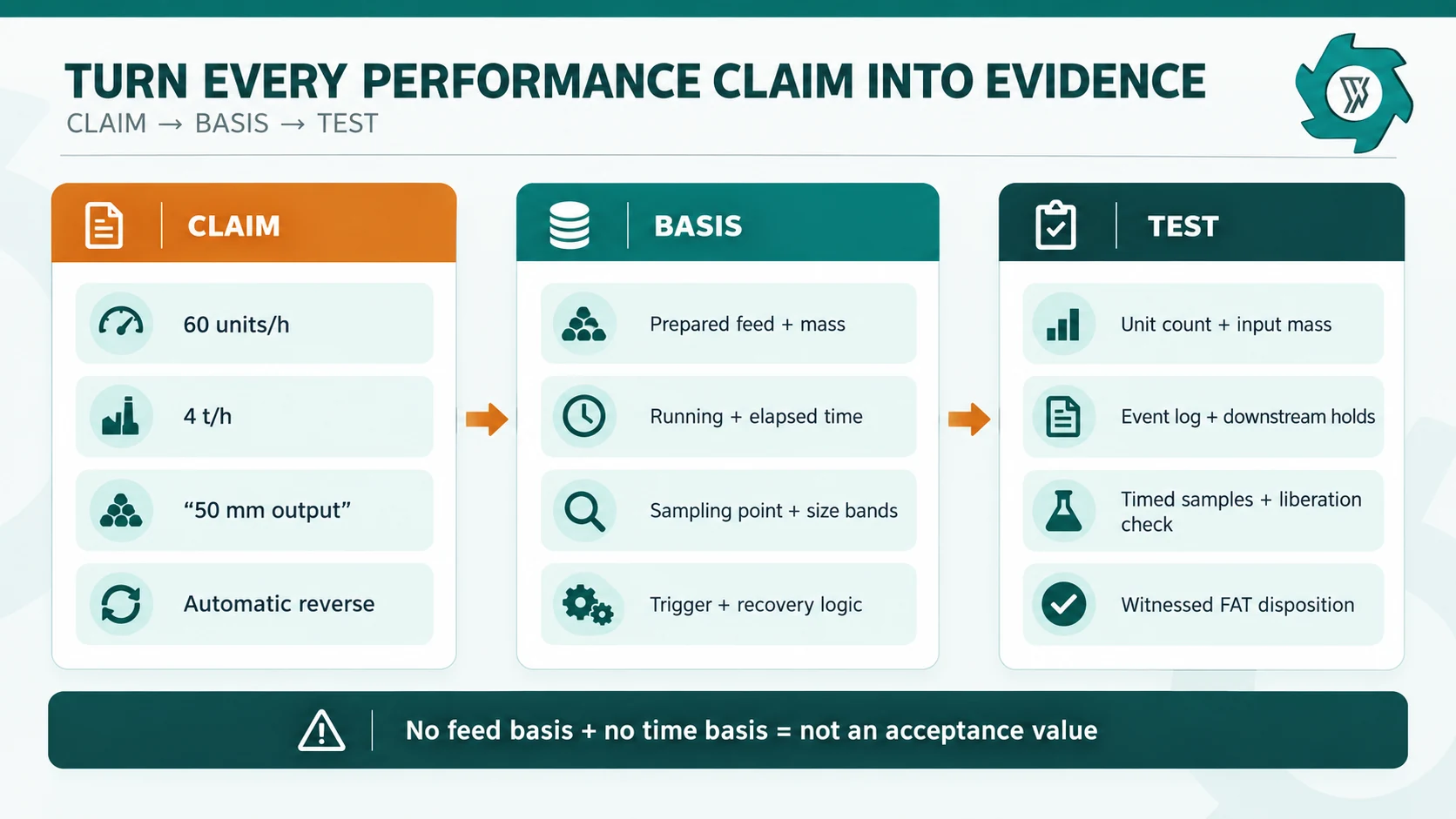
Ask whether the value is a design target, a short demonstration rate, a sustained running rate or an elapsed production rate. Then ask what stops the clock. If cabinet loading pauses, automatic reversals, manual clearing, downstream holds, bin changes or maintenance stops disappear from the denominator, the number cannot be used directly for shift planning.
For refrigerators, record both units per hour and tonnes per hour. Unit count describes cabinet cadence; mass flow describes the duty seen by conveyors and downstream equipment. Tie them together with the average mass of the prepared feed entering the quoted boundary. The refrigerator shredder sizing guide goes deeper into cabinet dimensions, cadence and productive runtime; in a quotation comparison, your aim is simply to make every supplier use the same calculation basis.
Useful comparison rule: if the quotation does not state feed condition + unit mass basis + running time + elapsed time, treat its capacity as a screening value, not an acceptance value.
3. Output Specification: Ask What the Next Machine Receives
Primary refrigerator shredders are often expected to open and reduce bulky prepared cabinets. That makes vague output statements especially risky. “50 mm output,” for example, could mean a screen aperture, an approximate visual size, a nominal target or a maximum dimension.
Translate the quote into an output duty. State the sampling point, the accepted size window where applicable, the oversize or return rule, the treatment of long strips or wire, and the material condition needed by the next stage. If the commercial objective depends on liberation, include a simple inspection method for steel-plastic-foam composites. The dedicated refrigerator shredder output-size guide explains why particle distribution and liberation matter to downstream separation.
Figure 2. Convert each performance claim into a feed basis, a time basis and an observable output condition.
4. Mechanical Specification: Compare Function, Not the Biggest Number
Installed power, chamber width and shaft diameter are useful descriptors, but none is a purchasing verdict by itself. A higher motor rating does not prove better ingestion, lower wear or higher practical throughput. Likewise, a wider chamber may accept a bulky cabinet more easily while still being limited by the bite zone, cutter arrangement, discharge opening or downstream conveyor.
Use the mechanical section of the quote to understand the proposed duty. Record shaft count, working chamber dimensions, cutter arrangement, drive architecture, overload protection, reverse logic, discharge restriction and any screen or secondary sizing device. Then ask why those features match the reference feed. The explanation is often more valuable than the raw dimension.
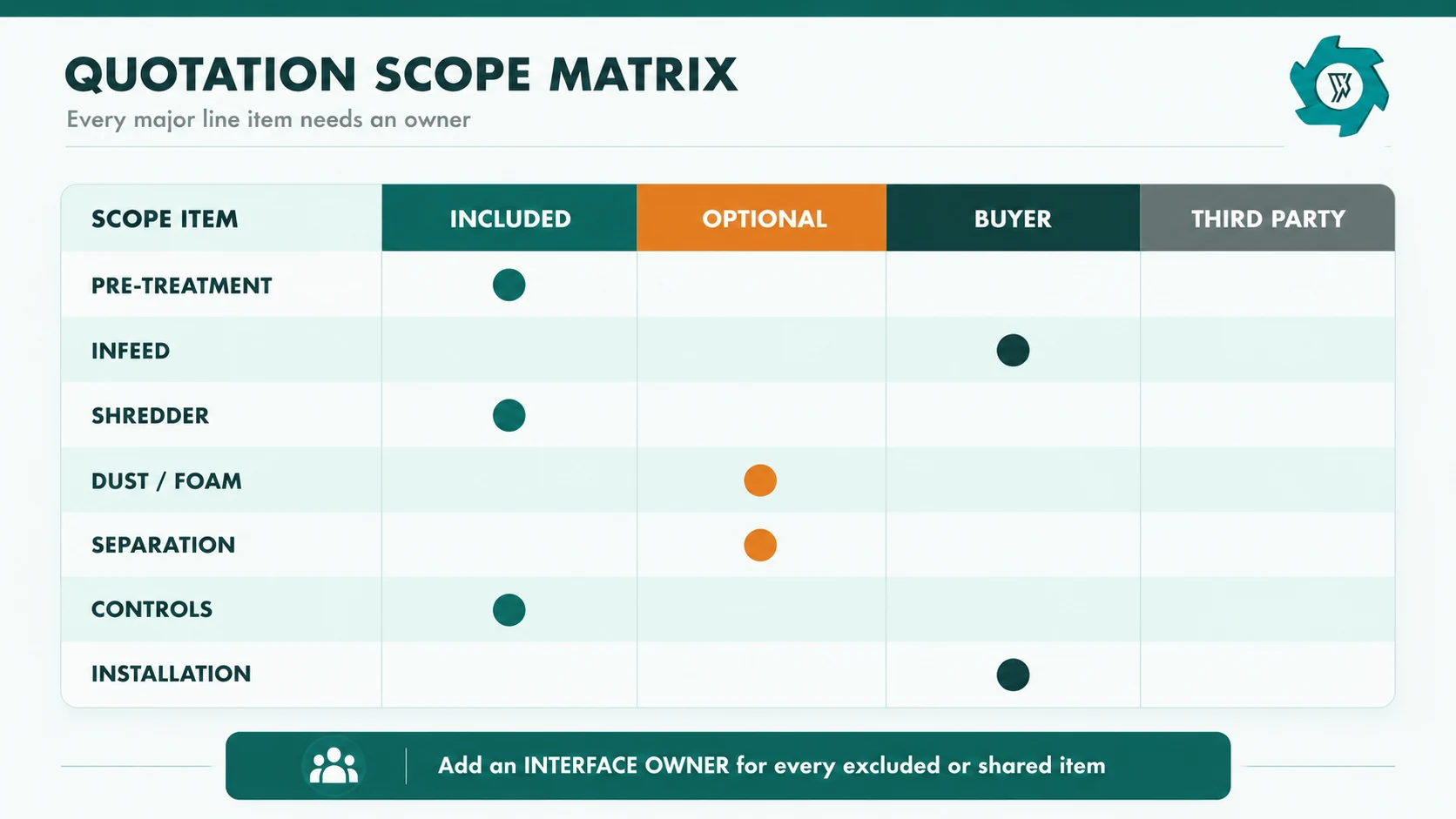
5. Scope Boundary: Mark Every Line as Included, Optional, Buyer or Third Party
This is where many apparently cheap quotations become expensive projects. One offer may include only the shredder body and local control cabinet. Another may include the infeed conveyor, discharge conveyor, steel support, guarding, dust pickup connection, central controls, spare cutters, commissioning and training. A total-price comparison hides those differences.
Require each major item to carry one of four labels: included, optional, buyer-supplied, or third-party. If the supplier provides a duct flange but the buyer provides the fan, filter and building duct, the interface owner still needs to define airflow, connection size, control interlock and who verifies performance after installation.
Figure 3. A scope matrix prevents equipment, site work and interface ownership from disappearing inside a single quotation total.
Scope item
Buyer should confirm
Typical gap to expose
Infeed
Conveyor, guides, metering, loading height, support steel
Machine quoted without the device needed to present cabinets consistently
Shredder package
Drive, gearbox/hydraulics, lubrication, guards, access, local panel
Auxiliaries shown on drawing but priced separately
Discharge
Conveyor width, transfer height, oversize route, downstream interlock
Shredder capacity quoted without a defined discharge path
“Dust connection provided” interpreted as a complete extraction system
Electrical
MCC, PLC/HMI, field cabling, cable trays, transformers, instruments
Controls included but site wiring excluded
Installation
Supervision, labor, lifting, foundations, commissioning days
Supplier attendance included but mechanical/electrical labor excluded
6. Safety and Isolation: Check What Is Designed Into the Package
Safety documentation should not be reduced to a generic “CE” or “guarding included” line. In the United States, OSHA’s general machine-guarding rule requires protection from hazards such as points of operation, ingoing nip points, rotating parts, flying chips and sparks.[3] The buyer still needs to review the installed system, but the quotation should make it possible to see what physical guarding, interlocks, emergency stops and access controls are actually supplied.
Servicing and jam clearing also need a defined isolation boundary. OSHA’s hazardous-energy standard covers servicing and maintenance where unexpected energization, startup or release of stored energy could cause injury; its definition includes activities such as cleaning and unjamming when exposure exists.[4] From a procurement standpoint, ask for the location of energy-isolating devices, stored-energy considerations, access points and the manual needed to develop the site’s own energy-control procedure.
If dust extraction is included, require a defined design boundary. OSHA notes that finely divided combustible material can become explosible under certain conditions when suspended in air.[5] The project still needs material- and site-specific review.
7. Wear Parts and Maintenance: Compare the First Service Event Before Ordering
Ask what the supplier recommends holding on site at startup, which parts are wear items, how cutters are inspected, whether they can be rotated or reconditioned, what lifting or special tools are needed, and which consumables are required for the drive, bearings or lubrication system. Do not ask for a fabricated cutter-life number if the supplier has not tested your feed; ask instead what wear evidence it uses to set the inspection interval.
Use the refrigerator shredder maintenance guide when you need a deeper review of cutters, bearings, gearboxes and downtime records. For bid comparison, record the supplier’s recommended startup spares, lead-time assumptions, service documentation and warranty exclusions in one row so they cannot be overlooked after the machine price is approved.
8. Electrical, Controls and Site Utilities: Turn “Complete” Into a Wiring Boundary
“Complete electrical control” can mean anything from a local starter panel to a line-level PLC with field sensors, interlocks and communication to upstream and downstream equipment. Ask for a single-line or control architecture that shows the quoted boundary. Record motor voltages, control voltage, frequency, connected load, major auxiliary loads, cabinet rating, field-device supply, cable responsibility and the communication interface expected from third-party equipment.
9. Drawings and Documentation: Ask for the Documents That Close Interfaces
The best technical quotation is not the one with the most brochures. It is the one that produces enough project information to let the buyer verify fit. Before the order is released, ask to see the general arrangement for the machine. It should show the overall footprint, space needed for maintenance, feed and discharge heights, access for service work, and the main connection points. Also make sure the supplier has said when the key drawings will be issued—during fabrication, before shipment, or as part of the final handover package.
10. Warranty and Service: Compare What Happens After a Failed Test or Failure Event
Warranty length by itself is a weak comparison field. Ask when the warranty starts, what events are excluded, how wear parts are treated, who pays freight for replacement parts, what evidence is required for a claim, and whether commissioning by the supplier is a condition. If remote diagnosis is offered, identify what data can be accessed and who controls the connection.
11. FAT: Convert the Quotation Into a Testable Promise
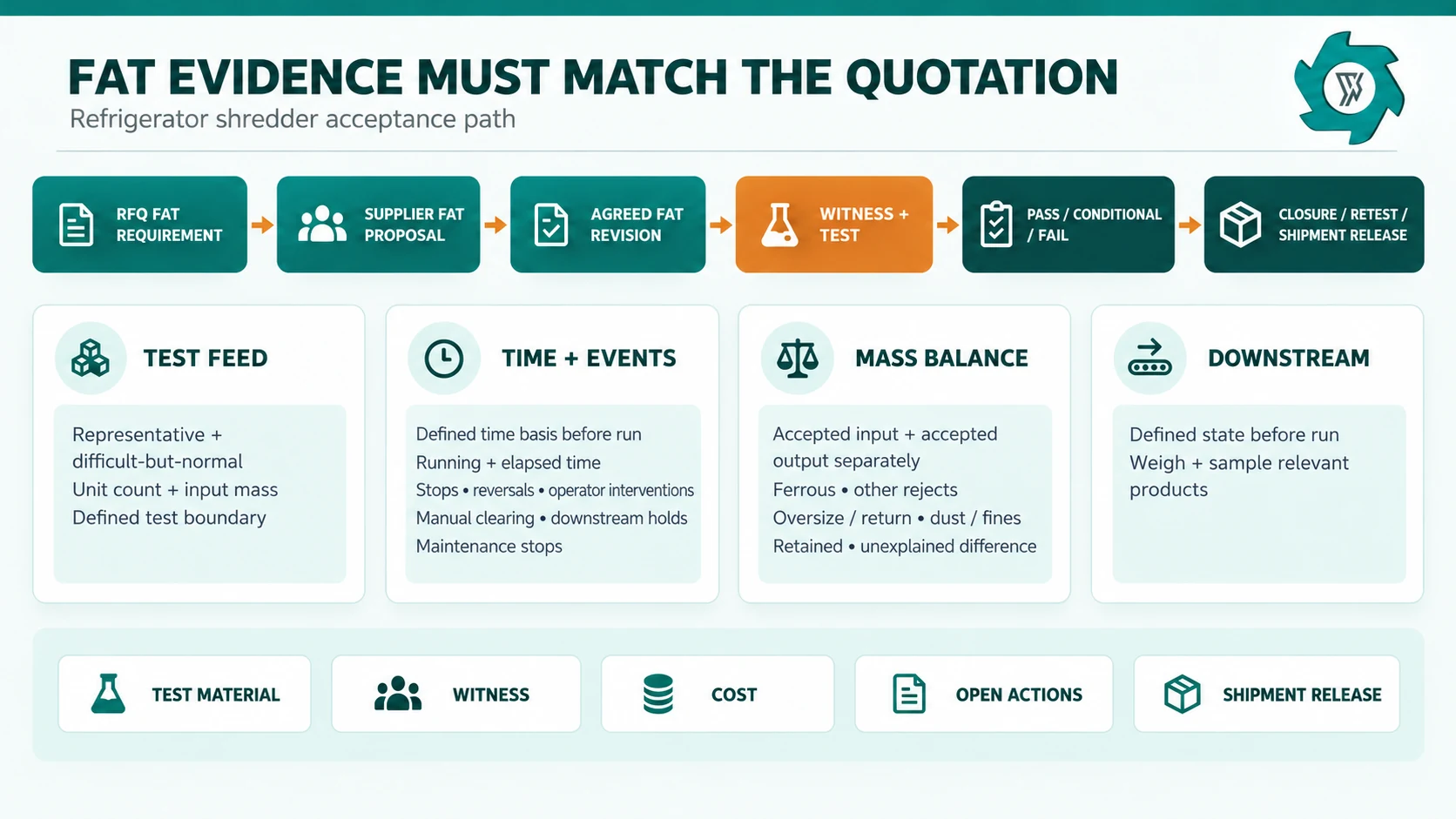
The factory acceptance test should not be written after the machine is finished. Use it during quotation comparison. The supplier’s proposal should explain how the key claims will be demonstrated, and the agreed revision should become part of the order documents. That prevents a late argument about whether capacity meant running time, whether a difficult cabinet was allowed, or whether downstream stoppages should count.
Define the FAT boundary before material enters the machine. Use representative and difficult-but-normal appliances from every approved class. Record unit count and input mass, running time and elapsed time, and all stops, reversals, operator interventions, manual clearing, downstream holds and maintenance stops. The downstream condition and the test time basis should be agreed before the run.
For a complete or connected test, weigh accepted input and accepted output separately. Then weigh the relevant downstream fractions separately: ferrous output, other rejects, oversize or return material when present, dust or fines, and retained material. State any unexplained mass difference as its own line. Where product quality matters, weigh and sample the downstream product streams under the same test boundary.
The decision path should also be written: pass, conditional acceptance with open actions, or fail/retest. Define who witnesses the test, who pays for repeat material and travel if a retest is needed, and whether shipment release is automatic or requires closure of the agreed actions.
Figure 4. Link the RFQ requirement to the supplier proposal, agreed FAT revision, witnessed test, disposition and shipment release.
A Practical Quotation Comparison Scorecard
Avoid assigning points simply because one supplier quotes the largest motor or highest throughput. Instead, mark each item as confirmed, clarification required, excluded, or not evidenced. That gives procurement a clear list of unresolved risks.
Check
Confirmed means
Red flag
Feed
Offer repeats the agreed preparation, dimensions and difficult-but-normal boundary
Only “refrigerator” or “white goods” appears
Capacity
UPH + TPH + feed mass + running/elapsed time basis are stated
One headline rate with no test condition
Output
Sampling point, size/liberation duty and oversize treatment are defined
Single nominal size with no method
Scope
Major items and interface owners are tagged
“Complete line” without a boundary matrix
Controls
Reverse/interlock behavior and system boundary are described
Only component brand names are listed
Maintenance
Startup spares, service access and wear strategy are visible
No critical-spare or access discussion
FAT
Representative feed, timing, events, mass balance and decision rule are agreed
“Test before shipment” with no protocol
Commercial
Freight, installation, taxes/duties, warranty and exclusions are separated
Large undefined “customer scope”
Five Questions That Quickly Expose a Weak Quotation
What exact refrigerator condition supports your quoted capacity? If the answer changes from the RFQ, the rate is no longer directly comparable.
What stops the capacity clock? Ask about reversals, clearing, downstream holds, bin changes and planned stops.
Which equipment shown on the flow drawing is excluded from the price? This catches “complete line” drawings built from optional modules.
What output condition will you accept as evidence that the shredder has done its job? A supplier should be able to describe a sample or downstream handoff, not only quote a millimeter figure.
Which quotation claims will be written into the FAT and purchase order? If a performance statement disappears when acceptance is discussed, it was probably a sales estimate rather than a contractual basis.
Common Buyer Mistakes When Comparing Offers
Choosing the lowest total before normalizing scope
The lowest equipment price may carry the most site work, the fewest auxiliaries or the weakest test boundary. Compare the normalized scope first, then compare money.
Treating motor power as a proxy for throughput
Power is one design input. Feed geometry, cutter engagement, reverse frequency, discharge stability and downstream constraints can dominate the practical rate.
Accepting “complete line” as a technical description
Make the supplier mark every interface. A complete line on a flow sheet can still exclude ductwork, foundations, field wiring, product bins, erection labor or environmental controls.
Writing the FAT after the order
Late acceptance criteria create arguments because the supplier has already designed around its own assumptions. Put the evidence method into the quotation comparison.
Comparing warranties without exclusions
Wear parts, freight, labor, commissioning conditions and improper-feed exclusions can matter more than the headline duration.
What Should Be in the Final Clarification Sheet?
Do not let unresolved points sit in different email threads. Put them in one sheet before the order is signed off. Show the original requirement, the supplier’s latest reply, anything that is still missing or needs changing, and the document that will become the final reference once the job moves ahead.
The sheet should close the feed definition, machine duty, capacity basis, output evidence, included equipment, site interfaces, guarding and isolation scope, utilities, documentation schedule, spares, warranty, FAT, SAT where applicable, shipping terms and open actions.
OSHA’s recycling guidance emphasizes that recycling facilities can expose workers to moving-machine hazards and that machine guarding and hazardous-energy control are central concerns.[6] That is another reason technical clarification should include the installed interface, not just the shredder chassis sitting on a factory floor.
Frequently Asked Questions
What is the first specification to compare in refrigerator shredder quotations?
Start with the feed basis. Confirm appliance classes, preparation state, typical and difficult-but-normal dimensions, prepared mass range, prohibited items and loading method. Capacity and machine size are not directly comparable until those conditions match.
Should I compare refrigerator shredder capacity in units per hour or tons per hour?
Use both. Units per hour shows cabinet cadence, while tons per hour shows mass flow. Tie them to the average prepared cabinet mass, and require both running time and elapsed time so the rate can be translated into real production planning.
Is a larger motor a better refrigerator shredder specification?
Installed power does not by itself prove feedability, torque response, practical throughput, output condition or wear life. Compare the complete cutting duty, feed envelope, protection logic, discharge path and FAT evidence.
What should a refrigerator shredder FAT record?
Use representative and difficult-but-normal appliances from every approved class. Record unit count and input mass, running time and elapsed time, stops, reversals, operator interventions, manual clearing, downstream holds and maintenance stops. Weigh accepted input and accepted output separately, then weigh ferrous output, other rejects, oversize or return material if present, dust or fines and retained material, and state any unexplained mass difference separately. The downstream condition and test time basis should be agreed before the run.
How many quotation exclusions should be acceptable?
There is no universal number. The issue is whether every exclusion has an owner, an interface definition and a budget consequence. A quotation with more exclusions can still be workable if the responsibilities are deliberate and fully visible.
Send One Reference Case, Then Compare Quotations on the Same Basis
Prepare appliance photos or video, the exact preparation condition, typical and maximum dimensions, prepared unit weights, target units/hour and tonnes/hour, required downstream handoff, site utilities and the scope you expect the supplier to own. That is enough to turn a generic machine quote into a technical comparison.
David focuses on industrial shredding and recycling equipment,including material evaluation,shredder selection,process configuration,and recycling line planning.
Speak To Our Shredder Machine Expert
Get in touch with our nice team today to get a price estimate for a shredder machine.