Can Refrigerators and Other White Goods Share the Same Shredder?
A shredder can be shared, but the feed rules cannot
Refrigerators, freezers, washing machines, dryers and dishwashers can sometimes use the same primary shredder. That does not mean they can be unloaded from a truck and mixed together without classification. A shared shredder is a mechanical asset. A shared treatment route is a separate engineering decision.
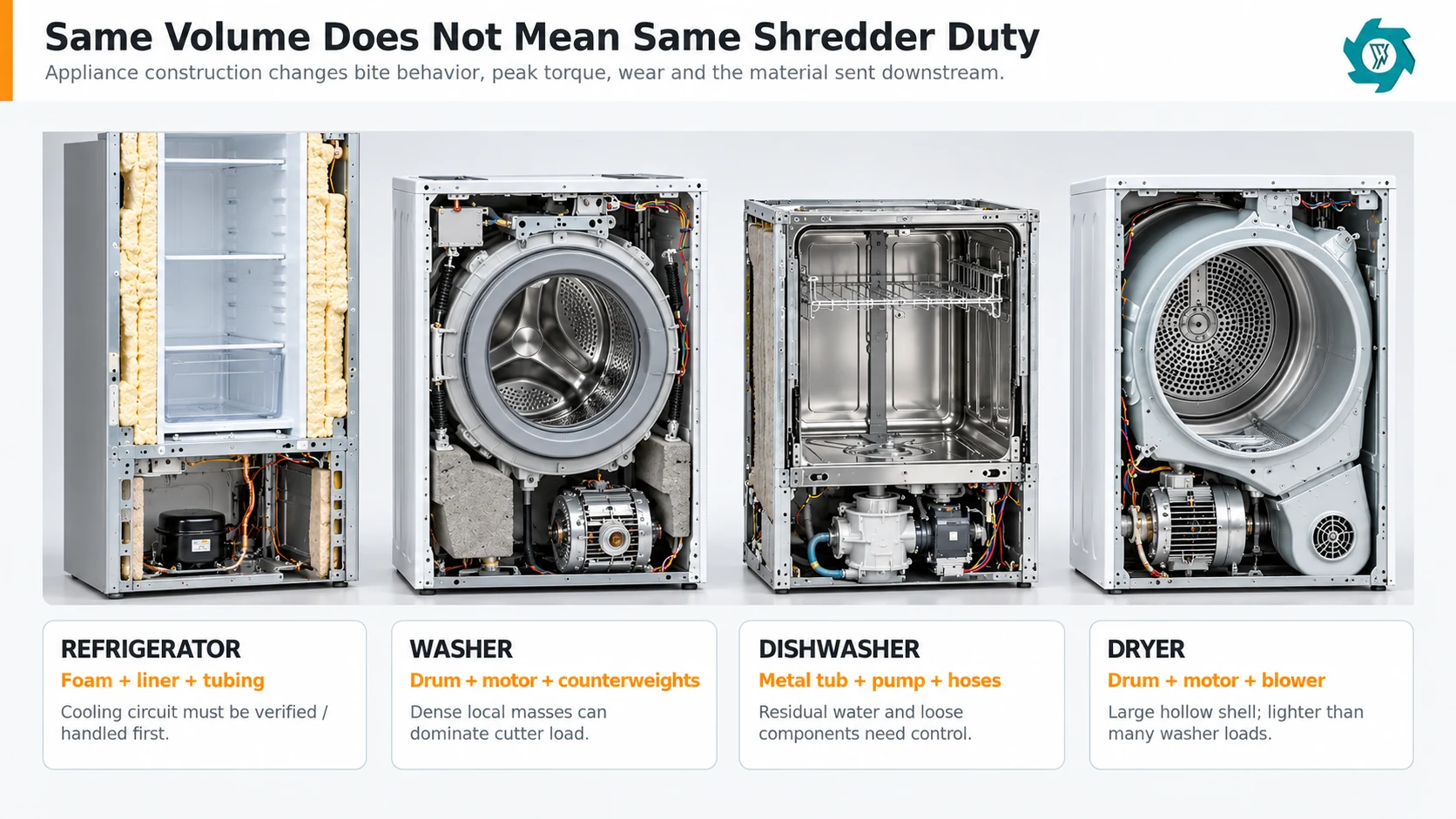
The distinction matters because these appliances look similar from the outside but put different work into the cutting chamber. A prepared refrigerator cabinet is bulky, light for its volume and full of steel skin, plastic liner and insulation foam. A washer can concentrate much more mass into a drum, motor, shaft, springs and counterweights. A dryer is usually a large hollow shell with a drum and drive. A dishwasher may contain a stainless or coated-steel tub, pump, hoses, wiring and residual water. When those feeds are mixed, the shredder sees changing bite behavior, peak torque, wrapping tendency and discharge composition from one unit to the next.
The safest purchasing rule is: approve named appliance classes in named prepared conditions. Do not approve “white goods” as one unlimited category. The complete waste refrigerator recycling line shows why cooling appliances need their own depollution and foam-management boundary even when selected white goods may later share part of the mechanical section.
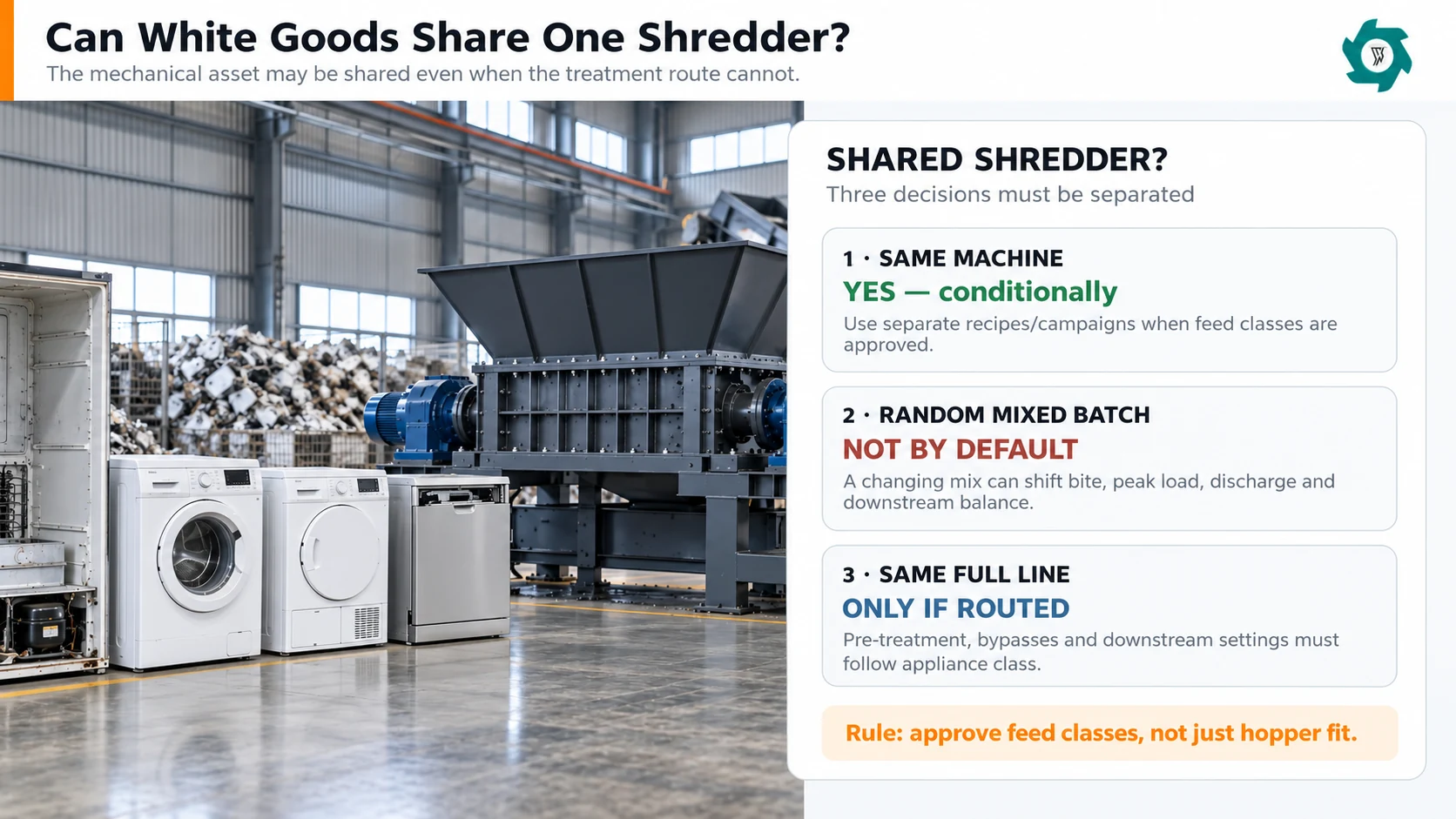
Figure 1. Sharing the machine, mixing the batch and sharing the entire downstream line are three different decisions.
First separate three meanings of “share the same shredder”
Same machine, separate campaigns. The plant processes prepared refrigerator cabinets for part of the shift, then changes the feed recipe and processes prepared washers or dryers. This is the easiest arrangement to control because each campaign can have a defined feed rate, preparation rule, alarm trend and downstream setting.
Same machine, controlled mixed recipe. The plant intentionally blends approved appliance classes at a defined ratio. This can work, but the ratio becomes part of the process specification. A run with nine dryers and one washer does not prove a recipe containing half heavy washers. The test must represent the peak combination the plant actually expects.
Same machine and same full downstream line. The shredder may tolerate several appliance types while the foam separator, magnet, eddy-current stage, screen or product bins do not tolerate the changing stream equally well. A shared primary shredder can therefore be reasonable even when some appliances need a bypass or a different downstream route.
That separation is the main way to avoid over-buying. A plant does not necessarily need a dedicated shredder for every appliance class, but it often needs dedicated receiving rules and pre-treatment gates.
Why appliance construction changes the shredder duty
Hopper dimensions answer only whether an appliance can enter. The real mechanical question is what happens after the cutters establish a bite. Local thickness, dense assemblies, springy sheet, wrapped wire, concrete, cast parts and rotating assemblies can create very different torque peaks even when two appliances have similar outside dimensions.
Appliance class
Typical structures that change the duty
Shared-shredder position
Main control before feeding
Refrigerator / freezer
Thin steel skin, plastic liner, PU foam, tubing, wiring; compressor if not removed
Good candidate after the cooling-appliance preparation boundary is met
Refrigerant and oil handling, compressor policy, loose glass/electronics removal
Front-load / top-load washer
Drum, motor, shaft, springs, concrete or cast counterweights, wiring
Conditional; dense assemblies can set the actual peak-load case
Counterweight and motor policy, loose parts, water removal, size and mass limits
Dryer
Large drum, sheet enclosure, motor, blower, belt, ducting
Often mechanically compatible after inspection, but prove the discharge and wrapping behavior
Loose lint, cords, gas components where applicable, dense parts outside the approved duty
Dishwasher
Metal/plastic tub, racks, pump, hoses, wiring, residual water
Conditional; composition can change non-ferrous and plastic streams
Do not treat as ordinary white goods; use a refrigerant-bearing appliance route first
Refrigerant recovery verification and project-specific component handling
Figure 2. Appliance envelopes can look similar while the internal mass distribution and cutting duty are very different.
Refrigerators create a treatment boundary that other white goods do not
A refrigerator is not just a hollow steel cabinet. Before final disposal in the United States, refrigerant-bearing equipment is subject to EPA safe-disposal requirements. The final disposer must ensure refrigerant has been recovered or obtain the required verification when equipment arrives without its charge.[1] That requirement exists independently of whether the mechanical shredder could physically cut the cabinet.
For the shredder buyer, this means the feed specification should say what a compliant refrigerator looks like at the shredder inlet: cooling circuit status, compressor rule, oil handling, loose glass and electronics policy, maximum dimensions, maximum unit mass and any prohibited assemblies. The existing refrigerator shredder selection and specification guide is useful for that machine-side boundary.
Cooling appliances may also create a light foam fraction that affects air handling after shredding. A washer or dryer added to the same primary shredder can reduce the proportion of foam in one moment and increase dense metal in the next. The shredder may not care about that change, but the air separator and product collection system can.
Washers are often the appliance that tests the real peak load
In a mixed white-goods project, washing machines deserve specific attention because the cabinet is only part of the mass. The drum, motor, shaft, springs and counterweights can place dense material close together. Some designs use concrete weights; others use different balancing arrangements. A machine that demonstrated smooth refrigerator processing may therefore meet a much sharper load event when a washer collapses and those parts enter the cutters together.
There is no universal rule that every counterweight must be removed or every motor must remain. The useful rule is to decide the policy before quotation. If the plant wants to leave those components in place, representative washers with the approved assemblies still installed must be part of the trial. If the supplier expects counterweights, motors or other dense items to be removed, that removal belongs in the receiving work instruction and labor estimate.
A batch of light dryer shells can make the same shredder look faster than a batch containing heavy washers. When the machine is sized for multiple appliance classes, record unit count, mass and class together. The method in the refrigerator shredder sizing guide can be extended here: outside dimensions set the acceptance envelope, while unit mass and productive time show the real production duty.
Dryers and dishwashers may fit mechanically but still change the process
Dryers are commonly less concentrated than washers, yet they bring their own issues. Large drums can deform into long curved sheet. Belts, wire and light ducting can wrap or travel differently from refrigerator cabinet fragments. Gas dryers also require the plant to define how gas-related components are inspected and prepared before mechanical processing.
Dishwashers can be another apparently easy feed. Their structure may include stainless or coated sheet, plastic, pumps, hoses and wiring. Residual water should be removed so the plant is not introducing unnecessary moisture into a dry shredding and separation system. Racks and loose parts should follow the agreed preparation rule rather than arriving inconsistently.
These appliances can often share a low-speed, high-torque primary machine when the cutter system, chamber and overload protection are suitable. A double shaft shredder is one common primary-reduction architecture for bulky mixed material, but the machine name alone is not proof. Cutter geometry, shaft strength, drive reserve, chamber width, feed control and downstream handoff still have to match the approved appliance mix.
Use feed classification and bypasses instead of a “universal appliance” promise
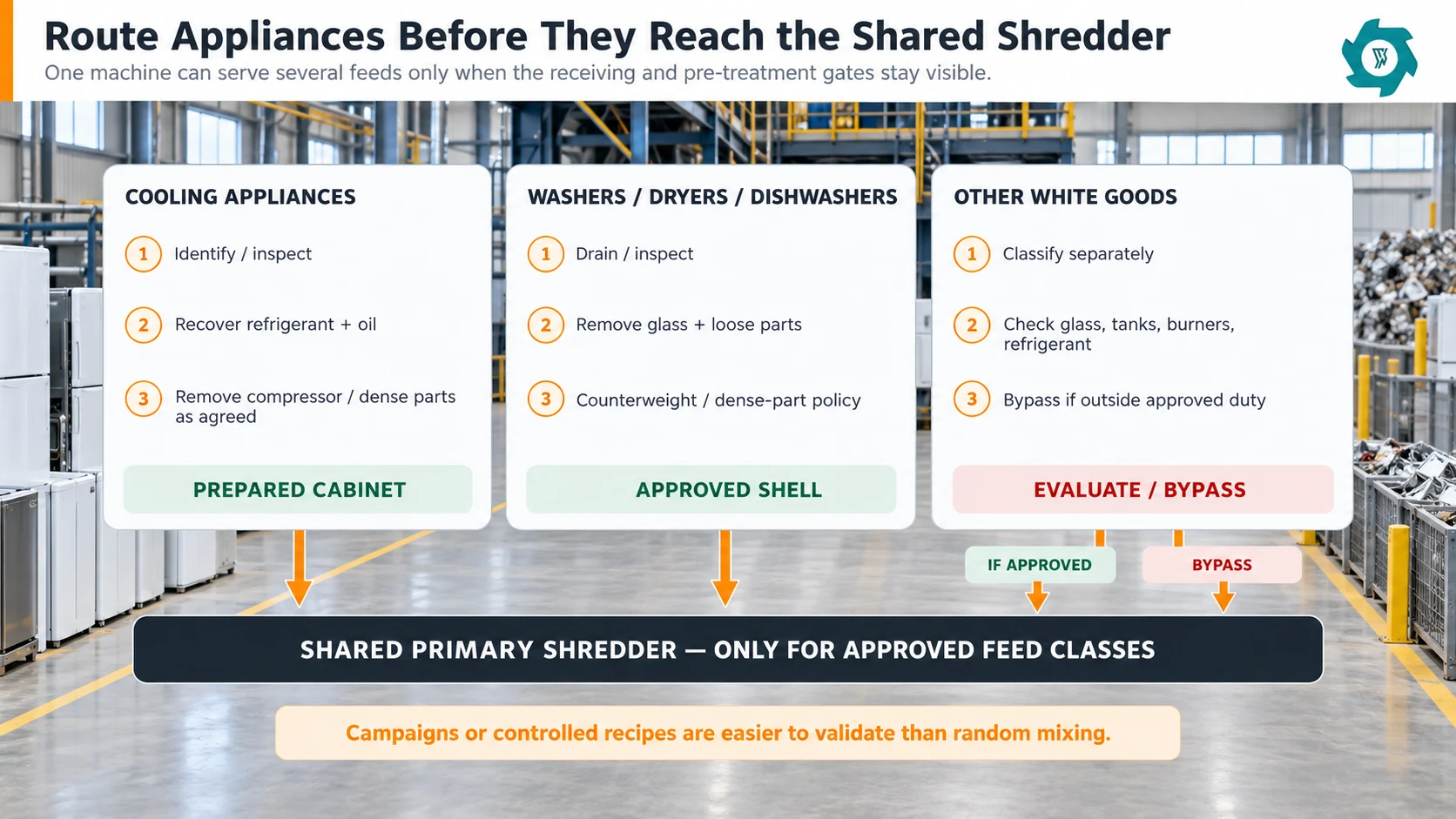
A practical plant can share the expensive mechanical core while keeping the preparation work separate. Receiving first identifies the appliance family. Refrigerant-bearing units go to the cooling-appliance route. Washers go through the agreed dense-component rule. Dishwashers are drained and inspected. Ranges or other glass-rich, unusually dense or out-of-envelope items can be diverted before they become a shredder problem.
After preparation, the approved shells may converge on one conveyor and one primary shredder. The PLC can then call different recipes for conveyor pacing, load limits or downstream routing if the installed system supports them. Even a simple operation benefits from physical batch labels: “refrigerator campaign,” “washer/dryer campaign,” or a defined mixed recipe.
Figure 3. Converge only after appliance-specific receiving and pre-treatment rules have been satisfied.
When feed problems appear, the class record helps diagnosis. Repeated bridging on broad refrigerator cabinets means something different from overloads that appear only when washer counterweights remain. The feed-problem diagnostic guide separates bridging, overload, reversal and true jamming; the same event logic is useful in a mixed-appliance plant as long as the appliance identity is captured with the event.
Do not let a mixed feed erase the downstream material balance
A shared shredder produces a combined discharge, but the commercial value still comes from separated fractions. Refrigerator-heavy batches may carry more foam and plastic liner. Washer-heavy batches may increase ferrous mass and dense motor-rich pieces. Dishwashers can change the stainless, plastic and wire content. If the feed composition changes faster than the downstream separators and bins can respond, the plant may meet shredder tonnage while producing less stable saleable products.
There are two sensible ways to control this. The first is campaign processing: run one appliance family long enough for the line to stabilize, then record the product fractions before changing over. The second is a controlled blend with a defined recipe and known limits. Random truck-by-truck mixing is harder to troubleshoot because a change in product purity can come from the incoming mix rather than from a separator fault.
Also separate shredder stops from downstream holds. If the magnetic or air-separation section is full and the shredder waits, that lost time is a line-balance issue. If the machine repeatedly reverses on one approved appliance class, that is a feed or cutting-duty signal. Maintenance records should keep those causes distinct; the refrigerator shredder maintenance guide uses the same event separation for cutters, bearings, gearboxes and downtime.
Write the RFQ as an approved-feed matrix
An RFQ for a shared appliance shredder should have one row for every appliance family the buyer expects to process. For each row, state the incoming condition, removals required before the shredder, maximum dimensions, typical and maximum unit mass, parts that may remain, parts that are prohibited, expected share of production and the downstream route.
Then ask the supplier to mark each row as standard, conditional or excluded. “Conditional” should point to the condition: for example, washer accepted only after counterweight removal; dishwasher accepted only when drained; refrigerator accepted only after refrigerant verification and compressor removal; oversized range excluded from the shared chamber.
This matrix prevents a supplier from demonstrating only the easiest appliance and later treating the harder classes as change orders. It also gives the commissioning team a document that can become a receiving checklist.
For U.S. plants, the mechanical design must also support safe servicing. OSHA’s lockout/tagout standard applies to servicing and maintenance where unexpected energization, start-up or stored energy could injure workers, including cleaning or unjamming when employees may be exposed.[2] Machine-guarding principles also address hazards from rotating parts, ingoing nip points and flying material.[3] Shared-feed flexibility should never be achieved by normalizing manual pushing, reaching or frequent unjamming.
Prove the hardest approved combination in the FAT
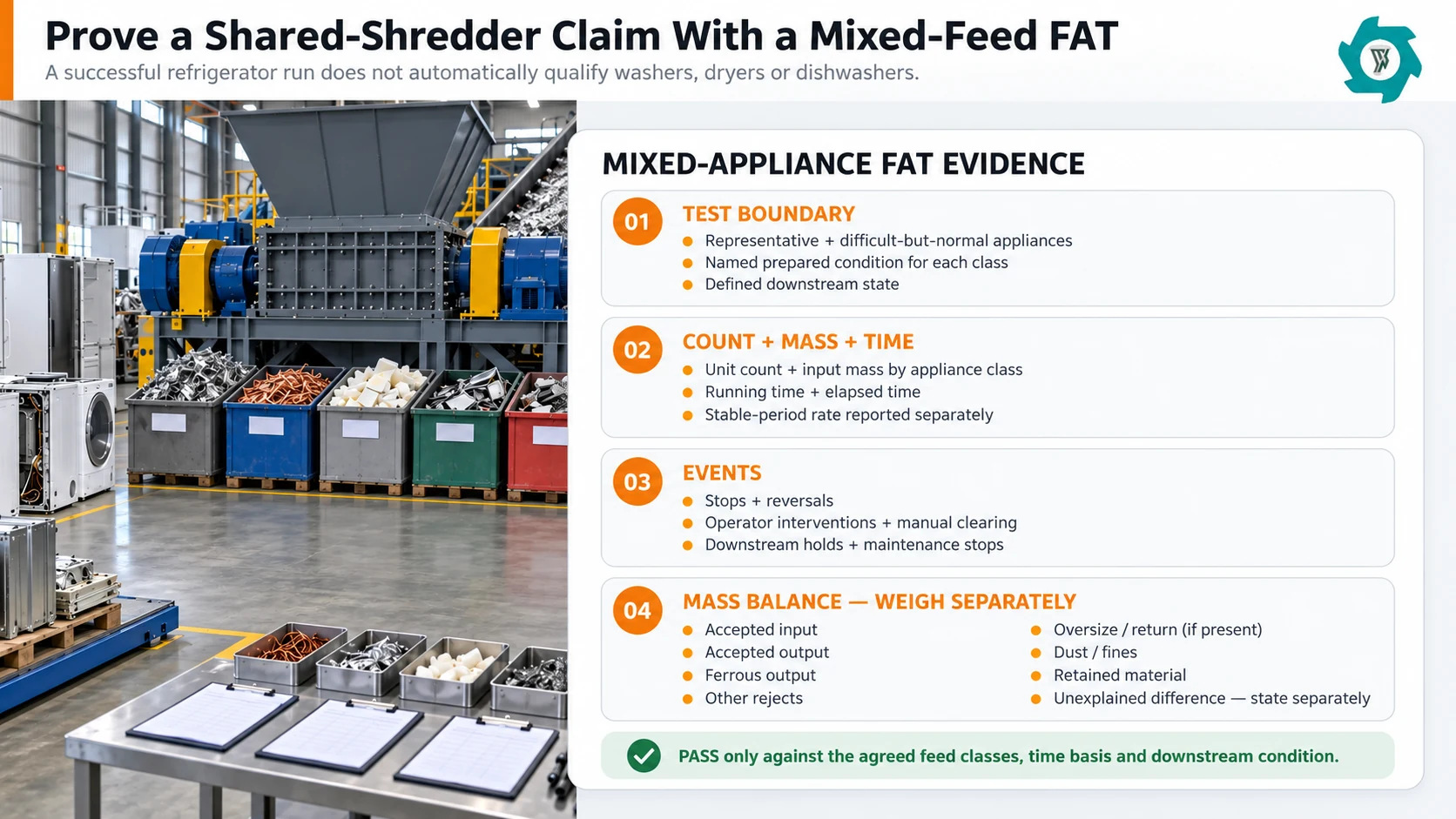
A factory acceptance test should not be four clean refrigerators if the purchase order also approves washers, dryers and dishwashers. Build the test batch from representative production and include difficult-but-normal examples inside the agreed feed boundary. The hardest class may be the heaviest washer, the largest cabinet, a springy dryer shell or the approved mixed recipe that creates the highest short-term load.
Before the run, define the test boundary: which parts have been removed, which remain, how appliances are loaded, what the downstream equipment is doing and where the accepted output is measured. Record appliance class, unit count and input mass. Report both running time and elapsed time, and state any stable-period rate separately.
During the run, log stops, automatic reversals, operator interventions, manual clearing, downstream holds and maintenance stops. A reversal that automatically clears a difficult bite is not the same event as an intervention that requires isolation and manual work.
Weigh accepted input and accepted output separately, then weigh the ferrous output, other rejects, oversize or return material if present, dust/fines and retained material. If the mass balance does not close, show the unexplained difference as its own line. Do not combine it with retained material. For a mixed appliance test, label samples by the feed recipe or campaign so the buyer can see whether the downstream fractions remain usable when the appliance mix changes.
Figure 4. A shared-shredder FAT needs feed identity, time basis, event logging and a separated mass balance—not a no-load video or one easy appliance.
When a dedicated or bypass route is the better decision
Sharing is attractive when it increases equipment utilization without changing the process beyond control. It stops being attractive when one feed class forces the entire line to be designed around an uncommon extreme. A dedicated route or bypass can be better when the appliance is far outside the normal size envelope, carries a dense component that creates repeated trips, introduces glass or mineral material that contaminates the desired product, requires a separate depollution procedure, or creates a downstream fraction that the shared separators cannot handle economically.
Buyer takeaway
Refrigerators and selected white goods can share one shredder when the machine is treated as a common mechanical stage inside a controlled routing system. Keep refrigerant-bearing appliances on their required preparation path. Define what remains in washers, dryers and dishwashers. Approve each feed class by dimensions, mass and component condition. Use campaigns or a tested blend rather than uncontrolled mixing, and make the FAT reproduce the hardest normal case.
Frequently Asked Questions
Can refrigerators, washing machines and dryers use the same shredder?
They can sometimes share the same primary shredder, but only after each appliance class has an approved preparation rule and has been proven against the machine duty. Refrigerators add refrigerant, oil and foam-management requirements; washers can add dense motors and counterweights; dryers are usually lighter but still change the feed geometry.
Should washing-machine counterweights be removed before shredding?
That decision should be written into the approved feed specification. Concrete, cast or other dense counterweights can create a very different local load from a refrigerator cabinet, so a shredder demonstrated only on light hollow appliances should not automatically be assumed to accept them. If counterweights remain, the supplier should prove the agreed washer design range during a representative test and record load events, reversals and any manual clearing.
Do refrigerant-containing appliances need separate pre-treatment before a shared shredder?
Yes. For U.S. projects, refrigerant-bearing appliances are subject to EPA safe-disposal requirements, so refrigerant recovery or verified prior recovery belongs ahead of final disposal and mechanical processing. Air conditioners, dehumidifiers and other cooling appliances should therefore enter a cooling-appliance preparation route rather than being treated as ordinary washer or dryer shells simply because the same shredder could physically accept them.
What should a factory acceptance test record for a shredder that will handle several white-goods classes?
Use representative and difficult-but-normal appliances from every approved class. Record unit count and input mass by class, running time and elapsed time, stops, reversals, operator interventions, manual clearing, downstream holds and maintenance stops. Weigh accepted input and accepted output separately, then weigh ferrous output, other rejects, oversize or return material if present, dust or fines and retained material, and state any unexplained mass difference separately. The downstream condition and test time basis should be agreed before the run.
Planning a refrigerator and white-goods recycling line?
Send the appliance mix, prepared condition, largest unit dimensions, typical and maximum unit mass, required throughput and target recovered fractions. YUXI can evaluate whether one shared primary shredder is practical and where separate pre-treatment or bypass routes are still needed.
David focuses on industrial shredding and recycling equipment,including material evaluation,shredder selection,process configuration,and recycling line planning.
Speak To Our Shredder Machine Expert
Get in touch with our nice team today to get a price estimate for a shredder machine.

 English



 Fast Delivery
 Reliable
 Certified
 Experienced