How to Size a Refrigerator Shredder for Cabinet Dimensions and Throughput
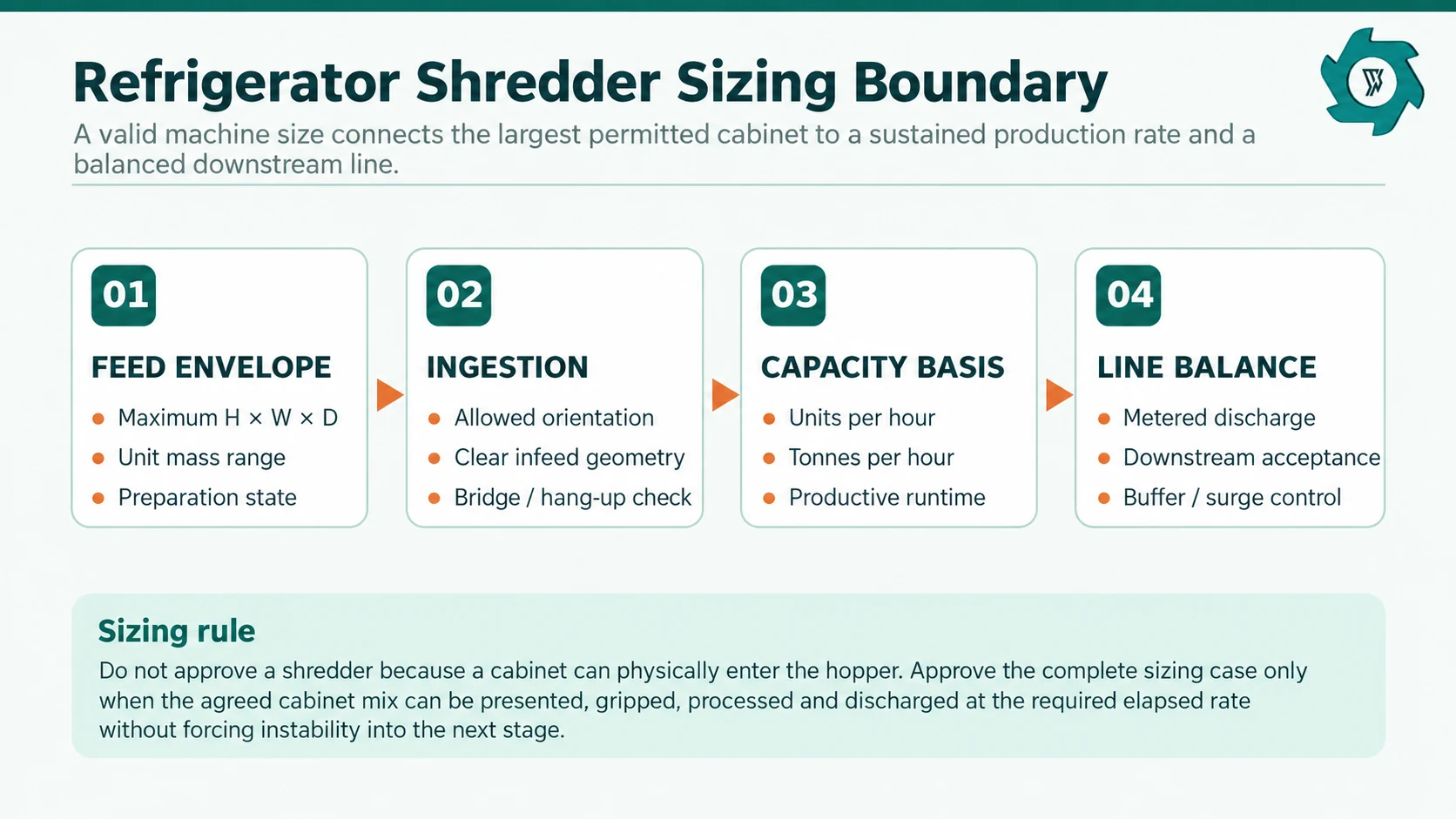
A refrigerator shredder should be sized from the feed envelope and the production duty, not from motor power or a brochure capacity alone. Start with the largest cabinet that is genuinely part of routine production, record the typical unit mass and the difficult-but-normal outliers, define how those cabinets will be presented to the infeed, and then convert the plant target into both units per hour and tonnes per hour. The selected machine still has to feed the next conveyor or liberation stage at a controllable rate.
For complete project context, the waste refrigerator recycling line shows where cabinet shredding sits after appliance preparation and before further liberation, foam handling and material separation.
Figure 1. Refrigerator shredder sizing only becomes useful when cabinet geometry, ingestion, capacity basis and downstream line balance are defined together.
Start With a Cabinet Survey, Not a Shredder Model
The word refrigerator hides too much variation for equipment sizing. A narrow domestic refrigerator, a wide side-by-side cabinet, a chest freezer and a tall commercial cooling cabinet can all be counted as one unit, yet they present very different shapes to the infeed. Even two cabinets with similar external dimensions can behave differently if one has double doors, a reinforced base, bent sheet metal or components still attached after preparation.
Build a feed survey before comparing machines. For each representative unit, record external height, width and depth; actual mass after the agreed preparation step; appliance type; door arrangement; remaining attachments; and whether the cabinet is straight, crushed, bent or partially dismantled. Photos should include a scale reference.
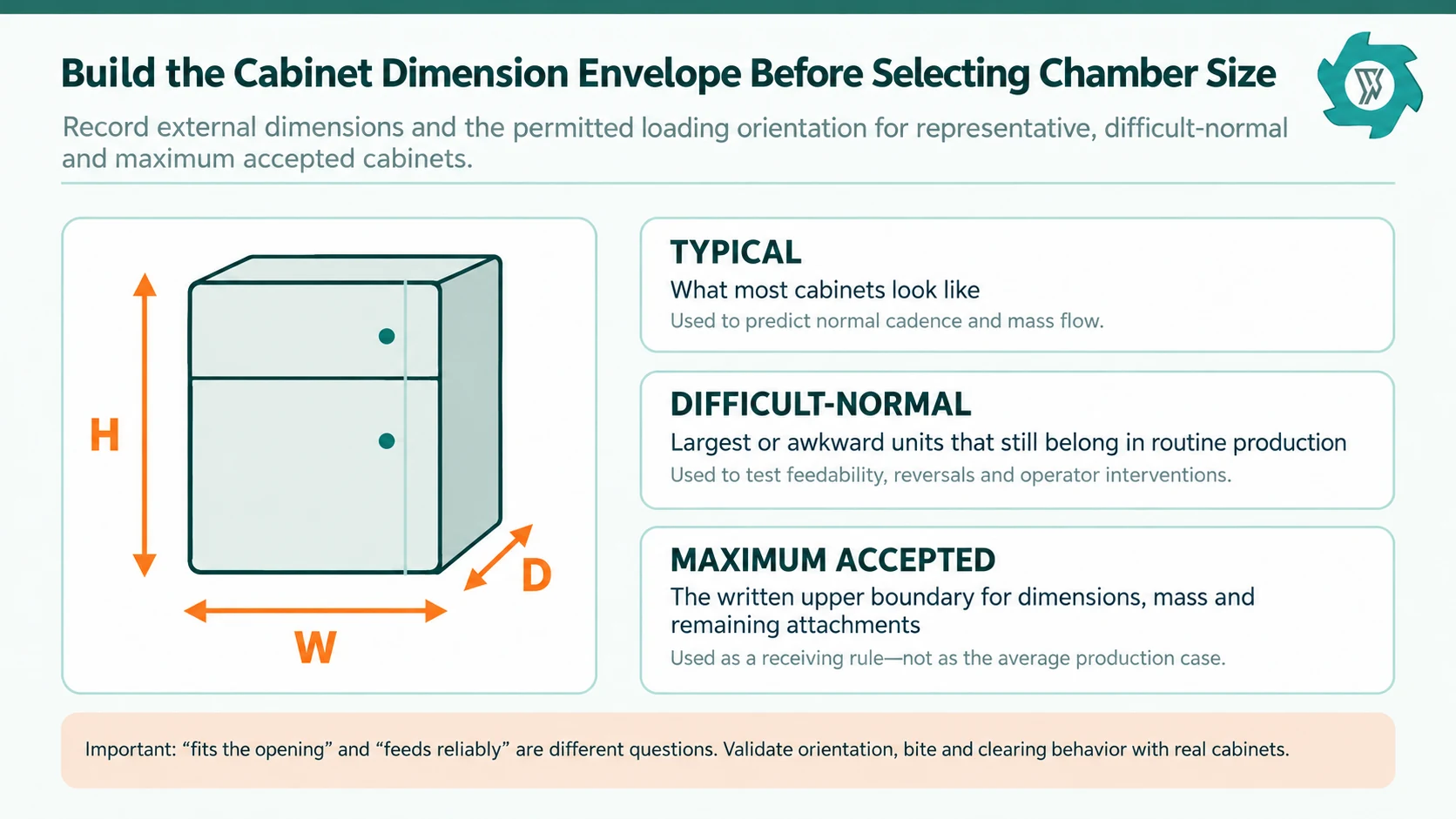
Split the survey into three practical groups. The typical group represents the units that make up most production. The difficult-normal group contains the larger, heavier or more awkward cabinets that the plant still expects to process every shift. The maximum accepted group defines the written receiving limit for routine intake.
Use the refrigerator shredder machine selection guide to compare the mechanical options. Once the primary reduction duty is fixed, size the chamber and operating rate against the actual cabinet mix.
Figure 2. Keep typical, difficult-normal and maximum accepted cabinets separate so one extreme unit does not silently become the assumed production average.
Cabinet Dimensions Must Be Converted Into a Feed Envelope
The machine sees the refrigerator in a particular orientation, at a particular angle, with a particular amount of freedom to rotate or bridge. That is why a hopper drawing with a large rectangle is not enough. A wide opening may accept the cabinet at the top while the narrowing chute below creates a hang-up before the cutters can get a reliable bite.
Ask the supplier to mark four dimensions on one drawing: the clear loading opening, the narrowest passage above the cutting chamber, the effective cutter or shaft working width, and the vertical distance from the presentation point to the first reliable bite zone. Then compare those dimensions with the actual loading method. A forklift, grab, pusher, chain conveyor and manual feed table do not present the same cabinet in the same way.
Orientation matters as much as width. A tall cabinet may enter door-first, side-first or at an angle. One orientation can expose a thin sheet edge that the cutters catch immediately; another can place a broad flat panel across the chamber and encourage skating or bridging. If the operating plan requires a preferred orientation, write it into the RFQ and FAT.
“It fits” is not the same as “it feeds reliably”
Physical fit answers one question: can the cabinet pass through the available opening? Reliable feeding answers several more: can the cabinet reach the cutters without hanging up, can the shafts establish a bite without repeated reversing, can the next cabinet be presented before the chamber clears completely, and can an abnormal but still permitted orientation be recovered without manual clearing?
For this reason, chamber size should never be approved from a catalog dimension alone. If a double-shaft primary shredder is being considered, the separate guide on when a double-shaft refrigerator shredder fits explains the primary-opening duty. The sizing decision then has to prove that the chosen chamber and feed arrangement can perform that duty on the project’s actual cabinet envelope.
Use Three Capacity Numbers: UPH, TPH and Cabinet Cadence
Refrigerator plants are often discussed in units per hour because receiving and pre-treatment are organized around individual appliances. Shredders, conveyors and downstream separators are also affected by mass flow. The same 60 units per hour can represent very different tonnes per hour if one project receives light domestic cabinets and another receives heavier units. Neither number should be used alone.
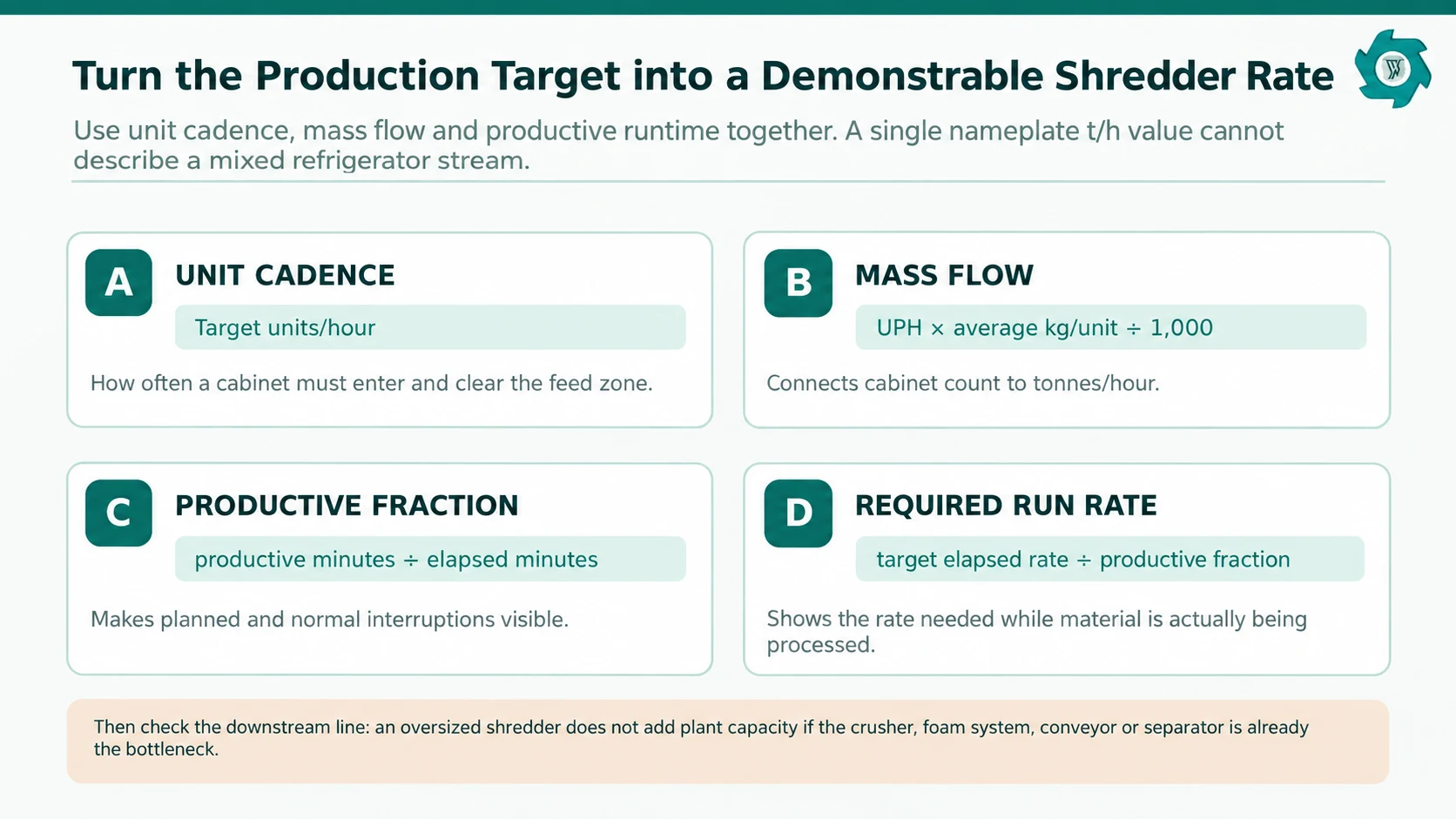
Metric tonnes per hour = units per hour × average prepared cabinet mass (kg/unit) ÷ 1,000
Use the prepared mass measured at the shredder boundary. If compressors, shelves, glass, drawers or other components are removed upstream, the mass entering the shredder can be materially lower than the mass of the complete appliance. The preparation state also needs to remain consistent between the quotation and the acceptance test.
The third number is cadence: the time available between cabinet presentations. At 60 units per hour, the average elapsed cadence is one cabinet per minute. At 90 units per hour, it is forty seconds. If the feed conveyor needs twenty seconds to index, the cabinet needs another twenty seconds before a reliable bite, and a normal reverse consumes part of the remaining window, the nominal rate may be difficult to sustain even when the motor has ample power.
Figure 3. Capacity should be translated into unit cadence, mass flow and productive runtime before a shredder rate is accepted.
Translate the Shift Target Into a Productive Run Rate
A plant may want 480 prepared cabinets processed during an eight-hour shift. Dividing 480 by eight gives 60 units per elapsed hour, but the shredder may not be available for the full 480 minutes. Planned inspection, sample collection, bin changes, operator handover and normal housekeeping can reduce the productive window. The sizing calculation should make that visible.
If the project needs an elapsed average of 60 prepared cabinets per hour and budgets a productive fraction of 0.80, the machine/feed combination must average 75 cabinets per productive hour during the periods when material is actually being processed. If the prepared cabinets average 62 kg, the elapsed mass target is 3.72 t/h, while the productive-period mass rate is about 4.65 t/h.
The productive fraction is a planning variable that should be built from the plant’s expected operating pattern. If a project predicts only 50% productive time because the downstream bins are too small or the upstream preparation station cannot release cabinets steadily, buying a shredder twice as large is unlikely to solve the underlying problem.
Account for Short-Term Surges and the Loading Method
An hourly average can hide a violent feed pattern. A loader may place three cabinets into a buffer quickly and then disappear for several minutes. A chain conveyor may meter one cabinet at a time with very little variation. Both lines could report the same hourly count, but the shredder, discharge conveyor and downstream crusher see different instantaneous loads.
Define the intended loading rule. If cabinets must be metered one at a time, state the minimum spacing or control logic. If a short queue is allowed in the hopper, state the maximum number of cabinets that may accumulate and how the next cabinet is prevented from entering when the shredder is still recovering from a difficult unit. The objective is not to keep the cutters visually full at every second; it is to maintain stable torque demand and stable discharge to the next process.
For simple buffer planning, convert time into units. A ten-minute buffer at a 60-UPH target represents about ten cabinets. At 90 UPH, the same ten-minute buffer represents about fifteen. The physical buffer still has to be checked by volume and cabinet orientation, because fifteen nested or partially crushed cabinets occupy a different footprint from fifteen intact boxes.
Do Not Size the Shredder Faster Than the Rest of the Line Can Recover
A primary shredder can meet its own mechanical rate and still destabilize the plant. Refrigerator cabinet output is bulky and irregular. If that discharge lands on a conveyor that is too narrow, reaches a secondary crusher in uneven slugs, or overloads a foam-removal zone, the apparent shredder “capacity” is not useful production capacity.
Check the next constrained stage with the same feed basis. If secondary liberation is limited by screen loading or residence time, the primary shredder should feed it at a rate it can accept continuously. If the air system depends on a shallow, even material bed, a larger shredder that creates bigger surges can reduce separation stability. If product bins require frequent stopping to change containers, that downtime belongs in the elapsed capacity calculation.
A larger primary chamber can improve ingestion of bulky cabinets, but it does not automatically improve final liberation. Keep the primary shredder’s job focused on controlled opening and transfer unless the downstream process specifically requires more.
A Practical Refrigerator Shredder Sizing Worksheet
The following worksheet can be attached to an RFQ. It gives the supplier enough information to explain a proposed chamber and throughput class.
Buyer input
Record
Why it changes sizing
Feed preparation state
Exactly what has been removed or recovered before shredding
Changes mass, hard inclusions, safety boundary and cutter duty
Typical cabinet H × W × D
Measured range from representative units
Defines normal presentation and feed geometry
Difficult-normal cabinet
Largest awkward unit expected in routine production
Tests bridging, bite, reversals and intervention risk
Maximum accepted cabinet
Written dimension, mass and attachment limit
Creates a receiving boundary instead of an open-ended promise
Average prepared mass
Measured kg/unit from the surveyed feed
Converts UPH into TPH
Target elapsed UPH
Production target measured over clock time
Connects machine sizing to the business requirement
Productive minutes/hour
Expected normal processing window
Converts elapsed target into required running rate
Loading method
Conveyor, forklift, grab, pusher or other
Determines orientation, spacing and surge behavior
Downstream acceptance rate
Mass/volume limit of conveyor, crusher, foam and sorting stages
Prevents the primary shredder from becoming a surge generator
Worked Example: Normalize the Sizing Case Before Comparing Offers
Assume a buyer surveys its prepared cabinet stream and finds a normal mix averaging 62 kg per unit. The business target is 60 units per elapsed hour. The plant expects 48 productive minutes in a typical clock hour after planned sampling, routine transfer interruptions and normal operating tasks. The production target is therefore 3.72 t/h on an elapsed basis, while the feed system and shredder need to sustain 75 units per productive hour, equivalent to about 4.65 t/h during productive periods.
The buyer identifies one large side-by-side cabinet as a difficult-normal unit and one larger commercial cabinet as outside normal production unless separately approved. The RFQ should not simply ask for “75 refrigerators per hour.” It should send photos and dimensions of the difficult-normal cabinet, define the permitted loading orientation, and ask the supplier to demonstrate how that cabinet reaches the bite zone. The maximum accepted cabinet then becomes a receiving rule.
Finally, test the downstream boundary. Suppose the next machine is comfortable with the average primary discharge only when the feed is metered. The proposed shredder therefore needs a control strategy that can hold or modulate the next cabinet rather than emptying the hopper as quickly as possible. In this case, a bigger theoretical cutting rate may add no value. Stable handoff is the actual design requirement.
When a Larger Chamber Is Useful—and When It Is Not
A larger usable feed opening can be justified when the routine mix contains wide or deep cabinets that otherwise require awkward pre-folding, diagonal presentation or repeated repositioning. More chamber width can also reduce sensitivity to small orientation errors when automatic conveying presents cabinets less precisely than a demonstration operator.
But larger is not automatically safer. Extra hopper and chamber volume can encourage batch dumping and larger discharge surges without improving the line when the real limit is preparation, metering or secondary processing. Choose the smallest configuration that accepts the full routine feed envelope and meets the proven production duty.
Where a double-shaft machine is the chosen primary platform, review the double shaft shredder product class for the mechanical role, then request project-specific chamber and capacity confirmation. Avoid borrowing a published capacity from another material and treating it as a refrigerator guarantee.
FAT Should Prove Both Cabinet Acceptance and Throughput
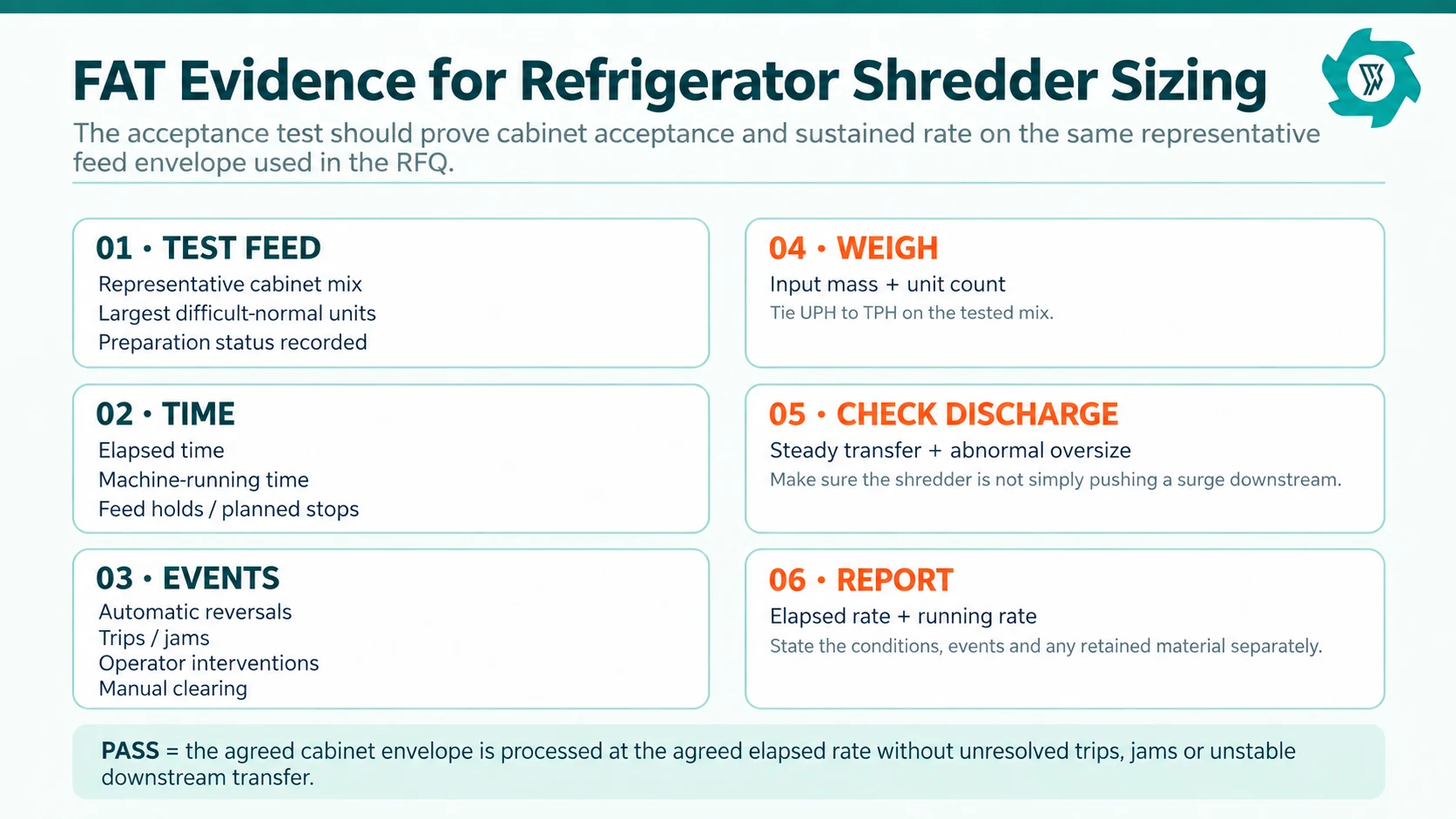
For sizing verification, the FAT should answer two separate questions: can the agreed cabinet envelope enter and establish a reliable bite, and can the feed system maintain the required cabinet cadence over a timed production run? Use a representative prepared mix and include at least one difficult-normal cabinet. Record cabinet dimensions, prepared mass and permitted orientation for the geometry check, then record total unit count, input mass, elapsed time, machine-running time, feed holds, reversals, jams, operator interventions and manual clearing during the capacity run. If the maximum accepted cabinet is outside the normal production mix, test its feedability separately rather than using it to calculate the routine throughput rate.
For U.S. projects, the test feed boundary must also remain consistent with refrigerant-management requirements. EPA’s appliance-disposal guidance explains the safe-disposal obligations for appliances that enter the waste stream with refrigerant charge intact.[1] Mechanical capability does not replace the required recovery procedure. During inspection, maintenance or unjamming, the site’s hazardous-energy procedure also needs to cover unexpected energization and stored energy; OSHA’s lockout/tagout requirements address these hazardous-energy risks.[2] OSHA’s machine-guarding requirements separately address points of operation, rotating parts and ingoing nip points.[3]
Figure 4. A sizing FAT should prove the agreed cabinet envelope and the elapsed production rate under the same test boundary.
Use Two Capacity Results, Not One Headline Number
Report elapsed throughput and running throughput side by side. Elapsed throughput tells the plant what it can plan around over clock time. Running throughput shows what the machine/feed combination does while it is actually processing material.
If running throughput is strong but elapsed throughput is weak, the problem may be feed presentation, clearing, transfer, downstream holds or operating procedure. If both are weak on permitted feed, investigate whether the chamber, cutters, torque response or feeding arrangement is mismatched. If the rate is acceptable but reversals and interventions are unusually high, the machine may be meeting the short test target in a way that creates a maintenance or labor problem in daily production.
Use the same evidence to normalize commercial comparisons. If capital cost is part of the decision, apply the fridge shredder price guide only after the sizing boundary is fixed, so offers are priced against the same feed and test conditions.
Common Refrigerator Shredder Sizing Mistakes
Using only the largest cabinet
The extreme unit becomes the whole design case, even though it may appear once a week. Separate difficult-normal from exceptional feed so routine production is not oversized around a rare event.
Using only average mass
Average kg/unit converts UPH to TPH, but it does not reveal a wide cabinet, reinforced base or awkward geometry that controls ingestion.
Equating hopper opening with usable feed size
The narrowest passage and the actual bite zone can matter more than the top opening. Review the complete infeed geometry.
Ignoring productive runtime
A nominal hourly rate based on uninterrupted cutting may not support the required shift output once normal operating tasks are included.
Batch-feeding to protect a headline TPH
Short bursts can make the shredder look fast while overloading transfer and separation equipment. Measure the connected line, not an isolated emptying event.
Testing only easy cabinets
A clean demonstration mix cannot prove the difficult-but-normal feed. Put representative outliers into the agreed FAT boundary.
RFQ Data to Send Before Asking for a Refrigerator Shredder Size
A serious sizing request should include enough evidence for the supplier to challenge the assumptions. Send the following as one data pack:
photos or video of the real cabinet stream, including a scale reference;
typical, difficult-normal and maximum accepted external dimensions;
measured prepared mass range and average kg/unit;
the exact preparation state before mechanical size reduction;
target elapsed units/hour, tonnes/hour and shift volume;
expected productive minutes per hour or shift;
loading method, preferred orientation and available buffer space;
downstream conveyor, crusher/liberation and separation capacity limits;
site power, footprint and access constraints;
the FAT feed mix, timing method, event log and pass criteria.
Frequently Asked Questions
How much larger should the shredder opening be than the refrigerator?
There is no universal clearance percentage. Use the largest routine cabinet, permitted loading orientation, the narrowest infeed passage and the actual bite zone. The supplier should validate feedability with representative cabinets.
Should refrigerator shredder capacity be specified in units per hour or tonnes per hour?
Specify both. Units per hour describes cabinet cadence, while tonnes per hour describes mass flow. Connect them with the measured average mass of the prepared cabinets entering the shredder.
How do I account for downtime when sizing the shredder?
Set an expected productive fraction from realistic operating minutes, then divide the target elapsed rate by that fraction. Keep planned stops, feed holds, machine events and downstream stops visible instead of hiding them inside one oversized safety factor.
Does a wider shredder always increase refrigerator throughput?
More width can improve acceptance of bulky cabinets, but plant throughput may still be limited by feed metering, torque response, discharge transfer, secondary liberation, foam handling or separation. Size the connected process.
What should a FAT prove for refrigerator shredder sizing?
Use the agreed prepared cabinet mix, include difficult-normal units, record input mass and unit count, elapsed and running time, reversals, stops and operator interventions, and confirm that discharge remains stable at the required rate.
Size the Shredder Against Your Real Cabinet Mix
Send representative cabinet photos, typical and maximum dimensions, prepared unit weights, target units/hour and tonnes/hour, loading method, productive operating window and downstream process. Those inputs allow the chamber, feeding arrangement and acceptance test to be checked against one consistent production basis.
David focuses on industrial shredding and recycling equipment,including material evaluation,shredder selection,process configuration,and recycling line planning.
Speak To Our Shredder Machine Expert
Get in touch with our nice team today to get a price estimate for a shredder machine.