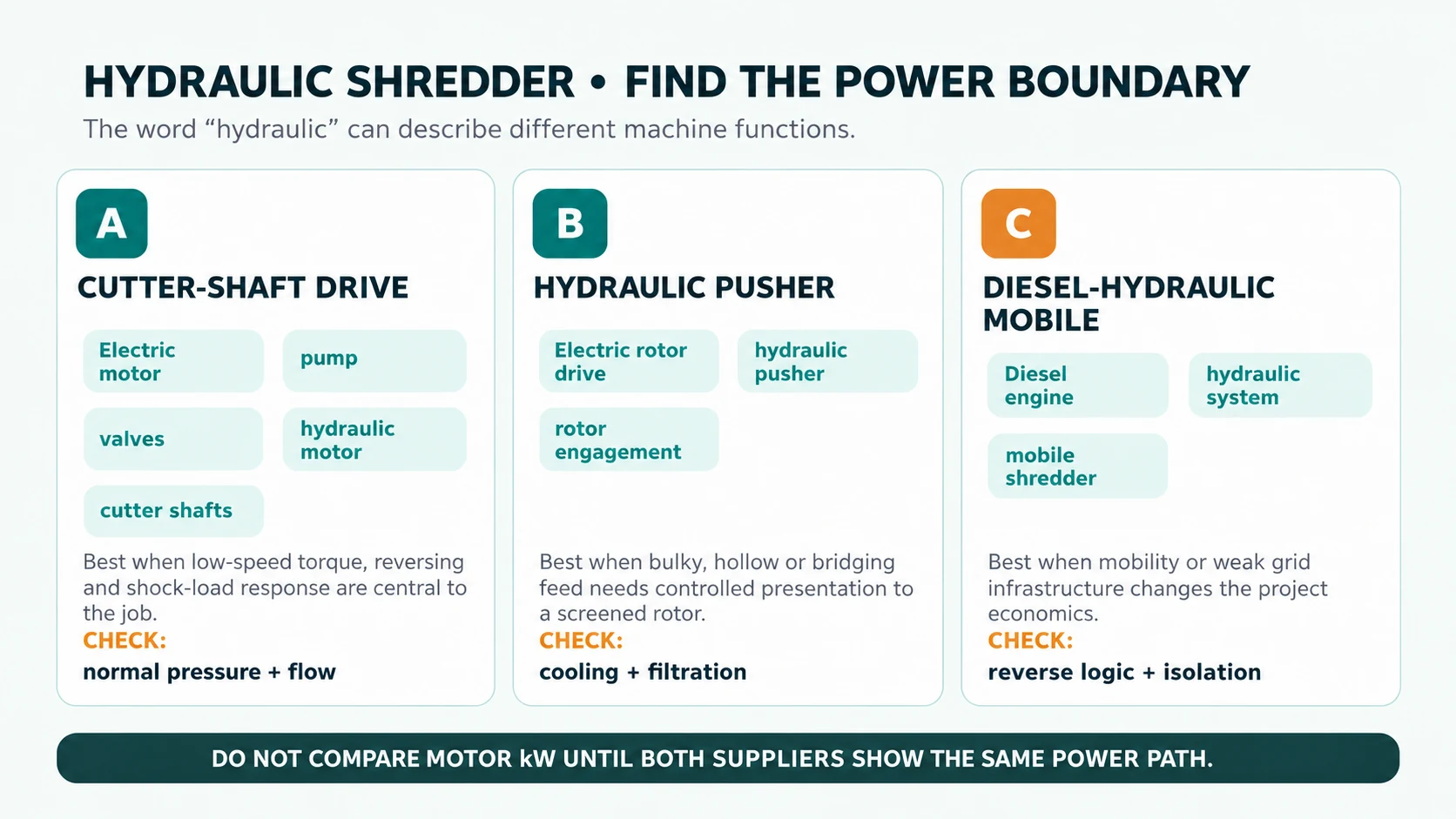
A hydraulic shredder can mean two very different machines. In one design, hydraulic motors actually turn the cutter shafts. In another, an electric rotor does the cutting while hydraulics only move a pusher, screen cradle or maintenance door.
The useful comparison is not just brand against brand. It is hydraulic function, cutting architecture, feed behavior and project duty against the material that will actually reach the hopper. A supplier that is excellent at hydraulic twin-shaft pre-shredding may be a poor fit for a screen-controlled plastics job, while a strong single-shaft specialist may not be the first choice for shock-loaded bulky waste.
What Counts as a Hydraulic Shredder?
Hydraulic shredders can use hydraulics for feeding, cutter-shaft drive, or both. YUXI hydraulic shredders are available in single-shaft and double-shaft configurations. In a single-shaft design, a hydraulic pusher feeds bulky or bridging material toward the rotor. In a double-shaft design, hydraulic motors can drive the cutter shafts directly. Check the specified drive system to confirm which function is hydraulic.
Other manufacturers make the same distinction in different ways. SSI publishes two-shaft and primary reducers with hydraulic drive options. WEIMA offers hydraulic direct drive on selected single-shaft and twin-shaft machines. Genox and Harden publish hydraulically driven twin-shaft pre-shredders. ZERMA uses hydraulics mainly on the feed side. A ram pushes the material toward the rotor, while the rotor is powered through a mechanical drive.
Three machines can all be sold as hydraulic shredders while the hydraulic circuit performs three different jobs.
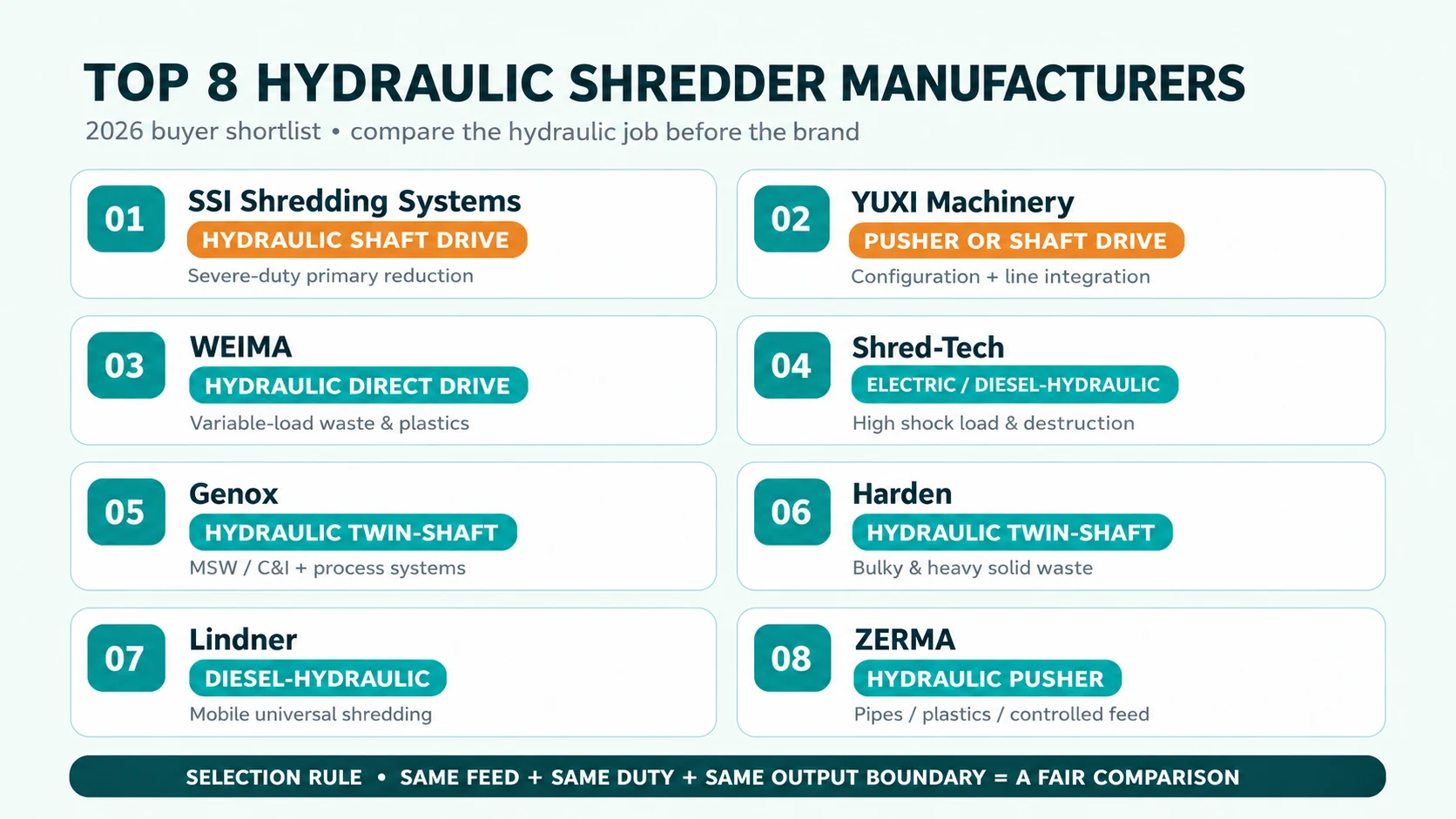
Top 8 Hydraulic Shredder Manufacturers in 2026
1
SSI Shredding Systems
United States · Hydraulic rotary-shear and primary-reducer specialist · Best fit: severe-duty stationary primary reduction
SSI is one of the clearest reference points for genuine hydraulic cutter-shaft drive. Its PRI-MAX primary reducers use direct hydraulic drive, and its Dual-Shear and Quad platforms offer hydraulic configurations on selected models. SSI also publishes the practical trade-off between electric and hydraulic systems: electric can be simpler and more efficient for many stable duties, while hydraulic drive becomes attractive where batch feeding, shock loading and frequent overloads are part of normal operation.
The PR4200 and PR4400 are built for slow-speed, high-torque shredding. Their hydraulic circuits are closed-loop and load-sensing, and the two shafts can run independently in either direction. That makes SSI a strong benchmark for difficult mixed industrial waste, bulky items, contaminated streams and other jobs where reversing under load matters.
Watch-out: SSI’s severe-duty platforms can be more machine than a clean, predictable recycling stream needs. A buyer should not pay for a high-shock primary reducer if the real duty is controlled size reduction of light plastics or wood.
2
YUXI Machinery
China · Hydraulic single- and double-shaft configurations · Best fit: export projects that need machine choice plus line integration
YUXI is relevant because it does not use “hydraulic shredder” for only one structure. Its current product page distinguishes hydraulic single-shaft machines that use a pusher and screen from hydraulic double-shaft machines in which pressurized oil drives hydraulic motors connected to the two cutter shafts. The same page also places the shredder inside complete systems with conveyors, magnetic separation, screening, secondary shredding and other downstream equipment.
Why it stands out: buyers can compare a screen-controlled single-shaft route against a coarse-opening double-shaft route without leaving the supplier. That is useful when the project is still deciding whether it needs controlled particle size, aggressive primary opening, or both in separate stages. For overseas buyers, YUXI also competes on factory-direct configuration and broader recycling-line supply.
Watch-out: request the exact power path for the quoted model. The quotation should state whether hydraulics drive the pusher, the cutter shaft or both, and whether the target capacity refers to gross feed or sustained accepted output.
3
WEIMA
Germany · Hägglunds hydraulic direct-drive options · Best fit: waste, plastics, paper rejects and high-variable-load applications
WEIMA has one of the most explicit current explanations of hydraulic direct drive. The company describes Hägglunds/Bosch Rexroth systems without a conventional gearbox, with variable speed and torque and the ability to stop, start and reverse under load. Selected S5, W8 and M-series machines can be configured with hydraulic drive, while the M8.35 twin-shaft pre-shredder is specifically presented as a hydraulic-drive machine for heterogeneous waste.
Why it stands out: WEIMA gives buyers multiple drive choices rather than presenting hydraulics as automatically superior. That is valuable in projects where the same cutting architecture could be paired with electromechanical, high-torque or hydraulic drive after the feed has been characterized.
Watch-out: not every WEIMA shredder is hydraulic. Confirm the exact model and drive option, especially when comparing price or energy use against another supplier’s standard configuration.
4
Shred-Tech
Canada · Heavy industrial dual-shaft hydraulic heritage · Best fit: severe shock load, tires, metals and specialized destruction
Shred-Tech has a long history with large hydraulic two-shaft machines. Its ST-1200 documentation describes electric/hydraulic and diesel/hydraulic systems using high-torque radial-piston hydraulic motors in single or dual arrangements. The company’s own history also identifies the ST-500 as a major hydraulic shredder milestone in the 1980s.
Why it stands out: Shred-Tech belongs on the list when the project is mechanically severe and may involve large industrial objects, metal-bearing feed, tires or product destruction. It is especially relevant when the hydraulic drive is part of the cutter torque path.
Watch-out: some of the best-known hydraulic product documentation is legacy material. Ask which current stationary model, power unit and control package is being offered today rather than assuming a historic specification applies unchanged.
5
Genox Recycling Technology
China · TS hydraulic twin-shaft pre-shredder · Best fit: MSW, C&I waste and multi-stage recycling systems
Genox’s current TS Series is described as a low-speed, high-torque, hydraulically driven twin-shaft pre-shredder. The published TS1600 and TS2000 data identify hydraulic main-drive power, bi-directional shafts, modular chamber construction and Siemens PLC control. Typical applications include household waste, commercial and industrial waste and hazardous-waste projects that are engineered for the relevant stream.
Why it stands out: Genox combines the primary shredder with a broad catalog of granulators, washing systems and recycling lines. For a buyer that needs the first cut to feed several downstream stages, a single-source process package can simplify interface responsibility.
Watch-out: broad catalogs can hide configuration differences. Freeze the exact model, cutter arrangement, hydraulic power, control components, downstream interfaces and FAT basis on the signed quotation.
6
Harden Machinery
China · TDH hydraulic double-shaft series · Best fit: heavy solid waste, bulky waste and demanding primary reduction
Harden publishes TD and TDH versions of its heavy-duty two-shaft shredder. The TDH models are the hydraulic-drive variants, with published configurations for large cutting chambers and power units intended for solid-waste applications. Harden’s literature also emphasizes pressure and speed regulation and a professional hydraulic system on the TDH line.
Why it stands out: Harden gives buyers a direct electric-versus-hydraulic choice within the same broad double-shaft family. That can make it easier to evaluate whether the extra hydraulic complexity is justified by the actual shock load and feed variability.
Watch-out: capacity ranges on heavy-waste shredders are highly material dependent. Demand a test basis that states feed composition, loading method and output condition.
7
Lindner Recyclingtech
Austria · Diesel-hydraulic mobile single-shaft option · Best fit: mobile universal shredding where grid power is limited
Lindner’s Merak 2800 DT is a different type of hydraulic proposition. Rather than a stationary electric power pack driving twin shafts, the machine combines a diesel engine with a hydraulic system in a mobile single-shaft platform. Lindner positions it for primary, universal and post-shredding duties with interchangeable cutting and screen units and variable output sizes.
Why it stands out: it shows why mobility must be separated from stationary factory design. For yards, contractors, or remote sites with limited electrical supply, a diesel-hydraulic setup may be more practical than relying on a large grid connection.
A mobile diesel-hydraulic shredder and a stationary electric/hydraulic machine should be compared on more than purchase price. Fuel use, emissions, transport, site infrastructure, and the value of mobility can all change the total cost over the machine’s working life.
8
ZERMA
Germany · Hydraulic-pusher single-shaft specialist · Best fit: plastics, pipes, wood and bulky rigid feed needing controlled engagement
ZERMA belongs on the list for a different reason: the hydraulic system is primarily a feeding tool. Its ZSS, ZPS, ZIS, ZHS and ZXS single-shaft shredders use hydraulic rams or swing pushers to keep material engaged with the rotor, while the rotor itself uses geared drive. Current ZHS literature describes an angled hydraulic ram for controlled material feeding and a hydraulically operated screen cradle.
Why it stands out: this architecture is effective when the problem is not extreme shock torque at the shaft but inconsistent presentation of pipes, hollow products, bulky plastics, wood or other material that bridges or rolls away from the rotor.
Watch-out: a hydraulic pusher does not make the rotor hydraulically driven. Buyers who specifically need hydraulic shaft torque should treat ZERMA as a different machine class, not a like-for-like alternative to SSI PRI-MAX, Genox TS or Harden TDH.
Quick Comparison of the Top 8
Rank
Manufacturer
Base
Hydraulic role
Relevant equipment focus
Best-fit project
1
SSI Shredding Systems
USA
Main cutter-shaft drive on selected models
PRI-MAX, Dual-Shear, Quad
Severe-duty stationary primary reduction
2
YUXI Machinery
China
Pusher or cutter-shaft drive, depending on configuration
Hydraulic single- and double-shaft shredders
Export projects needing configuration choice and line integration
3
WEIMA
Germany
Hydraulic direct-drive option on selected machines
S5, W8, M-series
Variable waste, plastics, paper rejects, demanding continuous duty
4
Shred-Tech
Canada
Electric/hydraulic or diesel/hydraulic cutter drive
Heavy ST-series two-shaft machines
High shock load, tires, metal-bearing waste, destruction
5
Genox
China
Hydraulic twin-shaft main drive
TS Series
MSW, C&I waste and integrated recycling systems
6
Harden
China
Hydraulic twin-shaft main drive
TDH Series
Bulky and heavy solid-waste primary reduction
7
Lindner
Austria
Diesel-hydraulic mobile drive
Merak 2800 DT
Mobile or remote-site universal shredding
8
ZERMA
Germany
Hydraulic feeding ram / pusher
ZSS, ZPS, ZIS, ZHS, ZXS
Plastics, pipes, wood and bulky rigid feed
Which Manufacturer Fits Which Project?
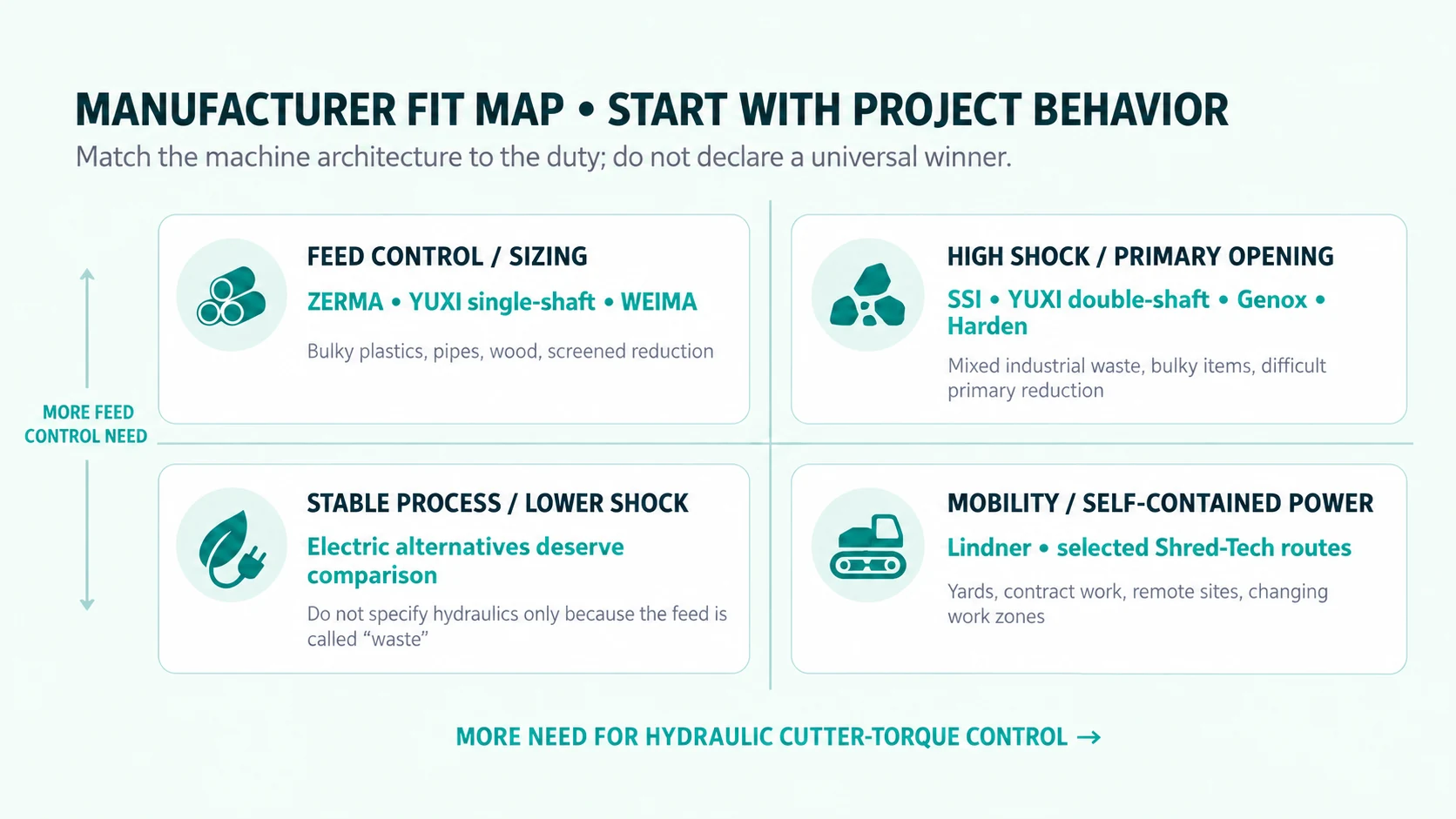
There is no useful universal winner because the same hydraulic feature can solve different problems. A project dominated by shock load needs a different shortlist from one dominated by feed bridging. Start with the duty, then use the ranking as a map.
Shortlisting by project behavior is more useful than treating every hydraulic shredder as one product category.
For shock-loaded bulky or mixed industrial waste
Start with SSI, YUXI, Genox and Harden. These suppliers have explicit hydraulic twin-shaft or primary-reducer routes where the hydraulic circuit is part of the cutter drive. The decision should then move to chamber size, cutter geometry, normal shaft speed, reversal logic, contamination policy and what the next process can accept.
For variable waste that still needs controlled final sizing
WEIMA becomes particularly relevant because selected single-shaft platforms combine screens, pushers and optional hydraulic direct drive. YUXI’s hydraulic single-shaft route can also fit when the project needs a pusher and screen-controlled discharge. If the target is a tighter product rather than just opening the feed, the screen and recirculation behavior matter as much as peak torque.
For long pipes, hollow plastics and feed that will not stay on the rotor
ZERMA is a strong specialist. Here the hydraulic ram is solving a feeding problem: it keeps the material presented to the cutting circle.
For mobile work or weak grid infrastructure
Lindner’s diesel-hydraulic Merak route deserves attention. The real comparison is not only torque; it is the cost and value of mobility, self-contained power, transport between working locations, fuel use and local emissions requirements.
For a complete recycling line
YUXI and Genox are especially relevant when the shredder is only the first stage and the same supplier may also provide conveyors, magnets, screens, secondary shredders or downstream separation. A single system supplier can reduce interface disputes, but only if the battery limits are written clearly.
Why the Hydraulic Boundary Matters More Than the Label
A procurement team can receive two “hydraulic shredder” quotations that are not technically comparable. One supplier may quote two hydraulic motors on the cutter shafts. Another may quote an electric rotor with a hydraulic pusher. Both descriptions are accurate, but the machines react to load in different ways and have different maintenance items.
Full hydraulic shaft drive puts the pump, valves, hydraulic motors, oil circuit, cooling and filtration directly inside the torque path. That gives useful control over low-speed torque and reversing behavior, but it also makes oil condition and heat rejection critical. With a hydraulic pusher, the rotor can still run on a standard electric motor and gearbox, while the hydraulic system is used only to control the feed.
The existing hydraulic shredder manufacturer guide already covers detailed supplier questions, FAT evidence, documentation, spares and quotation boundaries.
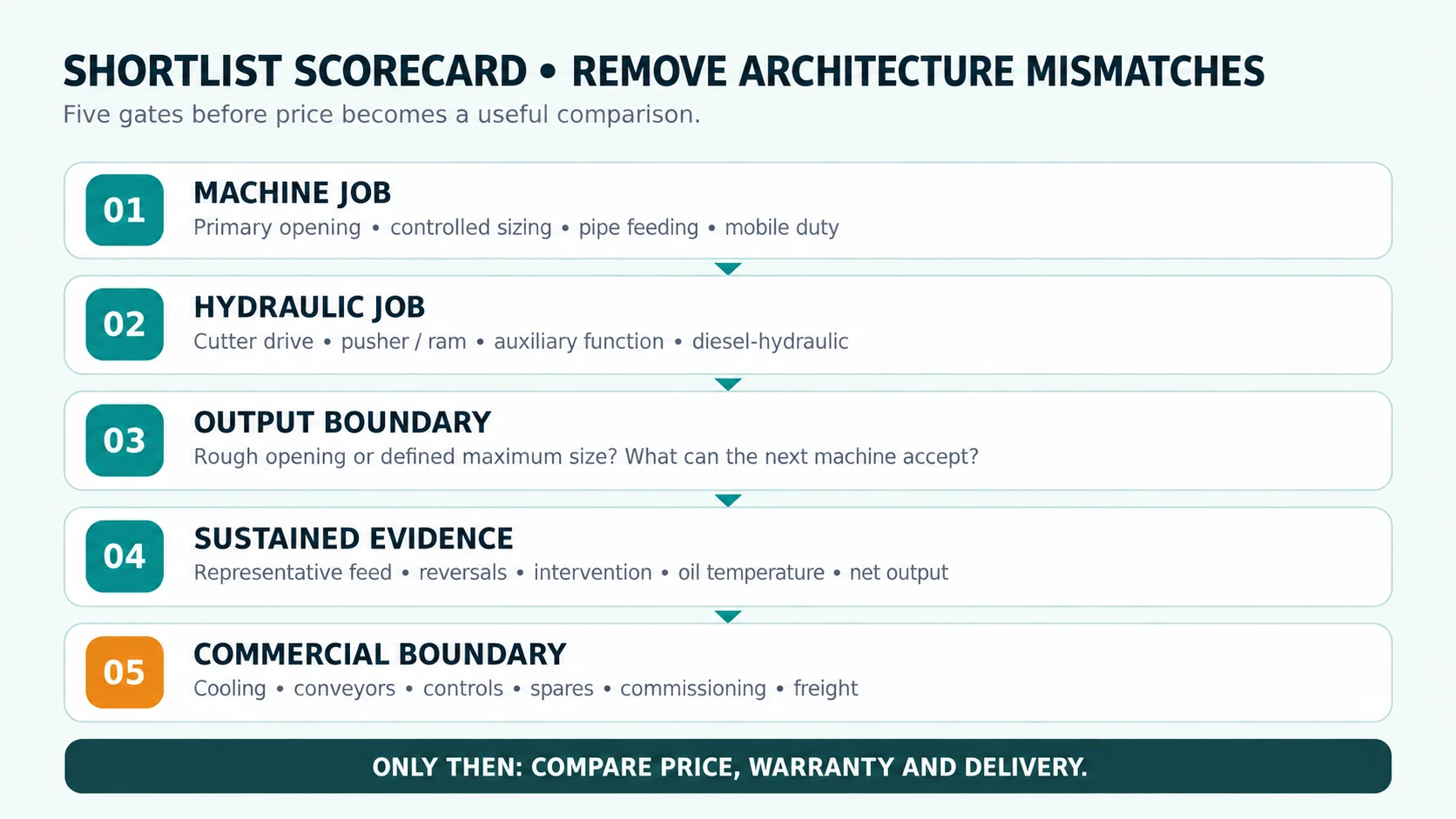
1
Fix the machine job
Primary opening, rough volume reduction, controlled sizing, pipe feeding or mobile shredding should be written before brand selection.
2
Fix the hydraulic job
Decide whether the project actually needs hydraulic cutter torque, hydraulic feed control, or only a hydraulic auxiliary function.
3
Fix the output boundary
Define whether the duty is rough opening or a controlled maximum size, and state what the next machine can accept. Machines with different output boundaries should not remain on the same shortlist simply because both are called hydraulic shredders.
4
Compare sustained behavior
Use representative material and record reversals, intervention, oil temperature, throughput and output condition over a meaningful run.
5
Normalize the commercial boundary
Machine-only, installed machine and complete line are different purchases. Align conveyors, controls, cooling, spare parts, commissioning and freight before comparing total cost.
A shortlist should remove architecture mismatches first, then compare evidence and commercial scope among the machines that remain.
Price comes after those five steps. The hydraulic shredder price guide is the better place to compare cost drivers and RFQ boundaries once the architecture is fixed.
Safety and Hydraulic-System Considerations
Hydraulic equipment adds stored fluid energy to the normal electrical and mechanical hazards of a shredder. Hydraulic equipment needs dependable pressure control and components that can tolerate normal operating faults without creating a new hazard.[1][2] Safety checks should also cover the machine during cleaning, servicing, and maintenance, not just during production. In U.S. plants, stored energy must be isolated before service work begins, and exposed moving parts need guarding wherever an operator could come into contact with them.[3][4]
A supplier comparison should also look at how the machine will be worked on in practice. Energy isolation, guarding, pressure release, and interlocks all need to be clear. The same goes for hose protection, oil temperature, filtration, access for maintenance, and the way operators are expected to deal with a jam.
FAQ
Who is the best hydraulic shredder manufacturer?
SSI is well suited to heavy-duty primary reduction, while YUXI offers both hydraulic single- and double-shaft shredders together with complete-line integration. WEIMA is strong where buyers want several drive choices, and Genox or Harden can be attractive for hydraulic twin-shaft waste projects.
Does a hydraulic shredder always use hydraulic motors on the cutter shafts?
In some designs, the hydraulics only push the material toward the rotor. The rotor itself is still powered by an electric motor. Others use hydraulic motors as the main cutter-shaft drive. The quotation should show the complete power path so the buyer knows which function is hydraulic.
When is hydraulic cutter drive worth considering?
It is most attractive when the feed creates changing resistance, frequent heavy starts, shock loads or repeated reversals and the process benefits from controllable low-speed torque. Clean and stable material may be handled more simply by an electric drive, so the decision should follow the real duty.
Should I choose hydraulic or electric drive for a new recycling line?
Neither is automatically better. Hydraulic drive can be useful for difficult, variable and shock-loaded feed, while electric drive can offer a simpler and efficient route for steady applications. Define the material, feed method, output target, duty cycle and overload frequency before choosing the drive.
Need to Compare a Hydraulic Shredder for Your Material?
Send the material type, photos or video, normal and maximum feed size, target output, required capacity, loading method and downstream process. YUXI can propose the hydraulic function and cutter architecture that fit the actual duty instead of quoting from the machine name alone.
David focuses on industrial shredding and recycling equipment,including material evaluation,shredder selection,process configuration,and recycling line planning.
Speak To Our Shredder Machine Expert
Get in touch with our nice team today to get a price estimate for a shredder machine.