Refrigerator Crusher vs Shredder: Primary vs Secondary Size Reduction
Primary vs Secondary Size Reduction
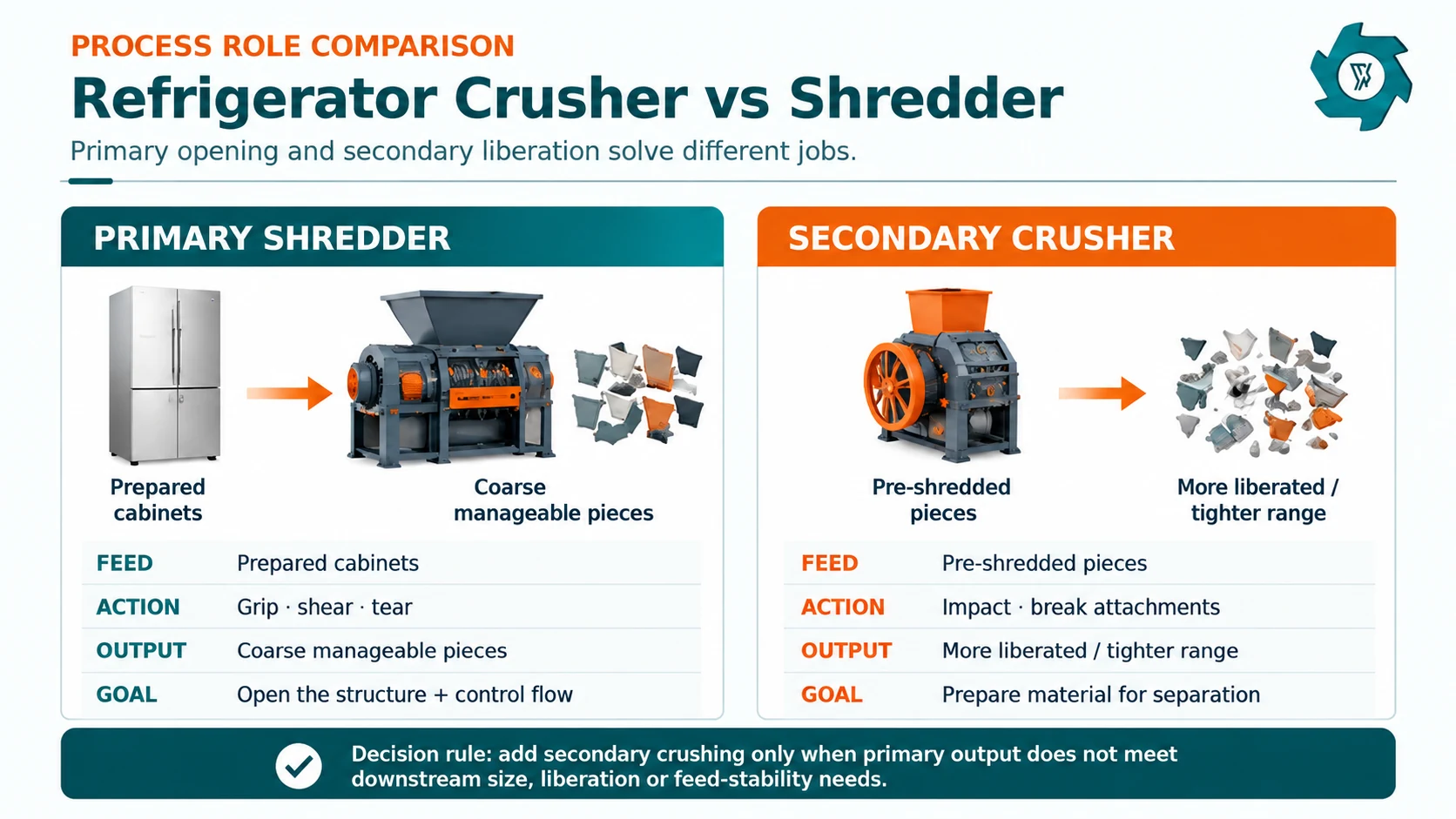
A primary shredder and a secondary crusher do different jobs in a refrigerator recycling line. The primary shredder takes in prepared, depolluted cabinets and opens up the bulky structure with slow, high-torque cutting. Its main purpose is to break the cabinet down enough for stable conveying and the next processing step. A secondary crusher works on that already-reduced stream. Its job is to break remaining steel-plastic-foam attachments, narrow the particle range where necessary and present material in a condition that the air, magnetic and non-ferrous separation stages can actually use.
The important buying decision is therefore not “shredder or crusher?” in isolation. It is whether the discharge from the first stage already meets the size and liberation requirement of the next process. If it does, another crusher may add cost, wear, dust and fines without improving saleable output. If it does not, the second stage can be the difference between coarse mixed bundles and a stable feed that downstream separators can handle. The complete waste refrigerator recycling line shows where these two mechanical stages sit after depollution and before foam, ferrous and non-ferrous separation.
Primary shredding turns a bulky prepared cabinet into manageable pieces. Secondary crushing is a later liberation step, not a substitute for refrigerator depollution or primary opening.
Why “crusher” and “shredder” are easy to compare incorrectly
Equipment names are not always used in the same way from one supplier to another. A two-shaft shear might be listed as a crusher in one quotation, while another supplier may describe a high-speed impact machine as a shredder. That is why a purchasing specification should describe the mechanical duty.
For quotation and process-comparison purposes, define the primary shredder as the low-speed, high-torque machine that receives prepared refrigerator cabinets and tears or shears them into coarse pieces. Define the secondary crusher as the downstream impact or hammer-type liberation stage that receives pre-shredded material. Using functional definitions prevents two suppliers from appearing to offer the same process simply because they use similar equipment names.
If you are deciding between shaft arrangements, cutter configurations or broad refrigerator shredder specifications, use the dedicated refrigerator shredder machine selection guide. For the reduction train itself, the important question is what each stage must accomplish and what measurable evidence is needed to justify a second stage.
Size reduction starts only after the refrigerator has been prepared for mechanical treatment
A recycling line should not use the primary shredder as a discovery tool for refrigerant, compressor oil, glass, loose electrical parts or other components that should have been managed earlier. For U.S. projects, EPA’s safe-disposal requirements place responsibility on the final disposer to ensure refrigerant is recovered before final disposal, and EPA describes appliance recycling as removal or management of relevant components before evacuated appliances are shredded.[1][2]
That preparation changes the mechanical load. A cabinet with the compressor removed behaves very differently from an intact cooling appliance. Glass shelves, heavy loose parts and unidentified components can create impact loads, contamination or unsafe manual clearing later. The feed specification should therefore state what has been removed, what may remain, the permitted appliance types and the largest normal cabinet that the primary stage is expected to accept.
Primary refrigerator shredding is an opening and flow-control job
The first mechanical stage has to do something a high-speed secondary machine is poorly suited to do: accept a bulky, hollow, thin-sheet composite body and turn it into a continuous material stream. A double shaft shredder is commonly used for this duty because counter-rotating cutters can grip irregular material at relatively low speed and high torque.
The primary shredder should open folded steel skin, plastic liner and foam-bearing panels far enough that downstream conveyors do not receive intact or near-intact cabinet sections. It should also avoid creating a discharge so fine that the first machine begins doing the secondary stage’s work at the cost of extra recirculation, cutter wear or reduced throughput.
The primary stage should prove five things
1. Stable grip
Normal and edge-compliant cabinets should enter the chamber without repeated bounce, bridging or operator pushing.
2. Structural opening
Large cabinet sections should be torn open enough to expose composite interfaces rather than leave closed boxes and folded sandwiches.
3. Manageable discharge
The next conveyor and machine should receive pieces they can accept without chronic bridging or uncontrolled surge loading.
4. Recoverable overloads
Reversals and stops should be recorded. The machine must recover from difficult but permitted feed without turning manual clearing into a normal operating method.
5. Predictable handoff
The output should be judged at the next machine’s inlet, not only at the shredder’s discharge chute.
A primary shredder can look successful because the cabinet disappears, yet the line can still perform badly if long folded sheet, attached foam panels or nested pieces arrive at the next stage in bursts. Good primary reduction is measured by what it enables downstream.
Secondary crushing is a liberation job, not simply “make it smaller”
Once the cabinet has been opened, the second mechanical question changes. The feed is no longer a refrigerator body; it is a mixed stream of steel sheet, plastic liner, foam-bearing fragments, wire, small non-ferrous pieces and residual attachments. The secondary crusher’s value comes from liberating materials that are still physically connected and, where needed, bringing the stream into a tighter size band for separation.
Suppose a large piece of steel skin still carries plastic and insulation. A magnet may recover the steel, but the attached non-steel material follows it and lowers the quality of the ferrous fraction. The reverse can also happen: a small copper-bearing or aluminum-bearing part trapped in a larger composite piece may not behave as expected at the downstream non-ferrous separator. Secondary impact can expose those interfaces. The objective is not maximum fragmentation; it is enough liberation to create clean mechanical decisions later.
A crusher can also make feed presentation more consistent. These separation steps are sensitive to how the material arrives. Big changes in size, shape, weight, or bed depth can make the process difficult to control. A mixed feed full of both large pieces and fines is especially troublesome, because the settings that work for one part of the stream may not work well for the other. The secondary stage can narrow that variability when the first stage alone cannot.
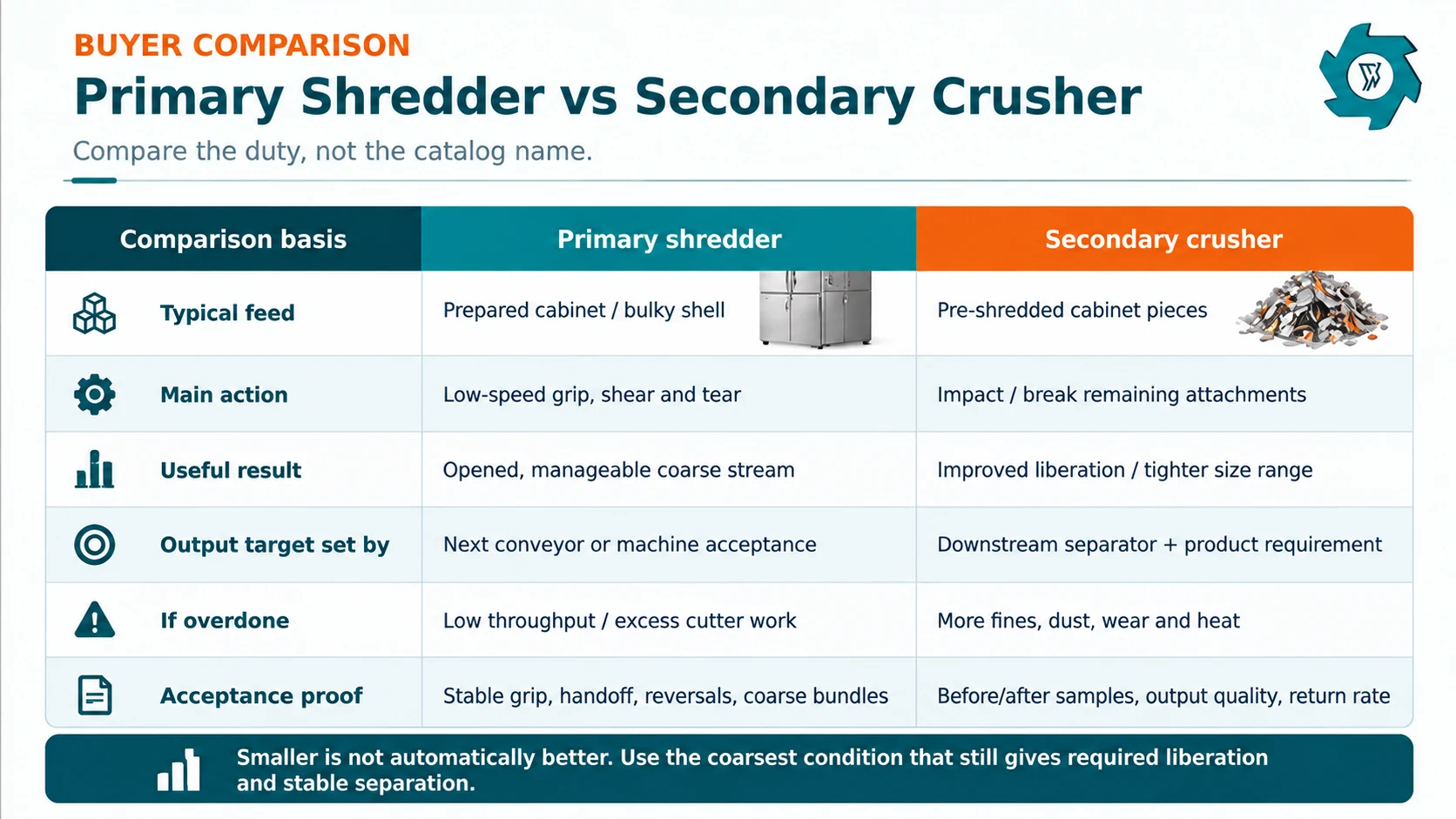
Comparison basis
Primary shredder
Secondary crusher
Main feed
Prepared refrigerator or freezer cabinets
Pre-shredded cabinet pieces
Main mechanical duty
Grip, tear, shear, open and reduce bulk
Impact, break attachments and refine size where required
Main process result
Manageable coarse stream
Improved liberation and more stable separator feed
What should set the output target
Next conveyor/machine acceptance and opening requirement
Downstream separation and product-quality requirement
Main risk if pushed too far
Low throughput, excessive cutter work and unnecessary recirculation
More fines, dust, wear, heat and loss of useful particle size
When it may be enough alone
When coarse output already meets the next process requirement
Not applicable; it is an optional follow-on stage
The useful comparison is based on duty and handoff condition. A primary shredder and a secondary crusher are complementary only when the process actually needs both.
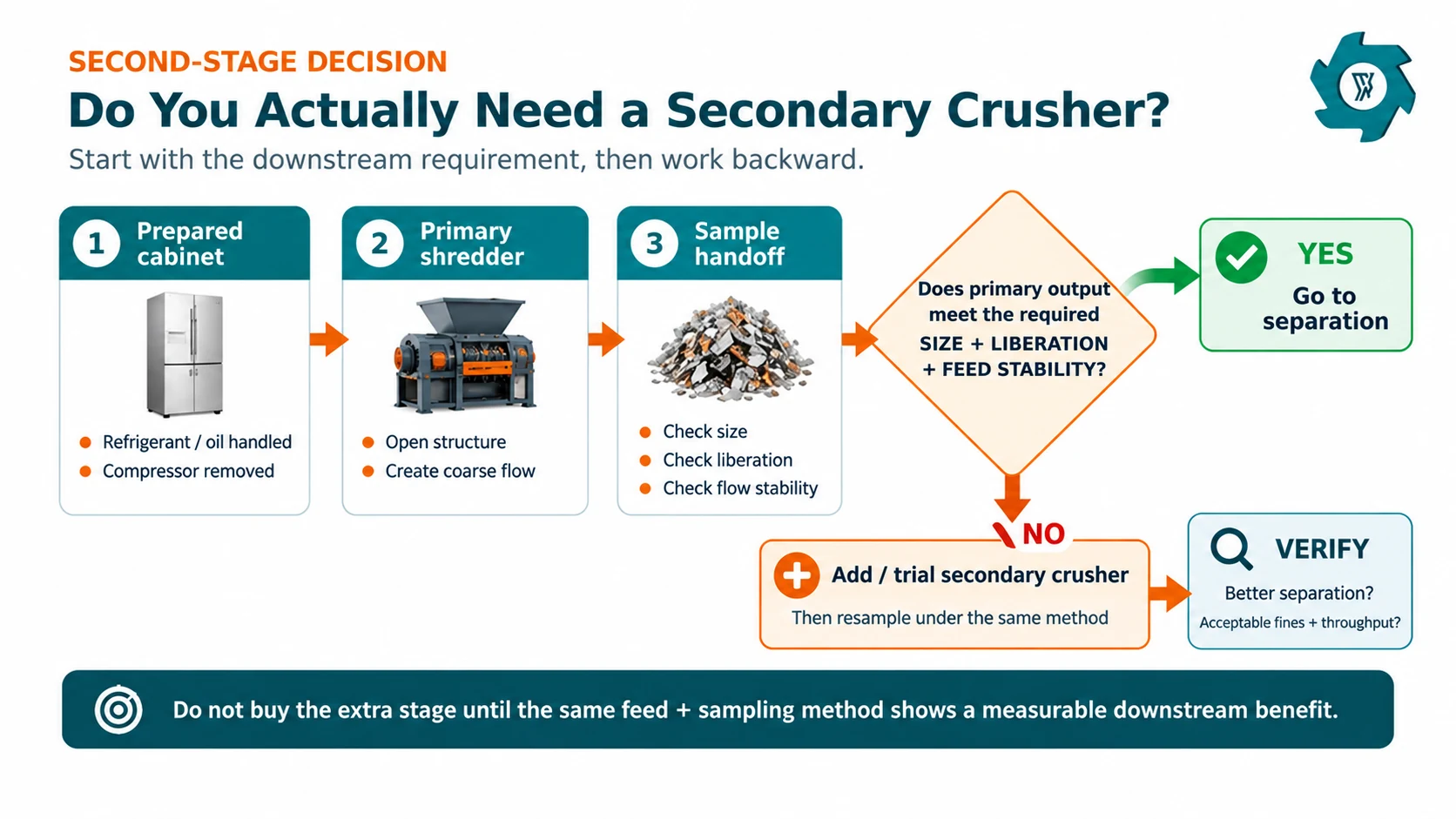
The decision gate: does the primary output already meet the next process requirement?
A two-stage drawing can look more complete than a one-stage drawing, but extra machinery is not automatically better engineering. The second reduction stage should earn its place by solving a measurable problem. Start with the separation train and work backward.
Ask the magnet, air system, screen, manual quality station or eddy-current stage what feed condition it needs. Then inspect and sample the primary shredder discharge. If the pieces are open enough, the burden can be metered reliably and the material fractions already separate to the required quality, the second crusher may not improve the economics. If large composite bundles survive, separator loading is unstable or saleable fractions remain physically locked together, secondary crushing becomes easier to justify.
Add the secondary stage when the primary discharge fails a defined size, liberation or downstream-feed requirement—not because a standard flowchart shows another machine.
Situations where primary shredding alone may be enough
The commercial objective is coarse opening, volume reduction or a simple ferrous-rich stream rather than tightly controlled multi-fraction separation.
The primary discharge already exposes the relevant materials and feeds the next separator without persistent bridging or surging.
The downstream buyer accepts a coarser product and additional size reduction does not create measurable value.
The plant has a separate downstream processor that will perform the next liberation step under its own specification.
Situations where secondary crushing is easier to justify
Steel, plastic and foam remain attached in pieces large enough to contaminate the recovered fractions.
The air or magnetic stage cannot be tuned consistently because the feed contains extreme size or shape variation.
Non-ferrous recovery depends on exposing smaller conductive pieces that remain trapped in composite bundles.
The accepted product specification requires a tighter particle window than the primary shredder can produce without excessive recirculation.
Repeated manual rework after primary shredding is already functioning as an unofficial “second stage.”
Compare product quality and recirculation before and after the proposed second stage. If the additional crusher cannot show a clear improvement under the same feed and sampling method, the buyer has not yet proved that the extra machine is necessary.
Why liberation matters more than a single discharge-size number
Refrigerator scrap is not a monolithic material. A 60 mm piece can be a clean steel fragment, a clean plastic fragment, a foam-rich sandwich or a tightly folded bundle that contains several materials. Those pieces share a nominal dimension but behave very differently in separation.
For ferrous recovery, the magnet needs steel to be exposed enough that the recovered magnetic fraction does not drag an excessive amount of attached plastic and foam with it. For air classification, particle mass and surface area affect how light material moves in the airflow. For eddy-current separation, conductive pieces need a size and presentation condition that allows the separator to act on them without being buried in a deep or chaotic burden. The upstream reduction stages influence all three.
There is also a lower limit to useful reduction. More impact can create small mixed fragments and fines that are difficult to sell, sample or separate. Foam can break into light particulate that increases the load on ducts, cyclones and filters. Plastic and paint-bearing surfaces can contribute additional dust. OSHA notes that many organic and synthetic materials can form combustible dust when sufficiently finely divided, so dust generation and collection should be part of the process risk review rather than an afterthought.[3]
The better target is therefore the coarsest particle condition that still delivers the required liberation and separator stability. That target preserves throughput and reduces unnecessary breakage while still producing the mechanical separation the project needs.
The secondary stage changes wear, energy, dust and maintenance—not just capital cost
Adding a crusher creates a second drive, another wear system, more transfer points and another place where the line can stop. It can be justified, but its operating consequences belong in the decision before the purchase order is signed. The existing fridge shredder price guide explains why buyers should compare complete treatment boundaries.
At the primary stage, common wear attention goes to cutters, spacers, shafts, bearings, gearbox loading and any components that experience shock when difficult cabinet pieces enter. The operating signature is usually torque-related: loading, reversal, jam recovery and feed control matter. At the secondary stage, the wear pattern shifts toward impact components, liners, screens or grate areas where fitted, and higher-speed rotating parts. The design may vary from one system to another, but producing finer material usually takes more mechanical effort and tends to increase wear.
Energy data should be recorded against accepted tonnes or accepted units, not read from installed motor power. Installed kW tells the engineer how large the electrical connection may need to be; it does not prove kWh per processed tonne. During FAT and commissioning, meter the agreed equipment boundary and record the same feed description used for throughput and output-quality sampling.
Dust and housekeeping cost can also change when the second stage is added. More breakage means more surface area and often more small material. That can require greater attention to enclosure, duct balance, filter loading, cleaning frequency and retained material inside the air-handling route. If these items are left outside the quotation, the “extra crusher” can look cheap while the real line becomes more expensive to operate.
Write the RFQ and FAT around evidence, not equipment names
A useful RFQ tells the supplier what the feed is, what must leave each stage and how the result will be checked. It should also prevent the common situation where the primary machine is tested on one easy cabinet and the secondary stage is demonstrated on a separately prepared pile that does not represent the actual handoff.
RFQ fields for the primary shredder
Permitted refrigerator and freezer types, depollution condition and compressor status.
Representative dimensions and weights, including the largest and hardest normal compliant units.
Required units per hour and mass throughput, with the preparation labor and feed method stated.
Expected coarse discharge condition and the maximum bundle or panel that the next stage can accept.
Overload/reversal logic, maintenance access and the rule for clearing a jam.
RFQ fields for the secondary crusher
Actual pre-shredded feed description, not a generic “refrigerator scrap” label.
Required liberation condition tied to the magnet, air system, screen or non-ferrous separator that follows.
Accepted particle window and the method used to measure oversize, fines and composite pieces.
Return/recirculation route and whether recirculated material is counted inside or outside net throughput.
Wear parts, safe inspection access, process-air connection and sampling point.
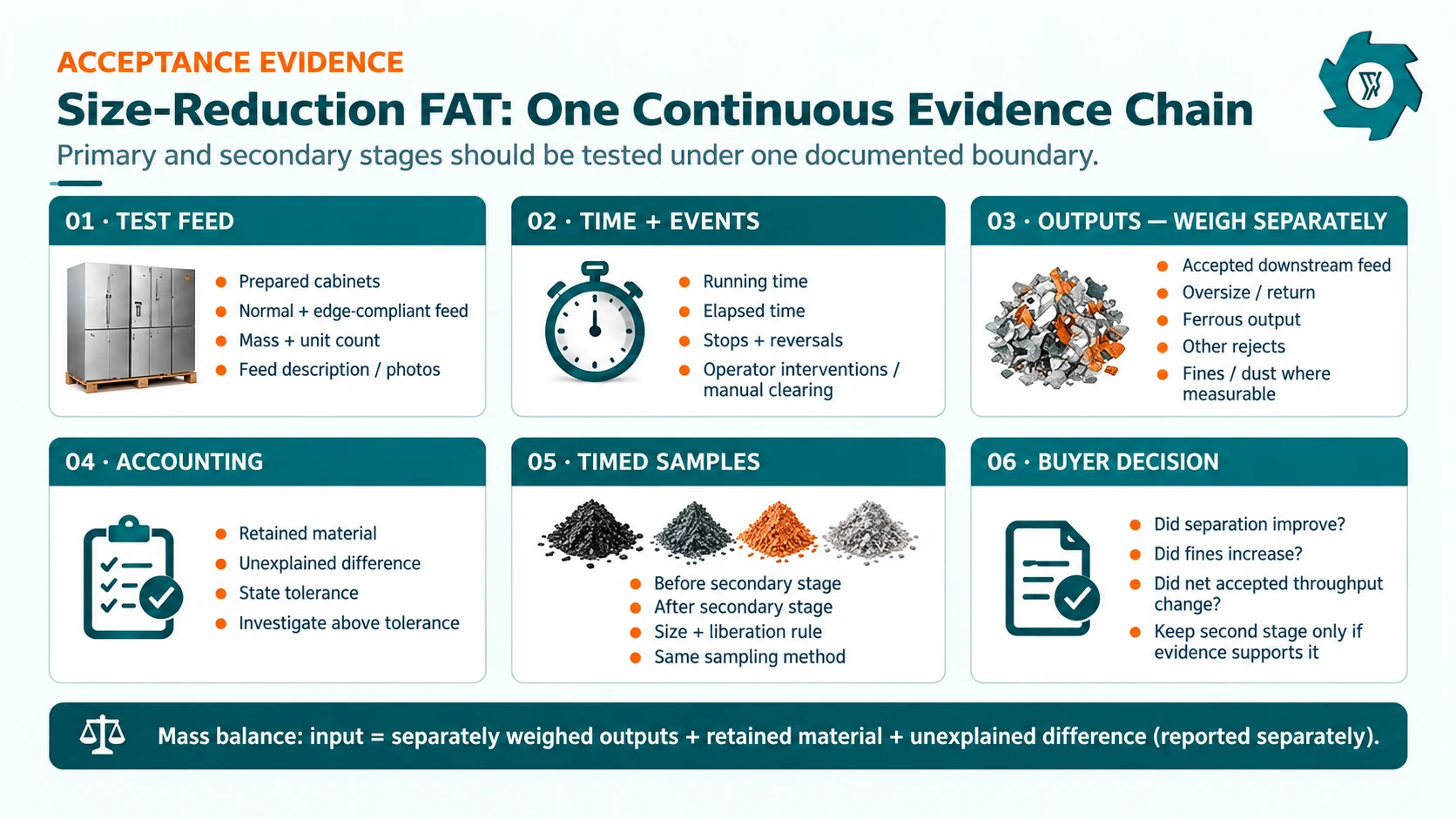
FAT should connect representative prepared feed, running and elapsed time, separate material weights, timed samples, stops, reversals and interventions under one agreed test boundary.
Use one continuous evidence chain during FAT
For the primary stage, use representative pre-treated cabinets and include the largest and hardest normal compliant feed plus an edge-compliant batch. Record input mass and unit count, running and elapsed time, reverse and stop events, operator interventions or manual clearing, the mass of material discharged to the next stage, any material removed or rejected during the test, retained material, coarse folded bundles and the condition of material entering the next machine. Reconcile the recorded masses at the end of the test and state any unexplained difference separately rather than hiding it inside another output category.
For the secondary stage, weigh the pre-shredded material entering the test boundary. Record running time and elapsed time separately. Log stops, reversals and operator interventions. Weigh accepted downstream feed, oversize or return material, ferrous removed within the boundary if applicable, other rejects, collected fines or dust when measurable, and retained material separately. Reconcile those recorded streams against the measured input and state any unexplained difference separately. Do not combine retained material with unexplained difference or use the difference as a balancing category.
Timed samples should be taken from the stream that drives the buying decision. If the concern is secondary liberation, sample both before and after the crusher under stable conditions and use the same classification rule. Record how many pieces remain composite, how much oversize is returned and whether the downstream product quality changes. If separation improves only while throughput collapses, that is not a successful setting.
The same discipline applies when suppliers are compared. A refrigerator recycling equipment manufacturer shortlist can narrow the market, but the final choice should be based on an equivalent feed definition and an equivalent acceptance test. Different test boundaries create incomparable claims.
Safety review belongs at both reduction stages
Primary and secondary machines expose workers to different operating hazards, but neither stage should depend on reaching into a machine or transfer point to restore flow. Guards, access doors, interlocks, emergency stops and isolation points need to be designed around the actual clearing and maintenance tasks. OSHA’s hazardous-energy standard requires energy-control procedures for servicing and maintenance where unexpected energization, start-up or release of stored energy could cause injury, including verification of isolation before work begins.[4]
For refrigerator material, the plant risk review also needs to consider what substances may remain in the feed and what dust is generated by breakage. EPA notes that older and newer appliances can contain different refrigerants and that some newer appliances use non-fluorinated refrigerants such as propane; site procedures therefore need a documented receiving and depollution rule rather than an assumption based on appliance appearance.[2]
A practical selection sequence for primary and secondary reduction
Define the prepared feed. State what has already been removed and which refrigerator/freezer types are permitted.
Define the primary handoff. Set the largest acceptable coarse piece, bridge-prone shapes and the next machine’s feed limit.
Sample the primary discharge. Measure composite bundles, oversize, flow stability and operator interventions.
Define the downstream separation requirement. Name the product-quality or separator problem that finer liberation is expected to solve.
Trial the secondary stage. Compare before/after liberation, accepted output, fines, recirculation, energy and interruptions under the same feed.
Do not add a second stage unless testing shows that it is actually needed. A shorter, simpler line is usually the better choice if it can consistently produce the required material fractions.
Configure the size-reduction section around your real refrigerator feed
For a useful equipment recommendation, prepare photos or video of the incoming refrigerators and freezers, the depollution condition, largest cabinet dimensions, units/hour and mass target, the downstream separation route, required product condition, workshop layout and utility constraints. Those details allow the primary shredder and any secondary crusher to be evaluated as one connected process rather than two catalog machines.
FAQ
Is a refrigerator shredder the same as a refrigerator crusher?
In the process described here, the primary shredder is a low-speed opening machine for prepared refrigerator cabinets, while the secondary crusher is a later liberation stage for already reduced material. The terms are sometimes used loosely in the market, so the RFQ should define the feed, discharge condition and job of each machine.
Do all refrigerator recycling lines need a secondary crusher?
Sometimes the material coming out of the first shredder is still too large or uneven for the separation equipment that follows. In that case, another crushing step can help. But when the first stage already produces a workable feed, extra crushing may simply mean more power, faster wear, and more fine material and dust.
What should the primary shredder prove during a factory acceptance test?
Use representative prepared cabinets and record input mass and unit count, running time, elapsed time, stops, reversals, operator interventions or manual clearing, the mass of material discharged to the next stage, any material removed or rejected during the test, retained material, coarse folded bundles and the condition of material entering the next machine. Reconcile the recorded masses and state any unexplained difference separately. The test should show stable opening and controllable discharge, not only that a cabinet can be torn apart.
What should the secondary crusher prove during a factory acceptance test?
The secondary stage should prove the agreed output condition under representative feed. Record the pre-shredded input, running and elapsed time, stops and interventions, separately weighed output and return streams, timed size or liberation samples, retained material and unexplained difference. Sampling must be tied to the downstream separation requirement.
Can smaller refrigerator scrap improve separation automatically?
Smaller particles can improve liberation when attachments remain locked together, but excessive reduction can also create more fines, foam dust and small mixed fragments. The useful target is the coarsest condition that still gives the required liberation and stable downstream sorting.
What information should I send before asking for a refrigerator shredder and crusher quotation?
Send the refrigerator and freezer mix, depollution condition, compressor status, photos and dimensions of normal and difficult units, required units per hour and mass throughput, downstream separator arrangement, desired output condition, utility limits, workshop layout and the acceptance evidence you expect to record during FAT.
David focuses on industrial shredding and recycling equipment,including material evaluation,shredder selection,process configuration,and recycling line planning.
Speak To Our Shredder Machine Expert
Get in touch with our nice team today to get a price estimate for a shredder machine.