





A Double-Shaft Shredder Fits the Primary-Opening Job
A double-shaft refrigerator shredder is a strong fit when it receives a verified, pre-treated cabinet and its job is to grip, shear and open that bulky shell into manageable pieces for the next machine. It is a poor fit when it is expected to replace depollution, make a tight one-pass particle size, perform final material liberation, or routinely swallow dense components that were never included in the approved feed.
The practical buying question is therefore not, “Can two shafts shred a refrigerator?” It is, “Does the condition leaving this machine make the next operation easier, stable and measurable?” In a complete waste refrigerator recycling line, primary shredding sits between cabinet preparation and secondary liberation. Keeping that handoff clear prevents the primary shredder from being blamed for work that belongs elsewhere.
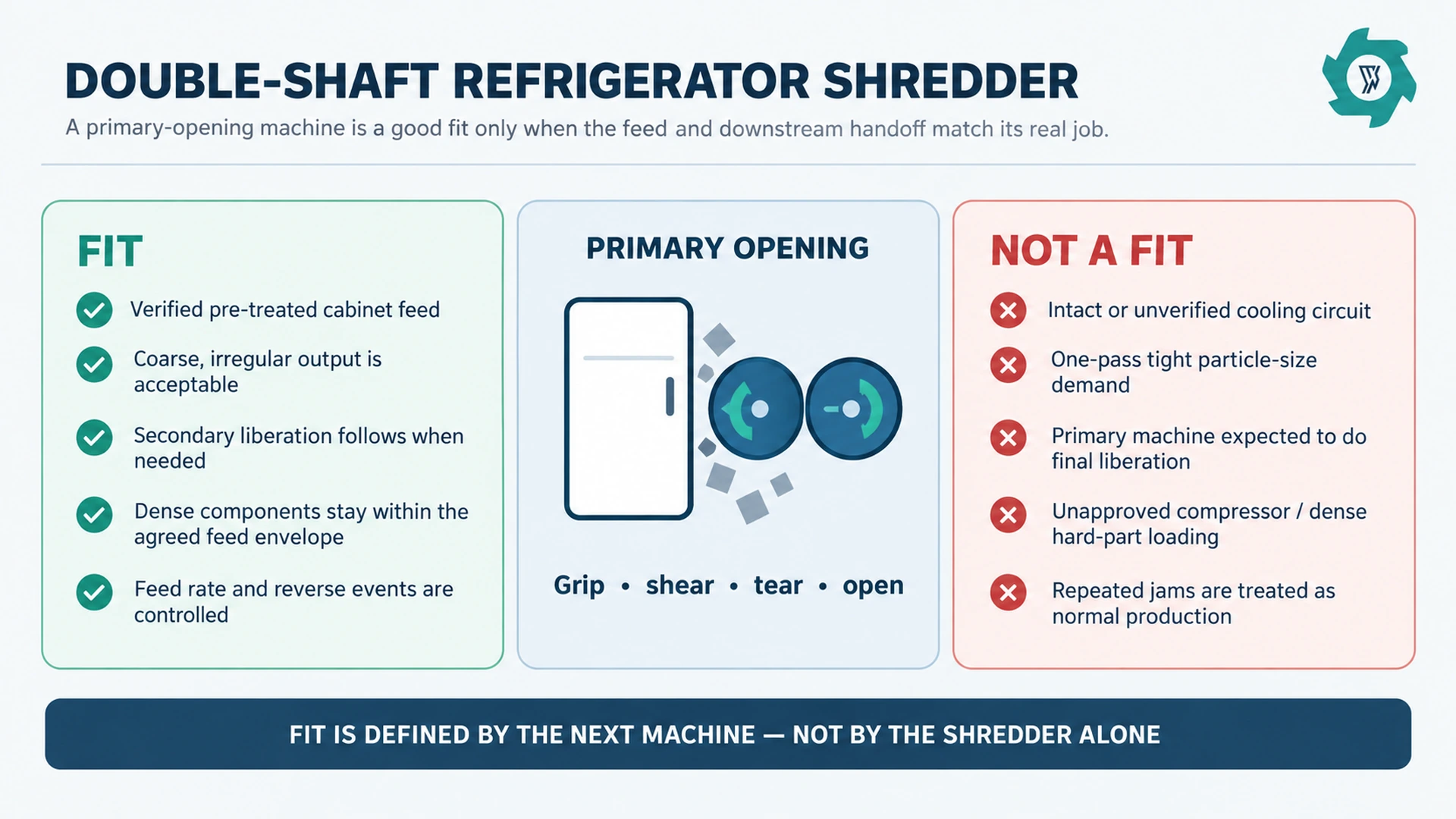
Usually a fit
Prepared refrigerator or freezer cabinets; hollow, irregular geometry; coarse primary opening; metered feed; downstream crushing or separation designed around the primary output.
Usually not a fit
Unverified cooling circuits; dense compressor-heavy loads outside the agreed feed; one-pass finished sizing; final liberation duty; a process where another stage is already the real bottleneck.
What the Two Shafts Are Actually Good At
A refrigerator cabinet is large for its mass, partly hollow, made from broad thin sheet, plastic liner and rigid insulation, and it does not arrive as a uniform bar or plate. That geometry rewards a machine that can catch edges, pull material into the chamber and apply repeated low-speed shearing.
A double-shaft metal shredder uses two counter-rotating cutter shafts. For refrigerator work, the useful performance is not a marketing claim about “crushing power.” It is the combination of bite, chamber acceptance, torque response, cutter geometry and discharge behavior on the actual cabinet mix.
Think of the machine as a shape changer. It turns a cabinet that is difficult to convey, meter and present to the next stage into smaller pieces that can travel on a conveyor and enter a secondary machine. The output will normally be less uniform than a screen-controlled fine shred. If the next machine is designed to liberate the composites, forcing the primary shredder to chase unnecessary uniformity can add residence time, wear and reversals without improving the final products.
Five Gates That Define a Credible Fit
The fastest way to decide whether two shafts belong in the process is to test five gates in order. A “no” at an early gate should not be hidden by moving to motor power, cutter alloy or throughput.
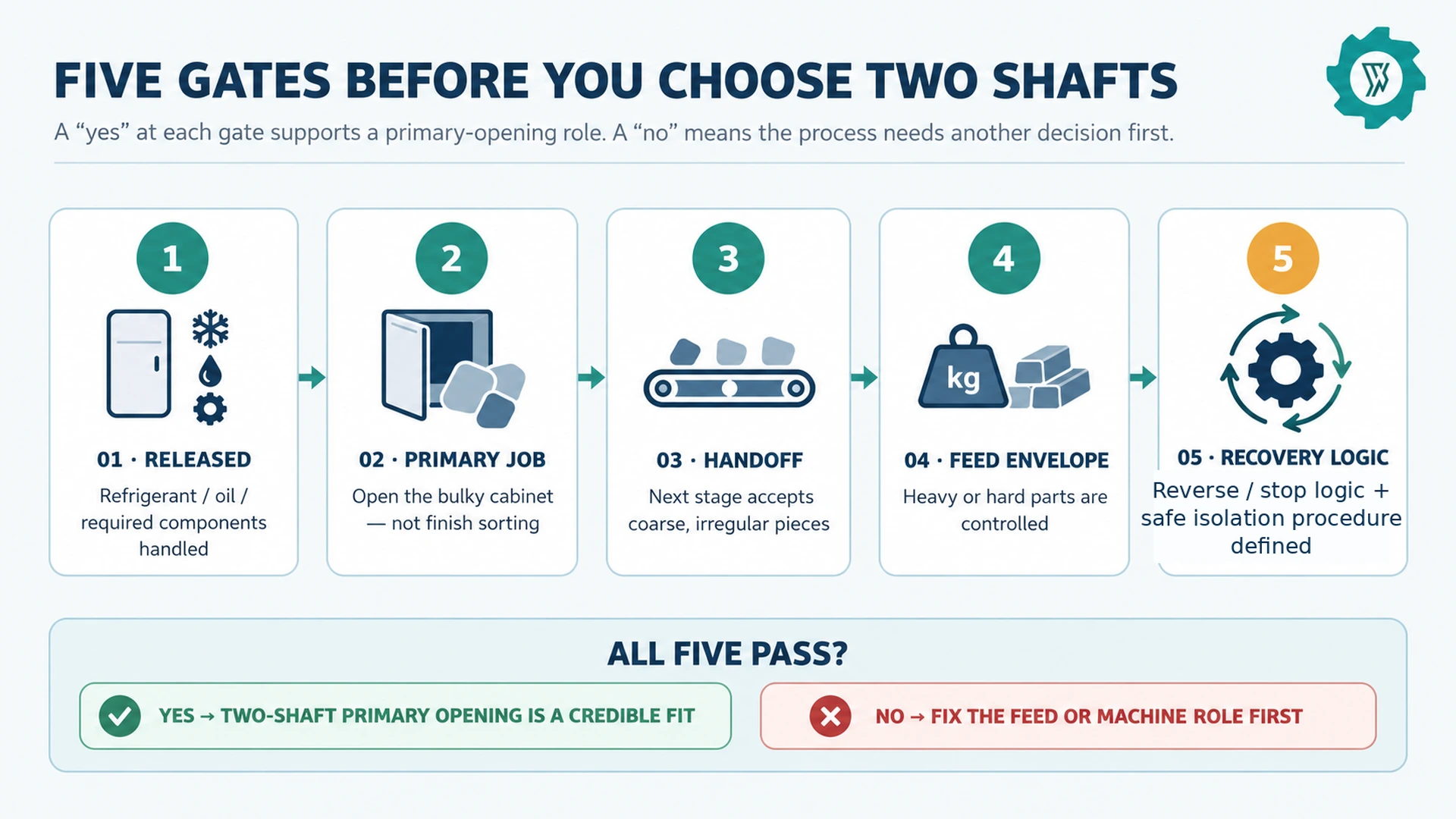
Gate 1 — Has the cabinet been released for mechanical processing?
In the United States, EPA describes refrigerated-appliance recycling as refrigerant recovery and removal of hazardous components followed by shredding of evacuated appliances.[1] The EU WEEE Directive likewise requires specified gases in refrigeration circuits and foams to be properly extracted and treated.[2] Local rules and site procedures still govern the exact release method.
For buyers who receive complete end-of-life units, the useful document is a release condition: what has been recovered, what has been removed, what may remain attached, who records the result, and what sends an appliance to quarantine. The separate guide to refrigerator depollution before shredding covers that preparation in more detail.
Gate 2 — Is the primary job opening rather than finished sizing?
If the goal is to break the bulky box shape, expose more edges and create a feed that the next conveyor can control, two shafts are doing work that suits their geometry. If the purchase specification instead says “every piece must leave below a narrow dimension in one pass,” the buyer is asking for a different kind of output control. A screen-controlled machine or dedicated secondary sizing stage may be more appropriate.
This is one of the easiest places to overspecify. A plant can spend more energy recutting material in the first machine even though the second machine still needs to perform the real liberation work.
Gate 3 — Can the downstream stage accept coarse, irregular pieces?
Measure the handoff physically. Look at maximum folded dimensions, long strips, bulk depth on the transfer conveyor and whether pieces bridge at the next chute. A broad size distribution can be perfectly workable if the secondary crusher accepts it consistently. The same output becomes a misfit if long folded sheets repeatedly hang over a narrow chute or cause unstable feeding.
The acceptance criterion should therefore be written around the next machine: “material passes the transfer and feeds continuously without routine manual intervention,” plus any project-specific maximum that the downstream manufacturer can support. That creates a testable interface.
Gate 4 — Are dense and hard components controlled?
Hinges, brackets, tubing and local reinforcements can be part of normal refrigerator construction. A compressor, a large cast component or unrelated scrap is a different duty. Do not convert “the machine can survive an occasional event” into “the event is approved continuous feed.” The feed list should separate normal construction, declared exceptions and prohibited items.
This distinction protects both production and maintenance. If dense components repeatedly trigger reverse cycles, the right response may be better receiving control or a different machine duty—not simply a more aggressive current limit.
Gate 5 — Is overload recovery observable and serviceable?
Automatic reversing is valuable because a primary shredder sees irregular loads. But a reverse event is also data. Record how often it occurs, which feed caused it, whether the material clears automatically and whether an operator intervention follows. A line that reaches its tonnage only because operators repeatedly clear the chamber is not demonstrating a stable fit.
When clearing or servicing exposes workers to hazardous energy, the site needs an energy-control procedure appropriate to the machine and task. Workplace safety guidance calls for isolating hazardous energy before servicing and guarding workers from moving parts during operation.[3][4] A supplier trial should demonstrate normal protective logic.
When a Double-Shaft Refrigerator Shredder Is the Practical Choice
Prepared household refrigerator and freezer cabinets
The cabinet has passed the required upstream checks, dense removed components follow their own route, and the shredder receives a known family of hollow composite shells. Feed variability remains—freezers can be more heavily insulated, larger units take more chamber volume, and cabinet construction changes—but the machine is still solving one coherent mechanical problem.
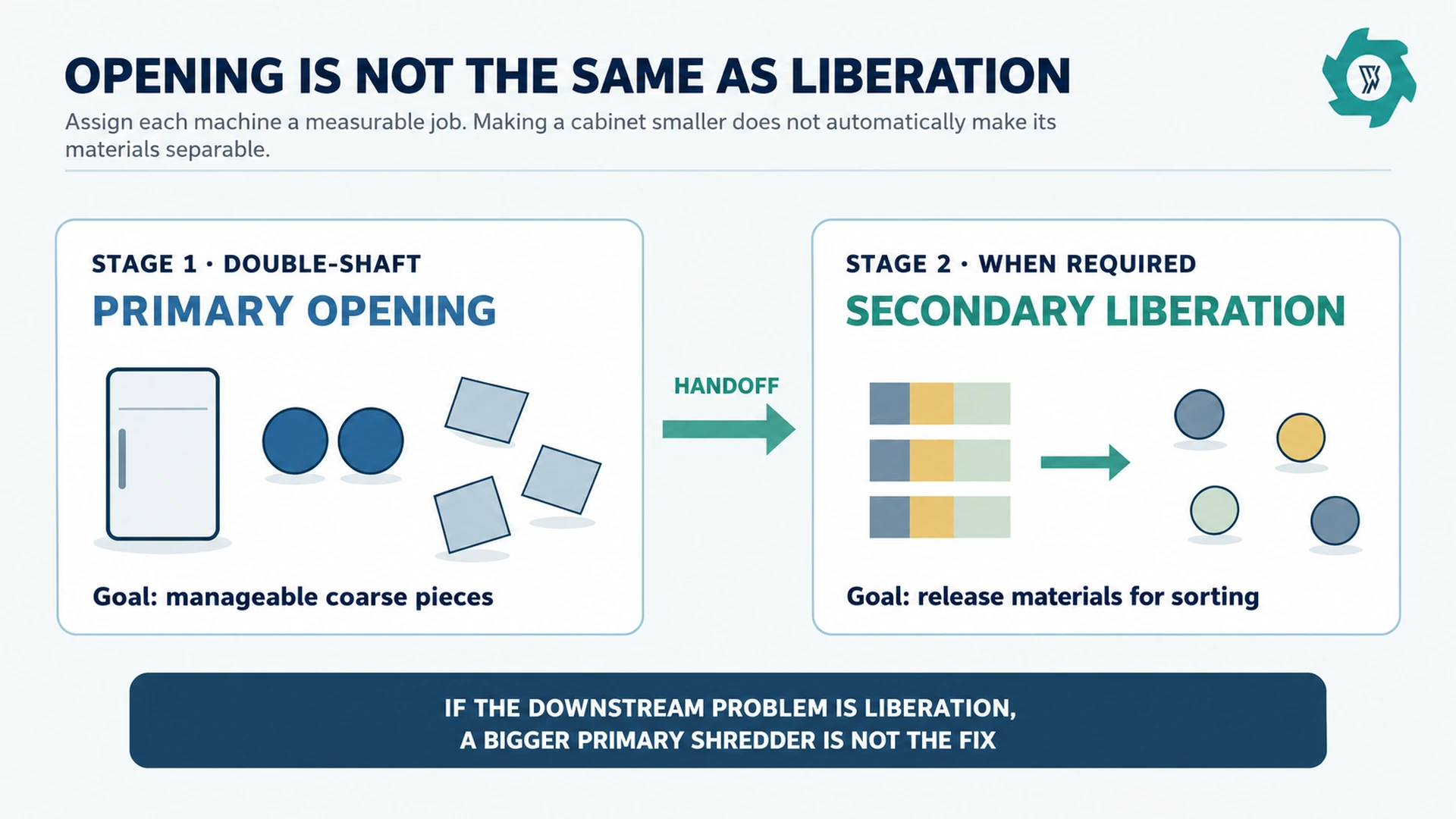
A line that deliberately separates opening from liberation
Primary opening and secondary liberation are different jobs. The first changes shape and size. The second breaks enough physical attachment between steel, liner, foam and small non-ferrous parts for downstream separation to work. The guide on improving material separation in refrigerator recycling explains why poor liberation cannot be repaired simply by adjusting a magnet or eddy-current splitter later in the line.
Projects that value tolerant feeding more than precise one-pass sizing
Bulky cabinet feed rarely presents the same edge twice. A twin-shaft arrangement is useful when the priority is to grab that changing geometry and keep the material moving into a coarse discharge. This can be a better engineering trade than forcing every fragment through a tight screen at the first stage.
The machine still needs a defined maximum cabinet size, loading orientation where relevant, permitted attached components and a controlled feed rate. The benefit comes from accepting natural cabinet variation inside that envelope.
A plant with a metered infeed and a visible downstream buffer
A shredder can only look stable when the feed is stable enough to evaluate. Dumping several cabinets into the hopper, waiting for the chamber to clear and then starving it creates large torque swings and makes the downstream burden uneven. A conveyor or other controlled feed method should pace the primary machine and prevent surges from becoming the normal operating pattern.
A small buffer after primary shredding can also decouple momentary cutter behavior from the next stage. The goal is not to hide poor performance. It is to give the downstream crusher or separator a steadier mass flow while the primary machine deals with natural piece-to-piece variation.
When It Doesn’t Fit — Even If the Machine Can Physically Shred the Cabinet
1. The feed is intact, unverified or inconsistently released
This is a process mismatch before it becomes a shredder mismatch. An intact cooling circuit, uncertain refrigerant status or uncontrolled oil/component condition should trigger the receiving rule. Do not use machine robustness as a reason to bypass the release gate.
2. The buyer wants a finished, narrow particle-size product from the primary machine
Two-shaft primary shredding is strongest when coarse reduction is acceptable. If a conveyor, screen, optical sorter or other downstream unit needs a tighter size distribution, solve that requirement deliberately. Repeatedly recutting in a primary machine can lower net throughput and raise wear while still leaving flat or elongated pieces that behave differently from compact particles.
3. The buyer expects primary shredding to equal final liberation
A cabinet piece can be “small” and still contain steel bonded to plastic and foam. If product contamination is caused by attached materials, the missing function is liberation. Adding more primary motor power will not automatically change that material relationship. Inspect the discharge and ask whether the steel, plastic liner and foam are actually separated enough for the next physical process.
4. Compressor-heavy or dense mixed scrap is treated as normal cabinet feed
A machine selected around prepared cabinets should not silently inherit a new stream of compressors, motors, castings, sealed objects or unrelated heavy scrap. Even if the chamber can pull them in, the cutter load, reverse frequency, wear pattern and downstream material balance can change sharply. Either remove those components, create a separate route, or have the supplier validate the harder feed as an explicit duty.
5. The real bottleneck is somewhere else
A larger or more aggressive primary shredder does not fix slow depollution, a saturated foam circuit, a secondary crusher that cannot liberate at the incoming rate, a separator buried under an uneven burden or product bins that cannot be changed fast enough. The refrigerator recycling plant capacity guide is useful here because it treats units per hour and mass per hour as connected line measures rather than a single shredder number.
Before upgrading the primary machine, time one complete production period and identify where material actually queues. A queue before the shredder points in one direction; a growing buffer after it points in another.
Define the Output by Its Handoff, Not by Appearance
| Handoff variable | What to inspect | Why it matters |
|---|---|---|
| Largest folded piece | Long dimension, folded geometry and frequency | May bridge chutes or exceed the next inlet even when most pieces are small. |
| Bulk behavior | Burden depth, nesting and surge tendency | Controls how steadily material reaches the secondary machine. |
| Attached material | Foam, liner and metal still bonded together | Shows whether the next step needs more liberation rather than more primary throughput. |
| Dense inclusions | Unexpected compressor pieces, castings or unrelated scrap | Reveals receiving deviations and hidden wear duty. |
| Fines created | Fine foam, dust and small fragments | Changes air handling, housekeeping and downstream classification. |
| Transfer stability | Bridging, manual clearing and feed interruption | Turns “acceptable size” into an operational test. |
The handoff view also prevents an easy mistake: choosing a smaller primary discharge just because smaller seems better. If the secondary crusher already receives the coarse pieces well, extra primary recutting may only move energy and wear upstream.
Use Reverse Events as a Fit Signal
Automatic reverse logic protects the cutter system when load rises or material resists the intended bite. A few reversals on irregular cabinet feed can be normal. What matters is the pattern. If reversals repeatedly occur with one cabinet type, one attached component or one loading method, they are telling the project team where the feed envelope is weak.
Record at least the batch ID, unit type, point in the run, number of reverse cycles, whether the machine recovered automatically, and whether material had to be removed. Pair that with cutter inspection. A rising reverse count after a known tonnage can indicate cutter-edge condition or clearance drift; a sudden spike after the feed mix changes points elsewhere.
Do not write an arbitrary “acceptable reversals per hour” into the purchase order without trial evidence. The useful limit is the one that separates stable automated recovery from repeated interventions, lost downstream feed and abnormal wear under the agreed test material.
FAT: Prove the Machine Fits the Feed, Not Just That It Turns
A factory acceptance test for this decision should be narrower than a full refrigerator-plant FAT. Its purpose is to show that the primary shredder accepts the approved cabinet feed, recovers from normal load variation and creates a workable handoff to the next stage.
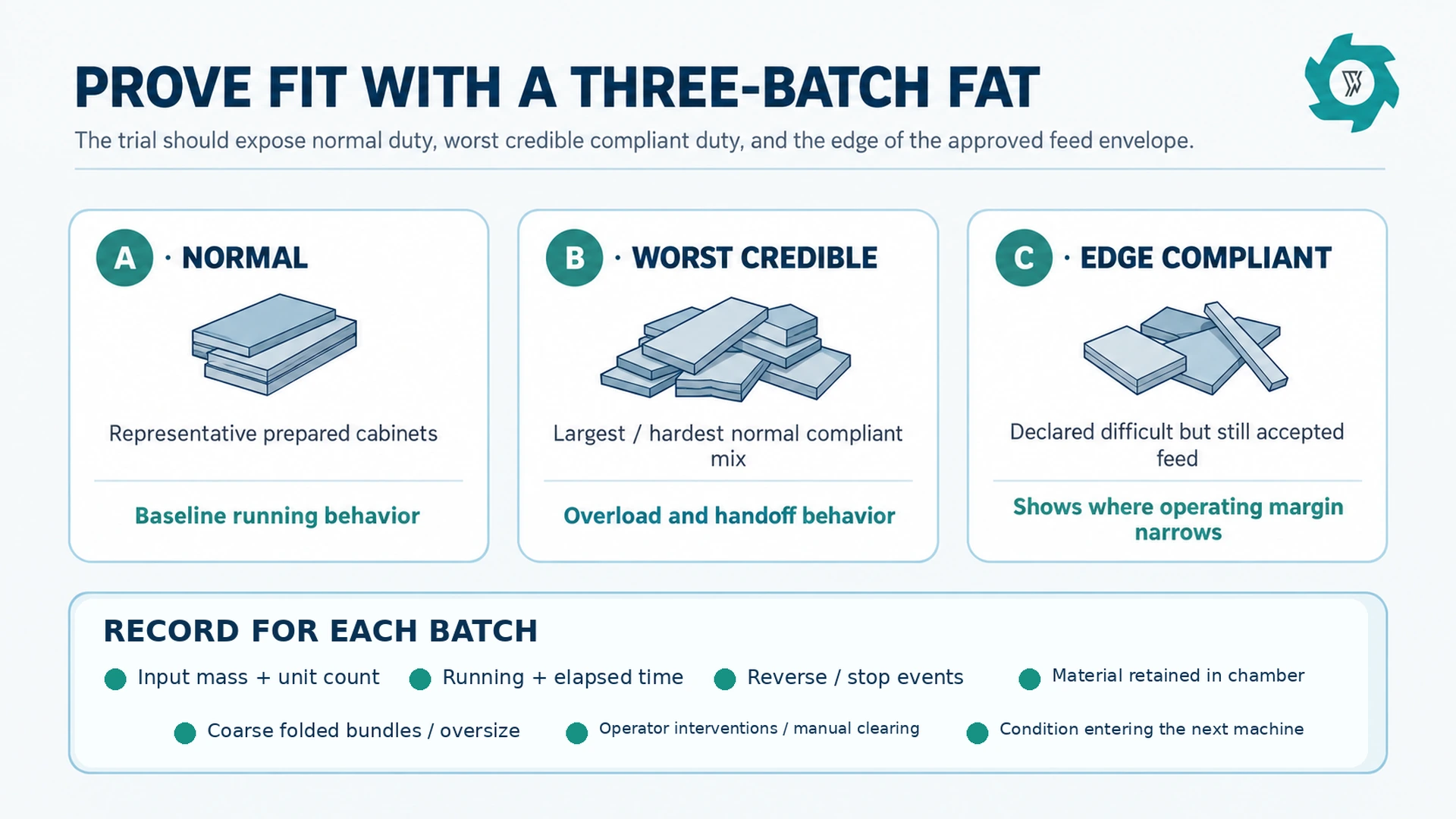
Test three feed batches
Batch A — normal: the representative prepared cabinet mix used for daily planning.
Batch B — worst credible compliant: the largest, most heavily built or most difficult cabinet type that is still expected in normal production.
Batch C — edge compliant: declared difficult feed that is still inside the approved envelope.
Record more than tonnes per hour
For each batch, record input mass, unit count, running time, elapsed time, reverse events, stoppages, operator interventions and material retained in the chamber at the end. Photograph representative discharge pieces. Then record whether the discharge moves through the transfer and enters the next machine without routine manual clearing.
If energy is measured, state the meter boundary and keep it the same for all batches. Do not mix shredder-only energy with conveyor-plus-shredder energy.
Write the failure condition before the test starts
The best FAT question is not “Did it run?” It is “What result would make us reject this machine role?” Examples include repeated non-recovering jams on compliant feed, coarse folded pieces that the agreed downstream inlet cannot accept, routine manual clearing, abnormal retained material, or a throughput claim that requires excluding normal compliant cabinets. The buyer and supplier should agree which observations require correction, retest or a change in machine selection.
Selection Mistakes That Make a Good Machine Look Bad
Comparing motor kilowatts before comparing the feed envelope
Installed power is easy to compare and hard to interpret alone. A chamber that grips the real cabinet well can outperform a higher-power machine that feeds poorly or spends more time reversing. Compare chamber geometry, cutter arrangement, gearbox/drive behavior, feed control and the test material together.
Using only the average refrigerator
The average unit rarely causes the problem. Large freezers, commercial cabinets or unusually reinforced models can control chamber acceptance and momentary torque. The machine should be tested on the upper end of the normal feed, not only the neatest sample in the supplier’s yard.
Calling every reverse event a machine defect
Reverse is a protective operating response. The defect is a pattern that prevents stable production, hides an unapproved feed, or requires frequent intervention. Keep the event log so the cause can be separated from normal automatic recovery.
Calling every separation problem a shredder problem
If the primary output feeds the next machine steadily but product purity remains poor, inspect liberation, foam removal and separator presentation before redesigning the first stage. The right diagnostic point is the first place where the material condition stops matching what the next machine needs.
A Buyer Fit/No-Fit Worksheet
| Question | YES points toward | NO means |
|---|---|---|
| Is the cabinet released for mechanical processing? | Proceed to machine fit. | Finish the upstream handling decision first. |
| Is coarse opening the primary duty? | Two shafts are a credible starting point. | Consider a sizing-controlled or different reduction duty. |
| Can the next machine accept irregular coarse pieces? | Define the handoff and test it. | Add size control or change the upstream machine role. |
| Are dense components controlled? | Validate normal construction and declared exceptions. | Separate the heavy stream or redesign for it. |
| Can automatic reversals be logged and recovered safely? | Use the data to prove stable duty. | Fix controls, access or the feed before production. |
| Does the connected line remain balanced at the requested rate? | The primary machine is contributing useful capacity. | Find the real bottleneck before buying more shredder capacity. |
Frequently Asked Questions
Can a complete refrigerator go directly into a double-shaft shredder?
Not as an unrestricted feed rule. Refrigerant and the required hazardous or unsuitable components need a documented handling route before mechanical size reduction. The machine may be able to grip an intact cabinet, but physical capability is not the same as an approved process condition.
Does a double-shaft refrigerator shredder need a screen?
A typical twin-shaft primary-opening duty is not defined by a tight screen-controlled product. Its main job is to grip, shear and open bulky cabinets. If the next process needs a narrow particle-size window, add or select a dedicated sizing or secondary reduction stage rather than assuming the primary shredder will create uniform pieces.
Will a larger motor solve repeated jams?
Not necessarily. Repeated reversals or jams can come from feed geometry, unremoved hard components, poor metering, cutter condition, chamber design or a mismatch between the requested output and the machine’s primary-opening role. Treat the event history as diagnostic evidence before increasing installed power.
Can a double-shaft shredder replace the secondary crusher?
Only when the downstream process genuinely accepts the coarse output and does not require further liberation. In many refrigerator lines, secondary crushing is used to release steel, plastic liner, foam and non-ferrous pieces before air, magnetic and eddy-current separation.
What should a buyer test before approving a double-shaft refrigerator shredder?
Use representative pre-treated cabinets, include the largest and hardest normal compliant feed, and define an edge-compliant batch. Record input mass and unit count, running and elapsed time, reverse and stop events, operator interventions or manual clearing, retained material, coarse folded bundles, and the condition of material entering the next machine.
Define the Feed Before You Size the Shredder
Send representative cabinet photos or video, maximum dimensions, preparation condition, expected unit and mass rate, difficult-but-normal feed examples, and the condition required at the next machine. YUXI can use that information to check whether a double-shaft primary shredder is a sensible fit.
Engineering References
- EPA — Appliance disposal guidance.
- European Union — WEEE treatment rules, Annex VII.
- OSHA — Hazardous energy control for servicing.
- OSHA — Machine guarding requirements.