Fridge Shredder Price: What Affects Refrigerator Shredder Cost?
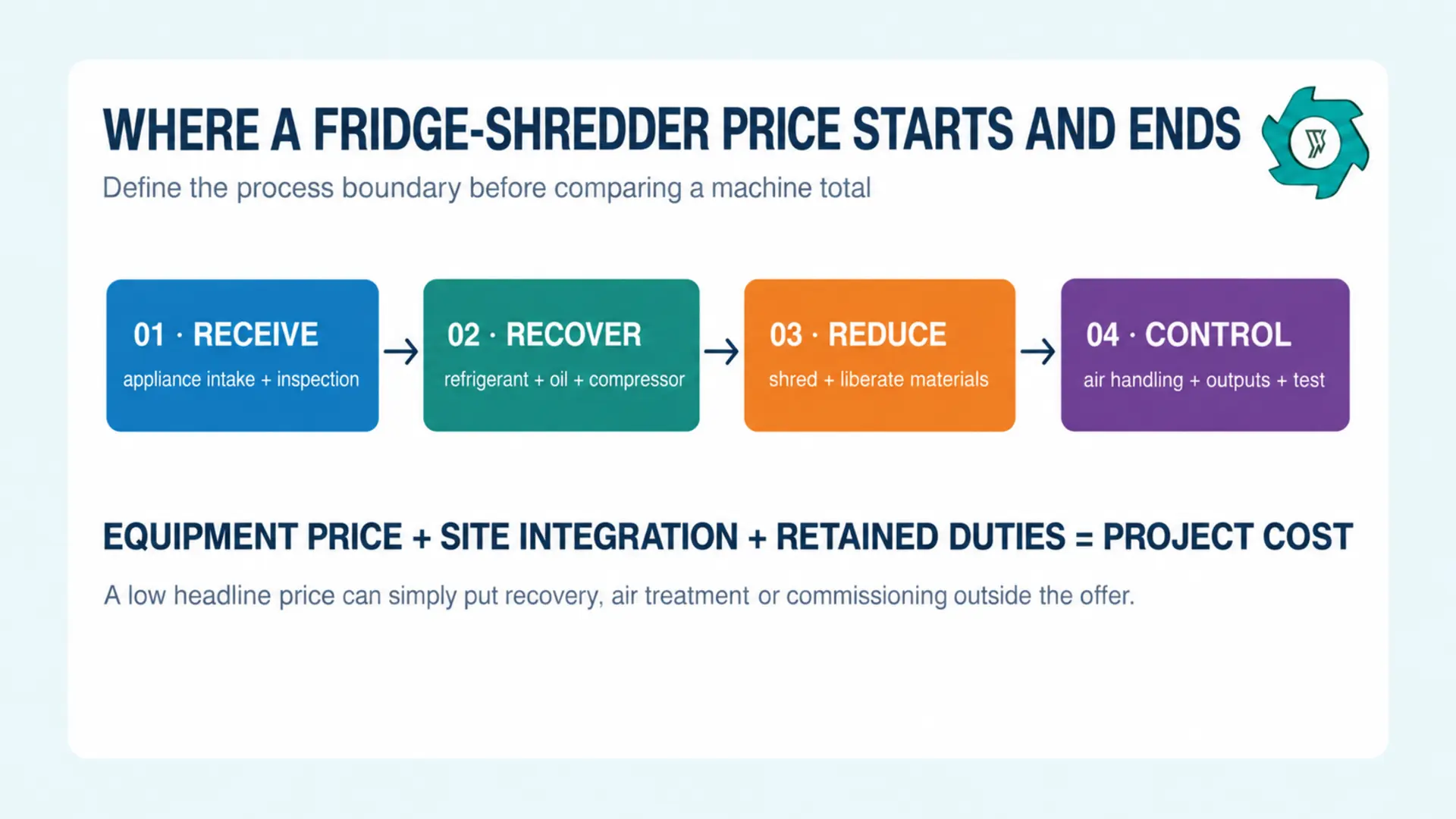
A refrigerator shredder price only becomes useful when the quotation names everything before and after the cutting chamber. This guide shows how to compare offers without mistaking an incomplete machine price for a project budget.Start the price discussion by drawing the treatment boundary, not by comparing motor power.
The useful question is not “How much is a fridge shredder?”
Buyers often receive two quotations that look several hundred thousand dollars apart, then assume one supplier is simply expensive. More often, the offers describe different jobs. One may start with already evacuated, manually stripped cabinets and end at mixed shredded material. Another may include appliance reception, refrigerant and oil recovery, compressor removal, an enclosed foam stage, dust control, magnetic separation, nonferrous separation, controls, installation and a demonstrated output test.For US projects, that first boundary matters before the machine enters the building. EPA describes appliance recycling as recovery of refrigerant and removal of hazardous components before evacuated appliances are shredded. [1] If intact refrigerators are arriving at the gate, make the recovery and recordkeeping responsibility explicit; do not leave it implied in a line item called “pre-treatment.”
What sits inside the quoted capital cost?
A quotation normally has three layers: the equipment package, the work needed to make it operate at the site, and the risks the buyer has retained. The purchase order should expose all three.
What feed condition and maximum appliance size support the stated rate?
Foam and air handling
Encapsulation, capture method, duct routing, filtration and discharge route
What is captured, where is it measured, and what remains in the foam fraction?
Separation and product handling
Required ferrous, nonferrous and plastic quality; return material
Which output streams are separately conveyed, sampled and weighed?
Controls and safety
Interlocks, gas detection, fire protection interface, local code basis
Which devices and documents are included at the stated price?
Six factors that move a refrigerator shredder price
1. Feed condition changes the whole plant
State whether the equipment receives intact cooling appliances, units drained off-line, cabinets with compressors removed, or already depolluted shells. Give a representative mix by height, width, mass, age, door configuration and contamination. The upper-bound cabinet matters as much as the average. A quote built around thin, pre-stripped domestic units can look attractive until commercial cabinets, loose glass, shelves or nonconforming loads arrive.The broader waste refrigerator recycling line shows why a refrigerator is a multi-material feed, not a simple steel object. The price consequence is practical: every material that must be recovered, contained or routed has an equipment, labor or compliance cost.
2. Required environmental boundary
Price climbs sharply when the line must treat refrigerant and foam blowing agents as a controlled process rather than as a handling issue. Refrigerators entering the line may contain refrigerant, compressor oil and insulation foam, so the recovery method, containment boundary and monitoring points should be stated in the quotation. For projects in Europe, confirm the applicable national WEEE requirements and the treatment standard accepted by the local authority before fixing the foam-handling scope. In every market, ask the bidder to identify what is captured, where it is measured and who is responsible for the downstream route. Those choices can affect enclosures, ductwork, monitoring points, discharge treatment, maintenance access and operator procedures.
3. Throughput means verified net rate, not a nameplate number
Ask for appliances/hour and tonnes/hour, then attach the feed mix, operating window and stoppage assumptions. A line may process a high count of light domestic units while delivering a much lower mass rate on larger cabinets. It may also quote cutting-chamber capacity instead of saleable-output rate. The cost of a larger rotor, drive, conveyor and separation train should be assessed against a timed trial using your expected mix.
4. Product specification drives separation cost
A ferrous-only recovery arrangement, an eddy-current train, and a line designed to make a controlled plastic fraction do not have the same price. A buyer should not purchase every separation stage by default; the right question is whether the expected product value and downstream buyer specification pay for it. Define residual metal tolerance, particle-size distribution, foam carryover, moisture and sampling method before comparing options. For the material logic behind that decision, see the guide to refrigerator shredder machine types and specifications.
5. Automation changes labor exposure and uptime exposure
Manual pre-treatment can reduce initial capital but transfers cost into staffing, ergonomics, supervision and inconsistent preparation. Automated stations may cost more upfront, yet can make recovery records and feed pacing more repeatable. There is no universal winner. Compare labor by shift, planned uptime, changeover, quality checks and stoppages.
6. Site integration is often the budget surprise
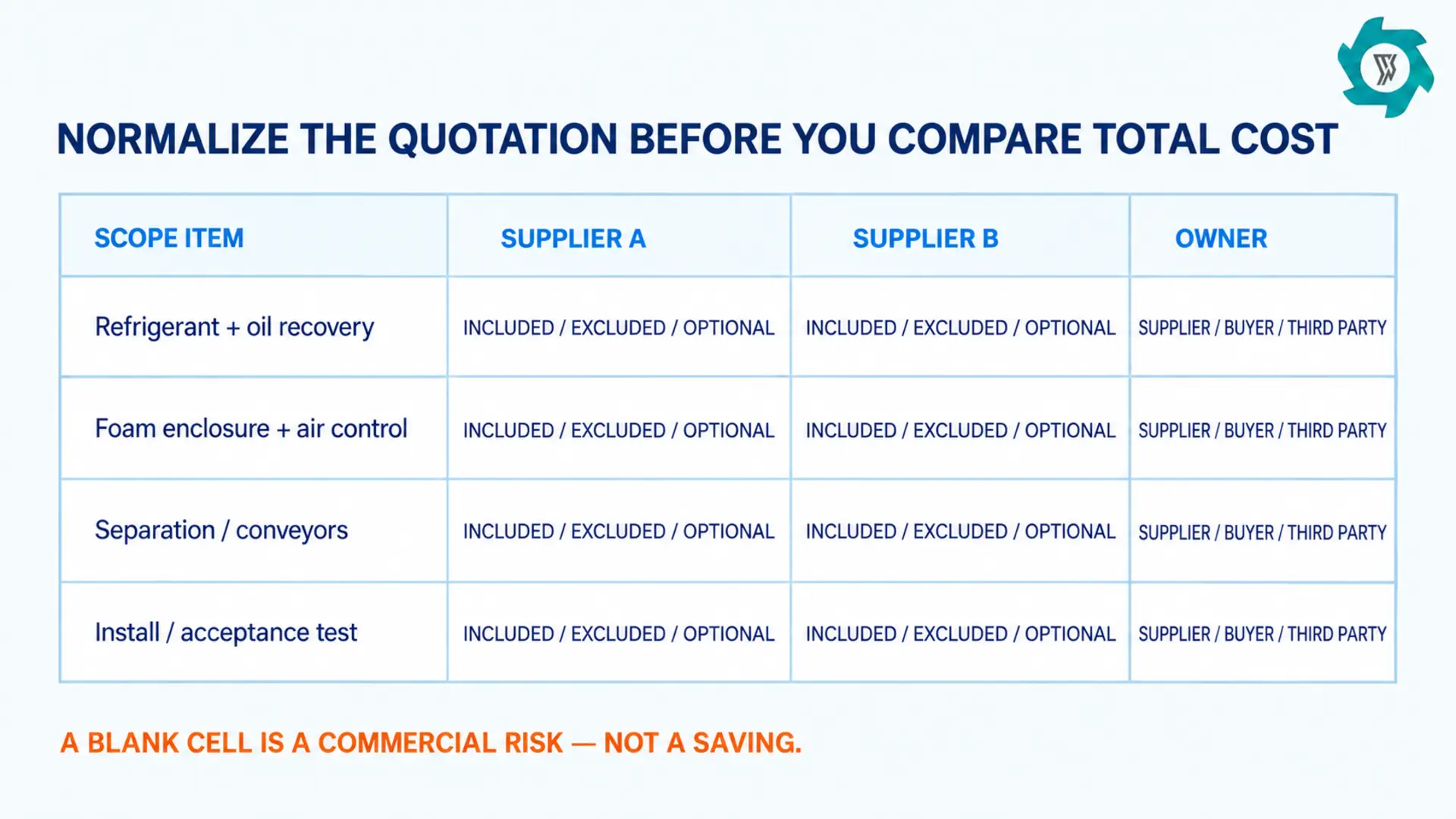
Foundations, crane access, power distribution, ventilation routing, fire interface, compressed air, loading clearances and export packaging can be larger than expected. In a retrofit, the price of rerouting ducts or creating maintenance clearance can dwarf a small machine upgrade. Ask suppliers to separate equipment EXW/FOB value from shipping, civil works, installation, commissioning and local-code work. That makes retained scope visible.Normalize scope before comparing totals. A blank cell is a commercial risk, not a saving.
Build a like-for-like quote sheet before asking for a number
When shortlisting refrigerator recycling equipment manufacturers, use the same scope checklist for every supplier so their quotations can be compared on equal terms. Require every bidder to mark each item as included, excluded, optional, supplied by buyer, or supplied by third party. Do not accept “included where necessary.” It makes it impossible to establish who owns the interface when the line is installed.
Feed specification, maximum envelope, representative mass mix and prohibited materials.
Depollution duties, recovery equipment, storage and records.
Every process module from infeed through final discharge.
Enclosure, air extraction, filtration, monitoring and waste route.
Output streams: ferrous, nonferrous where applicable, plastics, foam, dust, rejects and retained material.
Electrical scope, controls, guarding, manuals, spares, FAT/SAT and training.
Freight terms, installation duration, commissioning days, warranty response and exclusions.
Use a separate column for “interface owner.” For example, the line supplier may provide a duct connection flange while the buyer provides the building ductwork and fan.Before issuing the RFQ, review the refrigerator shredder selection guide to define the feed condition, machine configuration and performance requirements that each supplier must address in the quotation.
Do not turn a project estimate into a false price range
Published refrigerator-line price claims are frequently unsuitable for an investment decision because their boundary is unclear. A number may exclude land, buildings, utilities, depollution, encapsulation, discharge treatment and installation. Currency, year, shipping terms and throughput can also be missing. Treat online figures only as a signal that you need a structured budget—not as a benchmark against a scoped proposal.Instead, request a cost model with separate lines for equipment, freight, erection, utilities, civil work, commissioning spares, annual wear items, labor, consumables, energy and disposal. This lets the team test the economics under its own feed contract and product offtake assumptions.
Lifecycle cost: the cheaper line can be the more expensive choice
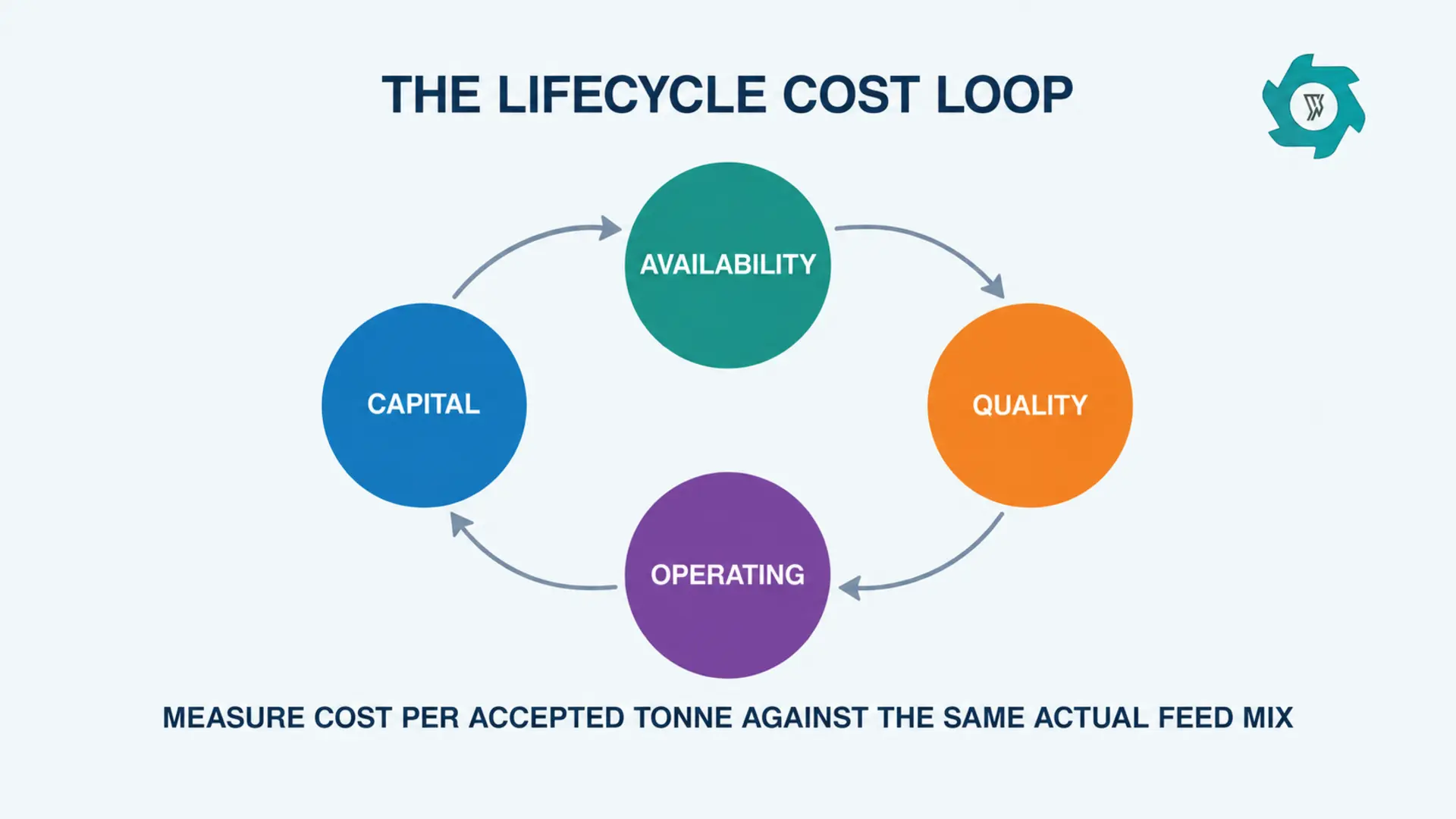
Capital price is paid once; poor availability, premature wear and weak product quality repeat every shift. The operating model should include labor by role, kWh per measured tonne, cutter and screen replacement, filter media, lubrication, planned cleaning, unplanned stoppage, material disposal, yield loss and stockpile handling. Record these against the actual feed type. A product-quality problem caused by foam carryover or inconsistent liberation can reduce revenue and increase disposal cost.Dust and foam handling also deserve their own operating line. OSHA notes that finely divided combustible material can burn rapidly when suspended in air under the right conditions. [2] The applicable hazard assessment and controls are site-specific, but a quotation should state the process-air design basis and what inspection, cleaning and maintenance work it assumes.Measure cost per accepted tonne alongside output quality and availability; otherwise the cheapest purchase order can hide the most expensive operating model.
Make the supplier prove the price with an acceptance test
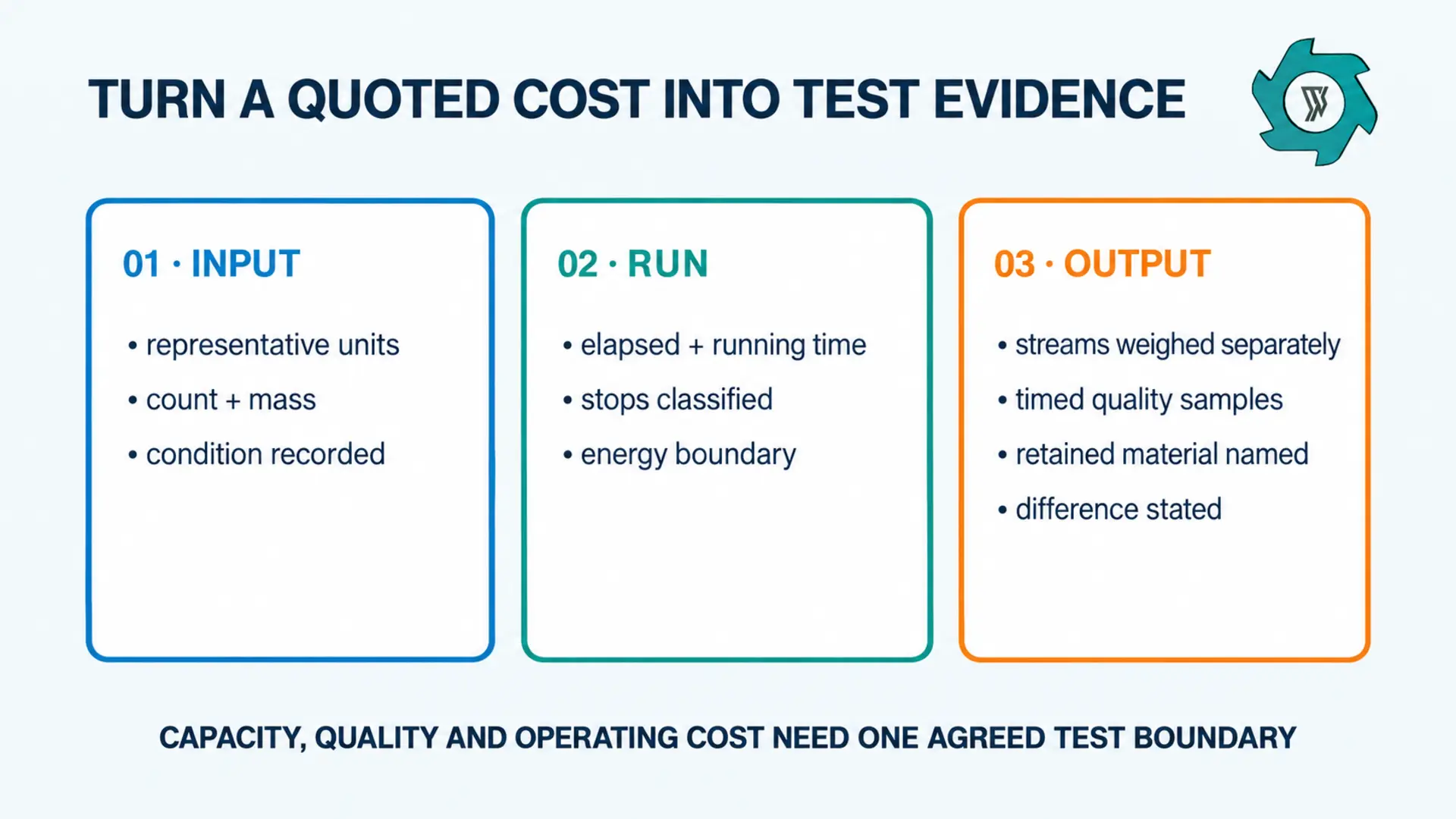
A good price is not proven by a smooth empty run. It is proven at an agreed test boundary. Before order placement, write the test method: input condition; sampled appliance mix; test duration; count and mass of feed; definition of running time; stoppage classification; energy boundary; and separate destination for every output stream.Weigh input, accepted ferrous product, nonferrous product where present, plastics where claimed, foam/dust fraction, oversize or return, other rejects and retained material separately. Then state unexplained difference separately rather than burying it in “loss.” The buyer should also know which streams receive timed quality samples and which data support the product claims. This discipline is particularly useful when comparing a highly automated design with a lower-capital line that relies on manual intervention.A test record turns quoted capacity, quality and energy assumptions into auditable cost inputs.
A practical RFQ decision rule
Reject any offer that cannot answer four questions in writing: What feed condition is assumed? What treatment boundary is included? What outputs and quality are promised? What site work and operating obligations remain with the buyer? Once those four are aligned, compare total installed cost and the cost per accepted tonne.A refrigerator recycling investment earns confidence when its cost model is tied to actual feed, actual environmental duties and measurable outputs. That is the point at which a supplier quotation becomes a project decision.
Use a three-number budget instead of one headline total
For an approval meeting, split the investment into three numbers.
The first is supplied-equipment value: machinery and vendor-supplied controls delivered at the agreed commercial term.
The second is installed project cost: supplied equipment plus freight, import costs where applicable, foundations, utilities, erection, local safety work, commissioning and training.
The third is first-year cash requirement: installed project cost plus working capital, opening spare-parts inventory, operator ramp-up, disposal contracts and the expected cost of lower availability during commissioning.
This format is more useful than an artificial universal price range because it reveals which number the finance team is approving. It also prevents a common error: comparing an equipment-only export quotation to a turnkey offer and calling the difference a supplier margin.
Budget layer
Include
Decision it supports
Supplied equipment
Process modules, controls, vendor-supplied spares and test scope
Can the technical package meet the specified feed and outputs?
Installed project
Equipment plus site work, logistics, connections, installation and startup
Can the site complete the project within the approved capital envelope?
First-year cash
Installed project plus ramp-up labor, consumables, outlet/disposal costs and contingency
Can the business carry the first operating year while stable production is established?
Cost red flags that should change the bid review
Some quotation language is useful only when backed by a drawing, a data sheet or a test definition. Treat the following as a reason to request clarification—not as a reason to reject a supplier automatically.
“Capacity up to …” with no appliance mix, timed period, stoppage rule or net-output definition.
“Environmental system included” without stating the enclosure boundary, air path, monitored point, filter/change-out responsibility and discharge route.
“Automatic depollution” without a cycle-time statement, rejected-unit route, refrigerant/oil containers and recovery record method.
“High purity output” without a named fraction, sample method, test mass or buyer acceptance criterion.
“Installation excluded” without an interface drawing that assigns power, duct, drain, controls and structural responsibilities.
“Lifetime support” without a wear-parts list, recommended stock, lead times and a response process for a production stop.
Two cost scenarios that should never be compared as equivalents
Scenario A: depolluted cabinet processing
A recycler may receive cabinets that have already been evacuated and stripped under a documented upstream process. Its equipment scope can be focused on controlled feeding, size reduction, metal separation, fractions handling and safety around the mechanical process. The commercial risk is not zero: the buyer still needs a verified incoming-control method so nonconforming intact appliances do not enter the cutting system.
Scenario B: intact refrigerator treatment
A plant accepting intact refrigerators takes on a broader operational boundary: inspection, recovery, compressor/oil work, container handling, controlled foam treatment where required, air management, operator procedures and records. Its cost structure can be higher even if the shredder itself is similar. The appropriate question is whether the site is paid for those duties through gate fees, compliance contracts, product value or a combination of them.
Add a sensitivity check before selecting capacity
Capacity is normally treated as a fixed demand figure. In practice, the relevant question is how much downtime and feed variation the project can absorb. Use three cases: conservative, expected and difficult-feed. Keep the equipment configuration constant, then change only the assumptions that matter: appliances per tonne, preparation quality, planned availability, unplanned stop allowance, material value and reject/disposal cost.A simple decision measure is contribution per operating hour: accepted product revenue plus processing/service revenue, less energy, direct labor, consumables, wear, disposal and other variable cost. Divide the installed project cost by the annual contribution under each case to see whether the selected capacity survives a weak-but-plausible operating year. This is not a promise of payback; it is a disciplined way to test whether the quotation depends on one optimistic assumption.
Minimum bid data pack
Ask every bidder to price from the same one-page data pack: monthly volume; shift pattern; appliance dimensions; intact/depolluted split; representative photographs; inbound contamination; required outputs; local utilities; available footprint; applicable permits; test requirements; and which party owns installation and air-handling interfaces. Attach the data pack to any final commercial offer. It turns future scope changes into visible changes rather than arguments about what was originally assumed.
Frequently Asked Questions
What information should I send for a refrigerator shredder quote?
Send photos, maximum and typical appliance dimensions, average and upper-bound mass, intact or depolluted condition, expected hourly and annual volume, target outputs, utilities, site layout and the responsibilities you expect the supplier to include.
Why do refrigerator recycling line prices vary so much?
They vary because offers may include very different boundaries: manual or automated depollution, foam containment, air treatment, separation stages, installation, controls, safety systems and performance testing.
Is a shredder quotation enough for intact refrigerators?
No. Intact refrigerators need an agreed recovery and handling process for refrigerant and other components before any cutting stage. Confirm the regulatory and operational responsibilities for your location.
Need a Refrigerator Recycling Line Quote?
Send your appliance photos, intact or depolluted feed condition, target throughput, required output fractions and site layout. We can review the equipment scope and installation interfaces for your refrigerator recycling project.
David focuses on industrial shredding and recycling equipment,including material evaluation,shredder selection,process configuration,and recycling line planning.
Speak To Our Shredder Machine Expert
Get in touch with our nice team today to get a price estimate for a shredder machine.

 English



 Fast Delivery
 Reliable
 Certified
 Experienced