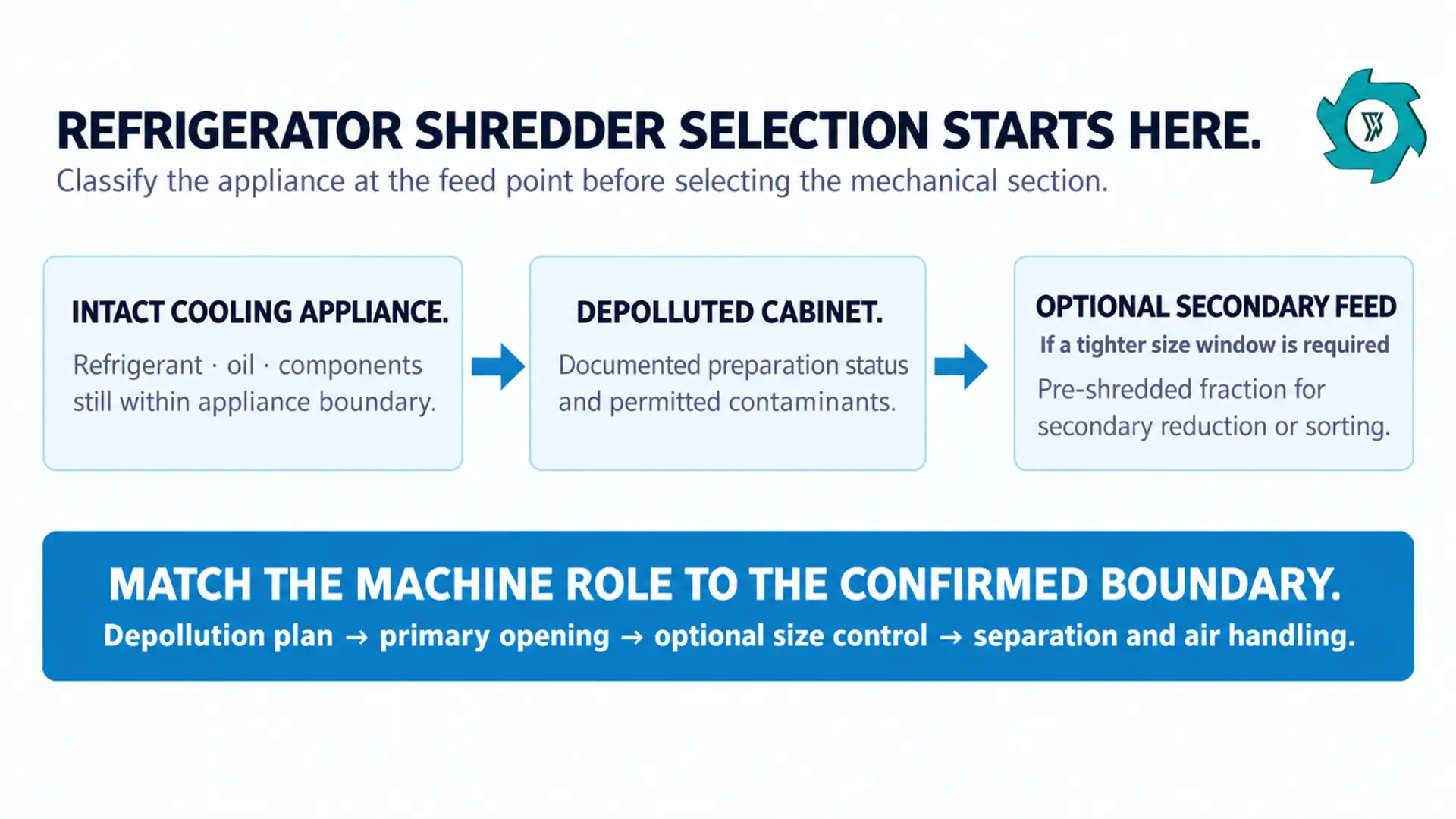
A refrigerator shredder machine is not selected by motor power alone. The useful choice starts with the appliance condition at the feed point, then works backward from the material routes and environmental controls the project must prove.For intact refrigerators and freezers, a shredder belongs downstream of refrigerant recovery, oil handling and any required component removal. For drained, depolluted cabinets, the mechanical section can be the main project scope. The distinction changes the equipment list, safety design and the meaning of the capacity quoted.Select the process boundary before comparing machines.
Start with the real feed, not the word “refrigerator”
“Refrigerator” can mean an intact domestic unit, a manually drained cabinet, a compressor-removed shell, commercial display equipment, or a mixed white-goods load. These materials do not impose the same duty. An offer should name the permitted feed condition, maximum external dimensions, average and upper-bound unit mass, and the prohibited items. Do not assume that an appliance which fits the hopper is suitable for the cutter chamber.U.S. disposal rules require refrigerant recovery before disposal of appliances, while EPA’s Responsible Appliance Disposal guidance also addresses oil, mercury and other components. The practical implication is simple: do not use a shredding quotation as a substitute for a documented depollution boundary. See EPA’s appliance-disposal requirements1 before defining the receiving procedure.
Stable opening and coarse size reduction; overload response; manageable discharge
A complete refrigerator treatment line
Hydraulic twin-shaft shredder
Prepared appliance shells with variable wall thickness or intermittent hard spots
Torque reserve, controlled feed and recovery from a jam under the agreed feed envelope
Permission to feed intact cooling appliances
Secondary crusher or granulator
Pre-shredded, liberated fractions needing a tighter downstream size window
Screen-defined output and stable feed to separation
A replacement for primary opening of whole cabinets
A double-shaft shredder is generally the mechanical starting point for prepared cabinet bodies when coarse opening is enough for the downstream line. A hydraulic version can be appropriate where feed resistance is less predictable, but the proposal still needs to state how the machine limits torque, reverses, and records overload events. A hydraulic shredder should be judged by that duty evidence, not by a generic claim that it handles “heavy scrap.”Where cabinets arrive with uncertain preparation or bulky attachments, the receiving rule should be aligned with the permitted feed limits for an industrial shredder guide. If the project also needs to recover non-ferrous fractions after size reduction, define the particle-size window and transfer conditions for the eddy current separator before selecting the secondary stage.
Specifications that belong in the RFQ
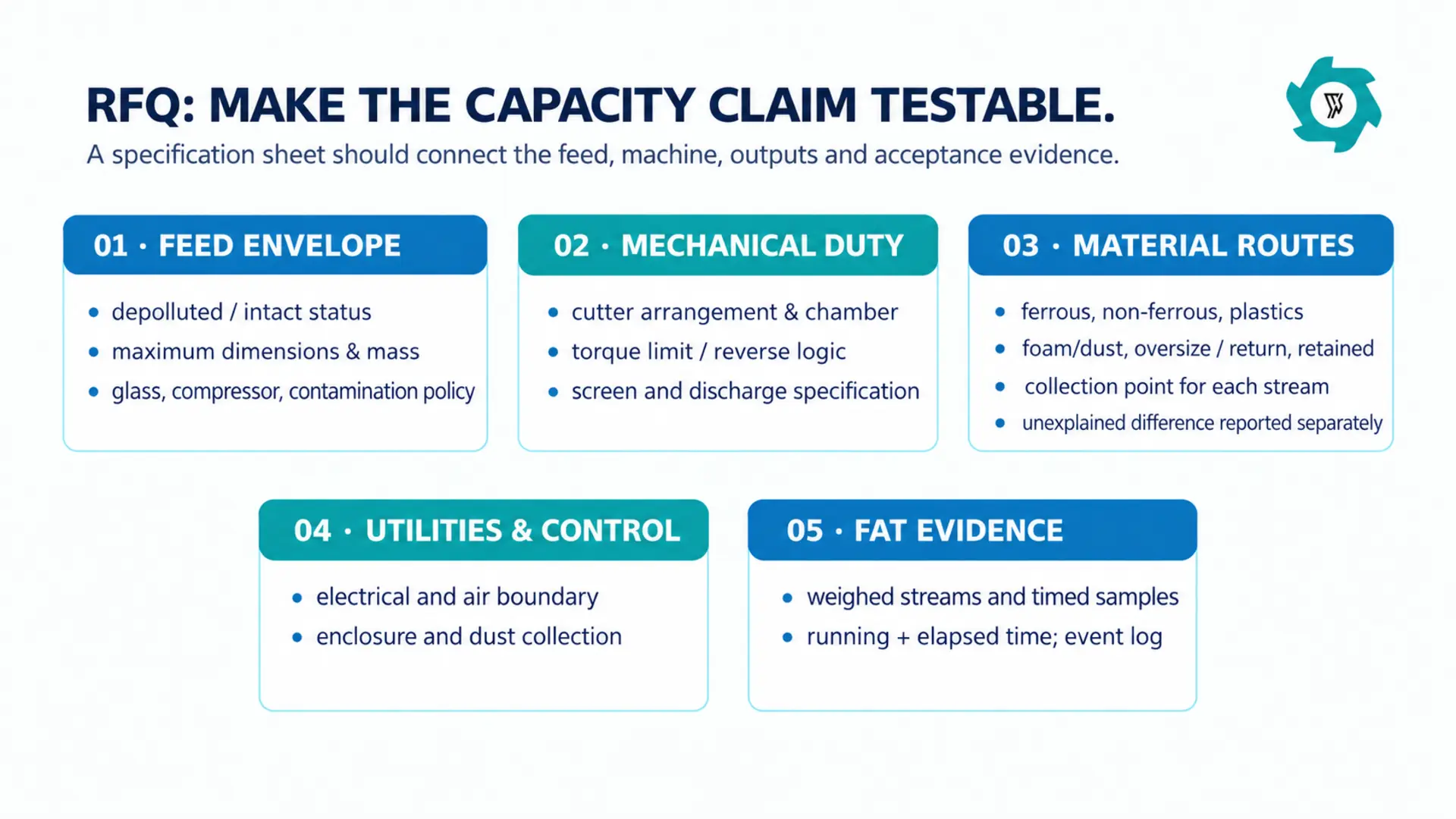
The most useful specification sheet defines what enters, what leaves, and the conditions under which the supplier’s number applies.Each capacity claim needs a feed condition and an evidence boundary.
Feed envelope: intact or depolluted status, permitted appliance types, maximum dimensions, contamination limit, compressor status, glass policy and prohibited materials.
Mechanical duty: rotor or shaft arrangement, cutter material and thickness, counter-knife arrangement, chamber dimensions, screen where used, drive power, torque limit and automatic reverse logic.
Material routes: ferrous, non-ferrous, plastics, foam/dust, oversize or return, and any retained material. Name where each route is collected.
Air and dust boundary: enclosure, pickup points, filtration, foam collection and the declared treatment route for collected material.
Acceptance evidence: weighed input and separately weighed outputs, running time and elapsed time, stops/reversals, energy-meter boundary, size samples and residual-metal checks where relevant.
Ask for the machine’s net installed power and the measuring point for kWh, but avoid treating either as a promise of energy per tonne. Feed density, appliance mix, cleaning interventions and recirculation can move the observed number materially.
Add a feed-uncertainty code to every quotation
Capacity disputes usually begin before commissioning: one side pictured uniform, drained household cabinets; the other delivered mixed units with unknown preparation, broken glass and occasional hard components. It is not a safety classification or a substitute for local compliance; it is a commercial control for comparing like with like.
Buyer-defined code
Feed condition
What the supplier must confirm
R0 · prepared
Depolluted cabinets, known maximum size, components removed as agreed
Throughput, cutter duty and output on this defined base case
R1 · variable prepared
Prepared cabinets with normal cosmetic damage and a declared outlier range
How feed rate is controlled and which events trigger automatic reverse
R2 · uncertain receiving
Unknown preparation records or mixed appliance types awaiting inspection
Receiving quarantine, inspection method and what may not enter the shredder
R3 · intact cooling appliances
Cooling circuit and insulation boundary still present
Separate depollution scope before mechanical processing; do not quote as cabinet-shredder feed
Put the selected code beside every t/h or units/h figure. If a supplier needs an R0 test to support its offer, do not use that number to plan an R2 receiving operation.
Turn receiving inspection into a machine-protection tool
A good shredder specification begins one conveyor upstream. The receiving station does not need to become a slow, exhaustive dismantling operation, but it should make the non-routine items visible before they reach the cutter chamber. The record should be concise: appliance type, preparation status, obvious glass breakage, compressor condition where relevant, loose shelves or trays, visible foreign metal, and any reason for quarantine. A photo of the batch at receipt is often more helpful during a later FAT discussion than a generic feed description.
Define three destinations at the inspection point.
Accept means the unit matches the agreed feed code and can enter the normal queue.
Hold for preparation means the unit may be processed after a documented step such as removing a loose part or confirming its depollution status.
Quarantine means it is outside the machine’s permitted boundary and cannot be pushed through merely to protect the shift target.
The supplier should identify the physical location and handling method for all three. Without that step, “exceptional” pieces tend to accumulate beside the infeed and eventually enter without a decision.
Ask one further question: which inspection findings are logged as feed quality, and which are logged as a shredder event? For example, an unapproved hard object found before the hopper is a receiving deviation. A normal, permitted cabinet that repeatedly causes overload is a machine-duty observation.
Specify cutter duty as an evidence package
Knife thickness, shaft diameter and drive power are only inputs to a cutter-duty decision; none alone tells a buyer how the machine will behave after months of cabinet processing. The RFQ should ask the supplier to explain the complete cutting system: cutter geometry, fixed-knife arrangement, material grade or hardfacing where offered, knife mounting method, recommended clearance check, access method, and the stated rule for rotation, reconditioning or replacement.A practical comparison asks for evidence per maintenance event. Have the supplier state the feed code, cumulative tonnes or units, observed wear condition, number of reversals, foreign-material events and the work carried out. A cabinet feed with occasional loose steel or unremoved hardware may not wear like a clean prepared shell, even if the average tonnes per hour are identical. The buyer can then evaluate whether the proposed arrangement is tolerant of the actual receiving practice.
Ask for
Why it matters during selection
Evidence to request
Knife access sequence
A design that requires excessive disassembly can turn a routine inspection into unplanned downtime.
Annotated maintenance drawing and isolation steps.
Clearance-control method
Cut quality and heat generation can change when the cutting relationship drifts.
Adjustment method, inspection interval and acceptance limit stated by the supplier.
Overload history logic
Frequent automatic reverse may protect the machine but also hide an unsuitable feed condition.
PLC event list showing torque, reverse count, duration and operator reset.
Wear decision rule
“Replace when worn” is not a maintenance plan.
Photographic examples or written criteria for rotate, recondition and replace decisions.
The point is to make the maintenance burden observable. It also helps the buyer allocate spares rationally: a critical cutter set, fasteners, wear plates or screens may be worth stocking when the lead time can stop the whole line.
Define the handoff between the shredder and the rest of the line
Many refrigerator projects fail at interfaces, not in the headline machine. The shredder supplier, conveyor supplier, air-handling package and separation equipment can each be correct inside their own drawings while the transfer points still bridge, leak dust or make sampling impossible. Put the following handoffs into the layout review before purchase order:
Infeed handoff: conveyor width, sidewall height, permitted accumulation, feed-rate control, inspection access and the point at which the machine assumes custody of the appliance.
Discharge handoff: chute geometry, fall height, conveyor loading, the maximum permitted piece size, and access for clearing an abnormal but permitted obstruction.
Air handoff: enclosure connection points, expected pickup zones, duct ownership, fan and filter boundary, and how foam or dust collection is isolated for weighing.
Controls handoff: common emergency-stop philosophy, run permissives, fault ownership, upstream/downstream interlocks, and the event data that the plant historian or operator screen must retain.
Sampling handoff: a safe, repeatable place to take timed increments without leaning into a conveyor or sampling only the easiest material to reach.
These details add more value to an RFQ than a long list of optional accessories. They force the commercial boundary to match the operating boundary. They also prevent a supplier from claiming that an observed problem sits “outside our scope” after the equipment has arrived.
Use a stop taxonomy during FAT and commissioning
A five-minute planned inspection, a ten-minute feed hold, and a ten-minute torque trip may all reduce elapsed throughput, but they call for different remedies. Require every interruption to be assigned one primary code. Keep the coding short enough that the operator will actually use it:
Stop code
Typical meaning
Buyer follow-up
F · feed
Feed outside the agreed envelope, delayed receiving decision or upstream starvation.
Check the feed code, inspection record and conveyor control.
M · machine
Torque trip, cutter issue, drive fault or abnormal mechanical behaviour on permitted feed.
Review event trend, inspection findings and supplier corrective action.
S · separation/air
Downstream transfer, dust, foam or separation condition prevents continued operation.
Review the interface drawing and the affected material route.
P · planned
Pre-agreed sample collection, inspection or normal handover.
Keep it visible but do not confuse it with unplanned unavailability.
During a short FAT, one M event may deserve investigation even when the total headline capacity is met. During site commissioning, repeated F events may show that the real improvement belongs at receiving rather than in a more powerful shredder. The test report should list the event code, start and end time, appliance/feed description, operator action and whether the material was returned, removed or processed.
Convert FAT evidence into a first-90-day operating plan
At handover, retain the agreed feed code, photographs of the tested batch, weight tickets, event log, cutter inspection record, parameter set used during the test and the exact definition of accepted output. Then set a short early-life review schedule: after the first representative batch, after the first planned cutter inspection and after the line has encountered its first normal feed variation.At each review, compare only like with like. Has elapsed throughput changed with the same feed code? Has the intervention share increased? Did a new downstream route change the accepted-fraction yield? Are reversals occurring at the same location in the feed sequence? This turns commissioning from a vague “the line is running” statement into a controlled learning period.Finally, agree the escalation trigger before startup. Examples include a repeated machine-coded event on permitted R0 feed, a material route that cannot be weighed separately, a sustained change in energy intensity under unchanged conditions, or a residual quality result outside the agreed acceptance range. The trigger should prompt a joint review of feed, settings and interfaces first. Replacing equipment before that evidence exists is expensive guesswork.
Match size reduction to separation, not to a marketing number
More reduction is not automatically more liberation. Excessively fine material can increase dust load, entrain foam and make the air system work harder. A coarse first cut may be the better decision when the next device needs opened panels rather than small pieces. Conversely, a controlled secondary stage may be justified when the separation equipment needs a narrower particle-size window.The downstream question is: what size and liberation state do the magnet, eddy-current separator, air classifier or manual quality station need? That is also why the waste refrigerator recycling line should be evaluated as a connected process, from pre-treatment through foam and material handling.
Make capacity claims comparable
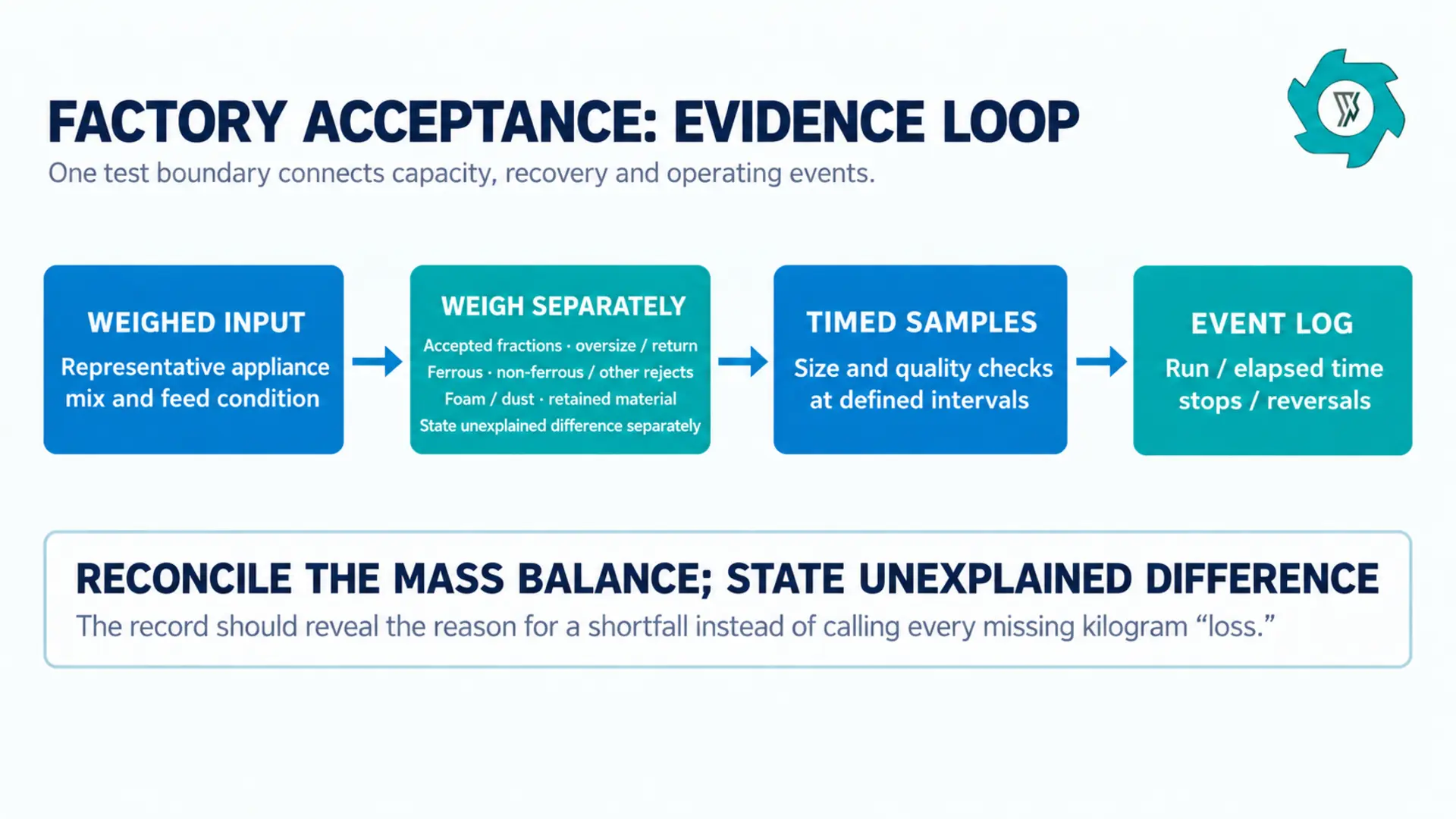
A quotation must record which refrigerators, who prepares them, and what time is counted. Record both running time and elapsed test time. If unloading, cutter cleaning, jam clearing or material transfers are excluded, the buyer cannot translate the number into a shift plan.Capacity becomes useful only when test conditions and outputs are recorded together.At FAT, weigh representative input; separately weigh accepted fractions, oversize/return, ferrous, non-ferrous or other rejects, foam/dust collection and retained material where present. State unexplained difference separately instead of burying it in “loss.” Collect timed samples from the material streams that drive the commercial decision. The resulting record tells you whether a blockage, a poor separation result or a missing fraction is a machine issue, a feed issue or a boundary gap.
Normalize the acceptance record before comparing two offers
Indicator
Calculation
Why it adds decision value
Elapsed throughput
Weighed input ÷ elapsed test time
Shows the rate the project can plan around, including normal interruptions.
Running throughput
Weighed input ÷ machine-running time
Separates mechanical cutting rate from time consumed by handling or interventions.
Intervention share
Intervention minutes ÷ elapsed test time
Exposes whether a good short-run rate depends on frequent manual attention.
Accepted-fraction yield
Accepted fraction mass ÷ input mass
Keeps a high feed rate from masking a weak saleable output.
Energy intensity
Metered kWh ÷ accepted fraction mass
Provides a more useful basis than motor nameplate power when boundaries match.
Do not combine these numbers across unmatched tests. A different appliance weight, feed code, operator intervention rule, energy boundary or recirculation route changes the meaning of the result. Keep a retained sample and a signed event log with the test record so a later claim can be traced back to the actual material processed.
Safety and environmental questions cannot be left to the last page
Cooling appliances can contain refrigerant, oil and insulation foam with blowing agents. EPA notes that foam-blowing-agent recovery is not federally required in the same way as refrigerant recovery; a project may therefore need a deliberate policy and local review rather than relying on a generic compliance statement.1 EPA’s RAD best-practice summary2 describes recovery of refrigerant, foam or its blowing agent, metals, plastic and glass, plus management of PCBs, mercury and used oil.Ask suppliers to map the sealed or enclosed zones, inspection points, negative-pressure or air-handling logic, dust collection, fire and gas risk controls, emergency stop locations, and lockout procedure. The answer should be specific to the feed boundary.
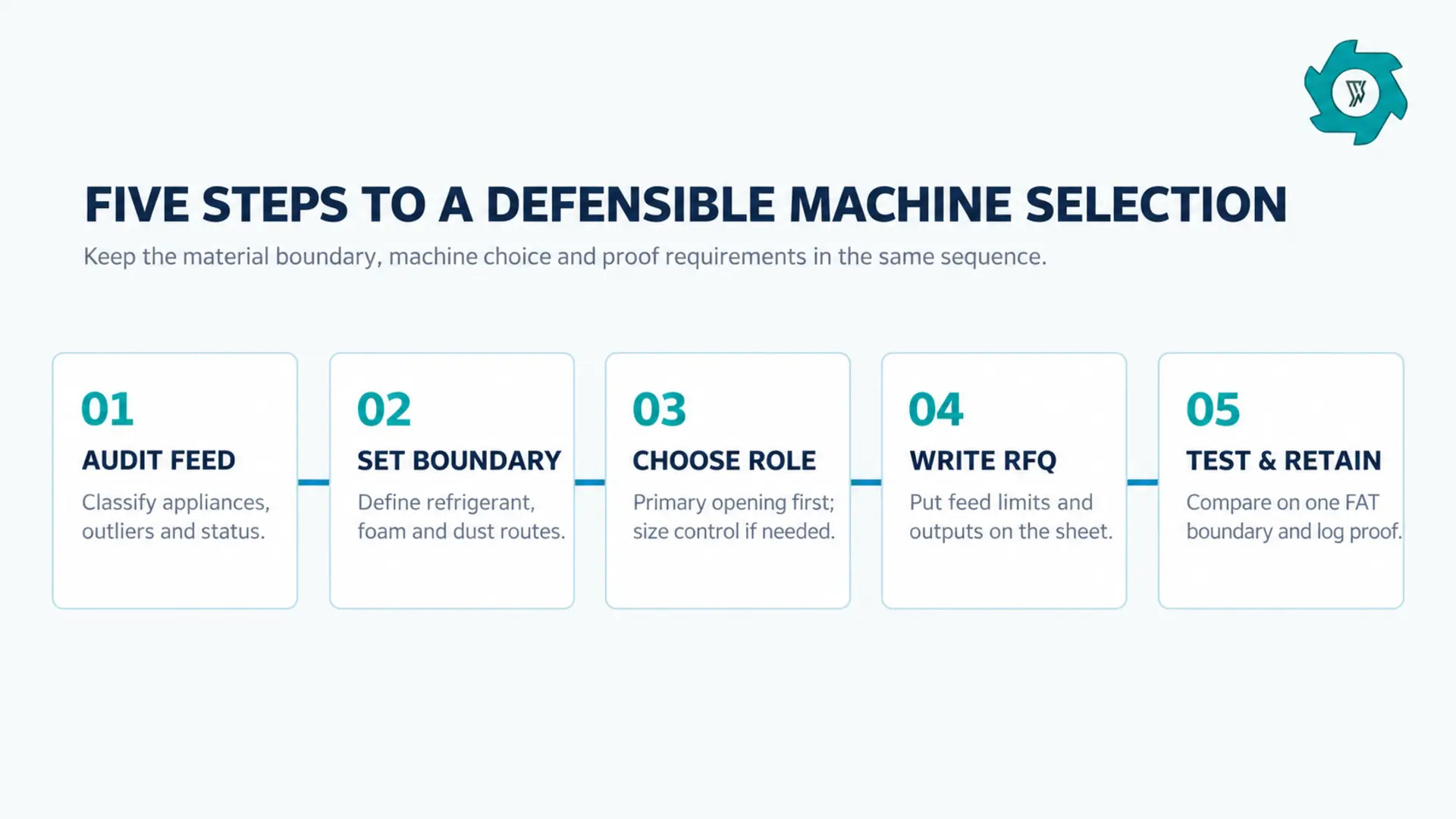
A practical selection sequence
A short sequence that keeps scope, equipment and proof connected.
Audit a representative incoming batch and classify units by depollution status and outliers.
Set the treatment boundary, including refrigerant, oil, foam, dust and product routes.
Choose the primary reduction role, then add secondary reduction only where separation requires it.
Write the RFQ around feed limits, output routes, controls, utilities and measurable FAT conditions.
Compare suppliers using the same test boundary, then retain the operating record with the final layout.
FAQ
Can a refrigerator shredder process intact refrigerators?
Intact refrigerators need an agreed depollution and refrigerant-management boundary before mechanical processing. The receiving and preparation steps must be defined in the project scope.
Which shredder type is best for refrigerator cabinets?
Prepared cabinets commonly start with low-speed twin-shaft reduction. The best configuration depends on cabinet size, feed variation, cutter duty, target output and downstream separation—not on horsepower alone.
What capacity figure should I request?
Request a capacity proven on a stated appliance mix and feed condition, with both running time and elapsed time recorded. Require separately weighed output fractions and logged stops, reversals and interventions.
Specify the right shredder for your refrigerator feed
Send appliance photos, maximum dimensions, refrigerant-recovery and depollution status, target throughput, and required output fractions. We can help define the shredding scope, downstream separation requirements, and a feed-specific acceptance test for your quotation.
David focuses on industrial shredding and recycling equipment,including material evaluation,shredder selection,process configuration,and recycling line planning.
Speak To Our Shredder Machine Expert
Get in touch with our nice team today to get a price estimate for a shredder machine.

 English



 Fast Delivery
 Reliable
 Certified
 Experienced