Aluminum Shredder FAT & RFQ Checklist for Industrial Buyers
An aluminum line is rarely purchased for a single number on a quotation. Profiles can bridge; wheels can shock-load a chamber; light sheet can occupy a conveyor before it reaches the stated weight rate. The right RFQ gives suppliers one defined job to price, while a factory acceptance test (FAT) shows whether the whole line—not isolated machines—can perform it.
What this guide covers:This guide helps industrial buyers turn material details into clearer quotation requirements and a practical factory acceptance plan. For the complete equipment flow and downstream options, see the scrap aluminum recycling line.
1. Start the RFQ with a “dominant-shift” feed passport
Do not describe the feed as simply “aluminum scrap.” Ask the supplier to size the line around the material that occupies most of a normal shift. Put occasional difficult items in a separate scenario rather than allowing them to inflate the base claim.
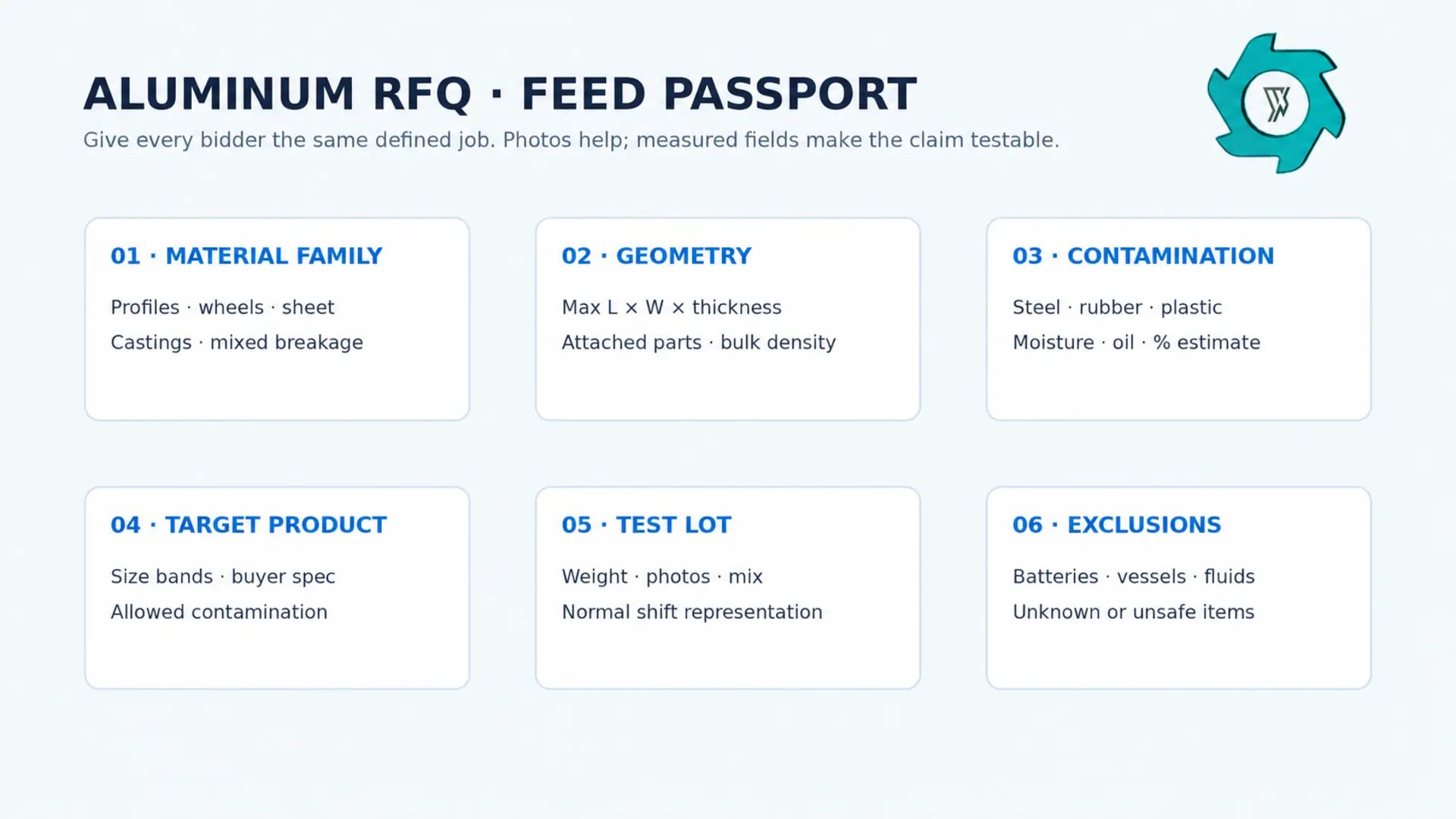
Give every bidder the same feed passport. Photos help, but measured dimensions and composition make a claim testable.
RFQ field
What to state
Why it changes the offer
Material family
Profiles, cast wheels, sheet, mixed breakage or a defined blend
Controls chamber duty and feed behavior.
Geometry
Maximum length, width, wall thickness and attached parts
Prevents a nominal throat size being mistaken for usable feed opening.
Contamination
Steel inserts, rubber, plastic, moisture, oil and estimated percentage
Sets pre-sort, separation and reject handling needs.
Target product
Size range, buyer specification and allowed contamination
Separates “smaller” from useful liberation.
For variable feed, include a test lot specification: weight, photograph set, composition estimate and the rule for any excluded dangerous or unshreddable items. Sealed vessels, batteries, fluids and unknown containers should be excluded from the trial and controlled before feeding.
2. Make the quotation boundary visible
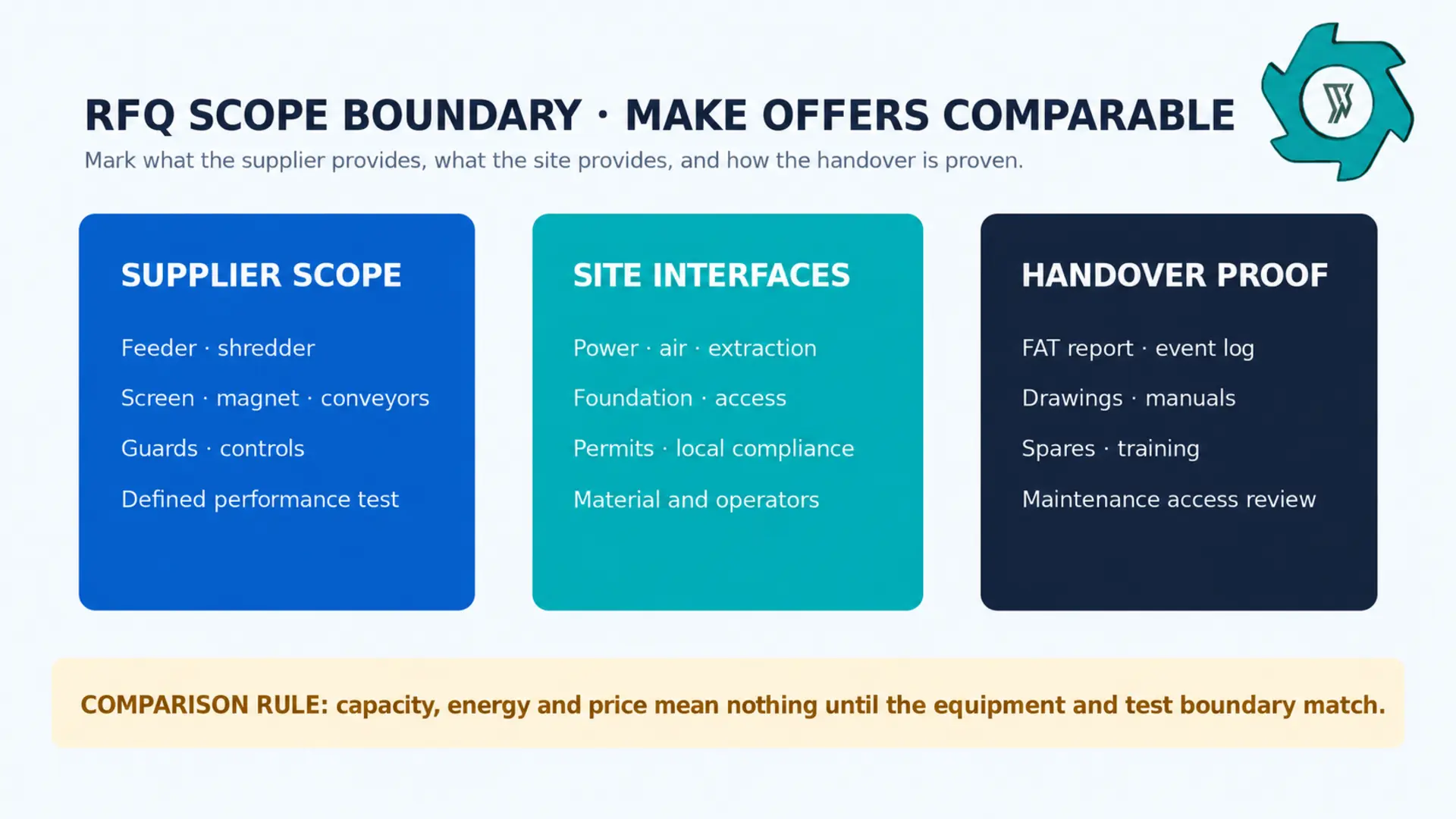
A low equipment price can hide conveyors, dust extraction interfaces, electrical panels, installation materials, commissioning time or spares. Require a one-page boundary drawing and a line-by-line inclusions/exclusions list. This also prevents a throughput promise for a shredder alone being compared with a complete line including magnet, screen and sorting stages.
Every bidder should mark ownership at each interface. “Supply” and “site responsibility” are not interchangeable.
Process equipment: feeder, shredder, screens, magnet, separators, conveyors and collection points.
Utilities: voltage, starting method, compressed air, water, extraction and foundation loads.
Performance: throughput basis, target material, running time, product definition and sampling method.
Handover: manuals, electrical drawings, spare-parts list, training, remote support and acceptance records.
Where output size is part of the sales promise, define the test sieve or size bands and whether oversize is returned, rejected or counted as unfinished material. The trade-off between liberation and fines should be declared before buying; see aluminum shredder output-size trade-offs for the operating consequences.
3. Convert a capacity claim into a FAT protocol
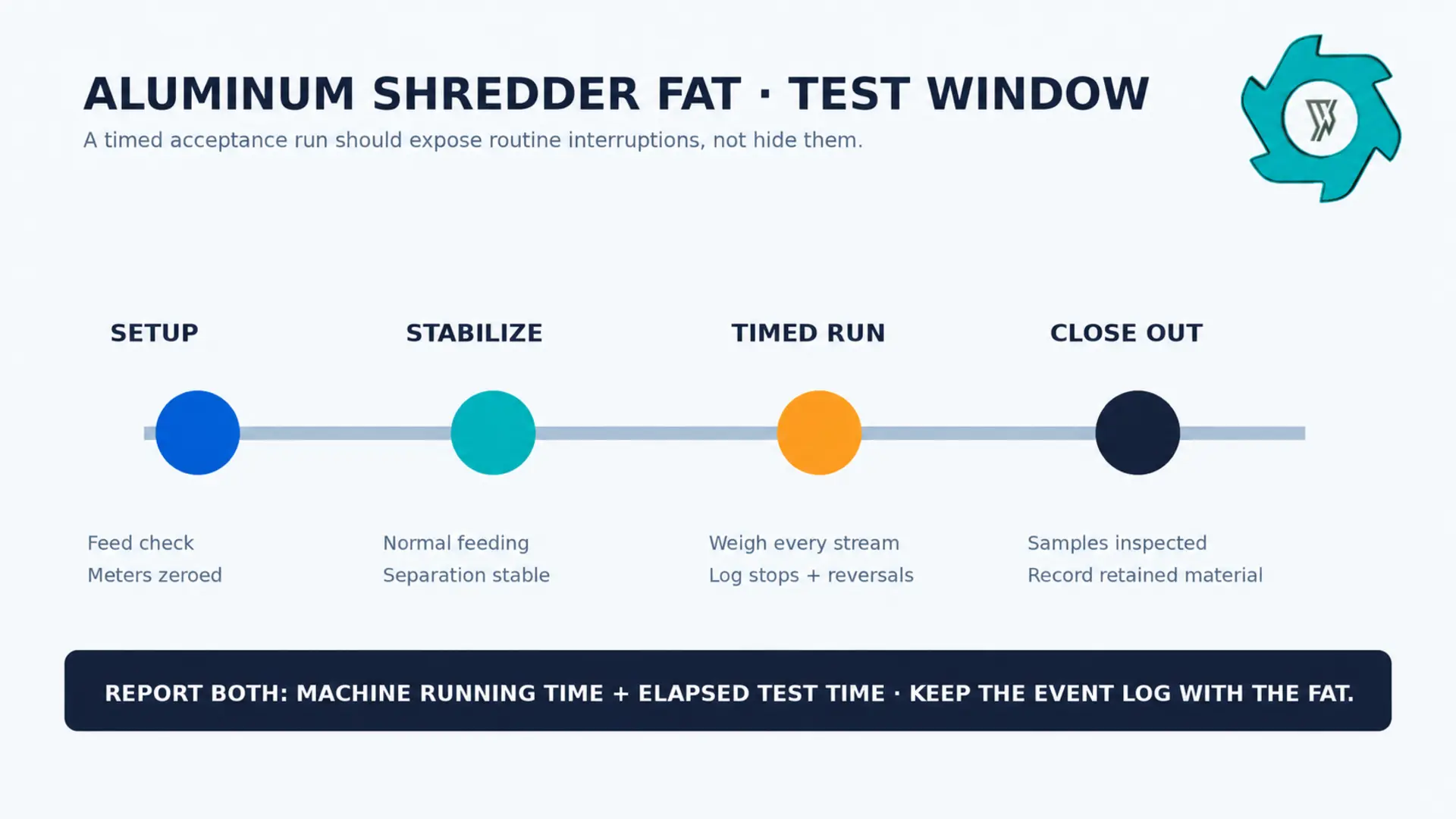
A FAT needs a duration, start/stop rule and a method for handling interruptions. Report both machine running time and elapsed test time. Keep any planned clear-out, reversal, screen cleaning or jam recovery in the log; do not quietly remove it from the denominator.
The timed run begins only after ordinary feeding and separation are stable. Record events throughout the entire window.
Measure
Acceptance wording to request
Accepted-product rate
Net accepted aluminum mass ÷ stated test basis; identify whether rate uses running or elapsed time.
Availability evidence
Event log for stops, reversals, overload alarms, cleaning and operator intervention.
Energy boundary
Metered equipment included in the kWh result; do not compare main-motor-only with complete-line energy.
Quality evidence
Timed increments from each stream, retained separately and inspected to the agreed method.
4. Demand a mass balance that exposes metal loss
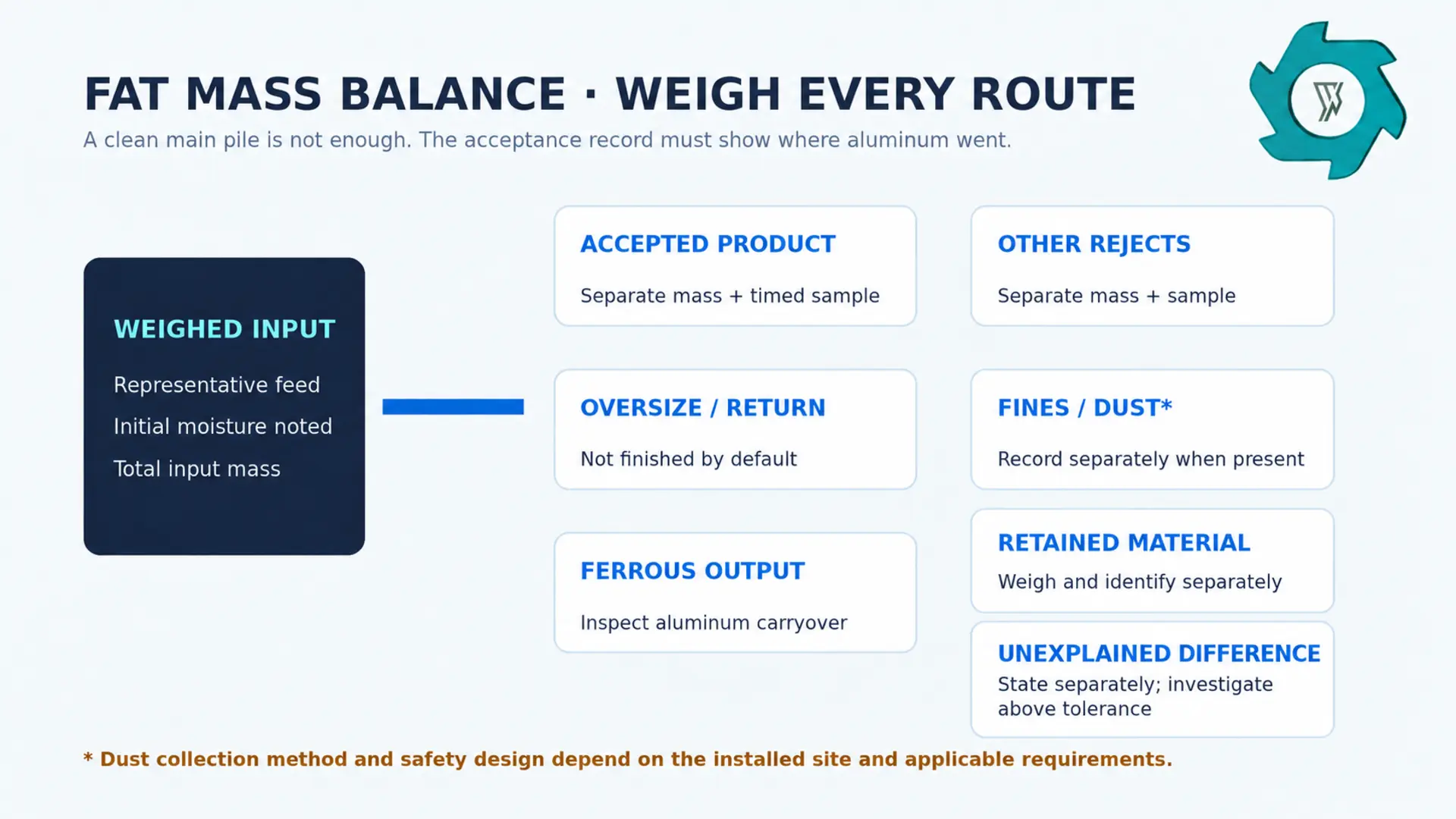
Take synchronized timed increments from the aluminum product, ferrous output, non-metal residue and fines/dust output where present. Weigh output streams separately. Oversize or return is not automatically finished product; retained material must also be identified. The unexplained difference belongs in the report.
A credible FAT makes recovery visible in every route, including retained material and unexplained difference.
Then open and inspect the non-product samples. Large aluminum flats in residue can indicate inadequate liberation; bright small pieces can point to excessive crushing or air loss. This inspection links the number back to a mechanical cause and helps avoid the false comfort of a clean-looking main pile. For prevention tactics, use the separate guide to reduce aluminum fines during shredding and crushing.
4A. Add a bidder-comparison sheet before you award
Require a one-page response sheet with no marketing substitutions. If an item is not included, the supplier should write “excluded” and identify the interface—not leave a blank.
Normalized bid field
Supplier must state
Buyer decision it supports
Guaranteed basis
Defined test feed, accepted-product rate, duration and time basis
Separates sustained output from a brief peak.
Recovery boundary
Streams weighed, sampling interval, and treatment of oversize, retained material and unexplained difference
Shows whether purity was obtained by losing aluminum.
Power boundary
Meter location, included motors and operating condition
Stops main-drive-only energy claims being compared with a complete line.
Wear duty
Cutter package, defined feed, inspection trigger and priced critical spares
Compares risk instead of unsupported wear-life promises.
Exceptions register
Every excluded conveyor, dust interface, civil work, permit, operator or consumable
Reveals the true project scope before award.
Practical scoring rule: do not average incomparable claims. First mark every bid as same basis, partly normalized or not comparable. Compare price per accepted capacity only within the first group. A lower price belongs in a separate decision column when it omits a boundary or cannot demonstrate the requested test.
4B. Pre-agree sampling and the response to a disputed result
Most FAT disputes occur after samples have been mixed, discarded or taken at different moments. Put the sampling routine in the RFQ: collect equal timed increments from each stream during the defined run; label every increment by time and stream; retain a sealed composite for buyer and supplier; record scale ID and tare. Agree the inspection method in advance—visual sort, hand sort, sieve analysis or laboratory method—and state who pays for a referee test if the parties disagree.
Use a two-stage decision. Stage one is the complete-line run against the agreed feed passport. Stage two is a repeat segment only when the event log shows a defined abnormal cause, such as a documented external utility interruption or test-lot inconsistency.
4C. Ask for three capacity scenarios, not one headline number
Request a normal, difficult and changeover scenario. The normal scenario uses the dominant-shift feed. The difficult scenario contains the agreed upper-bound geometry or contamination. The changeover scenario shows the cleaning, setting changes, time lost and product segregation needed when the line moves between two defined materials. This is especially useful where profiles and castings or steel inserts vary.
4D. Build an acceptance evidence pack—not a photo folder
Photographs and operator comments are useful context, but they cannot establish recovery, capacity or energy. Before the FAT begins, assign one record owner and create a numbered evidence pack. The pack should travel with the shipment handover file so a result can still be interpreted months later at site commissioning.
Evidence item
Minimum record
Why it matters later
Feed custody sheet
Lot ID, gross/net weights, photos, moisture observation, excluded pieces and feed sequence
Confirms the tested scrap matches the quoted basis.
Operating-event log
Time, alarm/reversal/stop, cause, corrective action and restart time
Separates routine instability from an exceptional interruption.
Stream ledger
Scale ID, tare, gross/net mass and container ID for every stream
Makes the mass balance auditable rather than reconstructed from memory.
Sample chain
Increment time, stream, composite ID, seal and inspection method
Protects both parties if contamination or recovery is disputed.
Configuration record
Cutter arrangement, screen opening, separator settings and installed options
Prevents a later claim being applied to a different machine setup.
4E. Use a worked mass-balance example to expose hidden assumptions
For a 10,000 kg test lot, the ledger may show 7,420 kg accepted aluminum product, 800 kg oversize/return, 420 kg ferrous output, 940 kg other rejects, 105 kg fines or dust output, 290 kg retained material and 25 kg unexplained difference. The total reconciles to 10,000 kg.
Reported stream
Illustrative mass
Required buyer question
Accepted aluminum product
7,420 kg
What is its size distribution and contamination result?
Oversize / return
800 kg
Was it reprocessed, retained or excluded from accepted capacity?
Fines / dust output
105 kg
How was it captured and accounted for under the site dust boundary?
Ferrous output
420 kg
What aluminum content remains in this separate stream?
Other rejects
940 kg
What aluminum content remains in this separate stream?
Retained material
290 kg
Where is it physically retained, and how will it be dispositioned?
Unexplained difference
25 kg
What tolerance applies, and what investigation is required above it?
For recovery claims, mass alone is only the first layer. If the project needs an aluminum recovery figure, specify the agreed analysis of aluminum remaining in ferrous, residue and fines. State the sampling and calculation method rather than allowing a supplier to label total accepted-product mass as “recovery.”
4F. Create a pass / conditional-pass / fail decision matrix
The contract should distinguish a hard safety or scope failure from an evidence gap that can be closed before shipment.
Finding
Suggested decision
Required close-out
Uncontrolled hazardous-energy exposure, missing guard or unsafe recovery procedure
Fail: stop and correct before further testing
Corrective-action record and safe re-test under the applicable procedure.
Missing stream weights, broken sample chain or unreconciled major difference
Conditional: performance cannot be accepted yet
Repeat the affected measurement using retained or new representative material.
Defined external interruption with complete log and intact samples
Conditional: repeat the relevant timed segment
Keep the original run in the evidence pack; do not overwrite it.
Complete test meets defined feed, rate, quality and evidence requirements
Pass
Issue signed FAT report, configuration record and outstanding-punch-list status.
These categories should be adapted to the purchase contract and local safety requirements. OSHA notes that fine aluminum can be explosible in dust form under relevant conditions; dust design and housekeeping therefore deserve a site-specific review rather than a generic supplier checkbox.1
4G. Define the feed envelope so “representative” cannot drift
Separate variables into normal variation, controlled change and requalification triggers. Normal variation can run under the accepted configuration; controlled changes use an agreed alternate setting and extra sampling; requalification triggers—such as new material families, excess moisture, oversized geometry or unknown contamination—must be held for a new review.
This protects both sides. The buyer does not lose the right to process the normal range, and the supplier is not held to a performance claim on an undeclared feed change.
4H. Plan the first 30 days as a field-verification period
Period
What to collect
Decision use
Days 1–3
Start-up sequence, interlocks, operator questions, access issues and dust observations
Close training and safety punch-list items before habits form.
Week 1
Daily feed passport, running and elapsed time, event log, cutter/screen observations
Check whether actual feed remains inside the accepted envelope.
Weeks 2–4
Weekly stream samples, separate weights, energy boundary data and critical-spares consumption
Set an operating baseline and maintenance inspection trigger.
Day 30 review
Compare site data with FAT configuration and assumptions
Agree settings, sample frequency, spare stock and corrective actions.
4I. Diagnose a capacity shortfall before blaming the shredder
Observed pattern
Inspect first
Evidence to open
Low running-time rate with high torque peaks and reversals
Feed geometry, unremoved dense objects or cutter engagement
Feed photos, event log and cutter condition.
Steady shredder load but low accepted-product rate
Screening, separation or return path
Individual stream masses and oversize/return condition.
Good rate but excess fine fraction
Screen setting, residence time or secondary reduction duty
Size distribution and fines sample.
Normal main product but poor aluminum recovery
Ferrous, residue and dust routes
Timed samples and aluminum carryover inspection.
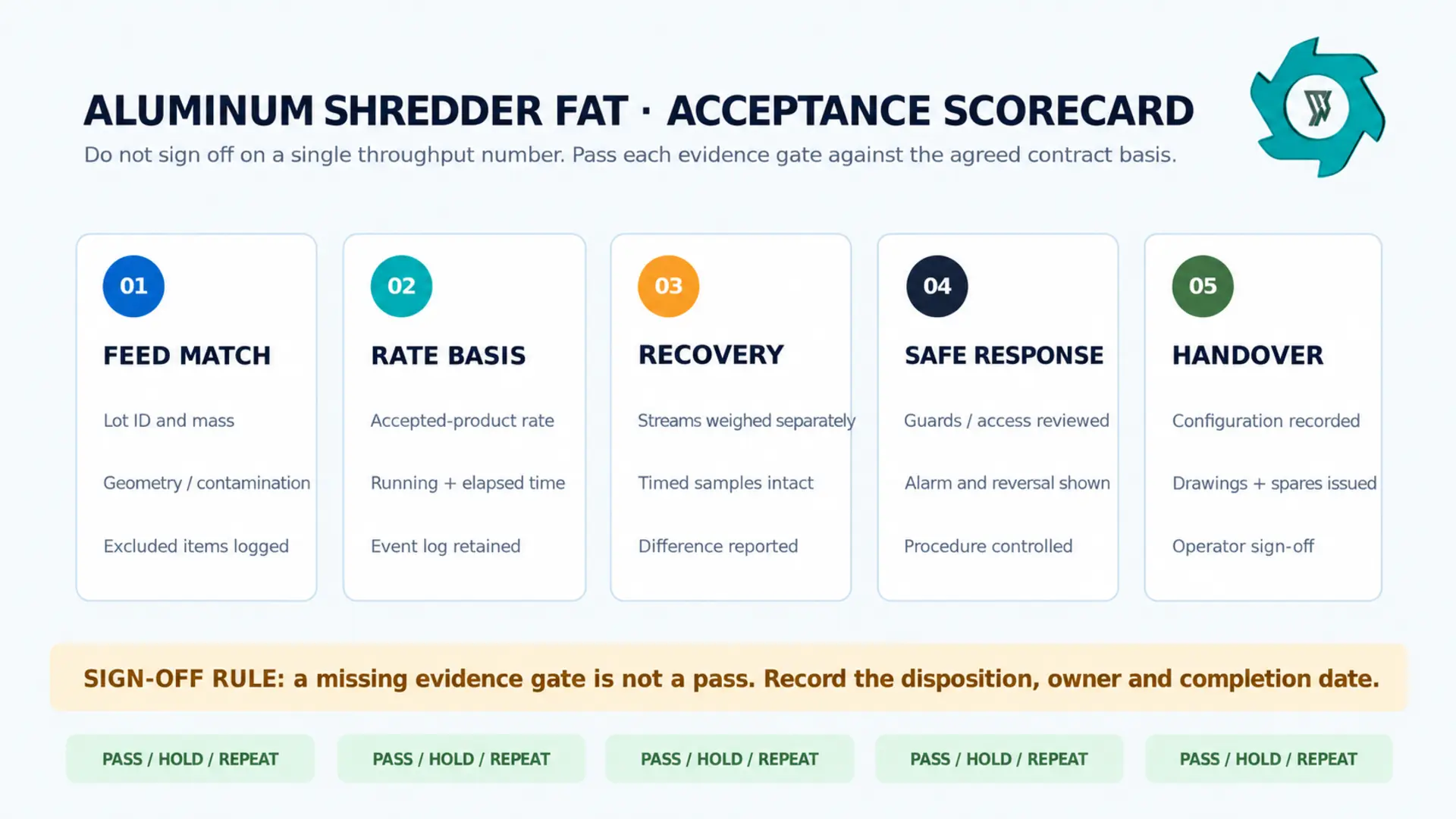
Use a gate scorecard to keep commercial, operational and safety evidence visible in the same acceptance meeting.
5. Test the failure path, not only normal production
The FAT should demonstrate alarm logic, controlled reversal and safe recovery for difficult feed—without introducing unsafe materials. Agree a realistic challenge piece or controlled operating condition in advance. Maintenance checks must use the site’s hazardous-energy procedure. OSHA’s control-of-hazardous-energy requirements address isolating devices and stored or residual energy; the local procedure remains the governing rule.2
Ask to see access to cutter stacks, screens, magnet discharge, bearings and cleaning points. Have the future operators complete a supervised inspection and changeover discussion. Wear claims are meaningful only when tied to the defined feed; steel inserts and castings are not comparable with clean profiles. See the aluminum shredder blade and cutter selection guide when setting those duty assumptions.
6. Buyer checklist: RFQ before FAT
Attach the feed passport and identify the dominant-shift material.
State forbidden, separately reviewed and pre-treated materials.
Define accepted product, oversize/return and every expected output stream.
Request a marked scope boundary, utilities list and exclusions.
Set the FAT lot, time basis, stabilization rule and event-log format.
Require separately weighed streams, timed samples, retained material and unexplained difference.
List training, drawings, spares, maintenance access and handover documents as deliverables.
FAQ
What is the most important item to include in an aluminum shredder RFQ?
It should identify the dominant material, maximum dimensions, contamination, target output and prohibited items. Without it, suppliers may be pricing different jobs.
Should FAT throughput use running time or elapsed time?
Record both. Running time shows the processing rate while elapsed time exposes stoppages, clearing and recovery. The contract should state which basis governs acceptance.
Which output streams should be weighed during FAT?
Weigh input, accepted aluminum product, oversize or return, ferrous output, other rejects, fines or dust output where present, and retained material separately. Report unexplained difference separately.
Is a cleaner aluminum product always a better result?
No. A cleaner product can result from rejecting recoverable aluminum. Judge product quality together with aluminum remaining in ferrous and residue samples.
Turn your material into a comparable proposal
Send feed photos, dimensions, contamination details, target output and intended operating hours. Ask for a test plan before you compare prices.
David focuses on industrial shredding and recycling equipment,including material evaluation,shredder selection,process configuration,and recycling line planning.
Speak To Our Shredder Machine Expert
Get in touch with our nice team today to get a price estimate for a shredder machine.

 English



 Fast Delivery
 Reliable
 Certified
 Experienced