Top 10 Refrigerator Recycling Equipment Manufacturers
A refrigerator recycling equipment supplier should be judged by the boundary it can actually deliver. Some companies publish evidence for complete cooling-appliance plants, including refrigerant and blowing-agent handling. Others are strongest in cabinet shredding, WEEE size reduction or downstream material separation. Those are different scopes, even when every proposal is described as a “refrigerator recycling line.”
Short answer: ANDRITZ, URT and ERDWICH show particularly direct public evidence for dedicated cooling-appliance plants. YUXI is included as a project-based option for buyers comparing an integrated line or a mechanical cabinet-processing section. FOR REC and ELDAN also publish refrigerator-specific solutions, while several other shortlisted firms are better evaluated as WEEE or configurable system suppliers. Final selection still requires a scope-matched quotation and a representative factory acceptance test.
A complete refrigerator project connects pre-treatment, cabinet opening, foam and gas control, and material separation. A machine list alone does not prove that the interfaces are covered.
How We Built the 2026 Shortlist
We began with a wider pool of suppliers found through refrigerator recycling, cooling-appliance treatment, WEEE processing and white-goods recycling searches. A company reached the final ten only when its current official material showed at least one relevant capability: a dedicated refrigerator plant, a documented cooling-device project, or equipment that can form a credible part of a refrigerator cabinet-processing line. The order reflects six editorial factors: direct refrigerator relevance, clarity of the offered process boundary, completeness of the published route, technical disclosure, visible project or installation evidence, and practical fit for different buyer profiles. It does not compare audited uptime, lifecycle cost or market share.
First Normalize What “Refrigerator Recycling Equipment” Means
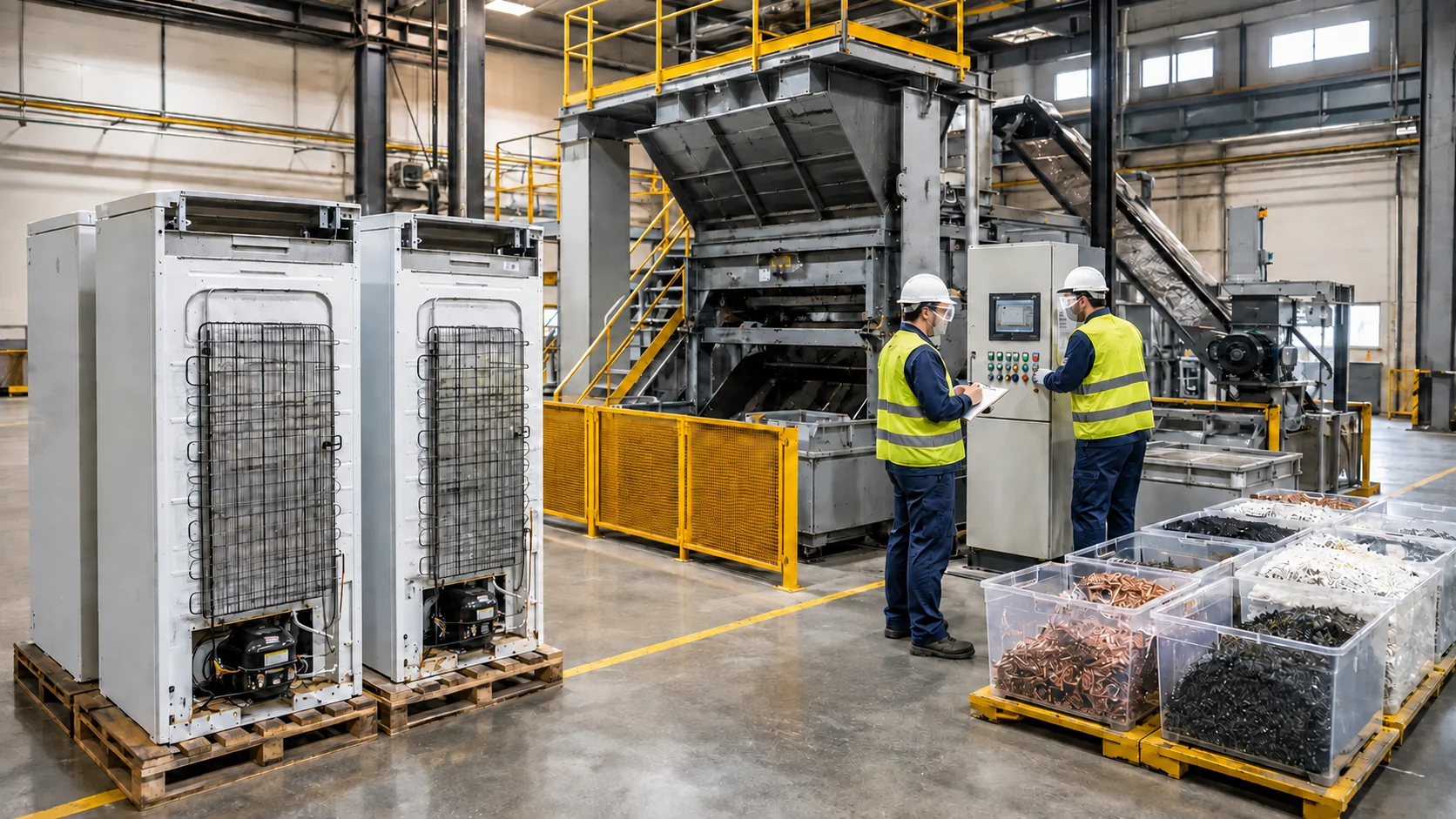
An intact refrigerator carries obligations that ordinary scrap metal does not. Refrigerant and compressor oil need a controlled route before cabinet size reduction. Insulation foam may contain blowing agents, and pentane-bearing appliances add a fire and gas-management question. The mechanical section then has to open a light, bulky composite cabinet, separate foam from heavier material and recover steel, non-ferrous metal and plastics without allowing one fraction to contaminate the next. That is why buyers should split every offer into two stages. Stage 1 covers receiving, identification, refrigerant recovery, oil handling, compressor removal and other required depollution. Stage 2 covers cabinet feeding, shredding or crushing, liberation, air handling, magnetic separation, non-ferrous recovery and product discharge. The YUXI waste refrigerator recycling line describes this complete boundary. Do not assume a strong general-purpose shredder supplier automatically delivers gas recovery or foam degassing. Equally, a specialist Stage 1 supplier may need to integrate with another company’s downstream line. If a project receives only prepared cabinets, a robust double-shaft shredder or another controlled low-speed opening system may be central to the scope, but it is still not a substitute for a complete-appliance treatment plan. Compare suppliers at the same process boundary. A cabinet-only mechanical line and a complete-appliance plant should never be treated as equivalent quotations.
Top 10 Refrigerator Recycling Equipment Manufacturers
1. ANDRITZ
Verified scope: dedicated recycling plants for refrigerators and cooling devices. ANDRITZ publicly describes a sealed ADuro QZ-based process, downstream matrix degassing and outputs including ferrous metal, non-ferrous metal, plastics and polyurethane. Its project references also include new plants and modernizations with published appliance-per-hour bases.
Best fit: buyers seeking a high-integration cooling-appliance plant with explicit attention to CFC/pentane handling and documented industrial references.
Confirm before RFQ: whether Stage 1 equipment, process-gas treatment, civil works, utilities and local compliance engineering are included in the same commercial boundary.
2. URT Umwelt- und Recyclingtechnik
Verified scope: engineering, design, construction, commissioning, maintenance and expansion of cooling-device recycling plants. URT states that it has delivered more than 40 cooling-device plants and publishes a capacity direction of up to 4 t/h, but that supplier-published figure still needs project-specific normalization.
Best fit: operators looking for a specialist plant engineer with a visible portfolio focused on cooling appliances and long-term system support.
Confirm before RFQ: the appliance mix behind any throughput figure, the applicable recovery measurement method and which local Stage 1 obligations remain with the operator.
3. YUXI Machinery
Verified scope: a project-configured waste refrigerator recycling route covering pre-treatment requirements, cabinet shredding, foam collection, ferrous and non-ferrous separation, plastics recovery, conveyors and centralized control options. The public solution correctly distinguishes whole appliances from already depolluted cabinets.
Best fit: buyers who want to compare a complete project with a mechanical-only cabinet processing section and who are prepared to define feed condition, output targets and local refrigerant-handling responsibilities before configuration.
Confirm before RFQ: representative feed dimensions, appliances per hour and tonnes per hour, the exact gas/oil scope, separation acceptance criteria, dust and foam handling, local service plan and the final revision-controlled equipment list. A four-shaft shredder may be considered where controlled sizing is useful, but selection must follow the actual cabinet construction and downstream route rather than a generic machine preference.
4. ERDWICH
Verified scope: refrigerator recycling plants with substantial public project experience. ERDWICH states that its plants have processed more than 30 million refrigerators, and external project reporting identifies dedicated refrigerator lines in large WEEE facilities.
Best fit: established recyclers that value refrigerator-specific references, engineered shredding and plant integration.
Confirm before RFQ: current treatment architecture, the responsibility for Stage 1 degassing, the gas and foam measurement boundary, and service coverage in the project country.
5. FOR REC
Verified scope: customized refrigerator treatment plants. FOR REC publishes a route that begins with compressor removal and oil/gas separation, continues through shredding, and then recovers ferrous and non-ferrous material before further size reduction and density-based separation.
Best fit: buyers comparing a customized European-style complete treatment route with clear mechanical and separation stages.
Confirm before RFQ: which gas-control technologies are supplied, how performance is demonstrated, and whether published output sizes refer to all material or one selected stream.
6. ELDAN Recycling
Verified scope: complete fridge recycling solutions covering downsizing, separation, and collection of oil and gases in an inert process.
Best fit: buyers who want a recognized multi-material recycling equipment manufacturer with a dedicated refrigerator system rather than only a generic WEEE shredder.
Confirm before RFQ: the current standard line configuration, treatment of mixed refrigerant generations, nitrogen or inerting demand, and how guaranteed values will be measured during acceptance.
7. Stokkermill Recycling Machinery
Verified scope: WEEE treatment and refining plants, including equipment for size reduction and recovery of metals from electronic and electrical waste.
Best fit: projects where prepared refrigerator material is one stream within a wider WEEE plant and the buyer needs modular mechanical processing or separation equipment.
Confirm before RFQ: direct refrigerator references, prohibited feed, the Stage 1 boundary, foam and blowing-agent management, and whether the proposed route has been validated on intact cabinets or only prepared WEEE.
8. Guidetti Recycling Systems
Verified scope: WEEE plants using mills, turbo equipment and separators, with public case material for large and small white goods.
Best fit: prepared WEEE and downstream metal-recovery projects where fine liberation and separation matter more than whole-appliance depollution.
Confirm before RFQ: allowable refrigerator feed condition, cabinet opening equipment, foam route, gas handling and the exact capacity basis for the proposed material.
9. AIShred / GEP ECOTECH
Verified scope: published material for an automated refrigerator and cooling-appliance recycling plant, alongside broader industrial shredding and separation systems.
Best fit: buyers assembling an early-stage international shortlist and willing to verify project-specific cooling-appliance evidence in detail.
Confirm before RFQ: installed refrigerator references, Stage 1 refrigerant/oil responsibility, explosion-risk controls, foam treatment, acceptance data and after-sales support in the destination market.
10. RecycleGroups
Verified scope: a configurable refrigerator shredding and sorting plant presented for white goods, WEEE and related recycling applications. The reviewed public page emphasizes tailored plant design and recovery through shredding and separation.
Best fit: buyers exploring configurable cabinet-processing equipment who will independently verify manufacturing responsibility and complete-project references.
Confirm before RFQ: legal manufacturer identity, installed refrigerator projects, equipment origin, gas and oil boundary, detailed mass balance, warranty owner and commissioning team.
Manufacturer Comparison at a Glance
Manufacturer
Public refrigerator evidence
Likely comparison role
Priority verification
ANDRITZ
Dedicated plants and projects
High-integration specialist
Scope split, guarantees, utilities
URT
40+ cooling-device plants claimed
Cooling-device plant engineer
Capacity and recovery test basis
YUXI
Project-based complete/mechanical routes
Configurable system supplier
Stage 1 boundary and FAT criteria
ERDWICH
Dedicated application and project history
Specialist plant integrator
Current gas/foam architecture
FOR REC
Dedicated refrigerator plant
Customized complete route
Gas control and output definitions
ELDAN
Dedicated fridge system
Complete recycling supplier
Inerting and guarantee method
Stokkermill
Broader WEEE evidence
Modular WEEE/downstream option
Direct fridge references
Guidetti
WEEE and white-goods cases
Liberation/separation option
Whole-fridge process boundary
AIShred / GEP ECOTECH
Published automated fridge line
Emerging configurable option
Installed references and controls
RecycleGroups
Published fridge sorting plant
Early-stage shortlist option
Manufacturer identity and warranty
Five Questions That Expose Scope Gaps Quickly
What exactly enters your first powered machine? Ask whether the quoted line receives intact appliances, drained appliances or compressor-free cabinets.
Who owns refrigerant, oil and blowing-agent performance? “Prepared by customer” should be tied to an incoming-feed acceptance condition.
How is capacity defined? Units per hour needs the average and maximum appliance weight; tonnes per hour needs cabinet type, preparation state, feeding method and recirculation.
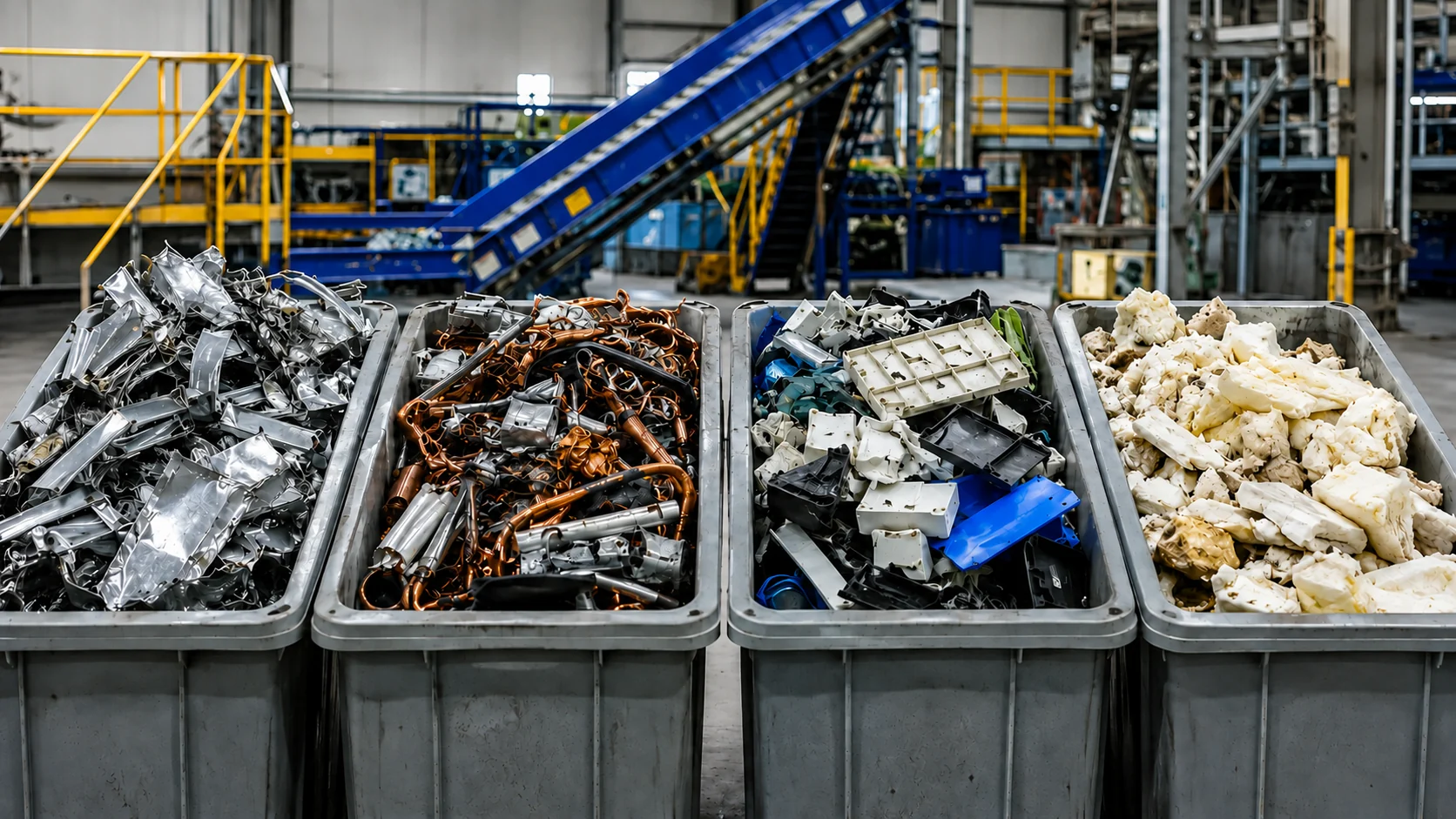
What leaves every discharge? Demand a mass-balance table that includes saleable fractions, foam, dust, fines, rejects and liquids or gases handled upstream.
Which claims become contractual acceptance criteria? A brochure value is not an FAT protocol. Define test feed, duration, weighing, samples, downtime treatment and repeat-test rules.
RFQ Data to Send Every Manufacturer
Include appliance types and age range, side-by-side or commercial cabinets, average and maximum dimensions, average weight, expected daily intake, existing depollution equipment, known refrigerants and blowing agents, local compliance requirements, target fractions, acceptable contamination, workshop drawings, clear height, electrical supply, shift pattern and preferred automation level. Also show what should not enter the line. Mixed WEEE can introduce batteries, mercury switches, glass, pressurized parts and liquids that change the hazard review. If recovered plastic will be sold as a plastic-rich fraction, state that. If the business case expects polymer-grade ABS, HIPS or PP, the downstream sorting scope becomes much larger and may include dedicated plastic size-reduction equipment plus polymer separation outside the basic refrigerator line. Use representative feed during the FAT and record throughput, stops, energy conditions and every output stream under an agreed sampling method.
How to Run a Useful Factory Acceptance Test
The FAT should reproduce normal production, not a short demonstration with hand-picked appliances. Include the largest recurring cabinet, the awkward feed that tends to bridge, typical attached components and the contamination level expected after normal pre-treatment. Weigh the test lot. State when the clock starts and stops. Record blocked chutes, reversals, manual interventions and recirculation rather than hiding them inside an average throughput number. Take increments across the stable run instead of collecting one clean-looking handful at the end. Agree whether “purity” is measured on a wet or dry basis and whether attached material counts as contamination. Recovery cannot be calculated from product purity alone; the test needs a defensible estimate of how much target material entered the lot and where it reported. Finally, inspect access. The team will eventually clear foam from a duct, change cutters, clean a magnet, open a screen and service bearings. Guarding, isolation points, platforms and lifting access belong in the purchase decision because they determine how long routine work takes after commissioning. Define each output by its buyer’s acceptance requirement. Four named fractions do not guarantee four saleable products.
Which Manufacturer Should You Choose?
Start with scope, not position in the list. A European operator planning a sealed high-throughput cooling-device plant may prioritize a specialist with extensive CFC and pentane references. A regional recycler that already owns compliant depollution equipment may gain more from a flexible cabinet shredding and separation supplier. An integrated WEEE center may prefer modular equipment that can share downstream separation, provided refrigerator-specific exceptions remain controlled. Shortlist two or three suppliers that match the same boundary. Issue the same RFQ. Then compare exclusions, utility demand, maintenance access, local support, commissioning responsibility, spare parts, controls, acceptance testing and the consequences of feed outside the agreed envelope. The lowest equipment total often stops being the lowest project total once omitted gas handling, building work, extraction or downstream sorting is added.
Frequently Asked Questions
Who makes complete refrigerator recycling plants?
ANDRITZ, URT, ERDWICH, FOR REC and ELDAN publish particularly direct evidence for dedicated refrigerator or cooling-device plants. YUXI also presents a project-based complete route.
Is a refrigerator shredder the same as a complete recycling line?
No. A shredder opens or downsizes prepared cabinets. A complete plant must also address refrigerant, oil, compressors, foam or blowing agents, dust, separation, discharge and site-specific safety requirements.
Can one line process refrigerators and mixed white goods?
Sometimes, but not as an unrestricted mixed feed. Cooling appliances need specific depollution and foam/gas controls. Other white goods may use shared downstream equipment only after feed routing and prohibited components are defined.
How should refrigerator recycling capacity be compared?
Use both appliances per hour and tonnes per hour, then add appliance mix, average weight, maximum dimensions, preparation condition, output size, recirculation and measured uptime.
What should be tested before buying?
Run representative appliances through the agreed process boundary and record weighed throughput, interventions, downtime, energy conditions, output mass, purity, recovery method, rejects and foam or dust behavior.
Compare a Refrigerator Recycling Line Against Your Real Feed
Send appliance photos or video, dimensions, preparation condition, target capacity, required fractions, workshop drawing, power supply and destination country. YUXI can review the process boundary and prepare a scope for technical comparison.
David focuses on industrial shredding and recycling equipment,including material evaluation,shredder selection,process configuration,and recycling line planning.
Speak To Our Shredder Machine Expert
Get in touch with our nice team today to get a price estimate for a shredder machine.

 English



 Fast Delivery
 Reliable
 Certified
 Experienced