Industrial Shredder & Recycling Systems Manufacturer - YUXI

 English

 English
 Fast Delivery
 Reliable
 Certified
 ExperiencedEnglishEnglishFast DeliveryReliableCertifiedExperienced
A search for radiator recycling machine manufacturers mixes together equipment that solves very different jobs. One supplier may specialize in clean-coil stripping, another in compact granulation, and another in a complete line for bent automotive radiators and mixed heat exchangers. The useful comparison is therefore not a popularity ranking. It is a fit check: which supplier publishes equipment for the feed and process boundary you actually need?
The inclusion rule was simple: a company needed a current official page that directly presents radiator processing, copper-aluminum radiator separation, or a machine series that explicitly lists radiators as feed. A generic metal shredder page was not enough. We reviewed public supplier information on September 8, 2026. Those pages are evidence of published scope—not an independent audit of factory capacity, installed base, product purity or sustained throughput.
We also removed the 1–8 ranking used in the earlier draft. A stripper that accepts pre-cut coil sections should not be scored against a 20-meter shredding and separation line as if they were the same product. A buyer gets more value from knowing which equipment class a supplier is strongest in and what must still be proven in an RFQ or FAT.
Before comparing brands, classify the feed. The radiator construction itself changes whether copper-aluminum separation is even the right objective. Clean copper-tube/aluminum-fin coils, all-aluminum cores and dirty automotive radiators should not be treated as one interchangeable material.
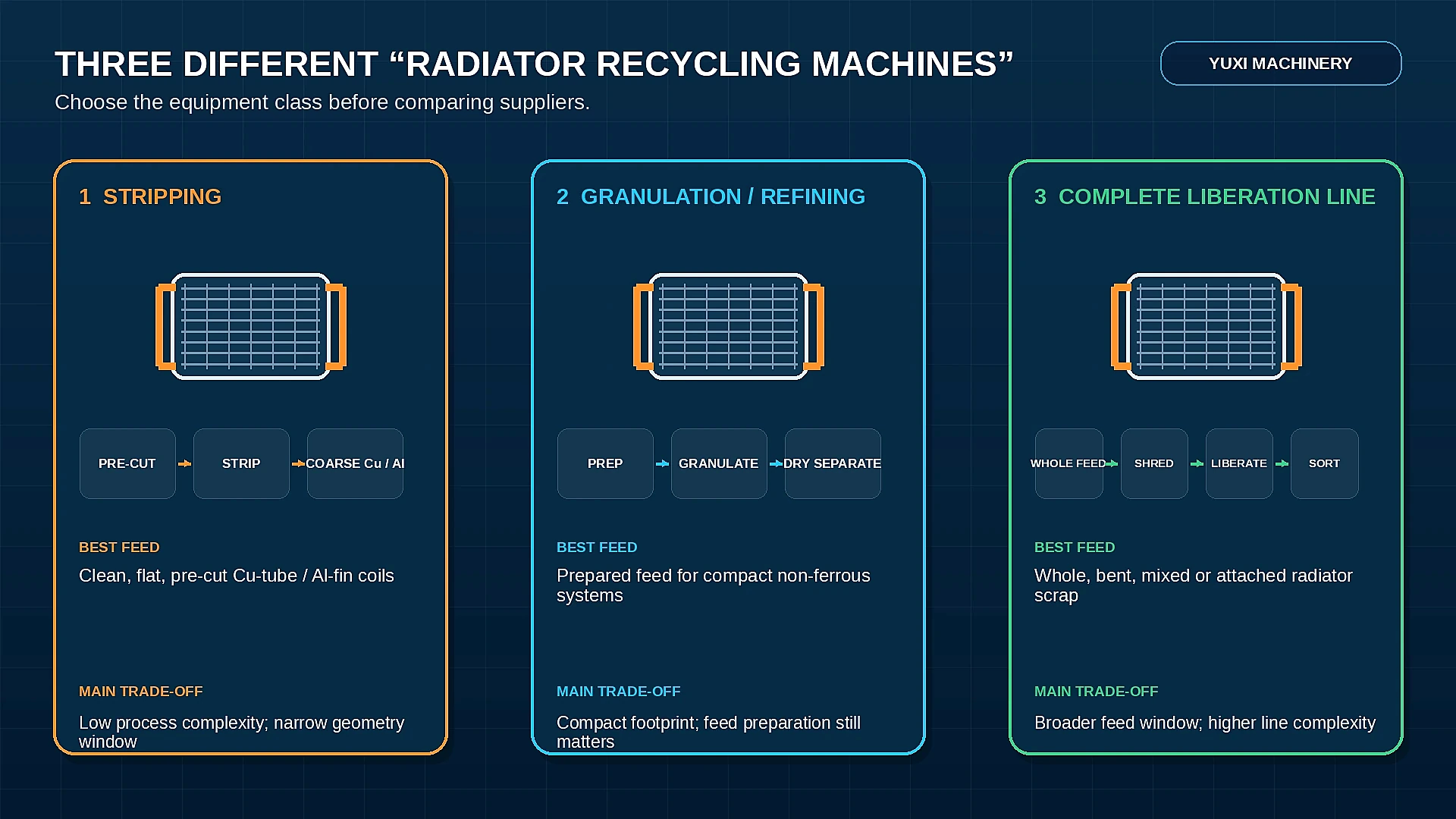
A stripping machine can be the most economical route when incoming cores are clean, flat, consistently cut and built around copper tubes with aluminum fins. The buyer should confirm tube spacing, number of layers, width, deformation tolerance and the amount of pre-cutting required. The advantage is simple handling and relatively coarse separated metals. The limitation is that geometry becomes part of the specification.
Granulation systems sit between a dedicated stripper and a long complete line. They can suit plants that already prepare feed, handle multiple non-ferrous materials, or need a smaller footprint. The key question is where the system boundary begins: does the quoted production figure assume the radiator has already been cut or pre-shredded?
A complete line is the more relevant class when feed arrives as whole, deformed or mixed radiators with steel brackets, plastic tanks, side frames or irregular heat exchangers. Primary shredding solves the handling problem; secondary crushing must then release joined copper and aluminum before separation can work reliably. For dirty automotive feed, the operational consequences are covered in the automotive radiator recycling guide.
The table below is a shortlisting tool, not a league table. “Published fit” means the application is described on the supplier page we reviewed. “Verify” is the information a buyer should close before treating two quotations as equivalent.
| Manufacturer | Published equipment class | Useful when your feed looks like | Verify before RFQ comparison |
|---|---|---|---|
| YUXI Machinery | Complete shredding, liberation and separation line | Mixed car/AC/heat-exchanger scrap; whole or deformed material | Exact feed envelope, line boundary, output specification, project-specific capacity |
| Stokkermill | Industrial hammermill, refining and copper/aluminum separation systems | Prepared or industrial radiator feed within a modular non-ferrous plant | Exact upstream preparation, selected modules and radiator-only test basis |
| Guidetti Recycling Systems | Compact granulation/refining systems that explicitly include radiators | Prepared radiator feed; compact or multi-product non-ferrous operations | Pre-shredding requirement, radiator-only sustained rate, downstream refining scope |
| ENERPAT | Complete radiator line with shredder, hammer mill, magnetic and air separation | Mixed radiator projects needing a packaged system | Model/feed basis, output sampling method, dust and controls boundary |
| SUNY GROUP | Complete scrap radiator recycling plant | Large radiator blocks and mixed copper/aluminum/ferrous feed | Model-specific feed condition, continuous rate and final-product acceptance criteria |
| Henan DOING | Complete shredding, crushing and separation line | AC radiators, car water tanks, condensers and mixed radiator-like feed | Feed preparation, process stages included, capacity basis and project test method |
| WANROOETECH | Compact separator options plus automatic crushing/separation lines | Buyers still deciding between prepared-coil and complete-line routes | Which route is being quoted, particle-size window, recirculation and operator scope |
| VANER Machinery | Compact radiator stripping/separator machines | Clean, prepared copper-tube/aluminum-fin cores | Required cutting width, number of layers, geometry limits and operator preparation |
YUXI’s current radiator solution is organized as a complete mechanical process rather than a narrow-slot stripper. The live page describes feeding, double-shaft shredding, further crushing/liberation, magnetic removal, non-ferrous separation, screening, gravity separation, dust collection and coordinated controls. It also distinguishes clean prepared coils from mixed or deformed radiator scrap.
Best fit: buyers whose feed is too irregular for a simple stripper and who want one project boundary from bulky feed handling through separated metal fractions. Confirm before order: representative feed, target products, sustained operating hours, allowable manual preparation, return-flow logic, dust boundary and the FAT method. Do not copy the general shredder model capacities into the radiator project; the line should be sized from the radiator feed and downstream bottleneck.
Stokkermill publishes radiator-specific hammermill applications and copper/aluminum recycling lines. Its official material shows radiators within a broader non-ferrous recycling architecture that can combine size reduction, refining and dry separation. A 2025 FAT update also states that an M100 plant was designed for electrical cables, copper and aluminum radiators and other conductive materials.
Best fit: established non-ferrous recyclers that want modular industrial processing rather than a dedicated small stripper. Confirm before order: which modules are required for your radiator construction, whether a primary shredder is included, how much material preparation is assumed, and whether the quoted production basis comes from radiator-only testing or a broader material family.
Guidetti’s current Sincro Eko and Wire Pro product pages explicitly include radiators alongside copper and aluminum cable recycling. The company also publishes pre-shredding, refining and dry-density separation equipment and offers material trials. This makes it a meaningful comparison when the buyer wants a compact modular system instead of a long dedicated radiator line.
Best fit: prepared feed, small-to-medium non-ferrous operations, or plants that need one compact platform for more than one material. Confirm before order: the radiator preparation required before the granulation box, the radiator-only sustained rate, which pre-shredder/refiner/separator modules are included, and what product specification the test is intended to meet.
ENERPAT’s current waste radiator line page shows a chain conveyor, dual-shaft shredder, hammer mill, magnetic separator, air separator and pulse dust collection. The same page publishes multiple complete-line models and presents radiator-specific project examples. Those supplier-published figures are useful for initial sizing, but they are not directly comparable with another company’s number until feed and test conditions are normalized.
Best fit: buyers comparing a packaged complete-line architecture for mixed radiator scrap. Confirm before order: which radiator construction and deformation level was used for the quoted model, where the commercial battery limit starts and ends, how product quality is sampled, and how maintenance access to hammer, screen and dust components is handled.
SUNY’s dedicated scrap radiator plant page publishes a process built around double-shaft shredding, hammer crushing, gravity separation, air separation and pulse dust collection, with copper, aluminum and iron shown as output categories. The page includes several standard capacity classes and states that configuration changes with raw material.
Best fit: projects looking for a standardized full-line starting point rather than a small stripping workstation. Confirm before order: maximum radiator dimensions and attached components for the selected model, whether the published rate is stable whole-line throughput, how output quality is measured, and which utilities, platforms, enclosures and dust ducts are included.
DOING’s official radiator page describes shredding, crushing, negative-pressure baffling, magnetic separation, air separation and dust collection for air-conditioning radiators, car water tanks, condensers and related feed. The company also publishes radiator project cases. As with other supplier cases, those pages should be treated as evidence of experience claimed by the supplier, not as independently verified performance.
Best fit: buyers comparing a project-oriented crushing and separation route for mixed radiator feed. Confirm before order: what the negative-pressure stage is expected to remove from your material, the inlet preparation and oversize rule, the sustained capacity basis, the test lot composition and the post-test sample method.
WANROOETECH’s current radiator solution is useful because the supplier presents both compact/manual separation routes and a larger automatic crushing-and-separation plant. That mirrors a real buyer decision: a clean, prepared coil business may not need the same investment or floor space as a mixed automotive/AC radiator operation.
Best fit: buyers who have not yet fixed the equipment class and want to compare prepared-feed and complete-line options from one supplier. Confirm before order: which route is actually being quoted, the required pre-cutting, target particle-size range, whether recirculation is expected, and what dust, conveying and control equipment sits inside the quotation boundary.
VANER’s V-1200P page is a clear example of the compact stripping class. It states that clean radiators are cut to fit the inlet and distinguishes direct processing of single/double-layer material from thicker cores that require band-saw preparation. That transparency about preparation is valuable because it shows why a stripper’s throughput should not be compared with a complete-line throughput figure.
Best fit: dismantlers and scrap processors with a steady stream of clean, dimensionally consistent copper-tube/aluminum-fin radiator sections. Confirm before order: tube pitch, layer count, cut width, deformation tolerance, operator cycle, the percentage of normal feed that falls outside the accepted geometry, and how rejected cores will be handled.
Manufacturer pages use different boundaries. One figure may start with a clean cut coil; another may start at a feed conveyor carrying whole radiators. One quote may include dust collection and output bins; another may stop at the separator discharge. A fair comparison begins with the same feed passport and the same answer format for every bidder.
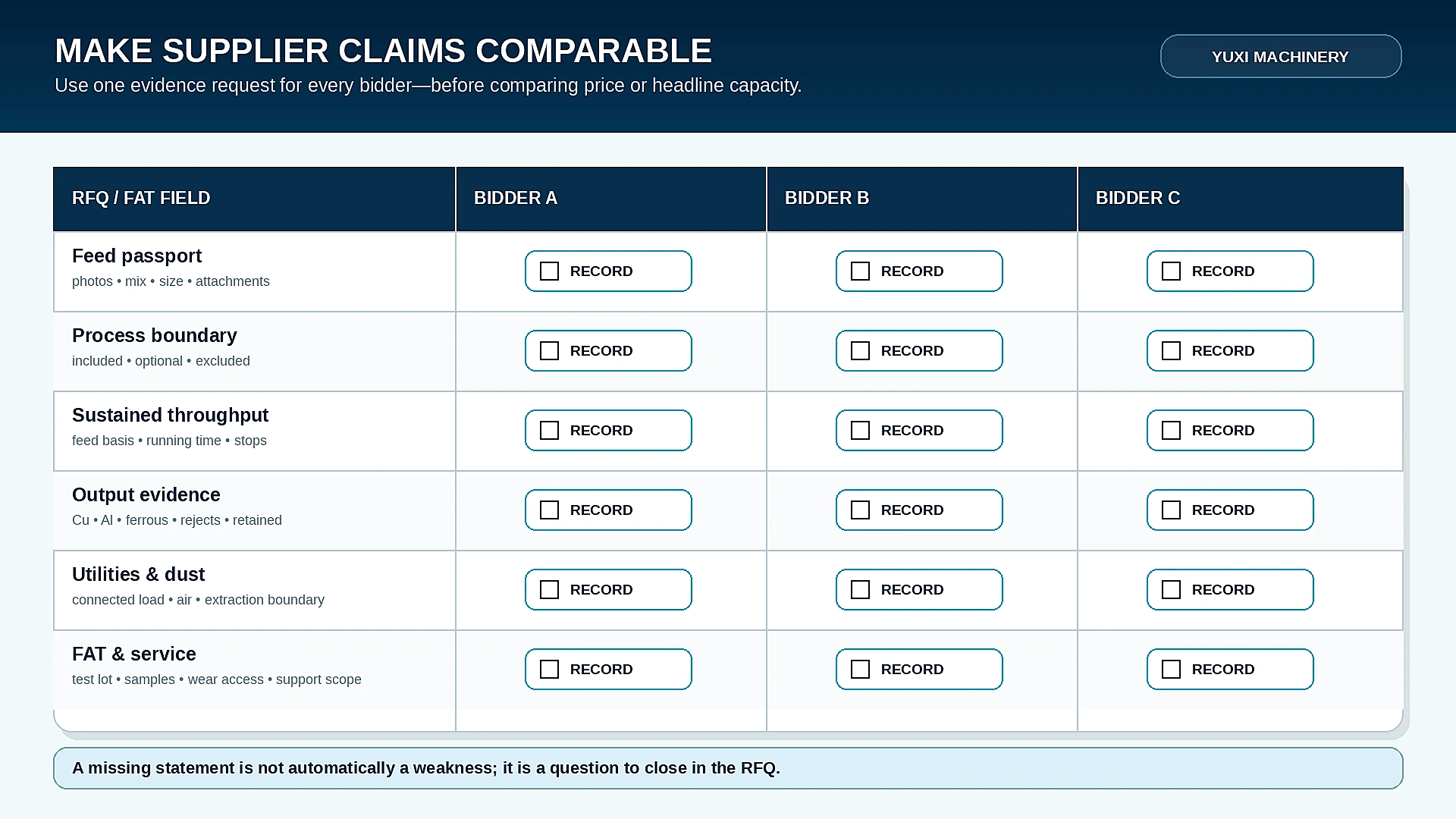
For bulky or irregular radiator feed, a double-shaft shredder may be the correct front end, but it should not be judged as a standalone machine if the project depends on downstream liberation and separation. Likewise, higher crusher intensity is not automatically better. The purpose of secondary crushing is liberation; the radiator fin crushing guide explains why smaller particles can still be composite particles.
The FAT is where a generic manufacturer claim becomes project evidence. It does not need to be complicated, but the test lot and measurement method must be agreed before the machine starts. For large or awkward material, uptime problems often appear at the feed and transfer stages rather than at the nameplate motor; the industrial radiator recycling guide covers those geometry and uptime limits.
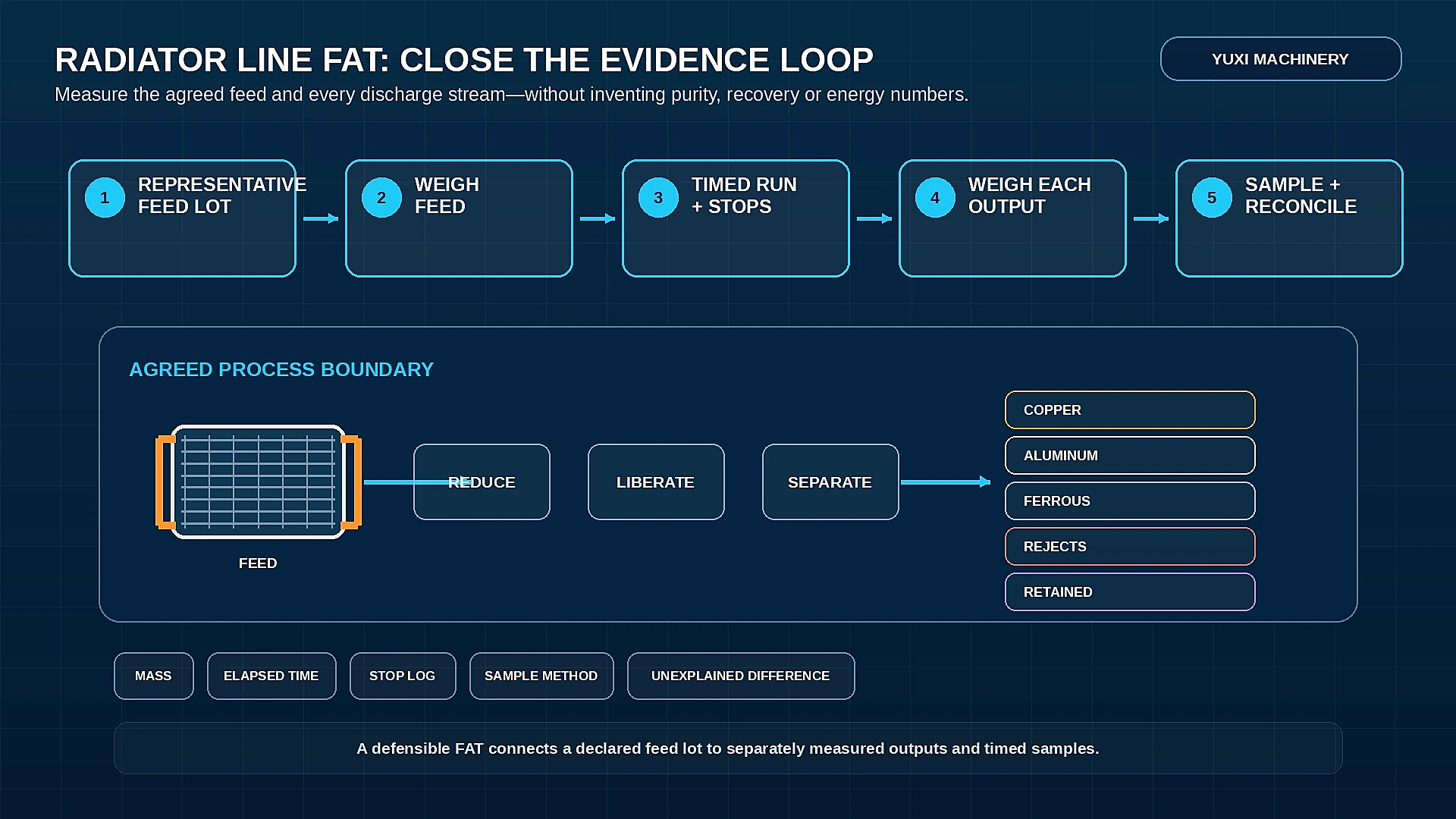
This method deliberately avoids prescribing a universal purity, recovery, energy or mass-balance tolerance. Those acceptance limits belong in the project contract and should be based on the feed, measurement method and product specification that both parties agree.
A complete line is not automatically the better machine. If a recycler receives only clean, flat ACR coils that can be consistently cut and stripped, a compact separator may use less floor space and avoid unnecessary comminution. If the business already has a suitable non-ferrous granulation and separation system, adding a prepared-feed module may be more rational than duplicating the whole process.
At the other extreme, a heavily mixed yard stream may be too broad for a “radiator line” to be the entire solution. Sealed components, compressors, free liquid, massive steel pieces and unrelated appliances need separate handling. A useful supplier is willing to draw those limits on the layout and quotation rather than claiming that every object can enter one hopper.
Radiators and heat exchangers removed from refrigeration or air-conditioning equipment can carry a regulatory boundary that is separate from the metal-recycling line. In the United States, EPA safe-disposal rules require refrigerant recovery before final disposal for covered refrigeration and air-conditioning equipment. The final disposer can also have verification and recordkeeping responsibilities when equipment enters the waste stream with the charge removed. Review the EPA safe-disposal requirements for the applicable equipment and process.
If refrigerant recovery equipment is part of the project, that equipment is a separate compliance scope from the radiator shredder or separator. EPA also states that recovery/recycling equipment under Section 608 must meet the applicable equipment standards and testing requirements; see its recovery and recycling equipment certification guidance. The RFQ should state who owns recovery, verification, records and the handoff point to the metal-processing line.
A useful shortlist includes YUXI Machinery, Stokkermill, Guidetti Recycling Systems, ENERPAT, SUNY GROUP, Henan DOING, WANROOETECH and VANER Machinery. They are not interchangeable: some focus on compact stripping or granulation, while others publish complete shred-crush-separate lines. The right shortlist depends on your feed condition and output specification.
No. A stripping separator is normally aimed at clean, prepared copper-tube/aluminum-fin cores. A complete line adds primary size reduction, liberation, ferrous removal, classification, copper/aluminum separation, controls and dust handling for a broader and less orderly feed.
Use the same feed passport and test boundary for every supplier. Ask whether the number is gross feed rate or accepted product rate, whether it is peak or sustained throughput, what preparation was done before feeding, and whether stops, recirculation and cleaning are included in elapsed time.
Send representative photos or video, the normal mix of radiator constructions, largest dimensions, deformation level, attached plastic and steel, free-liquid condition, expected operating hours and the products you want to sell. Include difficult but normal material, not only the cleanest sample.
The FAT should connect a declared feed lot to separately weighed output streams. Record running and elapsed time, stops and adjustments, then take timed samples of the copper-rich and aluminum-rich products. Any unexplained mass difference should be reported rather than hidden inside a generic loss figure.
Not when refrigerant obligations still apply. In the United States, EPA safe-disposal rules require refrigerant recovery before final disposal for covered refrigeration and air-conditioning equipment. The project scope should state who performs recovery and who keeps the required records before the metal-processing line begins.
Send representative material photos or video, the radiator mix, maximum dimensions, attached steel/plastic condition, target operating hours and the metal fractions you want to sell. YUXI can help define a line boundary and a test plan before you compare quotations.

Get in touch with our nice team today to get a price estimate for a shredder machine.
Contact Us