





“Large scale” is more about uptime and line balance than a fixed TPH
There is no useful universal tonnage where a radiator line suddenly becomes “large.” Published equipment ranges illustrate the problem. Current supplier pages show standard radiator lines around 400–500 kg/h at the lower end, 1–2 t/h in common mid-range packages, and configurations advertised up to about 5 t/h. Those numbers are helpful for market orientation, but they are not interchangeable guarantees. Feed dimensions, composition, preparation and separation depth differ from one project to another. That is why the first capacity figure in the RFQ should be a production requirement, not a model number. State the expected tons per day or tons per year, the number of shifts, and how many hours are realistically available for feeding material. Then work forward.Step 1: convert the business target into required sustained throughput
A buyer may say, “We need a 2 t/h line.” Sometimes that is already well defined. Quite often it is simply annual volume divided by calendar hours, with no allowance for breaks, inspections, blade changes, bin swaps or normal interruptions. A more useful starting formula is: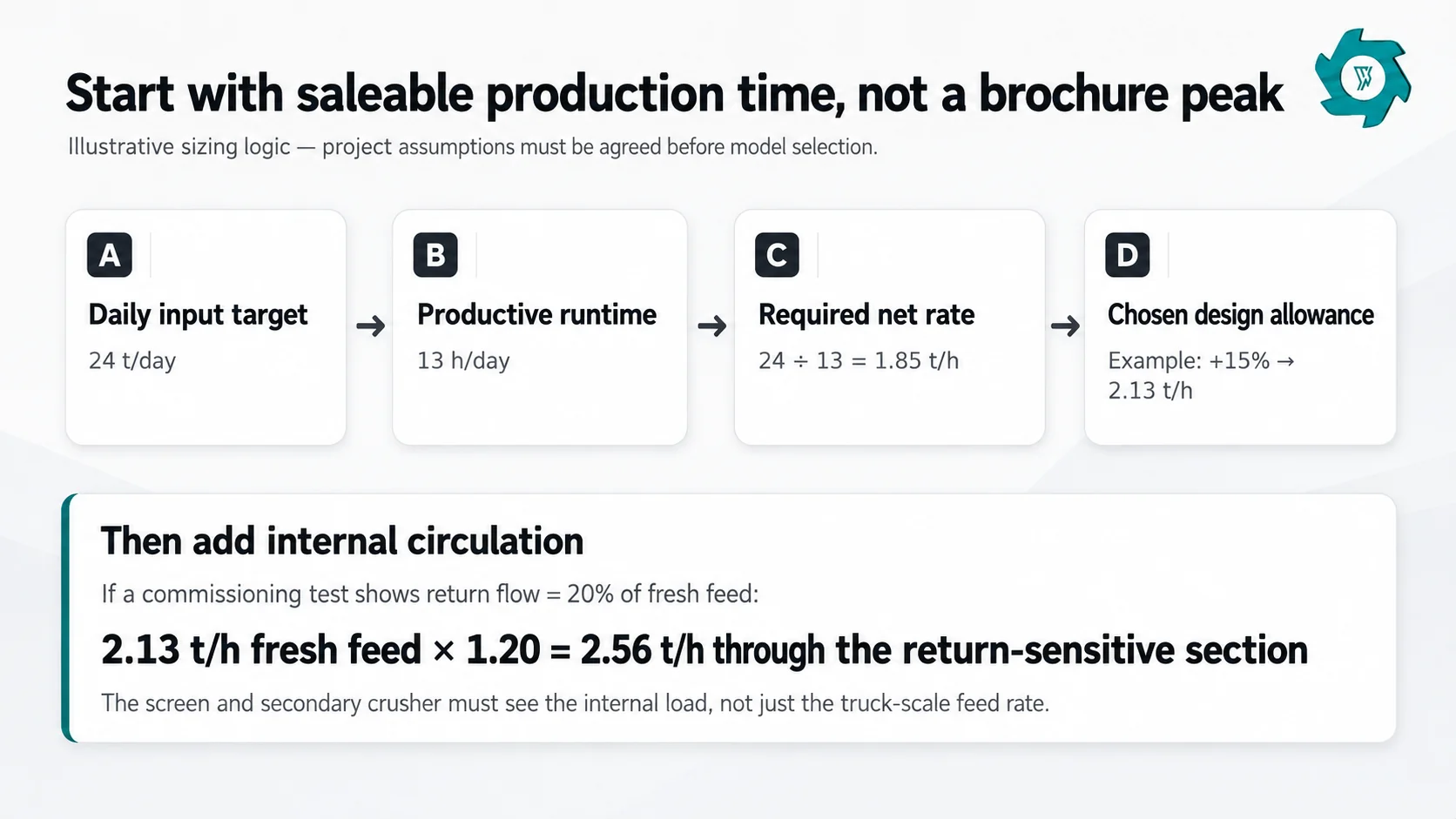
Step 2: describe the feed in both tonnes and volume
Radiators are awkward capacity material because mass alone does not tell you how they enter the line. A loose stack of passenger-car radiators can fill a hopper quickly while the scale still shows a modest weight. Baled cores do the opposite: the same apparent volume may carry much more mass and create sharper torque peaks. This is one reason the radiator shredder selection question cannot be separated from capacity. A shredder may have enough drive power on paper and still lose effective throughput because flat cores bridge above the cutters, oversize heat exchangers sit across the hopper, or the loader feeds several dense bundles at once. For a serious capacity review, we would normally record at least:- normal and maximum radiator dimensions;
- loose, flattened, stacked or baled condition;
- approximate bulk density from a representative container or loader bucket;
- plastic tanks, steel frames, rubber and dirt in the normal feed;
- the “worst normal” batch, not just the cleanest sample;
- how material will actually be loaded: manual, grab, forklift, bin tipper or conveyor.
Step 3: give each stage its own capacity definition
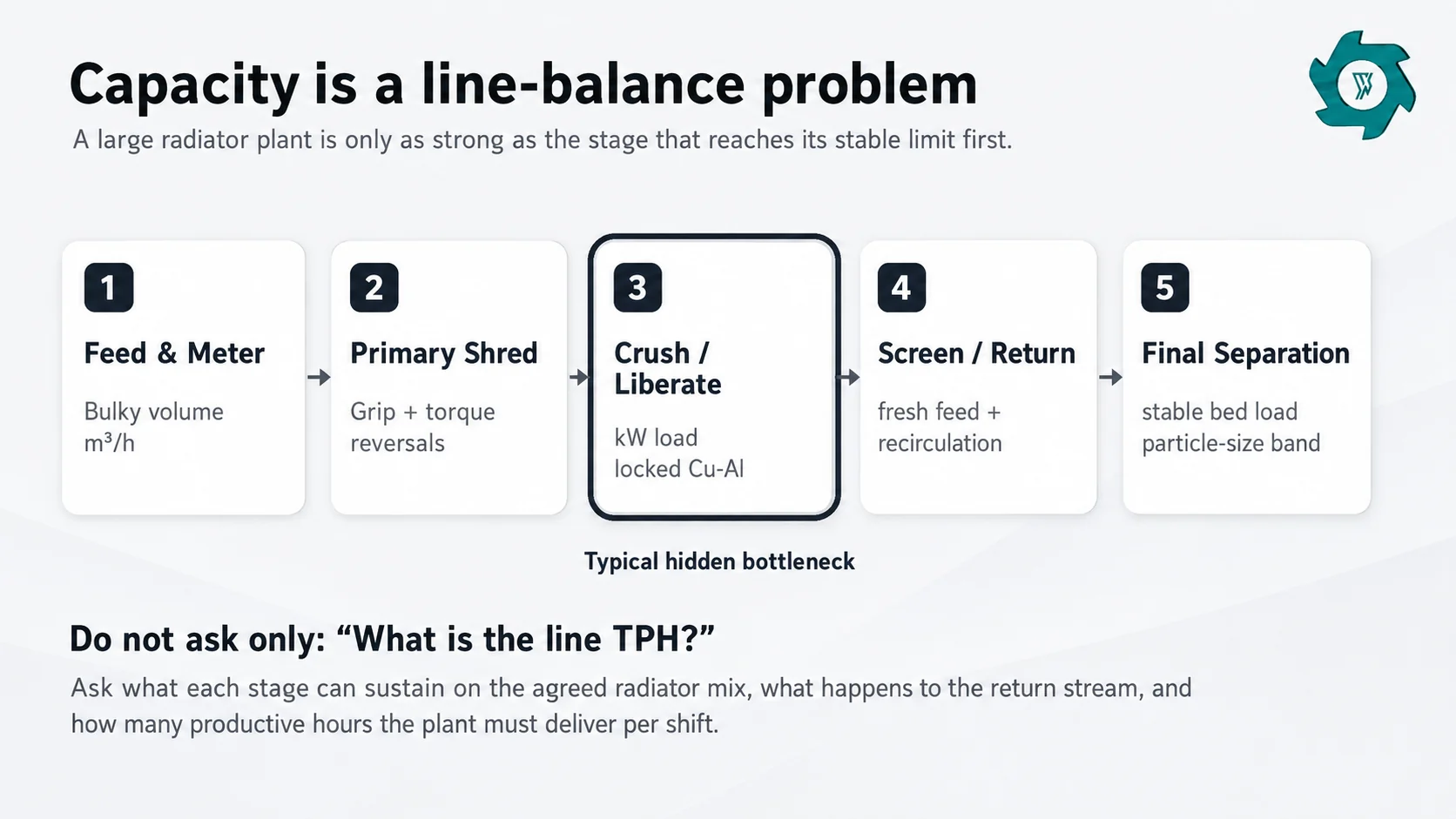
A common quotation mistake is to copy one number across the flow sheet: 2 t/h conveyor, 2 t/h shredder, 2 t/h crusher, 2 t/h separator. It looks tidy. In practice, each machine sees a different material condition and sometimes a different mass flow.| Stage | What really limits capacity | What to verify |
|---|---|---|
| Feeding & surge storage | Bulk volume, bridging, loader surges | m³/h, hopper residence, belt loading |
| Primary shredder | Grip, torque peaks, reversing, feed geometry | Sustained rate on representative radiators |
| Primary/secondary crusher | Liberation duty, screen size, wear, motor load | Rate plus locked Cu-Al after crushing |
| Screen & return loop | Fresh feed + recirculated oversize | Total internal flow and return percentage |
| Magnetic separation | Burden depth, belt speed, exposed ferrous pieces | Iron carryover at target flow |
| Gravity/air separation | Feed depth, size distribution, light fraction | Product quality at sustained feed |
| Dust collection | Air volume and dust generation, not TPH alone | Extraction at crusher, transfer and separator points |
The primary shredder should protect flow, not chase the final particle size
At the front of a large radiator line, stable feeding is often more valuable than fine discharge. The shredder should accept the agreed radiator envelope, break awkward shapes and supply the crusher without repeated surges. Watch the reverse count during a test. Occasional automatic reversing is normal in heavy scrap work. Reversing every few seconds is different. It can mean the feed rate is too aggressive, cutter geometry does not suit the material, steel content is outside the expected range, or the shredder is being asked to make a smaller product than the next stage actually needs. A loader can push several easy radiators through quickly and create an impressive momentary rate. What matters for line sizing is sustained feed over a meaningful run that includes normal variation.The crusher must be sized by liberation duty, not only motor power
The crushing section is where many “2 t/h” projects stop behaving like 2 t/h projects. Copper tubes, folded aluminum fins, plastic fragments and small steel attachments do not break at the same rate. A crusher that moves two tonnes of one prepared coil stream can slow down on another stream that needs more work to release the metals. The radiator fin crushing guide goes deeper into locked copper-aluminum pieces, screening and return flow. For capacity sizing, the important point is simple: a crusher has not met the duty just because two tonnes passed through it. It must pass the material at the required rate and leave the downstream separator with a feed it can actually sort. If the line has to reduce speed to achieve acceptable liberation, the lower rate is the real design capacity. If it maintains rate only by producing excessive fines, that also deserves attention. Fine aluminum can increase dust load and behave differently in air or gravity separation.Return flow can make the middle of the plant larger than the front end
This is the part that gets missed most often in early layouts. A closed circuit may screen out oversize or incompletely liberated pieces and send them back to a secondary crusher. The truck scale still records only fresh feed, but the screen, return conveyor and crusher see fresh feed plus the recycled material. Using the earlier 2.13 t/h example, assume a commissioning test shows that the return stream averages 20% of fresh feed. The return-sensitive section then handles roughly 2.56 t/h: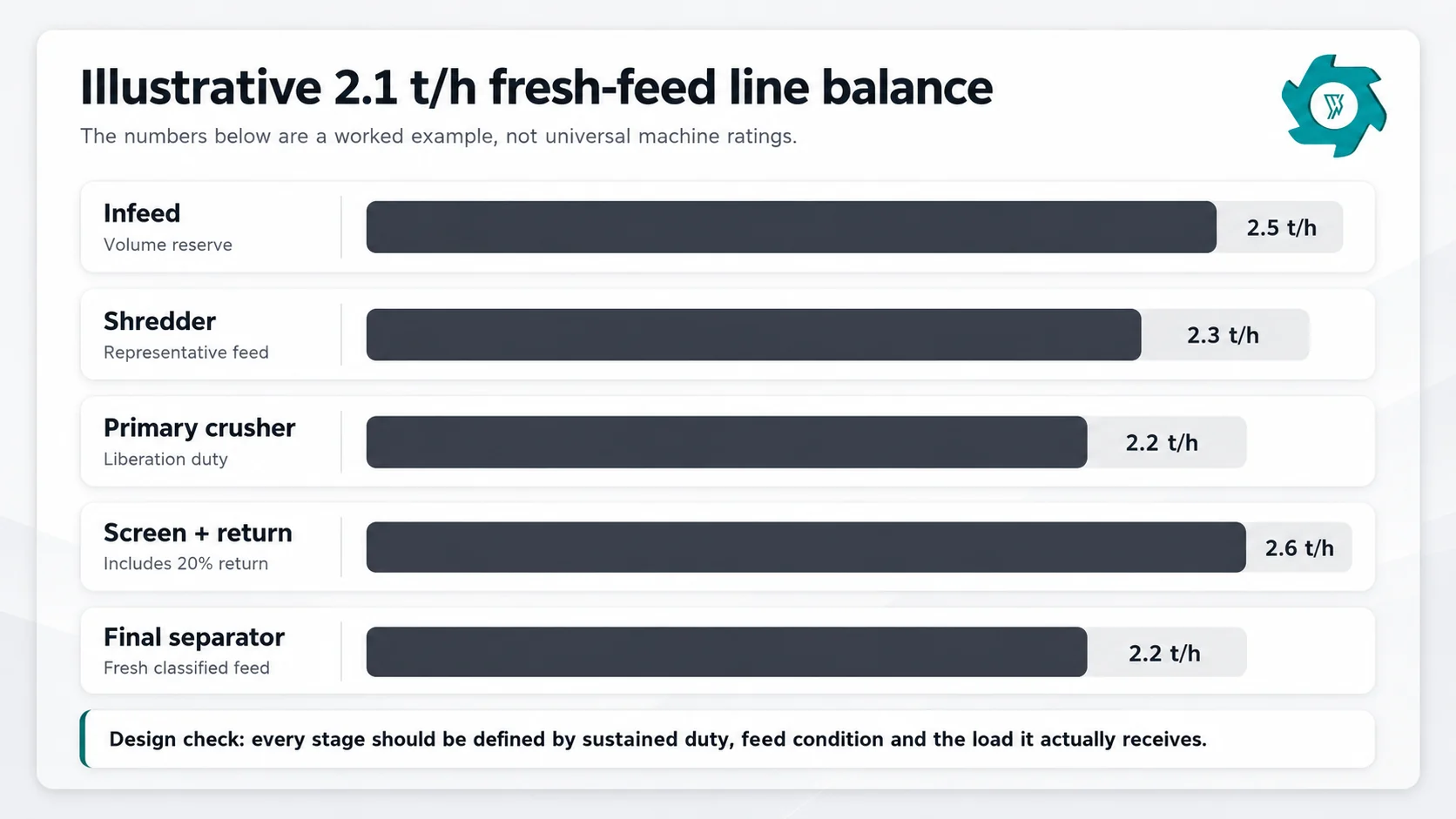
Final separation has a quality limit as well as a mass-flow limit
Gravity and air separators can continue moving material after the useful separation window has been exceeded. The warning sign is often not a motor trip. It is product quality drifting. As feed depth rises, copper-rich particles may start reporting with the aluminum-rich stream, light aluminum can be carried into the reject fraction, or the middlings load grows. Wide particle-size distribution makes the problem worse because a large aluminum flake and a small dense copper piece do not respond to airflow and deck motion in the same way. For that reason, the separator capacity test should be tied to product specifications. “The machine ran at 2.5 t/h” is incomplete. A more useful statement is: it sustained the agreed feed rate, with the agreed size distribution, while each product remained within the buyer’s acceptance range.Do not confuse gross feed TPH with saleable metal output
Dirty automotive radiators make this especially obvious. Plastic tanks, steel brackets, dirt and rubber add mass and volume to the line but do not become copper or aluminum product. A plant processing 2 t/h gross feed may produce a much smaller combined non-ferrous product rate, depending on the feed mix. For project economics, record both numbers. Gross feed tells you what the machinery must handle. Saleable output tells you what the business earns from the process. The ratio can change from one supplier or season to another. This also helps diagnose a misleading capacity “improvement.” If gross feed rises because the incoming load contains more steel and plastic, the scale may look better while copper-aluminum output stays flat. The plant did not become more productive; the feed changed.Where to place capacity headroom
Adding the same percentage everywhere is easy, but it is not always the best use of capital. Headroom is most valuable where variability is expensive to absorb. A surge conveyor or hopper may need volume reserve because the loader feeds in batches. The shredder may need torque and opening reserve because a difficult radiator occasionally arrives. The screen and return circuit may need extra mass-flow capacity because internal circulation changes with liberation. The final separator may need enough deck or air capacity to keep feed depth stable when the upstream section briefly surges. There is no single correct spare-capacity percentage. We normally decide it from four questions: how variable is the feed, how expensive is downtime, how much return flow is expected, and whether the plant can divert or store material when one section is stopped.One line or two parallel modules?
At higher annual volumes, buyers sometimes assume one very large line is always cheaper. Not necessarily. Parallel modules can make sense when the business receives two very different feed families, when maintenance continuity is critical, or when site expansion will happen in stages. For example, clean AC coils and dirty automotive radiators may not deserve the same process recipe. Two parallel front-end or liberation routes can avoid tuning one large line as a compromise. The tradeoff is obvious: more equipment, controls, conveyors and floor space. A single line is usually simpler to operate and maintain when the feed mix is reasonably stable. Parallelization becomes more attractive when flexibility or uptime has real financial value. This is a project decision, not a badge of scale.A practical capacity worksheet for a large radiator project
Before asking for model numbers, put the following on one page. It gives both the buyer and supplier a common definition of “capacity.”| Input | Example entry | Why it matters |
|---|---|---|
| Annual radiator input | 7,200 t/year | Sets the business target |
| Operating days | 300 days/year | Converts annual to daily load |
| Productive hours | 13 h/day | Defines sustained hourly need |
| Normal feed mix | 60% AC coils / 40% car radiators | Controls breakage and contamination |
| Largest normal piece | Record L × W × H | Sets hopper and shredder opening duty |
| Bulk condition | Loose / stacked / baled | Affects volumetric feeding |
| Expected return ratio | From material test | Sizes screen, return and secondary crusher |
| Target products | Separate Cu-rich and Al-rich fractions | Sets liberation/separation depth |
| Buyer quality limits | Define before FAT | Turns separator capacity into a measurable result |
How to find the bottleneck during commissioning
Large lines rarely announce the bottleneck with a single alarm. The pattern is usually visible across several measurements.- Shredder idles while crusher current stays high: the crushing section may be setting the plant rate.
- Shredder reverses frequently while downstream equipment waits: the front end may be under-sized or poorly matched to feed geometry.
- Screen return rises as feed rate increases: liberation or classification is not keeping pace.
- Separator products deteriorate before motors reach full load: the quality limit has been reached before the mechanical limit.
- Conveyor and hopper look full at low scale rate: the line has a volumetric feeding problem, common with loose light radiator cores.
- Good first hour, weak later hours: inspect wear, heat, dust buildup, bin changes and cleaning time before calling the peak rate “capacity.”
What a meaningful FAT or capacity test should record
A short factory video is useful for confirming layout and basic operation, but it is not enough to prove large-scale capacity. Agree on the feed and the measurements before the test starts. Use representative material, including the difficult but normal part of the feed. Run long enough for conveyors, screens and separators to reach a stable condition. Record interruptions rather than editing them out of the result.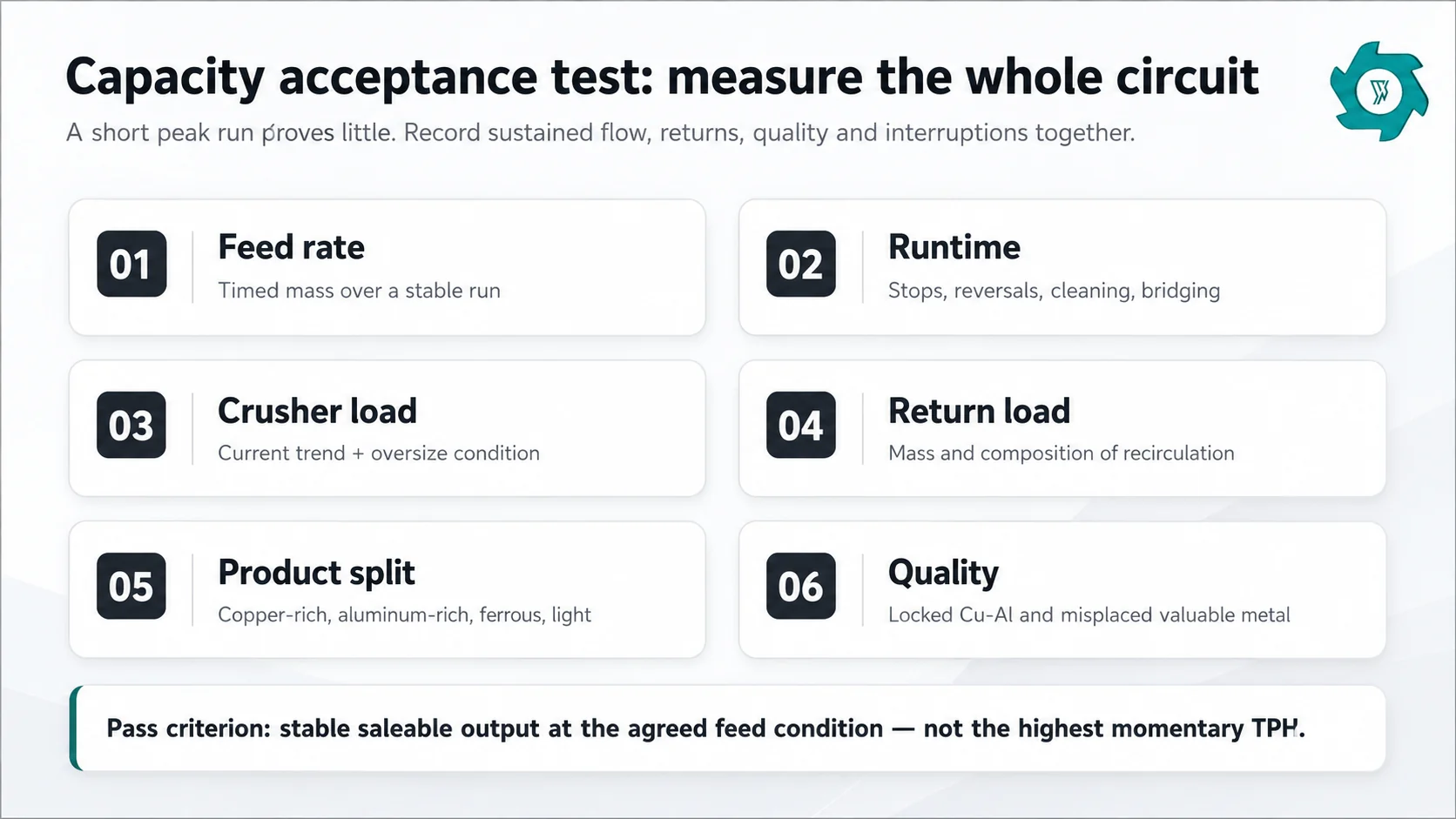
| Measurement | Minimum useful record |
|---|---|
| Fresh feed | Timed mass over the stable test period |
| Runtime losses | Bridging, reversals, cleaning, screen stops, bin changes |
| Crusher discharge | Size distribution and visible locked Cu-Al pieces |
| Return stream | Mass rate plus whether it is composite or already liberated metal |
| Final products | Mass split and samples from copper-rich, aluminum-rich, ferrous and light fractions |
| Fine fraction | Quantity and where valuable metal reports |
| Dust behavior | Visible escape, buildup and extraction performance at transfer points |
When a larger machine will not fix the problem
Some capacity problems are actually process problems. Buying a larger shredder will not fix a separator that is receiving wide, unstable particle sizes. A bigger crusher will not fix wet sticky feed. A wider separator will not fix copper and aluminum that remain physically locked together. Sometimes the cheapest capacity upgrade is feed control: a buffer bin, variable-speed conveyor or clearer receiving standard. In another plant it may be a screen change, selective return loop or better removal of bulky plastic before the main line. The correct upgrade is the one that removes the measured bottleneck.Capacity questions to put in the RFQ
Instead of asking only for “2 t/h” or “5 t/h,” ask the supplier to state what that capacity means. A useful RFQ can request:- sustained fresh-feed rate on the agreed radiator mix;
- maximum normal feed dimensions and bulk condition;
- expected condition after primary shredding;
- crusher duty and target liberation/size range;
- screen cut and expected return-flow basis;
- maximum internal load through the secondary circuit;
- separator feed range tied to product-quality targets;
- surge storage and conveying capacity between major stages;
- planned wear-part, cleaning and inspection access;
- FAT method for feed rate, return flow and output sampling.
Size the radiator line around your real shift target
Send YUXI your radiator photos or videos, annual volume, shift schedule, largest normal feed, contamination level and the products you want to sell. We can map the required fresh-feed rate, likely return-sensitive sections and the information needed for a capacity test before the final equipment configuration is selected.
Large-scale radiator recycling capacity FAQ
Is a 2 t/h radiator line enough for 16 tonnes in one eight-hour shift?
Not automatically. Eight clock hours rarely equal eight hours of material-on-belt time. Divide the shift target by realistic productive hours, then check the design allowance, feed variability and return load. A nominal 2 t/h line could be tight if the plant needs 16 tonnes of sustained input with normal stoppages.
Should the shredder, crusher and separator all have the same TPH rating?
No. Each stage sees a different material condition. Feeding can be limited by volume, shredding by grip and torque, crushing by liberation duty, and separation by stable feed depth and product quality. A return circuit can also make the middle of the line handle more mass than the fresh-feed rate.
How much spare capacity should a large radiator recycling line have?
There is no universal percentage. Headroom should reflect feed variation, loader surges, expected return flow, downtime cost and whether material can be buffered or diverted. Make the chosen allowance explicit in the project calculation rather than assuming one fixed margin applies everywhere.
Why can loose radiators limit capacity even when they are lightweight?
They occupy a lot of volume. Hoppers and conveyors can fill before the target mass rate is reached, and flat cores may bridge rather than enter the cutters cleanly. That is why bulk condition and loading method belong in the capacity calculation.
How should radiator line capacity be tested before purchase?
Use representative feed and a sustained run. Record fresh-feed mass, interruptions, crusher discharge, screen return, product mass split, visible locked copper-aluminum pieces and final product quality. A short peak-rate demonstration is not enough to establish continuous production capacity.
When are two parallel radiator processing lines worth considering?
Parallel modules can be useful when feed families need different process recipes, when uptime during maintenance is critical, or when the project will expand in stages. One larger line is usually simpler, so the extra flexibility should have a clear operating or financial reason.