A machine that shreds clean carton trim in a factory is not automatically the right machine for wired OCC bales, wet retail boxes or paper-mill rolls. This 2026 buyer’s shortlist compares manufacturers by the cardboard and paper applications they publicly show, the type of size reduction they offer, and the questions an industrial buyer still needs to verify.The shortlist favors demonstrated cardboard or paper relevance, a defined feed envelope, process fit, test evidence and usable support—not a generic claim that a shredder handles waste.
How We Evaluated Cardboard Shredder Manufacturers
The published scope of each company was checked on its own website. A manufacturer received stronger consideration when it showed cardboard, corrugated board, paper rolls, paper-mill waste or related applications rather than mentioning paper only in a long material list. We also considered available shredder architectures, feeding and discharge integration, test opportunities, maintainability and the clarity of the commercial boundary.The shortlist excludes office document shredders and most tabletop carton perforators because their feed width, loading method and operating pattern are different. It also avoids treating a baler as a shredder. Buyers unsure about that boundary should first compare a cardboard shredder versus a baler.
Weight
Criterion
What was reviewed
25%
Direct material relevance
Public cardboard, corrugated or paper examples and the incoming forms shown.
20%
Feed and output fit
Whether the technology can be configured for bulky sheets, bales, rolls, cores or a controlled screen size.
20%
System completeness
Feeding, controls, separation, discharge, dust interface and line-integration capability.
15%
Test and project evidence
Application videos, trials, references and willingness to define acceptance conditions.
10%
Maintenance access
Cutter access, foreign-object response, wear parts and service information.
10%
Commercial clarity
Defined inclusions, exclusions, utilities, installation duties and performance boundary.
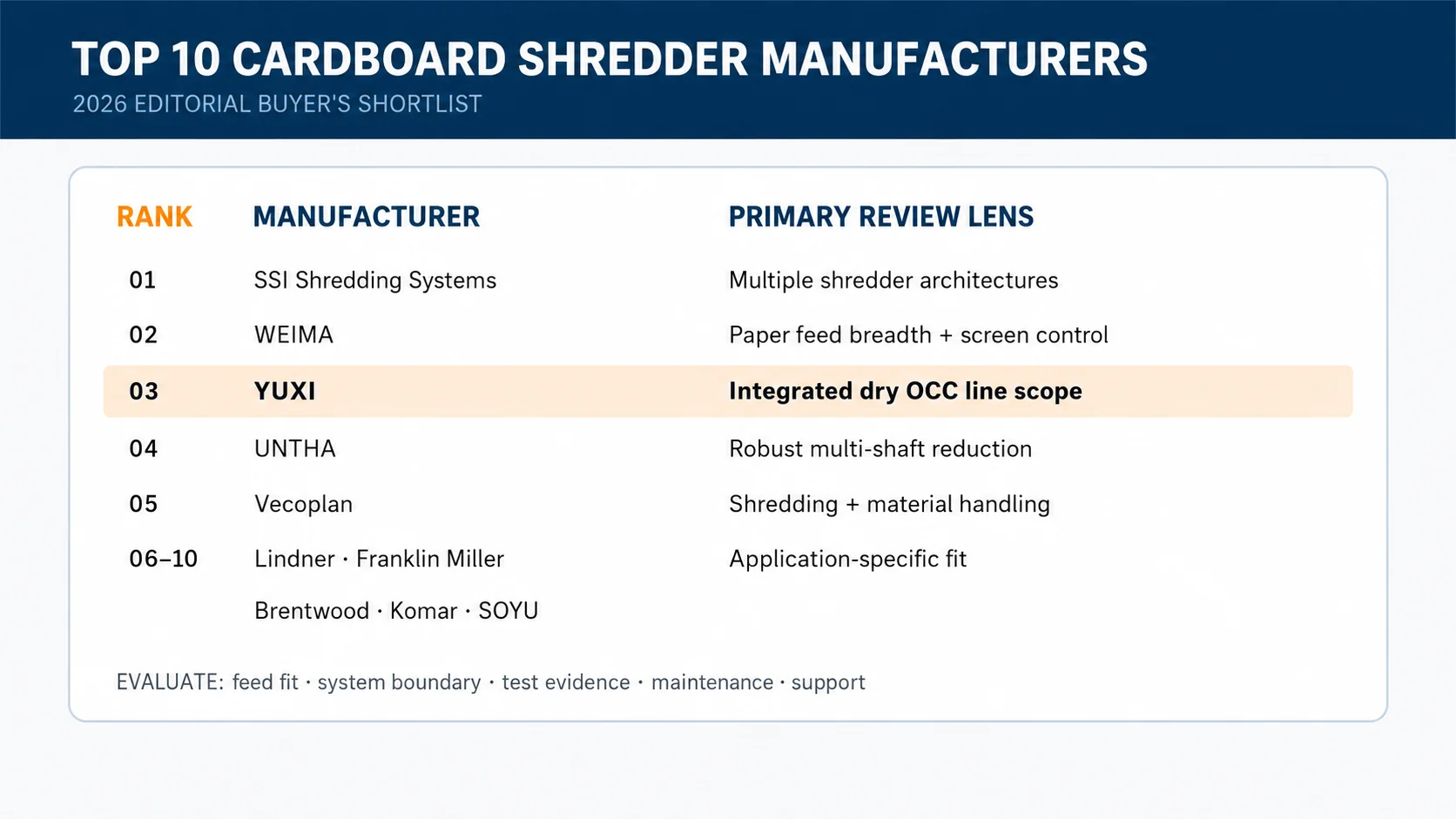
Top 10 Cardboard Shredder Manufacturers: Comparison
Rank
Manufacturer
Relevant equipment focus
Best evaluation fit
1
SSI Shredding Systems
Single-, dual- and four-shaft industrial shredders; paper and mill-waste applications
Buyers needing multiple shredder architectures and documented application trials
2
WEIMA
Single- and four-shaft shredders for cardboard, rolls, sheets, bales and production waste
Industrial paper processors comparing screen-controlled reduction and large-format feeds
3
YUXI
Double-shaft primary shredding and integrated dry OCC preparation systems
Projects seeking receiving-to-baling coordination from one line supplier
4
UNTHA
Four-shaft and other industrial shredders for paper, cardboard and paper-industry rejects
Applications needing robust reduction with configurable fraction control
5
Vecoplan
Single-shaft shredding, conveying, dosing and paper/cellulose systems
Large continuous systems where material handling is as important as the rotor
6
Lindner Recyclingtech
Paper recycling and product-destruction shredding systems
High-duty paper waste or product-destruction projects requiring defined output
7
Franklin Miller
Twin- and quad-shaft TASKMASTER equipment for cardboard and bulk paper
Facilities evaluating compact low-speed reduction and customized installation
8
Brentwood Recycling Systems
High-rate cardboard sheet shredders, strip shredders and conveyor integration
Australian projects and sheet-fed applications, including pneumatic transfer interfaces
9
Komar Industries
Auger compactors with ripper shafts and cardboard pre-shredding
Distribution and waste-handling sites where reduction and compaction are linked
10
SOYU
Heavy-duty paper and cardboard shredders for cartons, tubes, rolls and factory scrap
Buyers comparing configurable shredding for varied paper-product forms
The 10 Manufacturers in Detail
1 SSI Shredding Systems
Relevant focus: SSI publishes industrial paper and mill-waste applications and a corrugated-cardboard example using a four-shaft system. Its broader portfolio gives buyers room to compare primary reduction, controlled sizing and different cutter arrangements. Verify before purchase: Ask which architecture is proposed for your actual cardboard form, how the test sample represents normal and worst-case feed, and whether downstream conveyors and dust pickup points are inside SSI’s scope.
2 WEIMA
Relevant focus: WEIMA shows paper and cardboard applications covering sheets, rolls, bales and industrial waste, with single-shaft and four-shaft options. Screened single-shaft reduction may suit projects that need a defined upper particle size, but dense bales and long rolls require their own feeding strategy. Verify before purchase: Confirm ram behavior with springy corrugated feed, screen loading, throughput at the specified screen, and the procedure for wire or other foreign material.
3 YUXI
Relevant focus: YUXI’s waste cardboard recycling machine and plant covers a connected dry route: receiving, controlled feeding, primary shredding, ferrous removal, metered transfer, mechanical fiber opening, dust collection and loose or baled discharge. That broader boundary is useful when an OCC recycler wants one party to coordinate machine interfaces. Verify before purchase: Define whether feed is loose or baled, how bale wire is handled, which contaminants are prohibited, what “accepted output” means and which dust-control components belong to the project.
4 UNTHA
Relevant focus: UNTHA identifies paper, cardboard and complete paper rolls as application materials and offers multi-shaft machines with screen-based fraction control. Its paper-industry references also distinguish clean fiber feed from tougher paper rejects. Verify before purchase: Do not transfer results from paper rejects or document destruction to clean OCC without a material-specific test. Confirm cutter configuration, usable fraction and energy measured over a stable test window.
5 Vecoplan
Relevant focus: Vecoplan presents shredding, conveying, storage and dosing for paper and cellulose streams, including cardboard and paper tubes. This makes it relevant when feed stabilization and transfer are likely to control the project. Verify before purchase: Request the complete mass-flow diagram, interface capacities and control narrative. A powerful rotor cannot correct an undersized discharge conveyor or an overfilled intermediate bunker.
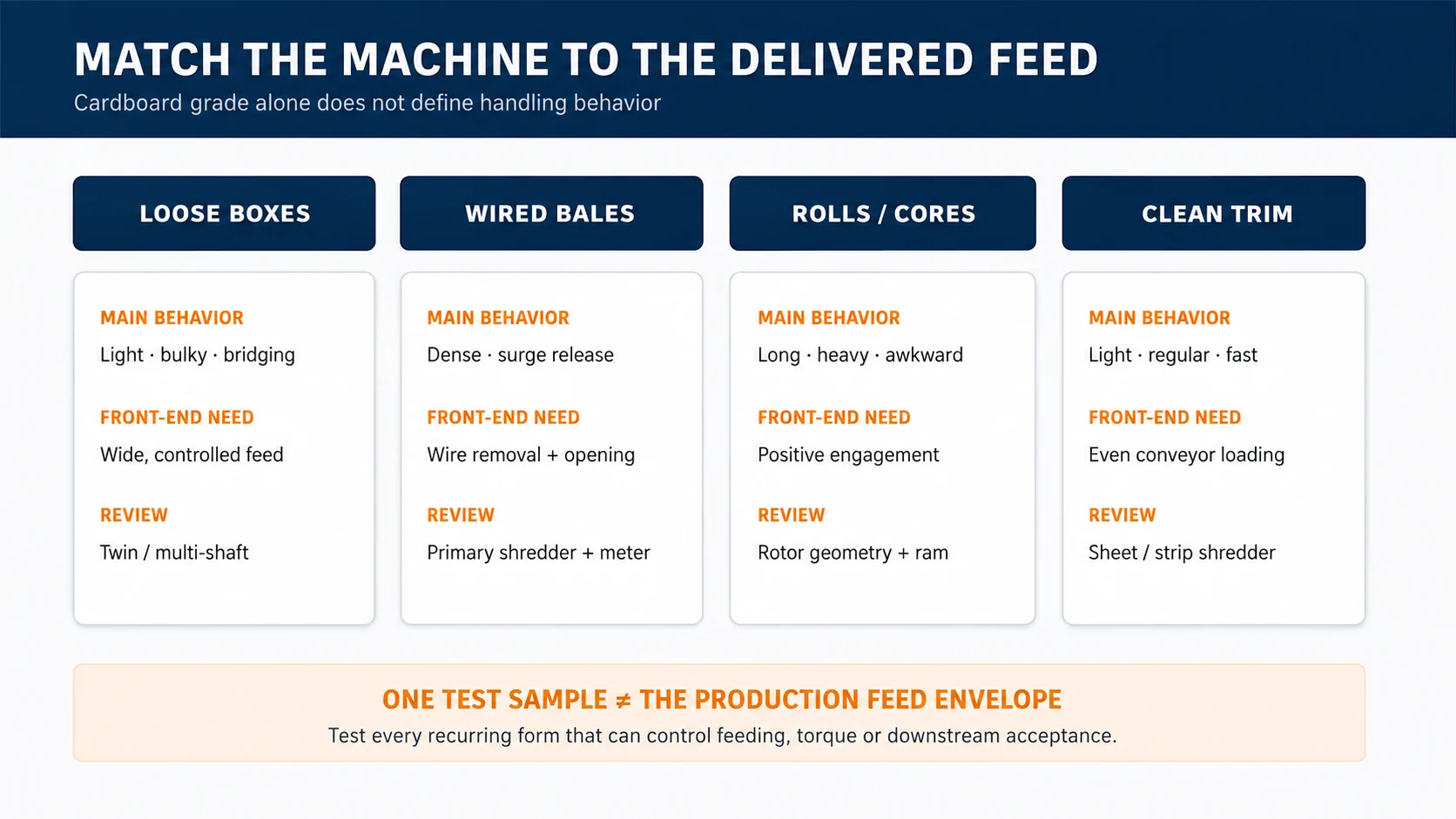
Machine type should follow the delivered feed and required output. The same cardboard grade behaves differently as loose boxes, dense bales, rolls, cores or trim.
6 Lindner Recyclingtech
Relevant focus: Lindner publishes paper-recycling and data-destruction solutions, with attention to knives, screens and drive configuration. This can suit high-duty industrial paper streams where controlled reduction is part of a larger recycling or destruction process. Verify before purchase: Establish whether the proposal targets recoverable OCC, confidential paper, product destruction or paper-industry waste.
7 Franklin Miller
Relevant focus: Franklin Miller’s TASKMASTER range includes twin- and quad-shaft machines publicly presented for cardboard and bulk paper reduction. Compact machine geometry may be valuable where the shredder must fit an existing receiving or discharge arrangement. Verify before purchase: Confirm feed-opening dimensions, loading height, the largest recurring box or bundle, cutter clearance, discharge size distribution and access for clearing non-routine material.
8 Brentwood Recycling Systems
Relevant focus: Brentwood describes cardboard-specific sheet shredders with controlled conveyor feeding and suitability for pneumatic conveying, plus higher-throughput strip shredders. This is a useful specialization for converters and paper-handling plants. Verify before purchase: Separate heavy industrial strip shredding from small packaging-padding machines in the quotation. Record feed width, thickness, loading pattern and the destination of the shredded material.
9 Komar Industries
Relevant focus: Komar approaches cardboard through waste handling: auger compactors and ripper-shaft feeders that pre-shred bulky board, reduce bridging and improve compaction. It is therefore most relevant when storage and haulage—not a precise screened fraction—drive the business case. Verify before purchase: Decide whether the output is for baling, compaction or downstream recycling. An auger system’s useful reduction is not equivalent to a screen-controlled shredder product.
10 SOYU
Relevant focus: SOYU publishes equipment for corrugated cartons, paper tubes, rolls and production rejects. Its range is relevant to buyers who want a configurable industrial paper shredder and need to compare handling of several bulky paper-product forms. Verify before purchase: Request a test using the actual mixture rather than one clean feed category. Confirm included conveyors, electrical standard, wear parts, commissioning duties and response arrangements after delivery.
First Choose the Supplier Category
Supplier category
Typical strength
Common scope gap to check
Shredder specialist
Several rotor or shaft concepts, application testing and deep size-reduction knowledge
Receiving, separation, dust collection or baling may come from other parties
Integrated recycling-line supplier
Coordinates material flow from feed to accepted discharge
Local service, detailed subsystem brands and performance boundaries need written confirmation
Waste-handling specialist
Links reduction with compaction, storage or haulage efficiency
May not produce a narrow or screen-controlled particle distribution
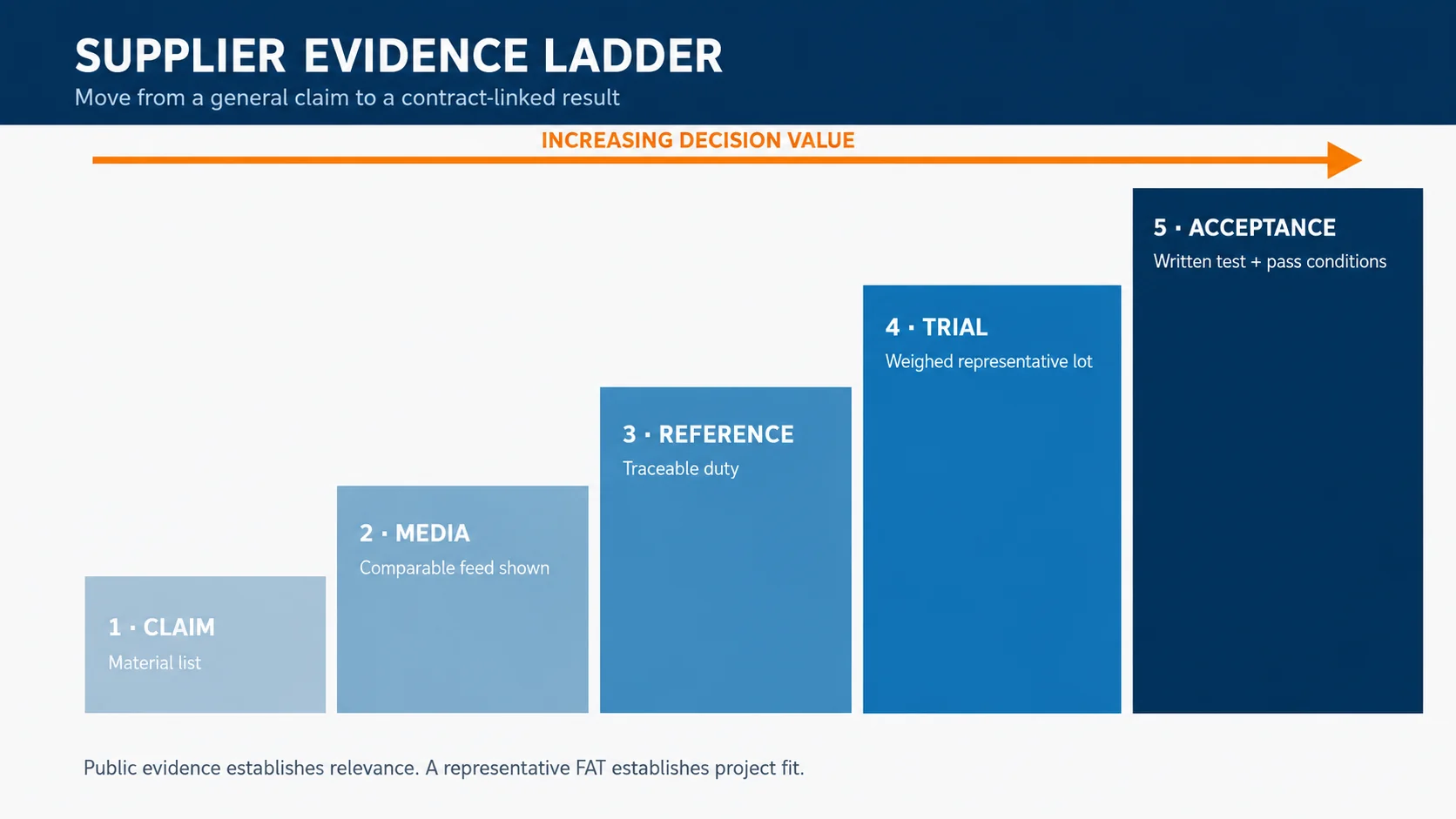
Evidence becomes more valuable as it moves from general claims to a witnessed, weighed and contract-linked test on representative material.
Level 1 — stated capability: cardboard appears in a material list.
Level 2 — relevant media: public images or video show a comparable cardboard form.
Level 3 — traceable application: a reference explains feed, machine duty and downstream purpose.
Level 4 — representative trial: the supplier processes the buyer’s normal and difficult feed while recording time, mass, stoppages and output.
Level 5 — contract-linked acceptance: the agreed test method, exclusions and pass conditions appear in the purchase specification.
This ladder prevents a common error: awarding full technical credit for a polished video. A video can establish relevance. It cannot establish sustained accepted tonnes per hour, contamination tolerance, power per accepted tonne or the labor needed to keep the line moving.
A Cardboard FAT Should Measure More Than Throughput
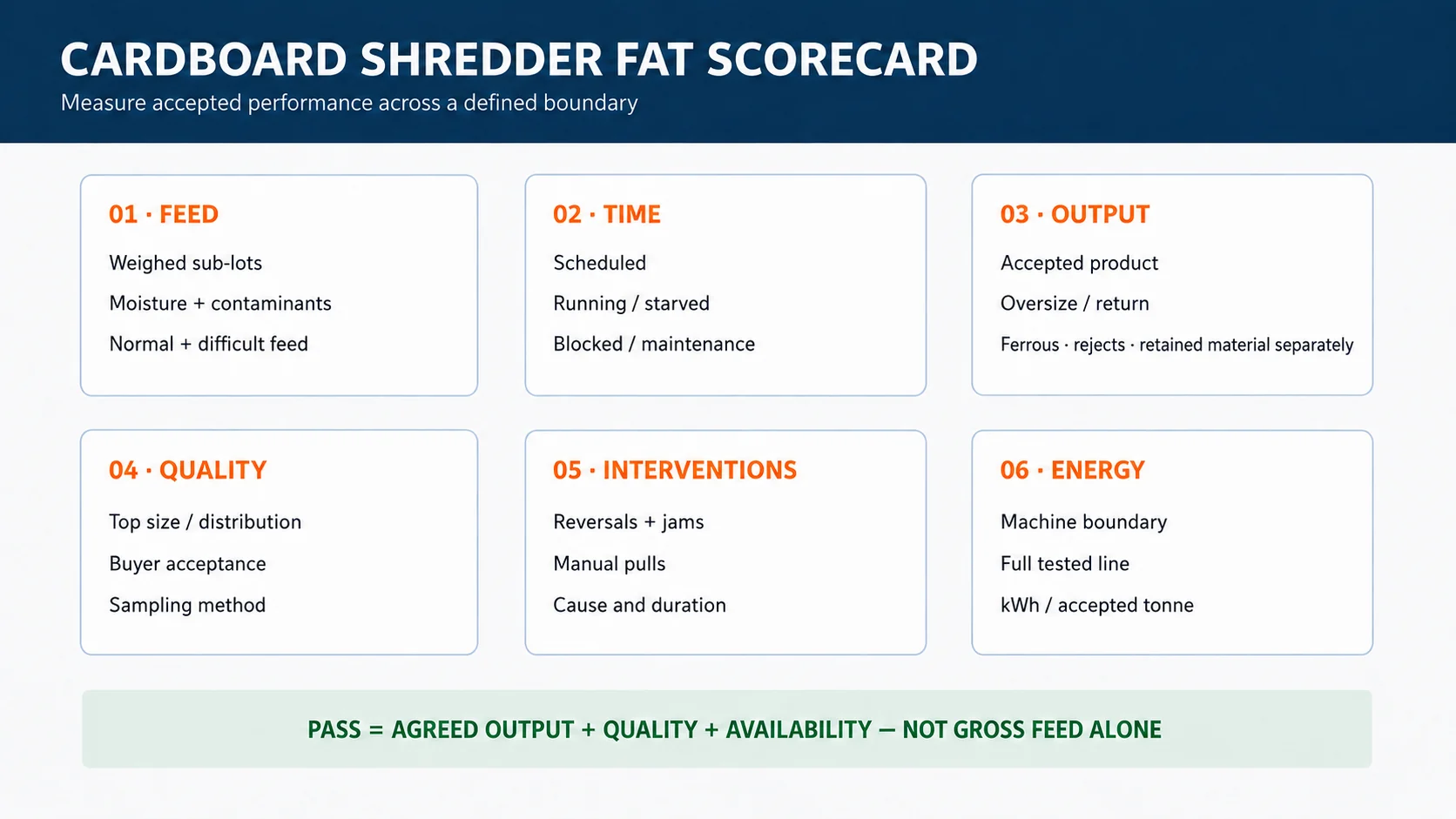
Build the trial lot from weighed sub-lots. Include normal loose OCC, the largest recurring flattened sheets, a defined share of dense bundles or bale sections, normal tape and labels, and an agreed difficult-but-acceptable fraction.A useful FAT connects feed identity, stable operating time, accepted output, interventions, energy and retained streams.
Record
Recommended basis
Why it matters
Feed
Weighed accepted material by sub-lot; moisture and contamination reported
Stops clean sample bias
Time
Scheduled, running, starved, blocked and maintenance time kept separately
Distinguishes machine rate from line availability
Output
Accepted product, oversize/return, ferrous, other rejects and retained material weighed separately where present
Prevents gross feed from being reported as saleable output
Quality
Agreed sampling method for top size, distribution or downstream acceptance
Connects shredding to the next process
Interventions
Reversals, jams, wrapping, manual pulls and causes
Exposes hidden labor and unstable feeding
Energy
Shredder and full tested boundary reported separately, divided by accepted tonnes
Makes competing scopes comparable
When the purchase covers a full dry line, review the complete cardboard recycling equipment list before freezing the FAT boundary. If the magnet, buffer, opener or baler is excluded from the test, its effect on sustained plant output remains unproven.
Normalize Every Quotation to One Boundary
Create a responsibility matrix with five labels: included, optional, by buyer, by third party and excluded. Apply it to receiving conveyors, bale-wire station, shredder, magnet, discharge, dust ducting and collector, platforms, guarding, PLC, cabling, foundations, freight, unloading, installation, commissioning, training and initial spares.Ask for guarantees in the same units. “Up to 5 t/h” is not comparable with “3 t/h accepted output” unless feed composition, moisture, screen, operating window and downstream acceptance are identical. For projects with tight buildings, check the cardboard plant layout and space requirements before accepting a machine-only footprint.
Safety and Dust Responsibilities Must Be Explicit
Paper and cardboard recycling exposes workers to moving machinery, unexpected startup, baling and crushing hazards. OSHA also identifies paper dust among materials that can be explosible when dispersed under the right conditions.12 A supplier shortlist cannot replace a site-specific hazard assessment.The proposal should state who designs guarding, interlocks, emergency stops, lockout points, access platforms, dust pickup locations, ductwork, collector protection, housekeeping access and fire controls.
Final Buyer Checklist
Define the downstream purpose: baling, pulping preparation, destruction, compaction or packaging reuse.
State loose, baled, rolled, cored and trim fractions separately.
Provide moisture and contamination ranges, not only a clean photograph.
Specify accepted output and operating hours.
Compare complete scope and interfaces.
Run a weighed trial on representative feed.
Link payment and acceptance to an agreed test method.
Confirm service response, remote support and wear-part lead times for the installation country.
Compare a Cardboard Shredding Line Around Your Feed
Send YUXI photos or video, loose or baled condition, bale size and wire, contamination, required accepted output, workshop dimensions, power supply and downstream use. The initial proposal can then define the shredder, transfer stages, separation, dust-control interfaces and output handling as one boundary.
FAQ
Who makes industrial cardboard shredders?
Industrial suppliers with public cardboard or paper applications include SSI Shredding Systems, WEIMA, YUXI, UNTHA, Vecoplan, Lindner, Franklin Miller, Brentwood, Komar and SOYU. The suitable manufacturer depends on feed form, output, duty cycle, system scope and service location.
What type of shredder is best for cardboard?
There is no single best type. Twin- or four-shaft machines can suit bulky primary reduction, while a screened single-shaft shredder can suit a controlled upper size. Sheet shredders, ripper feeders and packaging perforators serve different duties. Selection should follow the actual feed and downstream requirement.
Should a cardboard recycling plant use a shredder or a baler?
Use a baler when clean cardboard only needs densification for storage and transport. Use a shredder when bulky or irregular material must be reduced for conveying, destruction or downstream processing. Some plants need both, with shredding before baling.
How should manufacturers prove cardboard shredder capacity?
Use a weighed, representative test lot and record accepted feed, stable running time, accepted output, rejects, oversize or return material, interventions and energy. The contract should define the tested process boundary and pass conditions.
Can one cardboard shredder process loose boxes and OCC bales?
Dense OCC bales require controlled staging, wire management, opening and metering. Loose boxes are light and prone to bridging. Both forms should be included in the feed specification and trial if both will occur in production.
What information is needed for a cardboard shredder quotation?
Provide material photos, feed form, largest recurring size, bale data, moisture and contamination, required accepted output, operating hours, downstream use, workshop dimensions, power supply, loading method and destination.
References
U.S. OSHA, Recycling: Paper. Machinery, startup and crushing hazards.
U.S. OSHA, Combustible Dust. Paper dust may present an explosion hazard.
David focuses on industrial shredding and recycling equipment,including material evaluation,shredder selection,process configuration,and recycling line planning.
Speak To Our Shredder Machine Expert
Get in touch with our nice team today to get a price estimate for a shredder machine.

 English



 Fast Delivery
 Reliable
 Certified
 Experienced