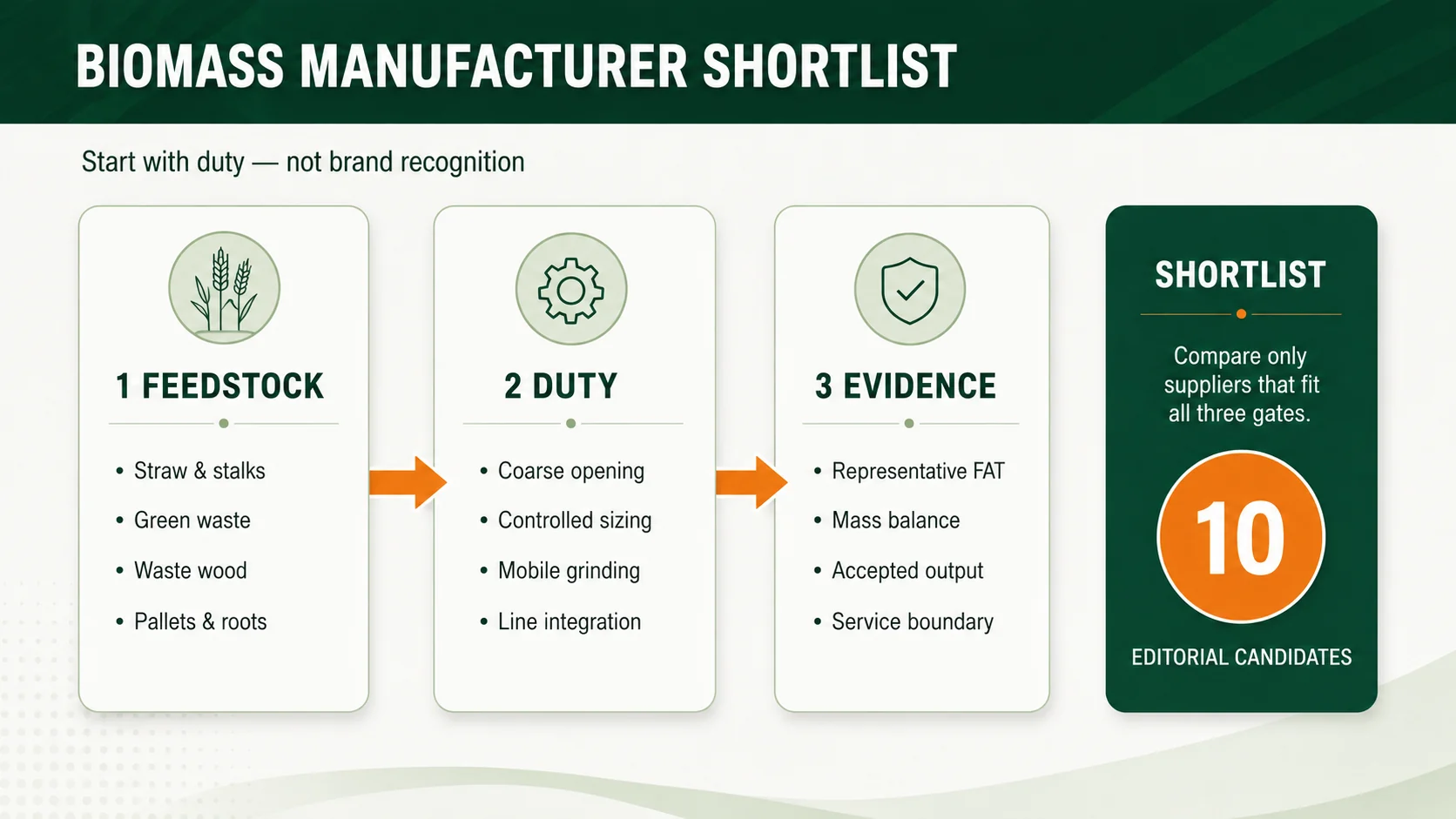
“Biomass shredder” covers several different machines. A slow-speed twin-shaft unit can open bales and tolerate occasional contaminants. A screen-controlled single-shaft shredder can make a tighter wood fraction. A mobile low-speed machine may be preferable when feedstock is spread between collection sites. High-speed grinders and chippers serve another duty again. The best manufacturer is therefore the one whose platform and project boundary match the material, not simply the best-known name.A useful shortlist starts with the feedstock and downstream specification, then narrows the machine architecture and supplier.
How We Evaluated Biomass Shredder Manufacturers
The ranking considers biomass relevance, available machine architectures, feeding and downstream integration, application testing, maintainability and service. It does not compare maximum brochure capacity because published rates rarely share the same moisture, bulk density, infeed geometry, screen opening or definition of acceptable output.
Evaluation area
What buyers should look for
Why it changes the result
Feedstock depth
Separate evidence for fibrous crops, green waste, clean wood and contaminated waste wood
These materials fail differently: wrapping, bridging, shock loading and abrasive wear
Machine fit
Slow-speed primary shredders, screen-controlled sizing, mobile options, grinders or chippers where relevant
No single cutter system is optimal for every biomass stream
Line integration
Metered feeding, conveyors, magnets, screening, recirculation, dust interfaces and controls
A correct shredder can still underperform inside a poorly balanced line
Test discipline
Representative material, recorded moisture, contamination, runtime and mass balance
A short demonstration with hand-selected feed does not establish continuous output
Maintenance
Knife access, wear protection, cleaning space, bearing protection and local spare-parts plan
Annual accepted tons depend on service time as well as instantaneous rate
Commercial clarity
Defined battery limits, exclusions, guarantees and commissioning responsibility
Low headline prices can omit essential conveyors, extraction or controls
Top 10 Biomass Shredder Manufacturers: Quick Comparison
Rank
Manufacturer
Relevant equipment focus
Best comparison use
1
Vecoplan
Wood and biomass size reduction; stationary systems and material handling
Engineered wood-fuel and integrated stationary projects
2
YUXI Machinery
Single-, double- and four-shaft shredders; configurable biomass lines
Factory-direct projects requiring flexible line configuration
3
UNTHA
Slow-speed shredding for wood, waste wood and alternative fuel duties
Energy-conscious stationary processing and defined fuel preparation
4
Lindner Recyclingtech
Stationary and mobile shredding; waste wood and fuel preparation
Continuous systems needing primary/secondary choices
5
WEIMA
Single-shaft and multi-shaft size reduction plus briquetting
Controlled clean-wood and in-house residue processing
6
Komptech
Mobile and stationary low-speed shredding and screening
Green waste, woody biomass and multi-site operations
7
Doppstadt
Mobile shredding, grinding and screening systems
Yard-scale green waste and variable incoming material
8
CBI / Terex
Horizontal grinders and high-capacity wood processing
Large woody material and high-volume grinding duties
Difficult or contaminated industrial biomass streams
10
Rotochopper
Horizontal grinding and finished-product systems
Wood waste operators targeting marketable end products
Manufacturer Profiles
1. Vecoplan
Germany / United States · Integrated wood and biomass processingVecoplan is a strong first benchmark when the project is built around waste wood, chips, boiler fuel or a stationary feed-preparation system. Its relevance is not limited to the cutting machine: conveying, storage discharge, separation and controls are important parts of the comparison. That broader scope suits buyers who want one party to discuss the material path rather than a stand-alone shredder only.
Ask during evaluation: Which rotor and screen combination is proposed for the worst recurring feed, and how will tramp metal, recirculation and surge storage affect the guaranteed accepted rate?
2. YUXI Machinery
China · Configurable stationary shredders and complete linesYUXI is relevant for buyers who want to configure a stationary line around several biomass forms instead of purchasing a fixed mobile package. The available single-, double- and four-shaft structures allow the project discussion to begin with coarse opening versus screen-controlled sizing. Conveying, metal removal, screening and downstream interfaces can be included around the shredder.Baled straw, loose stalks, bagasse, branches and nail-bearing pallets should not be grouped under one capacity figure. Buyers can start with the biomass shredding line pillar page, then provide photographs, bale dimensions, moisture range, contamination limits, target size and operating hours for a project-specific proposal.
Ask during evaluation: Request a test using the most difficult normal batch and a quotation that identifies every conveyor, magnet, screen, dust-interface provision and control responsibility.
3. UNTHA
Austria · Slow-speed waste-wood and fuel preparationUNTHA belongs near the top of a biomass shortlist where energy use, low-speed cutting and continuous waste-wood processing matter. Its equipment range is particularly relevant to stationary operators comparing one-stage and two-stage preparation for fuel or recycling. Buyers should still separate clean production wood from demolition wood and mixed waste wood because wear, contaminants and output requirements will differ.
Ask during evaluation: Obtain the energy and throughput basis for the quoted configuration, including screen, moisture, bulk density and percentage of recirculated oversize.
4. Lindner Recyclingtech
Austria · Stationary and mobile primary/secondary shreddingLindner offers useful breadth for waste wood and alternative-fuel projects, including choices between primary reduction and more controlled secondary sizing. It is a sensible comparison when the buyer is unsure whether the bottleneck is opening bulky feed, meeting a particle specification, or connecting both stages.
Ask during evaluation: Have the supplier mark the guaranteed process boundary on the flowsheet and state whether the rate is raw infeed, screen throughput or accepted product.
The material name is only a starting point. Feed form, moisture, contamination and downstream size determine the real duty.
5. WEIMA
Germany / United States · Single-shaft reduction and compactionWEIMA is especially relevant to controlled, comparatively clean wood residues from manufacturing, pallets and in-house recycling. Its portfolio also makes it worth comparing where size reduction leads to briquetting. A single-shaft configuration can offer screen-controlled discharge, but the buyer must confirm how the pusher and rotor behave with long fibrous feed or highly variable bulky material. The single-shaft shredder guide explains the basic screen-and-pusher architecture before proposals are compared.
Ask during evaluation: Confirm the maximum recurring piece, feeding orientation, screen open area and expected rate at the required—not merely nominal—particle size.
6. Komptech
Austria · Mobile and stationary green-waste processingKomptech is a natural benchmark for green waste, woody biomass, composting sites and operators who need mobile processing. Its combination of shredding and screening experience matters when seasonal feed changes or multiple yards make a fixed line less attractive. Mobility has trade-offs: the operator should compare fuel, transport, setup, noise, dust control and the ability to integrate magnets or recirculation.
Ask during evaluation: Compare net productive hours after moves, cleaning and screen changes rather than using engine hours or peak demonstrations.
7. Doppstadt
Germany · Mobile shredding and screeningDoppstadt is another useful reference for yard-based green waste and woody material. Its role in a shortlist is strongest where robust mobile processing and screening flexibility matter more than a tightly enclosed factory line. Buyers should test the actual mixture of branches, leaves, root balls and soil; a clean log demonstration will not reveal performance on stringy or abrasive yard material.
Ask during evaluation: Record reject material, oversize and fines separately during the test so “processed tons” cannot hide an unsuitable product distribution.
8. CBI / Terex
United States · High-capacity horizontal grindingCBI is relevant when the core duty is high-volume processing of logs, forestry residue, land-clearing material or bulky wood. Horizontal grinders and low-speed rotary shear shredders are not the same type of equipment. They differ in feeding method, operating speed, output control, wear behavior, and tolerance for contaminants, so they are suited to different applications.
Ask during evaluation: Establish whether the project really needs grinding intensity or only coarse opening. Unnecessary fines consume energy, increase dust load and may reduce downstream value.
9. SSI Shredding Systems
United States · Heavy-duty multi-shaft industrial shreddingSSI is a relevant specialist when biomass arrives as difficult industrial waste: bulky crates, contaminated wood, roots, mixed packaging or material with shock-load risk. Its broad low-speed multi-shaft range is valuable for engineered applications, though some clean-wood fuel projects may be better served by a dedicated grinder or screen-controlled single-shaft machine. For coarse primary reduction, buyers can compare the mechanism with the double-shaft shredder selection page.
Ask during evaluation: Define contamination limits and protection response. “Occasional metal” is not measurable unless size, mass and frequency are specified.
10. Rotochopper
United States · Grinding systems for finished wood productsRotochopper is worth including for operators converting wood waste into mulch, fuel or other saleable fractions. The comparison should cover the full product-making system, not only tons per hour. Colouring, screening, regrinding and handling may determine the commercial result.
Ask during evaluation: Tie acceptance to saleable product tons, particle distribution and contamination—not merely material passing through the grinder.
Match the Manufacturer to the Biomass Duty
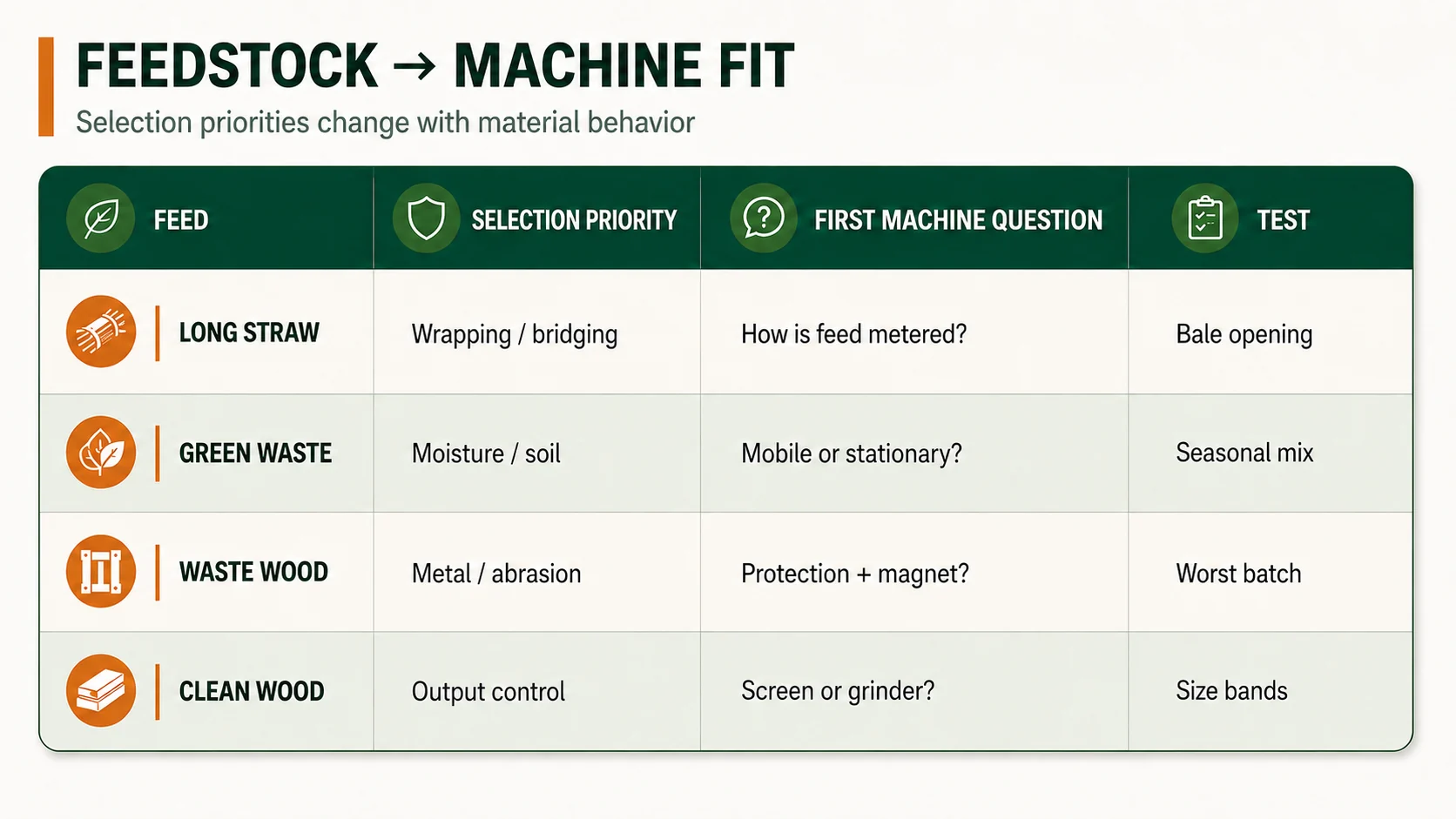
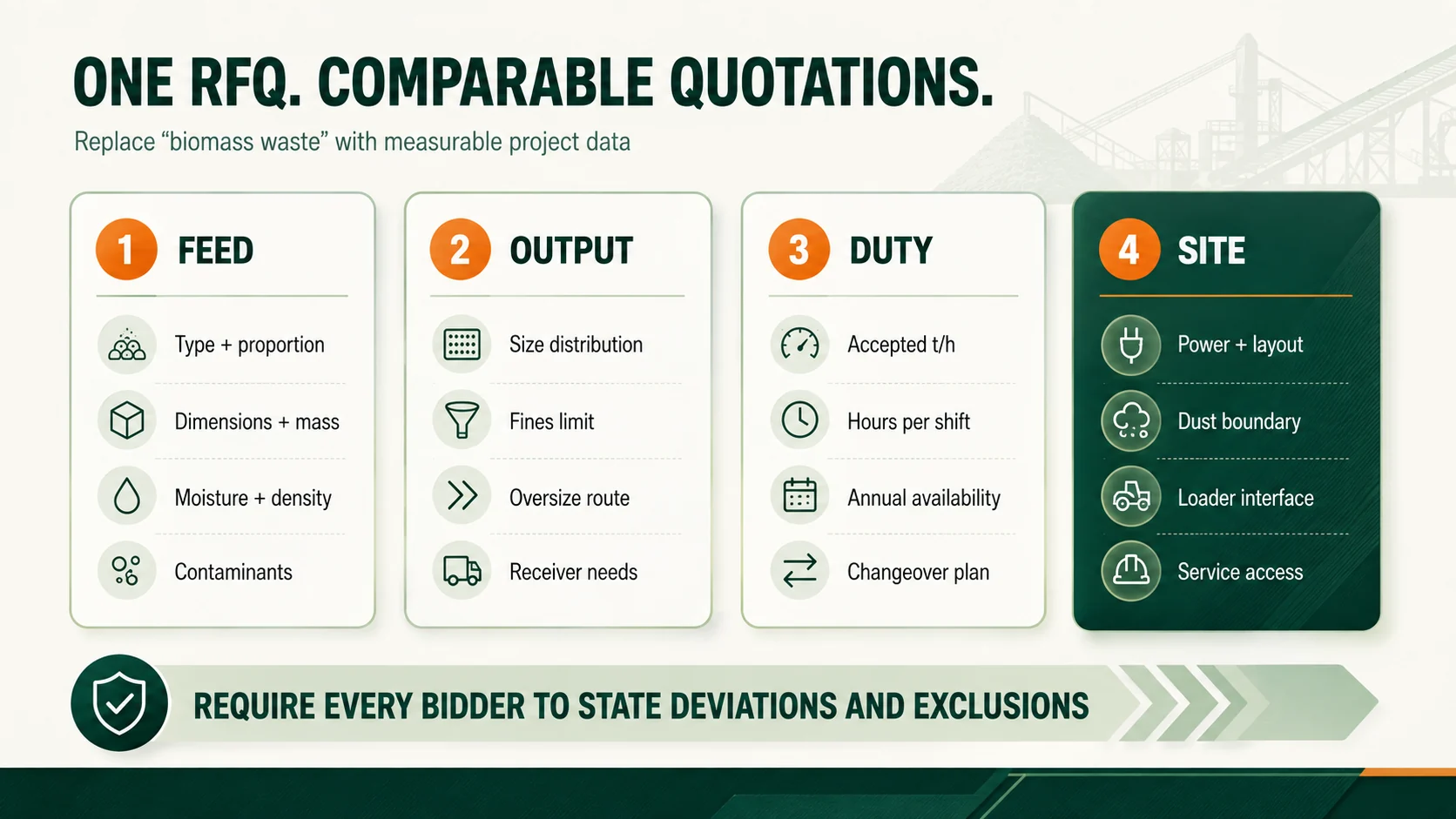
Record each recurring feedstock separately, including the worst normal condition. Long straw may wrap around shafts or bridge above the rotor. Wet bagasse can compress and feed unevenly. Green waste carries moisture, soil and variable geometry. Pallets introduce nails and blocks; demolition wood can add coatings, fasteners and non-wood contaminants.Next define the downstream receiver. Boiler feed, pelletizing, composting, anaerobic digestion, mulch and transport reduction do not require the same cut. A narrower particle specification usually adds recirculation, energy, wear and fines. If output control is essential, compare screen-based systems; the four-shaft shredder overview provides another architecture to consider for repeated cutting, although it is not automatically the right answer for high-volume fibrous biomass.A comparable RFQ replaces broad labels such as “agricultural waste” with measurable feed, output, duty and site conditions.
How to Normalize Biomass Shredder Quotations
Issue one data sheet and require deviations to be stated. At minimum, include:
Feedstock types and their expected annual proportions.
Loose, baled, bundled or palletized condition; largest recurring dimensions and mass.
Moisture range, bulk density range and seasonal change.
Soil, stones, fasteners, wire and other contaminants, with rejection limits.
Target output expressed as a particle-size distribution, not a single nominal number.
Required accepted tons per operating hour and operating hours per shift.
Downstream receiver, allowable fines and oversize recirculation.
Electrical supply, mobile or stationary need, enclosure and dust-control boundary.
Then make every bidder complete the same boundary table: feed hopper, loader interface, metering device, shredder, screen, magnet, conveyors, supports, access platforms, electrical panels, PLC, cabling, extraction connection, freight, installation, commissioning, training and initial spares. Use the site’s shredder machine hub only to understand architecture; the RFQ must still be based on the biomass duty.
Compare cost per accepted ton, not price per machine
The useful denominator is accepted product over a defined observation period. Include scheduled knife work, cleaning, blockage clearance, screen changes and the disposal or reprocessing of rejects. A machine with a higher peak rate can produce fewer annual tons if it needs frequent intervention or generates a large off-spec fraction.
Build a Representative FAT
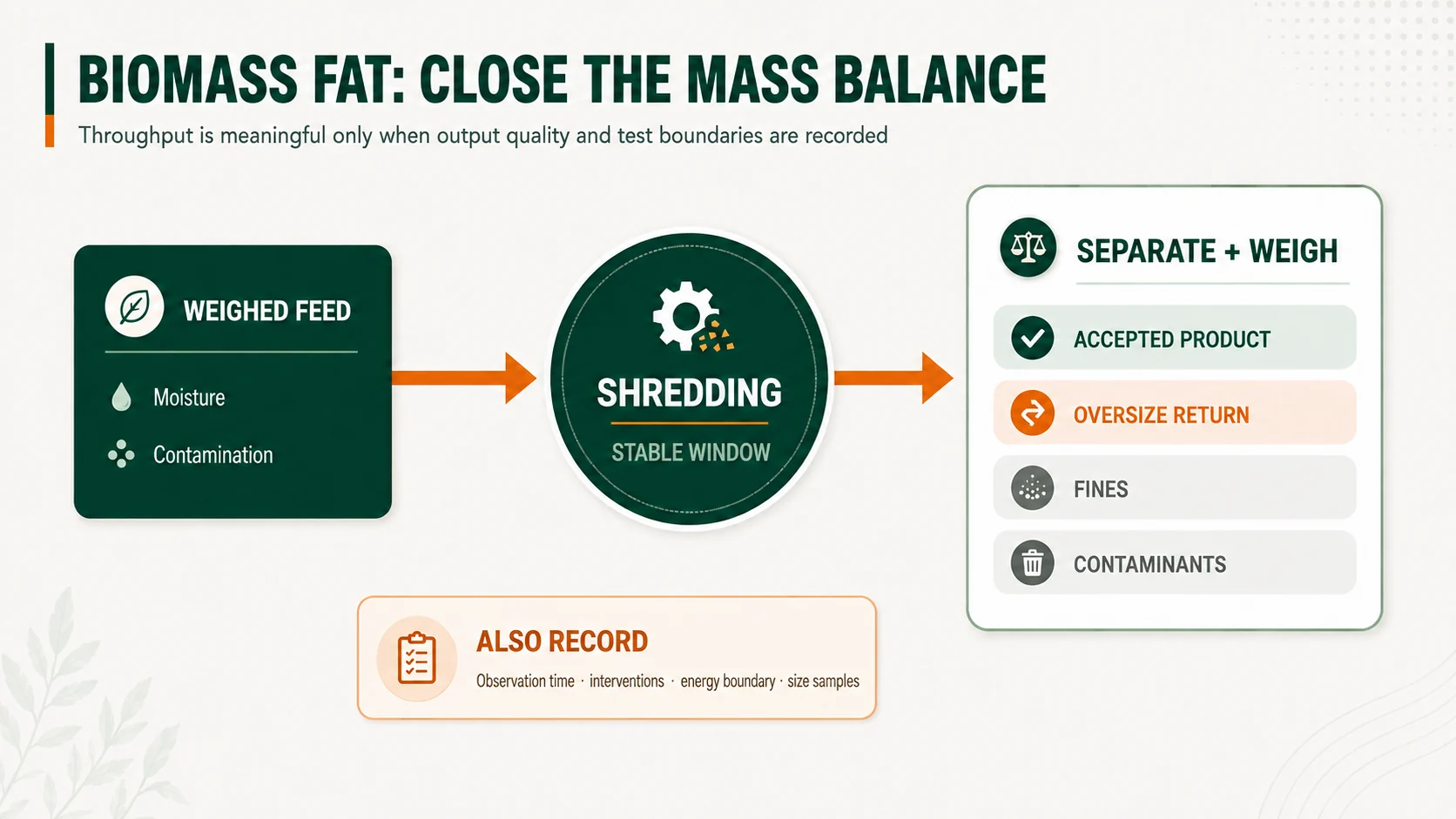
A factory acceptance test should use enough material to reach stable operation. Photograph and weigh each feed lot, record moisture using an agreed method, and document any pre-sorting. The clock should include planned observation time and clearly identify excluded pauses. Weigh accepted product, oversize return, fines and removed contaminants separately.Particle size must be measured by an agreed sampling plan. Take timed increments from the discharge during the stable test window, combine them consistently, and report the mass retained in each agreed size band. The same principle applies to energy: specify whether the number covers only the shredder or the complete test boundary.The FAT should close a mass balance and connect throughput to product quality, energy boundary and interventions.
Safety and dust are site-specific engineering duties
Biomass size reduction can create airborne dust. OSHA notes that handling and size reduction may generate combustible dust capable of flash fire, deflagration or explosion under the right conditions.1 Wood dust also presents respiratory hazards, and OSHA identifies local exhaust ventilation near the source as a primary control approach.2 The final system therefore requires a site-specific hazard assessment covering transfer points, enclosure, housekeeping, ignition sources, extraction and explosion/fire protection.
Information Gain: Four Checks Often Missing from Manufacturer Lists
Use a feed envelope, not an average sample. Averages hide the wettest, longest, densest and most contaminated normal batches—the conditions that often set the machine size.
Separate raw input from accepted output. Throughput without oversize, fines and reject data can reward the wrong configuration. DOE feedstock-interface work also links variable moisture and ash to throughput, energy use and fines generation.3
Price interface risk. Unassigned chutes, extraction ducts, foundations, cabling and control interlocks often become change orders.
Track variability after commissioning. DOE-backed biomass work highlights moisture, particle size and other feedstock variability as constraints on preprocessing and downstream operation.4 Acceptance criteria should therefore cover more than one ideal batch.
Frequently Asked Questions
Is a shredder or grinder better for biomass?
A slow-speed shredder is often better for coarse opening, bulky feed and contamination tolerance. A grinder may suit high-volume woody material or a smaller finished fraction. The choice should follow the feed envelope and downstream specification.
What should a biomass shredder FAT measure?
Measure representative feed mass and moisture, observation time, accepted output, oversize, fines, removed contaminants, interventions and energy within a stated boundary. Sample particle size during stable operation.
What should I send a biomass shredder manufacturer?
Send feedstock photos, largest recurring dimensions, moisture and density ranges, contamination limits, target particle-size distribution, accepted throughput, operating schedule, site power and layout constraints.
Can one machine process straw, green waste and pallets?
One platform may process several materials, but feeding, rotor, cutters, screen, protection and capacity can change substantially. Test the worst recurring normal feed and state the acceptable material envelope in the contract.
Need a biomass shredding proposal?
Send YUXI your feedstock photos, dimensions, moisture range, contaminants, target output, capacity and operating schedule. The engineering team can recommend a machine and line boundary for review.
David focuses on industrial shredding and recycling equipment,including material evaluation,shredder selection,process configuration,and recycling line planning.
Speak To Our Shredder Machine Expert
Get in touch with our nice team today to get a price estimate for a shredder machine.

 English



 Fast Delivery
 Reliable
 Certified
 Experienced