Refrigerator Shredder Feed Problems: Bridging, Overload, Reversal and Jamming
When refrigerator cabinets stop feeding cleanly, the visible symptom is often blamed on the shredder: “it bridged,” “it overloaded,” “it keeps reversing,” or “it jammed.” Bridging is usually a material-flow problem above the reliable bite zone. Overload is a load event inside the cutting or drive system. Automatic reversal is a recovery response. A true jam is what remains when the machine cannot restore normal forward cutting without intervention.
The wrong diagnosis leads to the wrong fix. More drive power will not cure a cabinet that hangs above the cutters, and a hopper change will not correct a blocked discharge conveyor. The practical objective is to keep permitted, prepared cabinets moving with recoverable events and a record that shows when the process is drifting.
Bridging, overload, reversal and jamming are four different conditions
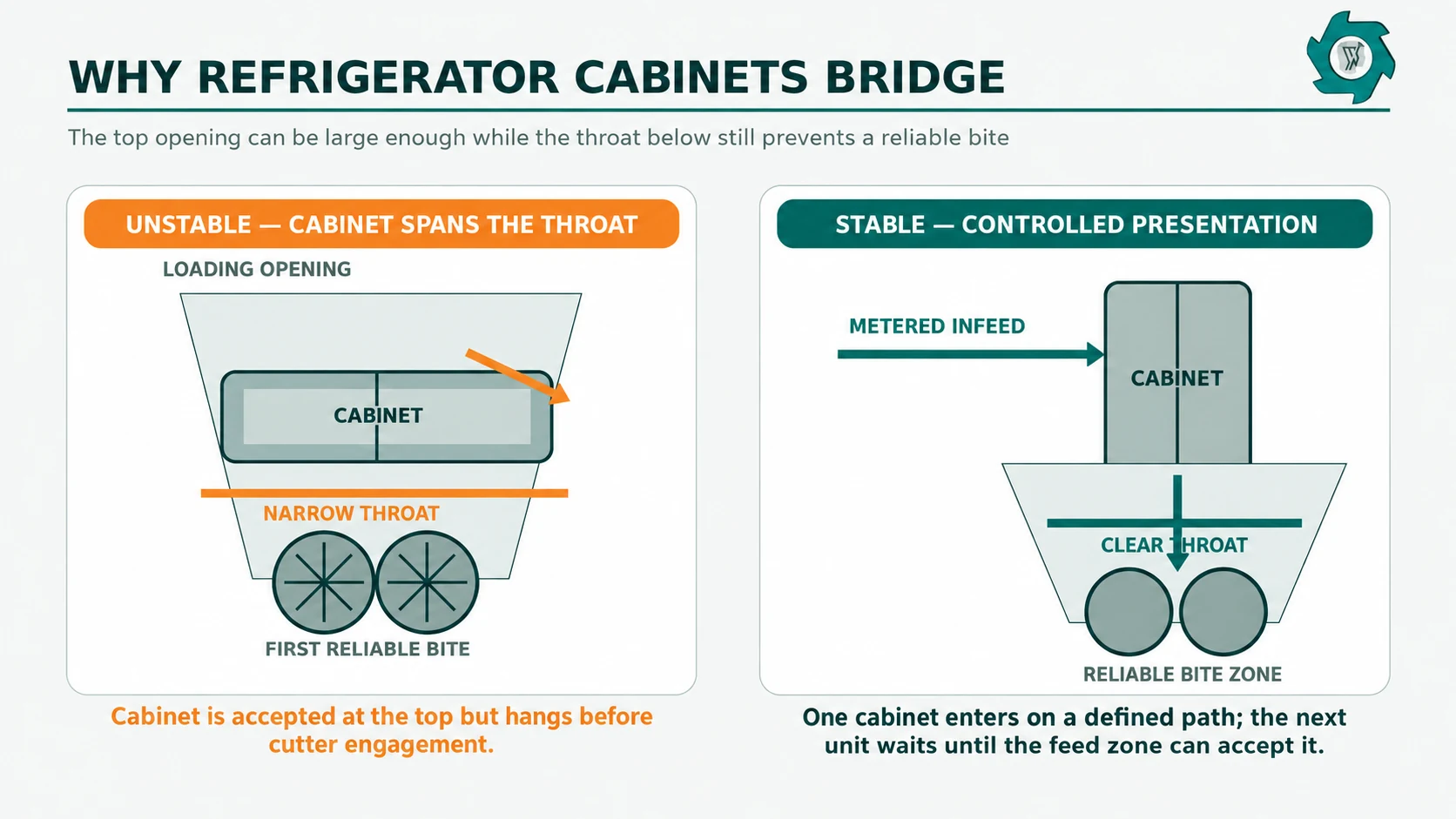
A refrigerator cabinet is light for its volume, hollow and deformable. Even after depollution, two similar units can enter differently: door-first, on a side or partly collapsed. A large hopper opening may accept the cabinet while a narrower passage below still lets it hang up before the cutters establish a consistent grip.
The existing refrigerator shredder sizing guide deals with cabinet envelope, unit mass and production duty. Troubleshooting begins one step later: once the approved feed envelope is defined, what does an abnormal feed event actually mean?
Observed event
What is happening
First diagnostic direction
What not to assume
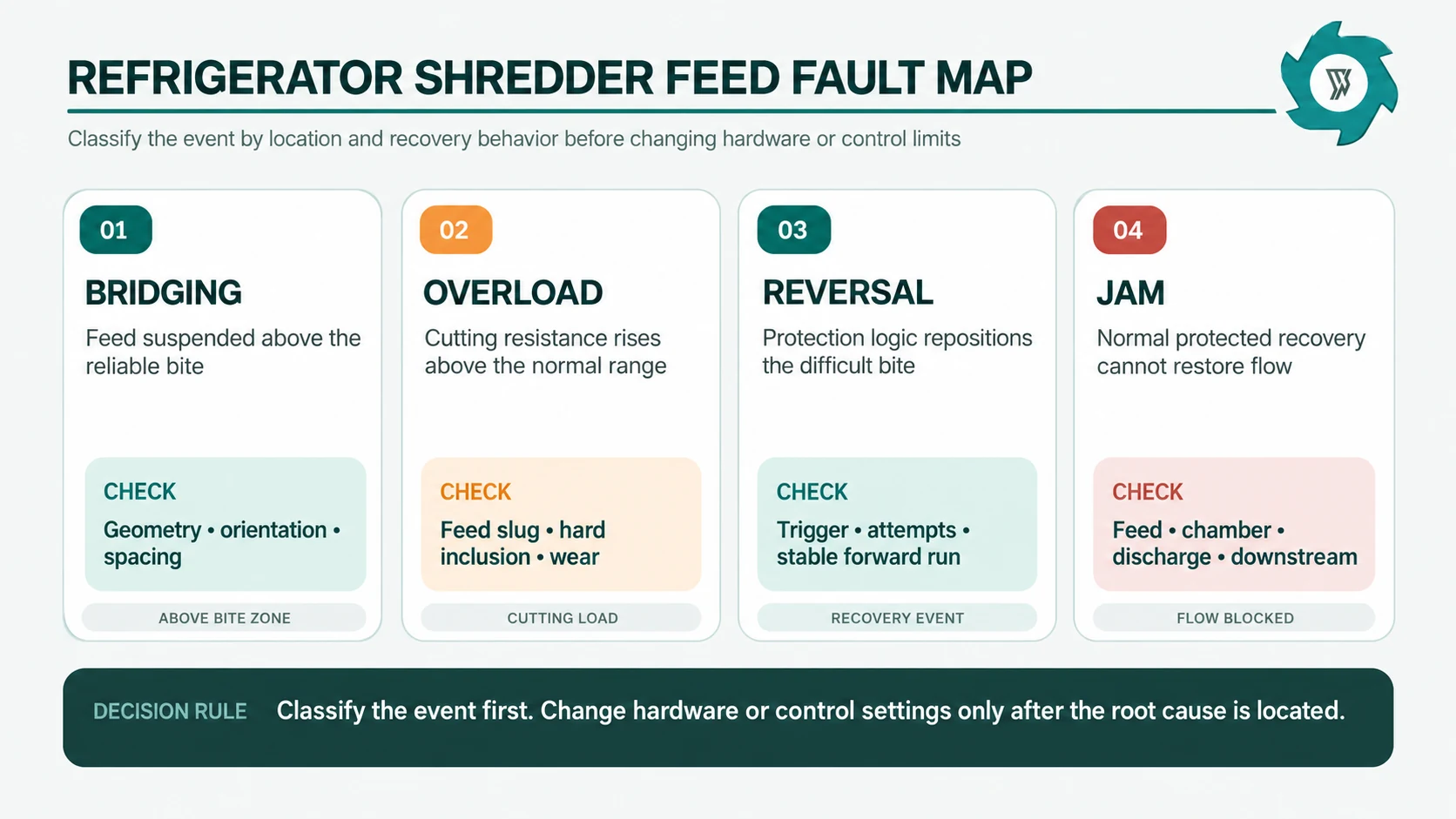
Bridging
Cabinet or folded material spans the feed path and does not reach a reliable bite
That more motor power will pull material that never reaches the cutters
Overload
Cutting resistance or chamber loading rises beyond the normal control range
Batch size, hard inclusions, cutter condition, feed rate, discharge restriction
That every overload proves the machine is undersized
Automatic reversal
PLC or drive logic backs material away from a difficult bite and retries
Whether recovery is quick, repeatable and followed by stable forward running
That frequent reversal is normal just because the machine recovers
Jam
Material remains trapped or flow remains blocked after normal recovery logic
Isolate the location: feed, chamber, shaft/cutter zone, discharge or downstream interface
That the obstruction is always inside the cutter chamber
Figure 1. Use the observed location and recovery behavior to classify the event before changing settings or hardware.
Start with the approved refrigerator feed, not with the alarm code
Troubleshooting only works when the incoming material is controlled. A line designed for depolluted refrigerator cabinets should not be judged while receiving undeclared compressors, glass, unrelated white goods or unknown intact appliances. For U.S. projects, refrigerant recovery remains an upstream disposal requirement; mechanical capability is not a substitute for that handling boundary.[1] The waste refrigerator recycling line shows how cabinet shredding sits after inspection and pre-treatment and before liberation, foam handling and material separation.
Record the appliance class, prepared condition, approximate mass, dimensions, remaining attachments and loading orientation. The aim is to separate a repeatable problem with an approved cabinet family from feed that has drifted outside the agreed condition. A sudden reversal spike after a new batch suggests feed variation; a gradual rise with unchanged feed points toward wear, clearance, buildup, sensors or downstream restrictions.
Bridging is a geometry and presentation problem before it is a torque problem
Bridging occurs when one cabinet, several nested pieces or long folded sheet sections create an arch across the feed path. The hopper may look full while the cutter load falls because little material is actually reaching the working zone. The bridge can then collapse suddenly, producing the opposite condition: a large slug enters at once and the drive load spikes. Operators may describe the entire sequence as “overload,” even though the overload was the second event and the bridge was the root cause.
Look at where the cabinet stops. The important dimensions are not only the top opening. Check the narrowest passage above the shafts, internal ledges or changes in wall angle, the available freedom for the cabinet to rotate, and the vertical distance to the first reliable bite. A cabinet that sits flat across two walls behaves differently from the same cabinet presented edge-first. Door assemblies, exposed tubing, brackets or partially folded panels can also catch on transitions that look harmless on a general arrangement drawing.
A grab that drops several cabinets together can create a self-supporting bundle even when each unit is acceptable. A metering conveyor helps only if spacing and stop/start logic prevent the next cabinet from pushing into a stalled one. Routine operator nudging is evidence of an unstable feed interface.
Figure 2. A large loading opening does not prevent bridging if the cabinet can span a narrower throat before the first reliable bite.
Evidence that points toward bridging
Typical clues are a visibly occupied hopper with unusually low cutting load, long no-load intervals followed by sudden load spikes, repeated hang-up at the same hopper elevation, and event frequency that changes strongly with cabinet orientation or loading method. These clues should be confirmed by safe observation from designed viewing points or cameras, not by bypassing guards or reaching into the feed area.
When bridging is confirmed, responses may include a revised hopper transition, better cabinet spacing, a defined presentation orientation or control changes that stop upstream feeding before a pile develops.
Overload means the cutting system is seeing more resistance than the normal process can absorb
An overload starts inside the load path. Depending on the drive and control architecture, the machine may detect rising motor current, torque, hydraulic pressure, speed decay or a combination of signals. The cause may be completely recoverable: two cabinet folds enter together, a reinforced corner reaches the cutters at an unfavorable angle, or a permitted component creates a short hard bite. The same alarm can also be caused by a bad feed slug, an unapproved dense component, worn cutting edges, incorrect clearance, material buildup or a blocked discharge.
An overload counter by itself has limited value. Pair each event with context: the cabinet just loaded, upstream feeder state, downstream availability, recovery attempt and the amount of stable forward cutting that followed. Repeated stop-reverse-retry cycles mean something different from one recoverable hard bite.
Separate single recoverable load events from repetitive process instability. A protected machine should tolerate irregular resistance, but a line that spends much of its productive time reversing is not healthy simply because the shafts never hard-stall.
The article on double-shaft refrigerator shredder fit makes the same distinction from a machine-selection angle: irregular cabinets can justify overload protection, but repeated intervention is evidence that the feed, duty or interface needs review. Here, the important step is to trace the event sequence.
Automatic reversal is a recovery function, not extra cutting capacity
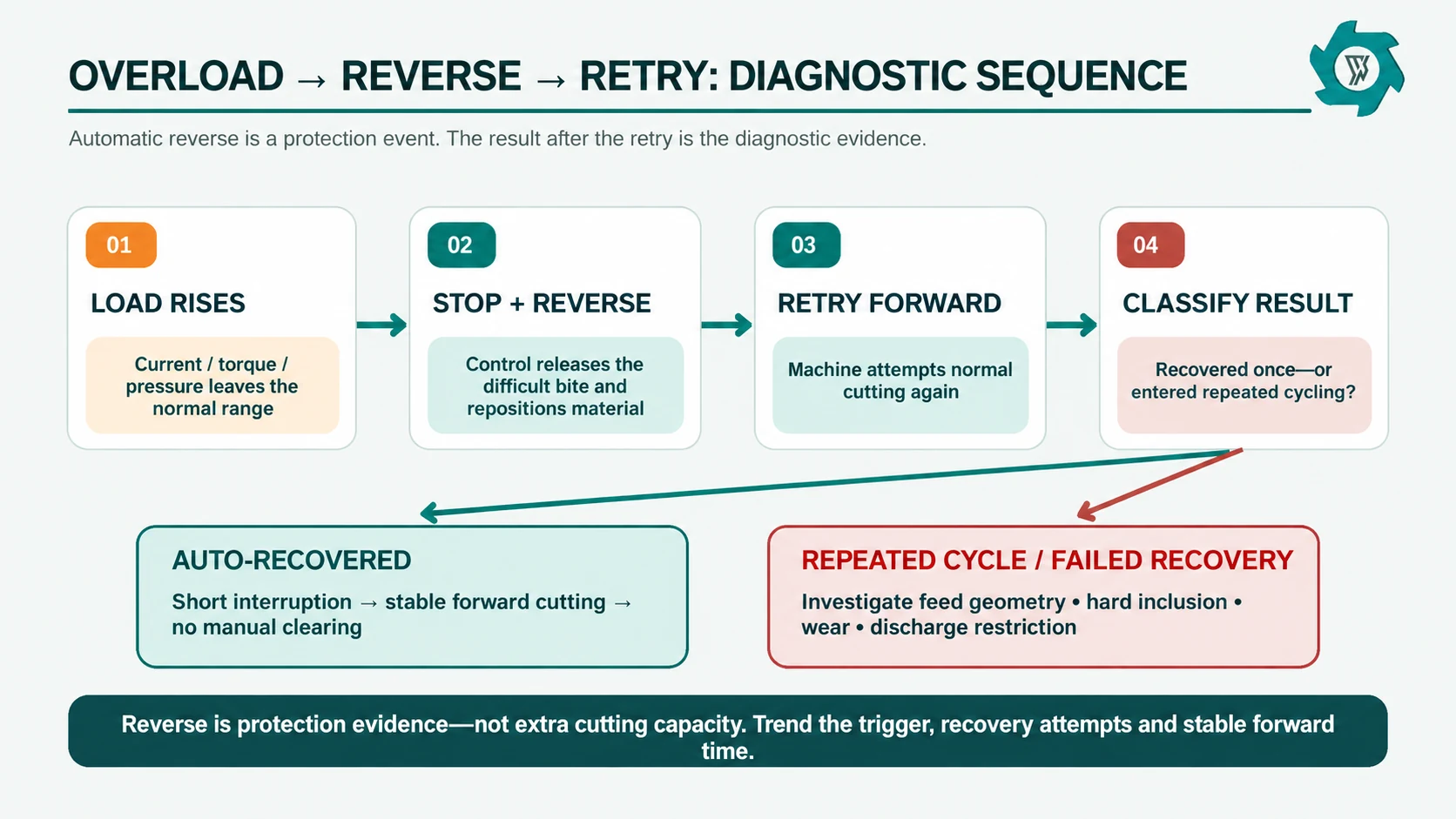
On many low-speed industrial shredders, automatic reverse logic releases a difficult bite so material can change position before forward cutting resumes. Record the trigger, recovery attempts and whether stable forward operation returned without manual clearing.
A healthy recovery is a short interruption within a much longer period of normal cutting. Repeated reverse-forward cycling is different. Extending reverse time or raising a load limit may reduce alarms without fixing the cause, so control changes should stay within documented engineering limits.
Figure 3. Treat every reverse as an event in a sequence: trigger, recovery attempt, result and root-cause category.
Read reversal patterns, not only reversal counts
Ten reversals across a shift mean something different from ten during one cabinet. Record the batch, cabinet identity, forward-running time between events and whether downstream feed was lost.
Do not create an arbitrary universal “acceptable reversals per hour” limit. The threshold should come from representative trials, supplier limits and the production requirement. The meaningful boundary is where occasional automatic recovery becomes repeated cycling, intervention, unstable discharge or abnormal wear.
A jam is not confirmed until you know where the material flow is blocked
Operators often say “the shredder jammed” when the real obstruction is downstream. A discharge belt may stop, a transfer chute may fill, a long folded steel panel may hang at the next machine, or a foam-heavy slug may restrict a transfer point. If the cutter chamber cannot discharge, material accumulates and the shredder load rises until the controls react. Clearing only the cutting area will not solve a blocked handoff.
Before maintenance work begins, use control history and safe inspection points to establish the likely location. Check feed-stop status, shredder discharge, the next conveyor or crusher, and any blockage sensor. The primary versus secondary size-reduction guide likewise judges the first machine by what it presents to the next stage.
A true chamber jam is the condition that remains when the normal protected recovery sequence cannot restore forward cutting and material is trapped in or around the cutter zone. At that point the task changes from production recovery to servicing or maintenance. OSHA’s control-of-hazardous-energy rule explicitly includes unjamming within servicing/maintenance when workers may be exposed to unexpected energization or stored energy.[2] NIOSH likewise warns that jam-clearing injuries occur when hazardous energy is not properly controlled.[3]
Use a fault matrix to separate feed, cutting and discharge causes
Knife condition and machine duty versus approved feed
Check whether coarse discharge from that family hangs downstream
Reverse events rise gradually over time
Confirm feed has not changed
Wear, clearance drift, buildup, sensor or drive condition
Check progressive buildup or reduced downstream availability
Shredder overloads after downstream stop
Verify feeder interlock stopped new material
Do not treat as a cutter problem first
Find blocked belt, chute, crusher or collection point
Manual clearing becoming routine
Feed envelope or presentation may be wrong
Machine may be operating outside stable duty
Connected process may be constraining discharge
This matrix tells the team where to collect evidence. It does not authorize a setting change, guard bypass or jam-clearing method. The machine manufacturer’s documented operating and maintenance procedures and the site’s risk assessment remain controlling.
Reduce recurrence by controlling the interfaces around the shredder
Most recurring feed faults are not solved by one component. Refrigerator shredding is a chain of interfaces: receiving, preparation, loading, hopper, cutter engagement, discharge and the next machine. A weakness at one interface often appears as an alarm at another.
1. Tighten receiving and preparation rules
Define the approved cabinet classes, maximum dimensions, preparation state, compressor policy, glass policy and prohibited items. Separate difficult-but-normal cabinets from out-of-envelope units. If a dense assembly is allowed only as an occasional exception, do not let it silently become routine feed. The general refrigerator shredder specification guide provides the broader RFQ boundary.
2. Meter cabinets instead of loading in uncontrolled slugs
A primary shredder can tolerate variation better than many fine-sizing machines, but it still needs a recoverable feed rate. Use the upstream control system to prevent the next cabinet from entering when the chamber load or downstream status says “wait.” A buffer helps only when its release is controlled.
3. Treat downstream availability as part of overload prevention
Interlocks should prevent the feed system from continuing to load a machine whose discharge path is unavailable. The exact logic is project-specific, but the principle is straightforward: a stopped downstream conveyor should not become a hidden storage bin under an operating shredder. During commissioning, test the stop sequence under safe, planned conditions and confirm which devices stop, hold or alarm.
4. Trend wear and event behavior together
Cutter wear rarely announces itself with one clean signal. The line may first show slower bite, longer recovery, more reversals on cabinets that previously ran well, larger folded discharge pieces or higher intervention frequency. Trend event data against processed tonnage and inspection findings. If the feed is stable and the reverse pattern drifts steadily, maintenance evidence becomes more persuasive than operator impressions.
5. Keep dust and foam handling from becoming a hidden restriction
Refrigerator processing produces light foam and fines as the cabinet structure is opened and further liberated. Restriction or buildup around enclosed transfers, extraction points or collection equipment can affect downstream flow. OSHA identifies plastic dust among materials that can present combustible-dust hazards and includes recycling operations among the industries where these hazards may arise.[4] Dust and foam systems therefore need their own inspection and housekeeping plan.
Build an event log that can actually identify root causes
date, batch or shift reference;
cabinet type and prepared condition;
approximate dimensions and mass when relevant;
loading orientation or method;
event type: bridge, overload, reverse, stop or confirmed jam;
time into the run and forward-running time since the previous event;
number of automatic recovery attempts;
whether normal forward cutting resumed automatically;
whether operator intervention or manual clearing was required;
observed location of the obstruction;
downstream equipment status at the time;
inspection finding after safe isolation, if maintenance was required.
Once the data exists, look for recurring patterns. Events tied to one cabinet class suggest a feed-envelope problem. Events tied to one loading operator or loader bucket pattern suggest presentation variability. Events that appear after a known maintenance interval may point to wear. Events that coincide with downstream stops belong to the line interface.
FAT should prove stable recovery, not just that the shredder can survive a difficult cabinet
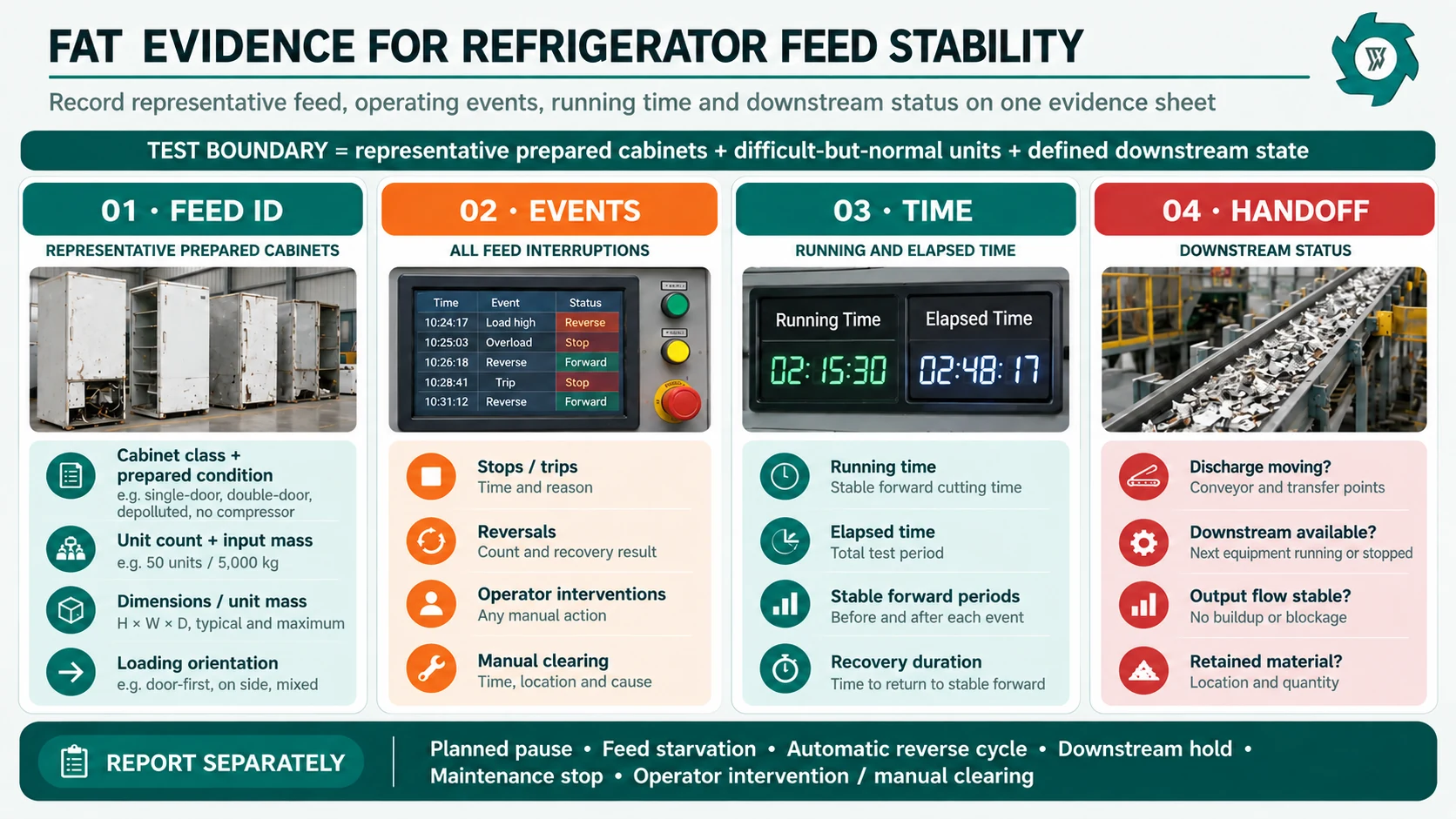
A useful factory acceptance test includes representative prepared cabinets and deliberately includes difficult-but-normal units inside the agreed feed boundary. Run enough material to observe feeding consistency, downstream handoff and event patterns under a defined time basis.
Record input mass and unit count, running time and elapsed time, stops, reversals, trips, operator interventions and manual clearing. Identify which cabinet caused each material event. If a cabinet outside the routine production mix is included only to test the maximum accepted envelope, report it separately so it does not distort the routine throughput result. For any interruption, state whether recovery was automatic and how long stable forward operation continued afterward.
A buyer needs to distinguish planned pauses, feed starvation, automatic reverse cycles, downstream holds and maintenance stops. Likewise, do not declare “no jams” if operators repeatedly reposition material. Manual clearing is an operating event and should be visible in the FAT record.
Figure 4. A feed-stability FAT links representative cabinets, event timing, recovery behavior and downstream status on one evidence sheet.
Jam clearing is a hazardous-energy task, not an extension of normal feeding
When a blockage requires access to a danger zone, the plant should treat the task under its documented hazardous-energy procedure. OSHA’s hazardous-energy control rule requires energy control where unexpected energization, start-up or release of stored energy could injure workers and specifically includes cleaning or unjamming in its servicing definition.[2] Stored energy can include mechanical and hydraulic energy, not only electricity, and isolation must be verified before covered work begins. OSHA’s machine-guarding rule separately requires protection from hazards including points of operation, ingoing nip points and rotating parts.[5]
Automatic reverse does not make manual access safe. An emergency stop is not the same as energy isolation. A control-panel “off” command may stop motion without isolating all energy sources. Site procedures, authorized personnel, machine-specific documentation and local regulations determine the correct method. The troubleshooting objective is to reduce the frequency of these interventions.
Questions to put in the RFQ before feed problems become commissioning arguments
What exact prepared refrigerator and freezer types are included in the proposed feed envelope?
What maximum cabinet dimensions and unit mass are accepted, and is orientation restricted?
What conditions trigger feeder hold, shredder stop, automatic reverse, alarm and lockout-required inspection?
Which reverse parameters are adjustable by the operator, which are service settings, and which must not be changed without engineering approval?
How are the infeed conveyor, shredder and discharge equipment interlocked?
What signals indicate a downstream blockage or unavailable conveyor?
What inspection access is provided without exposing workers to moving parts?
How are retained material and chamber cleaning handled during maintenance?
What event history is available from the PLC or HMI, and can it be exported?
What FAT data will be recorded for reversals, stops, interventions, manual clearing and downstream holds?
These questions replace vague claims such as “anti-jam automatic reverse” with a testable requirement: defined feed, documented protection logic, safe maintenance access and evidence that the feed-to-discharge path returns to stable operation after difficult but permitted loads.
Frequently asked questions
Is bridging the same as a refrigerator shredder jam?
Bridging usually means the cabinet is suspended in the hopper or feed path before reliable cutter engagement. A jam is a blockage that normal recovery cannot clear. Bridging can lead to a later overload if the suspended material collapses into the chamber as a large slug.
Are frequent automatic reversals acceptable?
Occasional reversals can be a normal protection response to irregular prepared cabinets. Frequent cycling is a diagnostic signal. Compare reversal patterns with cabinet type, loading method, cutter condition, downstream status and stable forward-running time instead of accepting a universal reversals-per-hour number.
Will a larger motor stop refrigerator shredder jams?
Repeated stoppages can come from bridging, surge loading, hard unapproved components, worn cutters, poor clearances or a blocked discharge. More installed power does not correct a material that never reaches the bite zone or a downstream conveyor that cannot clear the output.
What should be recorded during a jam or overload event?
Record the cabinet identity, prepared condition, loading method, event time, machine state, reverse attempts, recovery result, downstream status, operator intervention and any findings made after safe isolation. This turns isolated interruptions into evidence that can be trended.
Should operators manually push a bridged refrigerator into the cutters?
Manual intervention around the point of operation should not be treated as a normal feeding method. Use engineered feeding arrangements, guarding and the site’s machine-specific safety procedures. If clearing requires exposure to hazardous energy, the applicable energy-control procedure must be followed.
What should a refrigerator shredder FAT prove about feed stability?
Use representative prepared cabinets, include difficult-but-normal units, and record unit count, input mass, running and elapsed time, reversals, stops, interventions, manual clearing and downstream holds. The test should show whether the line recovers automatically and returns to stable forward cutting under the agreed feed condition.
Define the feed problem before changing the shredder
For a technical review, prepare cabinet photos or video, typical and maximum dimensions, preparation condition, loading method, event history, target units per hour and tonnes per hour, and a description of the downstream conveyor or secondary machine. That information makes it possible to separate a feed-geometry problem from a cutting, control or discharge problem.
David focuses on industrial shredding and recycling equipment,including material evaluation,shredder selection,process configuration,and recycling line planning.
Speak To Our Shredder Machine Expert
Get in touch with our nice team today to get a price estimate for a shredder machine.

 English



 Fast Delivery
 Reliable
 Certified
 Experienced