Refrigerator Shredder Output Size: How Particle Size Affects Separation
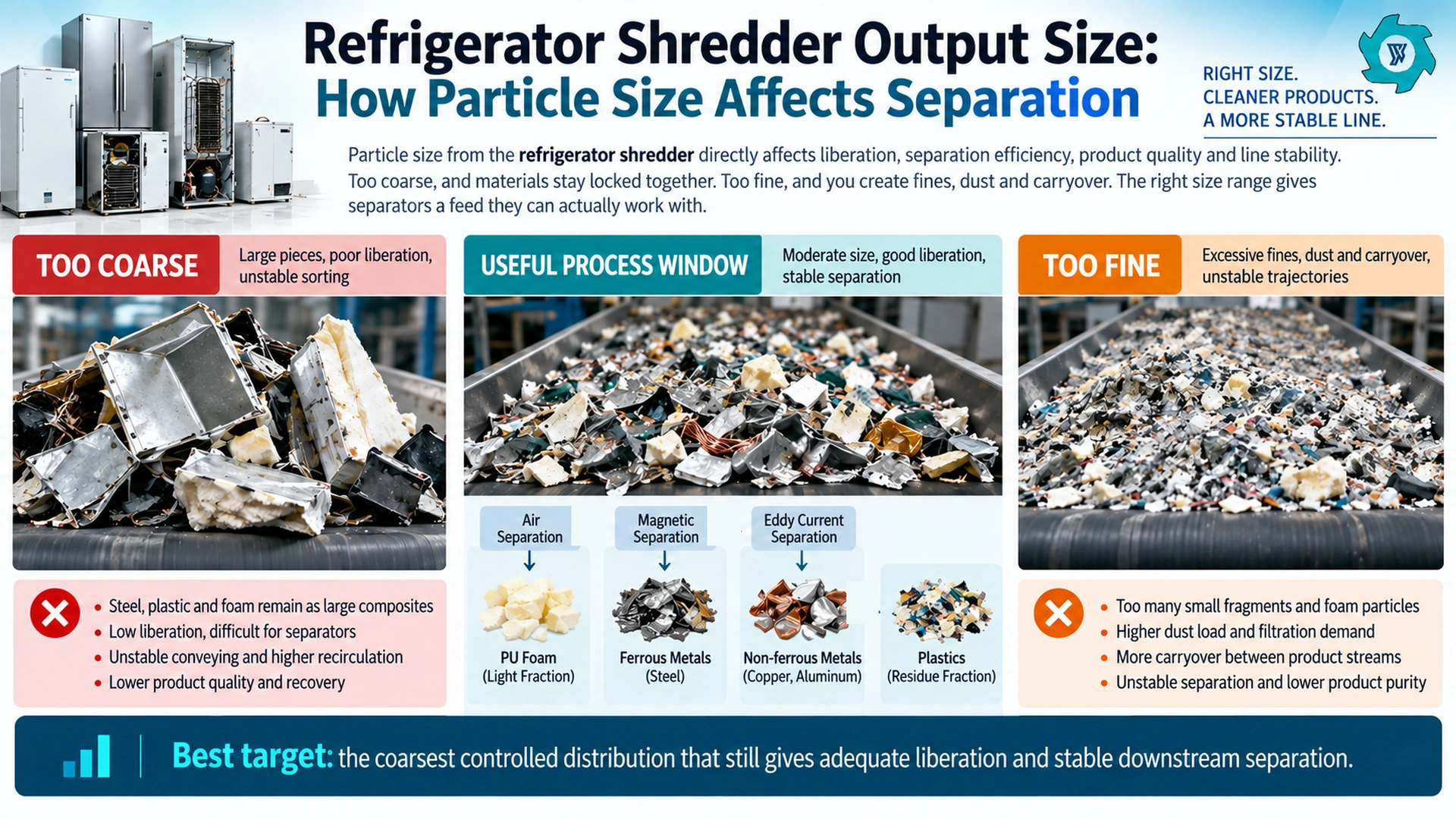
A refrigerator shredder output specification should describe a distribution of particle sizes and shapes, not a millimeter number. The reason is practical: downstream equipment does not process an average particle. It sees large folded sheet, foam-bearing composites, plastic pieces, wires, small non-ferrous fragments and fines at the same time. If that distribution is too coarse, materials remain attached and the separators inherit a liberation problem. If it is pushed too fine, the line can create more dust, light carryover and small-particle losses without producing a cleaner saleable fraction.
The useful target is therefore the coarsest controlled output that releases the materials your separators need to distinguish, while keeping oversize, fines and awkward long pieces inside agreed limits. In a complete waste refrigerator recycling line, that target belongs between cabinet opening and the air, magnetic and non-ferrous sorting stages. It has to be proved with representative samples and product-quality data.
Do not ask a supplier only for “50 mm output” or another single nominal size. Ask for the test method, size bands, allowed oversize and fines, treatment of long thin pieces, liberation condition and the downstream separation result obtained under the same feed and operating boundary.
The optimum is a process window, not the smallest possible particle. Coarse composites and excessive fines can both reduce separation quality for different reasons.
“Output Size” Is a Particle-Size Distribution, Not One Number
A quotation often reduces discharge size to a phrase such as “approximately 50 mm.” This is not specific. Is 50 mm the screen opening, the largest dimension of most pieces, a top-size guarantee, or only the supplier’s visual estimate? What share may be larger? What share is below 10 mm? Are long steel strips counted as acceptable because one dimension is narrow, even if the strip is several times longer than the nominal value?
Refrigerator scrap is especially awkward because the material is not made of compact, regular particles. Thin steel skin folds. Plastic liner can bend. Foam breaks into low-density pieces. Copper tube and wire can become long rather than small. A rectangular or irregular fragment may pass a screen in one orientation and remain above it in another. That is why the project should distinguish at least four descriptors:
Output descriptor
What it tells the buyer
What can go wrong if it is omitted
Oversize fraction
Mass above the agreed upper size boundary
Large composites or folded sheet can dominate downstream loading even when the average looks acceptable
Target-window fraction
Mass between the agreed lower and upper boundaries
A nominal size may hide a very broad and unstable distribution
Fines fraction
Mass below the agreed lower boundary
Dust, foam fragments and small metal can disappear into collection or residue streams
Long / thin pieces
Shape exception recorded separately
Wires and strips can bridge, wrap or behave differently from compact particles of the same sieve class
For coarse industrial samples, perforated-plate test sieves can provide a repeatable reference when the aperture range fits the material. The international standard for perforated-metal-plate test sieves specifies technical requirements for perforated-metal-plate test sieves and covers round openings from 125 mm down to 1 mm and square openings from 125 mm down to 4 mm.[1] The standard does not define your refrigerator process target; it provides a controlled measurement tool. The project still has to state the actual size bands, sample location and how flexible or elongated pieces are handled.
Particle Size Matters Because Liberation Happens Before Separation
The main reason for reducing refrigerator cabinet material is not cosmetic size reduction. It is liberation. Steel sheet, plastic liner, PU foam, wiring and small non-ferrous components often enter the mechanical section physically attached. A magnet can recover the steel portion of a steel-plastic composite, but the attached plastic will follow it into the ferrous product. An eddy current separator cannot recover a conductive fragment effectively if it is still trapped inside a larger non-conductive piece. Airflow cannot make a clean foam cut when heavy material is still bonded to the foam.
The dedicated refrigerator crusher vs shredder guide explains when another reduction stage is justified. For output-size specification, the narrower question is: what condition must the material reach before the next separator can make a stable cut?
If a dismantling team removes much of the copper tubing and high-value components before cabinet processing, the mechanical liberation duty changes. A line processing a narrow domestic refrigerator mix may also produce a more stable distribution than a line alternating between tall household cabinets, chest freezers and selected commercial bodies. The specification should therefore be tied to the approved feed definition.
Engineering rule: Smaller is useful only while additional breakage is releasing material that the next separator can actually recover. Once liberation is already adequate, extra reduction may become a fines, wear and dust problem.
Too Coarse and Too Fine Fail in Different Ways
When the discharge is too coarse
Coarse output is not automatically bad. The primary shredder may intentionally produce opened panels and large fragments because its job is gripping, opening and flow control. The problem starts when those pieces are still too composite or too bulky for the next stage. Large folded sheet can shield smaller material on a conveyor. Foam-bearing metal pieces can contaminate the ferrous product. Tubes and wires can remain wrapped in plastic. Oversize pieces can also create surge loading: a separator receives a shallow burden for several seconds, then a dense lump arrives and temporarily changes the cut.
This is why output size and throughput cannot be specified independently. The refrigerator shredder sizing guide treats cabinet cadence and downstream line balance as part of the machine duty. For the output-size test, record not only the size distribution but also whether the material reaches the sampling point in a stable flow or in irregular slugs.
When the discharge is too fine
Fine material creates a different set of problems. Foam breaks readily and can increase the volume of light particles presented to the air circuit. Small plastic and metal fragments are more easily carried with dust or light residue. Very small conductive particles have different trajectories from larger non-ferrous pieces, while their response also changes with rotor design, speed, material properties and geometry. Research on rotary-drum eddy current separation has shown that particle size has a significant effect on separation and that the optimum depends on the operating condition rather than following one universal rule.[2]
A plant can show a visibly “well crushed” sample while losing more recoverable metal into a fine residue. Conversely, a coarser sample may look untidy but produce cleaner saleable streams if the attachments are already released. Judge the size decision with mass and product-quality evidence.
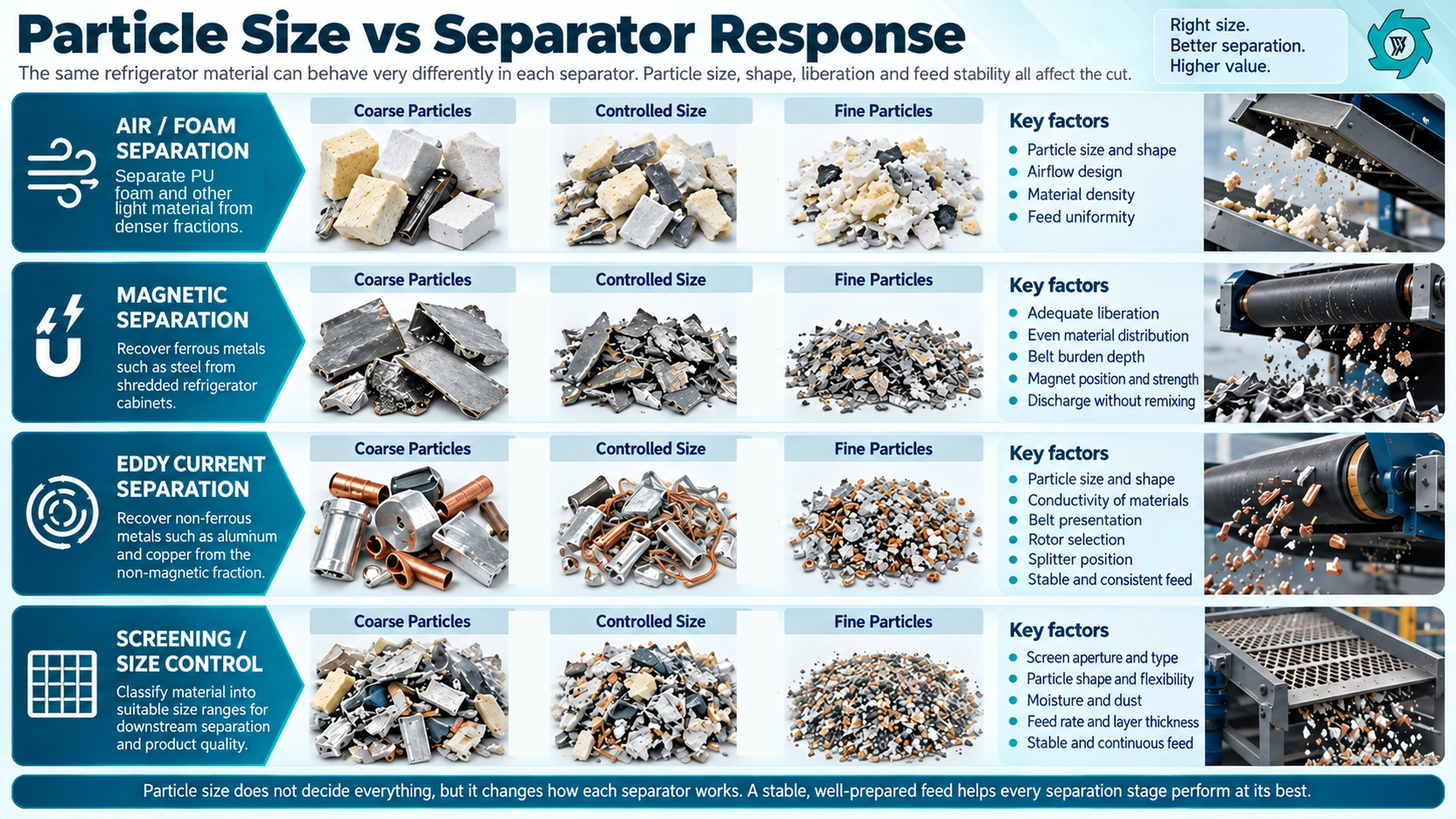
Each separator responds to more than size alone, but a controlled size range reduces the number of conflicting particle behaviors one setting has to handle.
How Particle Size Changes PU Foam and Air Separation
Air classification depends on how particles move under aerodynamic forces, and that behavior is influenced by size, density and shape. Waste streams are difficult because their particles are irregular rather than ideal spheres. Research on vertical air classification describes size, shape and density as important characteristics and notes that heterogeneous solid-waste particles require airflow to be chosen around the real material distribution.[3]
In refrigerator recycling, this matters because PU insulation is both light and fragile. If liberation is insufficient, foam remains attached to steel or plastic and reports with the heavier piece. If crushing is excessive, the process can create a large population of small foam particles and dust that loads ducts, cyclones and filters and may carry light plastic with the extracted stream. The useful operating point is therefore not “maximum foam breakup.” It is enough release for the air circuit to distinguish the foam from the heavier fractions without generating avoidable fines.
When checking the output size, sample both the feed to the air separator and its products. If the feed looks acceptable but foam remains in the heavy stream, the cause may be airflow, burden depth, leakage or classifier configuration rather than particle size. If the light stream contains increasing quantities of desirable plastic or metal after a tighter crusher setting, the extra reduction may be moving the line in the wrong direction.
Magnetic Separation Needs Liberation and Feed Presentation
Steel is usually the easiest major fraction to identify, but recovery quality still depends on the condition in which it reaches the magnet. A large liberated steel piece is not inherently a problem. A large steel-plastic-foam composite is. In the second case the magnet may recover the steel and carry the attached non-magnetic material into the ferrous product, lowering its quality.
Particle size also changes the burden geometry. A mixture dominated by large flat sheet can bridge over smaller particles and create a deep, uneven layer. Finer material can pack more densely and may be carried with magnetic pieces through contact and entrainment. The purchasing specification should therefore avoid statements such as “magnetic separator suitable for 50 mm material” unless that claim is tied to the real distribution, conveyor loading and product target.
A useful acceptance check takes a timed sample of the magnetic product and identifies non-ferrous, plastic and foam contamination as agreed for the project. It also samples the non-magnetic side for missed steel. A cleaner magnetic product is not a success if steel recovery has fallen sharply.
Eddy Current Separation Is Especially Sensitive to Size and Geometry
An eddy current separator induces currents in conductive non-ferrous particles and changes their discharge trajectory relative to non-conductive material. The underlying physics makes particle condition important. A comprehensive review of ECS technology identifies particle geometry as an important limitation in practical separator design, while experimental and modelling work has found that size, conductivity and particle orientation influence the throw of scrap particles.[4][5]
For a refrigerator line, the takeaway is not that every particle must be identical. It is that one rotor and splitter setting should not be expected to produce the same trajectory for a very broad mixture of copper-bearing fragments, aluminum pieces, plastic, foam and fines. If the non-ferrous product is unstable, divide the evidence by size band before changing hardware. You may find that the coarse band is clean while a fine band contains most of the losses, or the opposite.
That diagnosis creates better engineering decisions. Screening or a separate fine-material route may help when the value in that fraction justifies the extra equipment. In another project, the fine fraction may be small enough that simplifying the line is worth more than chasing every gram. The output-size specification should make that tradeoff visible.
Screen Aperture Is a Machine Setting, Not a Finished-Product Guarantee
Buyers often ask for a shredder with a particular screen or grate size and then treat that opening as the discharge size. Particle flexibility, thickness, orientation, recirculation path and the way material is cut all affect what finally passes. A long strip can pass through an opening in one orientation. A folded composite can remain above the same opening even though part of it is much smaller.
A machine selected for primary opening can reasonably produce a broader output than a screen-controlled secondary device. If the project question is which architecture should own the size-control duty, the refrigerator shredder machine selection guide covers the broader equipment choice. Do not force the primary machine to make a tight final distribution simply because a brochure offers a smaller cutter spacing.
For a double-shaft machine in particular, the useful question is whether its discharge is appropriate for the next stage, not whether it can be advertised with a precise final particle size. The double-shaft refrigerator shredder fit guide explains that boundary in more detail.
Write the RFQ Around Size Bands, Shape Exceptions and the Downstream Duty
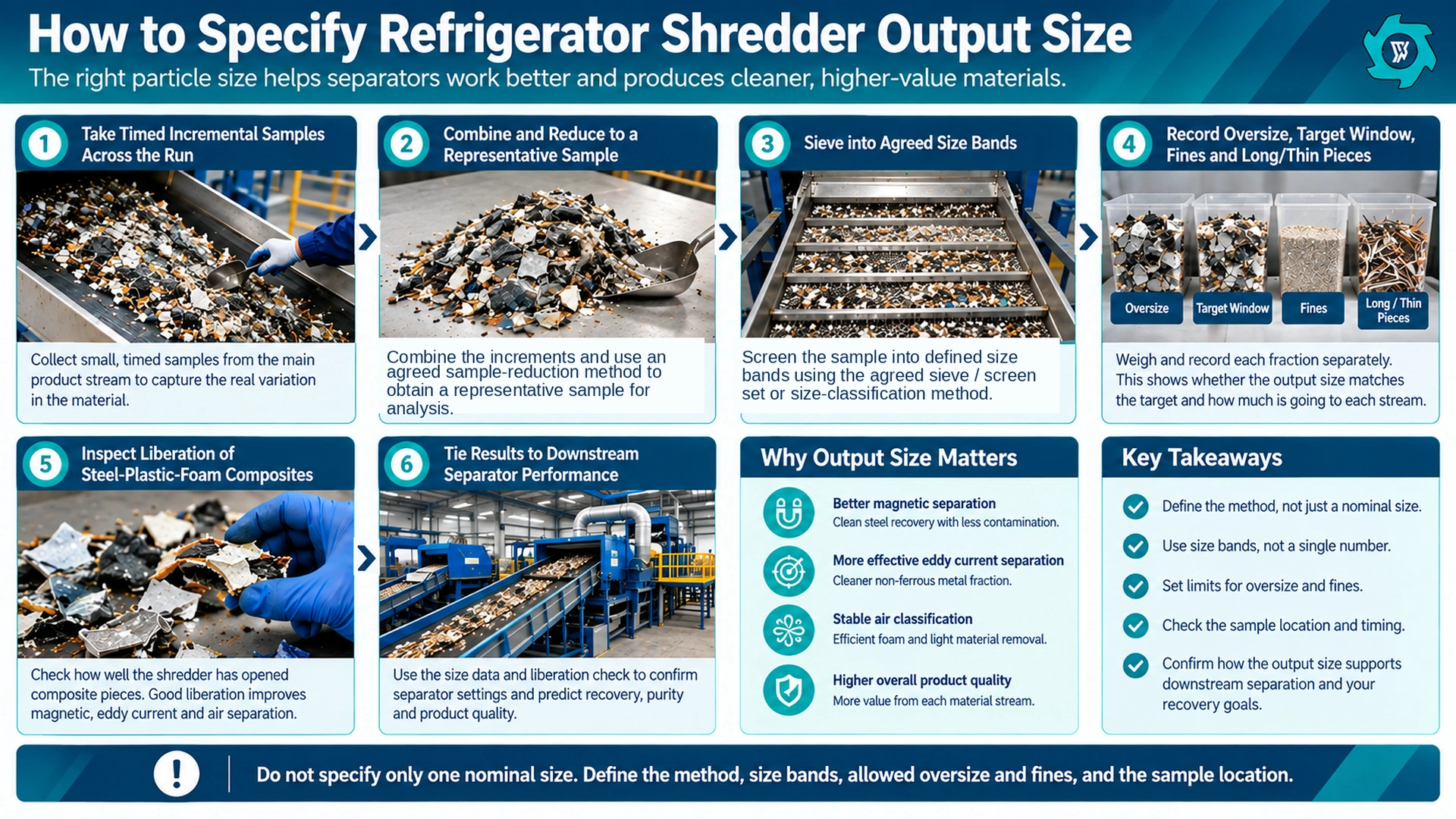
A strong RFQ turns “output size” into measurable evidence. The exact bands should be chosen for the project, but the structure below is reusable.
RFQ item
What to define
Why it matters
Sampling point
Exact conveyor or discharge location after the agreed machine or stage
Prevents one supplier from sampling before recirculation and another after it
Sampling timing
Timed increments across stable operation, not one hand-picked scoop
Captures normal variation and changing cabinet construction
Size bands
Upper oversize band, target window and lower fines band
Shows the distribution instead of an average
Elongated pieces
Separate rule for long wire, strip or folded sheet
These pieces can wrap, bridge or pass screens unpredictably
Liberation check
Method for inspecting steel-plastic-foam and metal-plastic composites
Connects size reduction to its actual process purpose
Separator result
Product and reject samples from the downstream cut that matters commercially
Prevents a good sieve result from masking poor recovery or contamination
Three simple mass percentages can make offers much easier to compare:
Oversize % = mass above the agreed upper boundary ÷ total sample mass × 100
Target-window % = mass between the agreed boundaries ÷ total sample mass × 100
Fines % = mass below the agreed lower boundary ÷ total sample mass × 100
A reproducible specification records where the sample was taken, when it was taken, how it was classified and whether the material was actually liberated.
FAT: Prove Size and Separation Under the Same Test Boundary
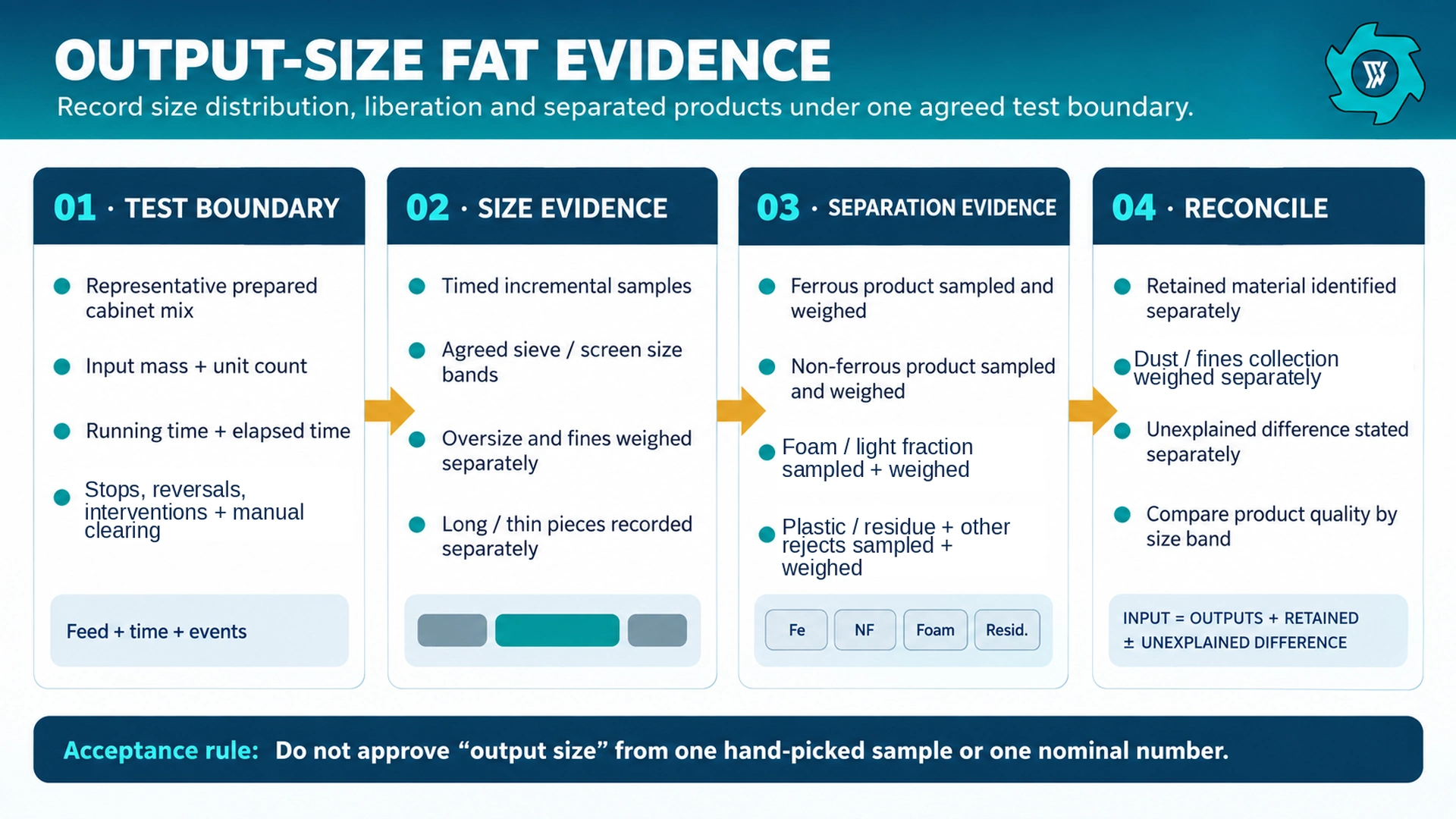
A factory acceptance test should connect representative feed, operating time, particle-size evidence and separated products. Begin by defining the appliance mix and pre-treatment condition. For U.S. projects, refrigerant recovery belongs upstream of final disposal and mechanical treatment; EPA places safe-disposal responsibilities on the final disposer and requires proper recovery or verification before disposal.[6] The mechanical FAT should therefore use the same prepared-cabinet condition that the supplier was asked to quote.
During the run, record input mass and unit count, running and elapsed time, stops, reversals, operator interventions and manual clearing. Take incremental samples at agreed intervals after the size-control stage. Combine or reduce them by the agreed method, then classify the sample into the specified bands. Record oversize, target-window, fines and long/thin pieces separately. Photograph representative composites so that a future reviewer can see what “poorly liberated” meant during the test.
The next step is critical: weigh and sample the downstream product streams that the output size is supposed to improve. Depending on the supplied process boundary, that can include ferrous product, non-ferrous product, foam/light fraction, plastic-rich residue, other rejects, dust/fines collection and recirculated oversize. Identify retained material separately. State any unexplained mass difference separately instead of burying it inside “loss.”
Finally, compare size bands with product results. If the oversize fraction rises at the same time as plastic contamination in steel, that is useful evidence. If the fines fraction rises while non-ferrous recovery into the saleable product falls, that is also useful evidence. The point is not to prove a universal optimum in one day. It is to prove that the proposed machine and settings can hold the agreed process window with representative material.
Output-size acceptance works best when test conditions, size fractions, separator products and the mass balance are recorded together.
Use a Process Window Instead of Chasing One “Best” Millimeter Size
The strongest design decision is usually a window with clear failure signals. On the coarse side, watch the share of attached steel-plastic-foam composites, oversize recirculation and uneven downstream burden. On the fine side, watch fines production, dust load, light-plastic carryover and metal lost into fine residue. Between those two boundaries is a region where liberation is adequate and the separators remain stable.
That window may change with cabinet mix. A batch of thin, easily opened domestic refrigerators can reach acceptable liberation with less breakage than a batch containing more reinforced or unusually constructed units. Wear condition matters as well: the same machine setting can produce a different distribution after cutters or impact surfaces wear. For this reason, the output-size check is useful not only for buying the machine but also for production control later.
In practice, operators can keep a small reference set of test screens or defined size bins and periodically compare the discharge with the commissioning baseline. They should also track the product streams. A change in particle distribution may appear before a separator purity problem becomes obvious. Conversely, if particle size remains stable while product quality deteriorates, the team has evidence to investigate airflow, magnet position, belt loading, splitter setting or feed contamination instead of blaming the shredder automatically.
Five Buyer Mistakes That Make Output-Size Claims Hard to Verify
1. Writing only a nominal size
A single number does not control oversize, fines or long strips. Use defined bands and a sampling method.
2. Copying another plant’s setting
Cabinet construction, pre-treatment, separator arrangement and commercial products may be different. Copy the measurement method, not the target number.
3. Measuring size without liberation
Two samples can have similar size distributions while one contains far more attached composites. Add a liberation inspection.
4. Checking only the saleable product
High purity can be produced by throwing valuable material into residue. Sample both sides of the separation cut.
5. Ignoring operating events
A tidy sample after a short, easy run says little about a setting that causes repeated recirculation, trips or manual clearing during representative production.
FAQ: Refrigerator Shredder Output Size
What is the best refrigerator shredder output size?
There is no universal millimeter target. The useful target is the coarsest controlled size distribution that gives adequate liberation and stable downstream separation for the actual refrigerator mix, while keeping oversize, fines and long thin pieces within agreed limits.
Is shredder screen size the same as actual particle size?
A screen or grate opening is a machine setting, while the discharge is an irregular three-dimensional distribution. Long strips, folded sheet, foam-bearing composites and flexible plastic can behave differently from compact particles, so the finished stream should be sampled and measured.
Does smaller refrigerator scrap always improve separation?
More breakage can release attached steel, plastic, foam and non-ferrous pieces, but excessive reduction can create fines, dust and unstable small-particle behavior. Separation should be optimized around a useful process window rather than the smallest achievable size.
How should output size be written into an RFQ or FAT?
Define the sampling location and timing, the agreed size bands, allowed oversize and fines, treatment of long or thin pieces, the liberation check and the downstream product-quality measurements. Record the test feed and operating events so the size result is tied to a reproducible process condition.
Why does particle size matter to an eddy current separator?
Particle size and geometry influence the force and trajectory of conductive non-ferrous pieces. A broad mixture of very different sizes forces one rotor and splitter setting to handle conflicting particle behavior, so size classification or separate settings may be useful when the project data justify them.
Should particle size be accepted without checking separated products?
A size distribution is useful only when it supports the required process result. During acceptance, compare size data with ferrous, non-ferrous, foam and residue quality, plus recovery or loss information defined for the project.
Define the Output Window Before You Ask for the Machine
Send the refrigerator and freezer mix, pre-treatment condition, representative photos, target units per hour and tonnes per hour, the downstream separation route, the product streams you plan to sell and any existing size or contamination data. YUXI can then review where size control should occur and what evidence should be included in the quotation and acceptance test.
References
ISO 3310-2:2013. Perforated-plate test sieves: Sieve Standard.
David focuses on industrial shredding and recycling equipment,including material evaluation,shredder selection,process configuration,and recycling line planning.
Speak To Our Shredder Machine Expert
Get in touch with our nice team today to get a price estimate for a shredder machine.