Refrigerator Shredder Maintenance: Cutters, Bearings, Gearboxes and Downtime
A refrigerator shredder may still appear to run normally even when wear is starting to build. Wear often shows up in small ways before the shredder actually fails. Cutter profiles change, bearings may start running warmer, and the gearbox oil can pick up signs of contamination or wear. The maintenance team has to decide which of those changes are worth acting on and which can be watched until the next planned stop.
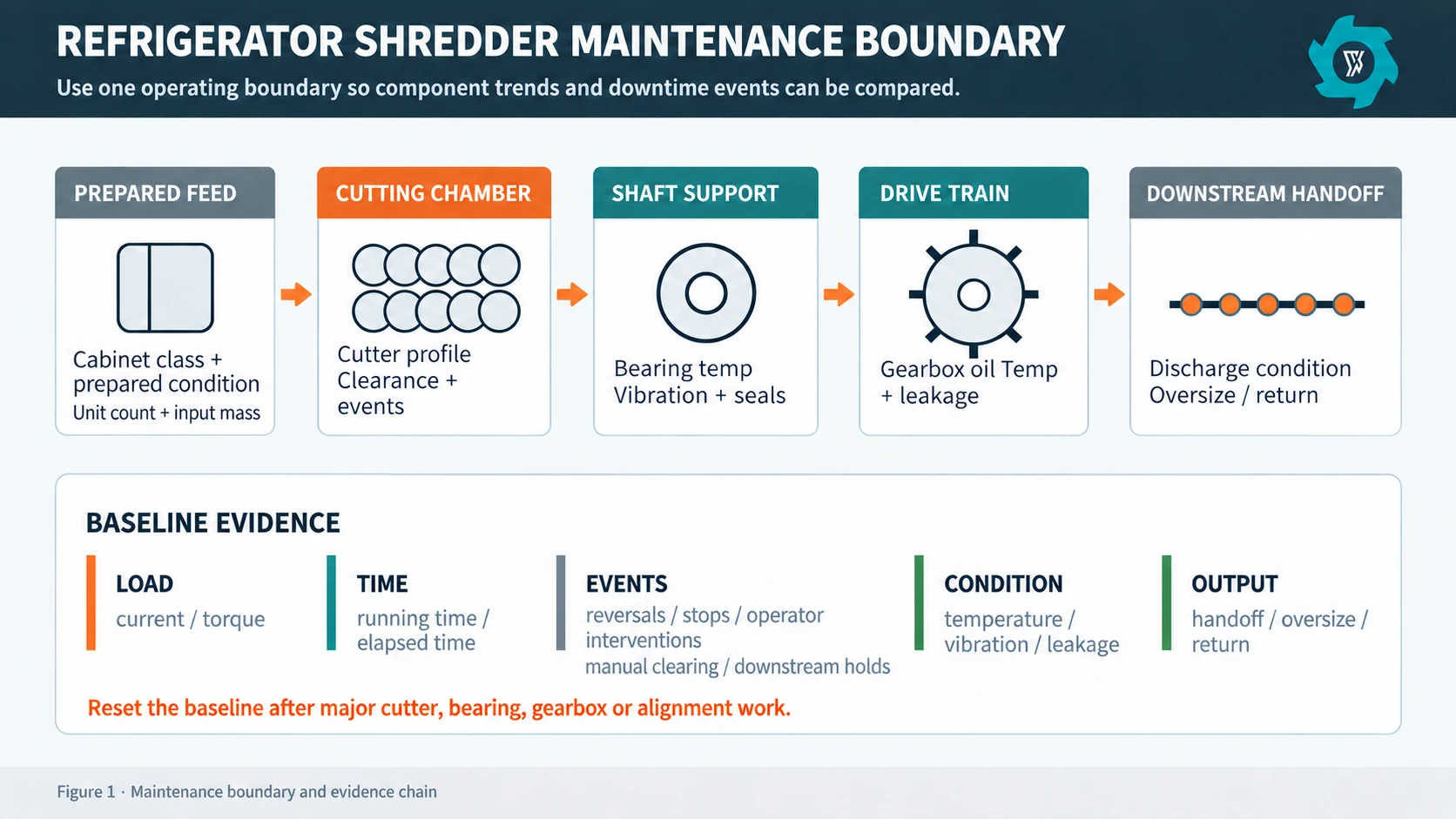
This guide treats the shredder as part of a complete waste refrigerator recycling line. Its maintenance boundary starts with a verified, prepared cabinet entering the machine and ends with a stable discharge reaching the next process stage. Feed preparation, cutter condition, bearing health, gearbox condition and downstream holds or discharge restrictions can all change the load seen by the same drive. A useful maintenance program therefore separates component wear from process disturbances.
Maintenance starts with a baseline, not a calendar
A fixed calendar is useful for tasks the equipment manufacturer explicitly schedules, such as lubricant inspection or replacement. It is weaker as the only trigger for wear parts because cabinet construction, residual attachments, shift pattern, feed pacing and foreign-object exposure change the duty.
Start a new maintenance baseline after commissioning, a major cutter service, bearing replacement, gearbox work, alignment correction or any material change large enough to alter the duty. Record the machine under a representative stable run rather than during an unusually easy batch. The goal is to capture what “healthy” looks like for this machine, this feed and this installation.
At minimum, keep the following values together in one record:
Baseline item
Why it matters
Cabinet class, prepared condition and unit count
Shows what the machine was actually processing
Input mass and running/elapsed time
Separates production rate from time lost to stops
Motor current, torque or hydraulic load available from the control system
Separates rising cutting resistance, manual intervention and downstream-related interruptions
Cutter clearance and visible edge condition
Connects output behavior to cutter wear
Bearing temperature and vibration at named measurement points
Creates a trend instead of a one-off reading
Gearbox oil level, oil temperature, leakage and condition
Gives the drive a repeatable health record
Oversize/return material and discharge condition
Shows whether the machine is still producing a usable handoff
Keep measurement locations consistent. Bearing-housing temperature, gearbox oil temperature and motor-frame temperature describe different things; vibration readings also need a named, repeatable point.
The equipment configuration also matters. The maintenance pattern of a low-speed twin-shaft primary shredder is not the same as a high-speed secondary crusher. If the project team is still defining the machine role, review the refrigerator shredder machine types and specifications guide before writing service intervals around the wrong duty.
Figure 1. Build the maintenance record around a defined operating boundary: representative prepared feed, the cutting chamber, shaft support, drive train and the downstream handoff.
Isolate and verify before maintenance work begins
Cutters, shafts and drives can store or transmit dangerous energy even when the machine is no longer processing material. In the United States, OSHA’s lockout/tagout standard covers servicing and maintenance where unexpected energization, startup or release of stored energy could injure employees, including cleaning, unjamming, adjustments and tool changes when workers may be exposed to that hazard.[1] Machine guarding requirements also address hazards from points of operation, ingoing nip points and rotating parts.[2]
Before maintenance starts, the procedure needs to show where the machine’s energy comes from and how each source is isolated on site. That applies before opening the chamber, removing guards, working around the shafts, reaching into the discharge area, or changing cutters. Electrical isolation may be only one part of the job; the installed design may also contain hydraulic, pneumatic, gravity or stored mechanical energy.
The safe sequence must come from the installed machine documentation and the site’s energy-control program. From a purchasing standpoint, confirm that isolation points, lifting points, guarding and service access support routine work.
Cutters: measure loss of function, not only loss of metal
Prepared refrigerator cabinets still contain folded sheet, liners, foam, tubes, wires, fasteners and local reinforcements. Primary-shredder cutter wear therefore shows up in both the hardware and the process.
A rounded edge is one sign, but it is not the whole diagnosis. Look for chipped corners, uneven wear across the shaft, damaged spacers, side-face rubbing, loose hardware, wrapped wire, material packed between cutters, abnormal shaft clearance and evidence that one side of the chamber is doing more work than the other. Photograph the same positions at each planned inspection.
Process clues include rising reversals, slower bite-in, larger folded pieces, poorer liberation or higher load on the same feed. These symptoms do not prove cutter failure, but they justify inspection against the baseline.
Separate four cutter decisions
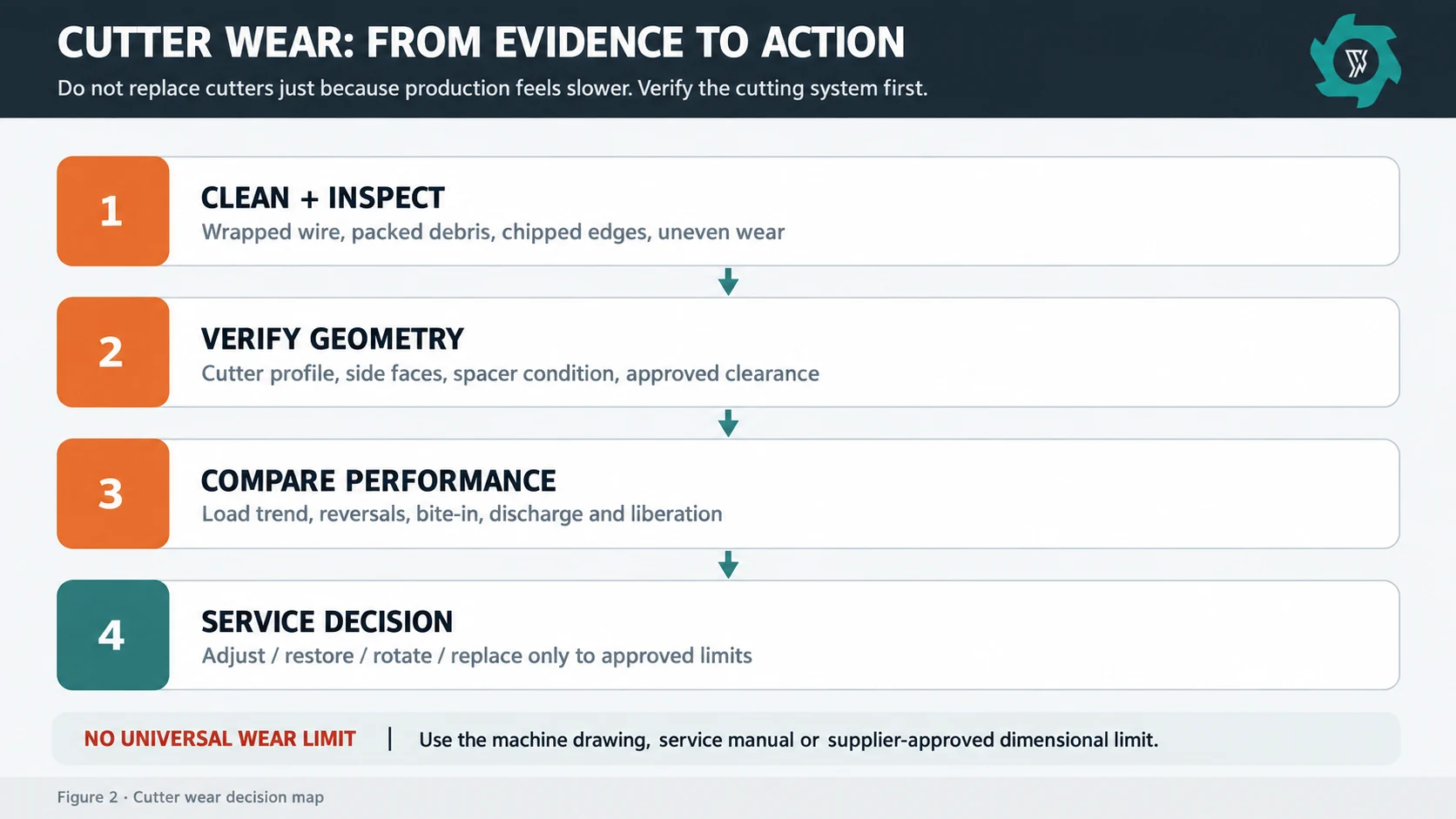
Do not treat every worn cutter as an automatic replacement. The service decision normally falls into one of four categories:
Clean and inspect. Remove wrapped material, packed debris and deposits that prevent a valid visual and clearance check.
Adjust or restore the stack. Correct only where the machine design and manufacturer procedure allow spacer, clearance or fastener work.
Rotate, rebuild or recondition. Use this route only if the cutter geometry and material permit it and the supplier has defined the acceptable restoration method.
Replace. Replace cutters or associated stack parts when damage, wear or dimensional loss has passed the approved service limit.
The exact wear limit must come from the machine drawing, service manual or supplier. A universal millimeter limit would be misleading because cutter thickness, hook profile, alloy, shaft arrangement and intended overlap vary by design.
Figure 2. Cutter maintenance should move from evidence to action: clean and inspect, verify geometry and clearance, then restore or replace only against approved limits.
Use output evidence to confirm the cutter decision
After cutter work, do not accept the machine on a no-load run alone. Process representative prepared cabinets and compare load pattern, reversals, interventions and discharge condition with the baseline.
If pieces become progressively coarser or more folded, downstream liberation and separation can change even when the shredder still meets an hourly tonnage number. The refrigerator shredder output-size guide explains why a usable size distribution and liberation state matter more than one nominal size figure.
Bearings: trend heat, vibration, lubrication and sealing together
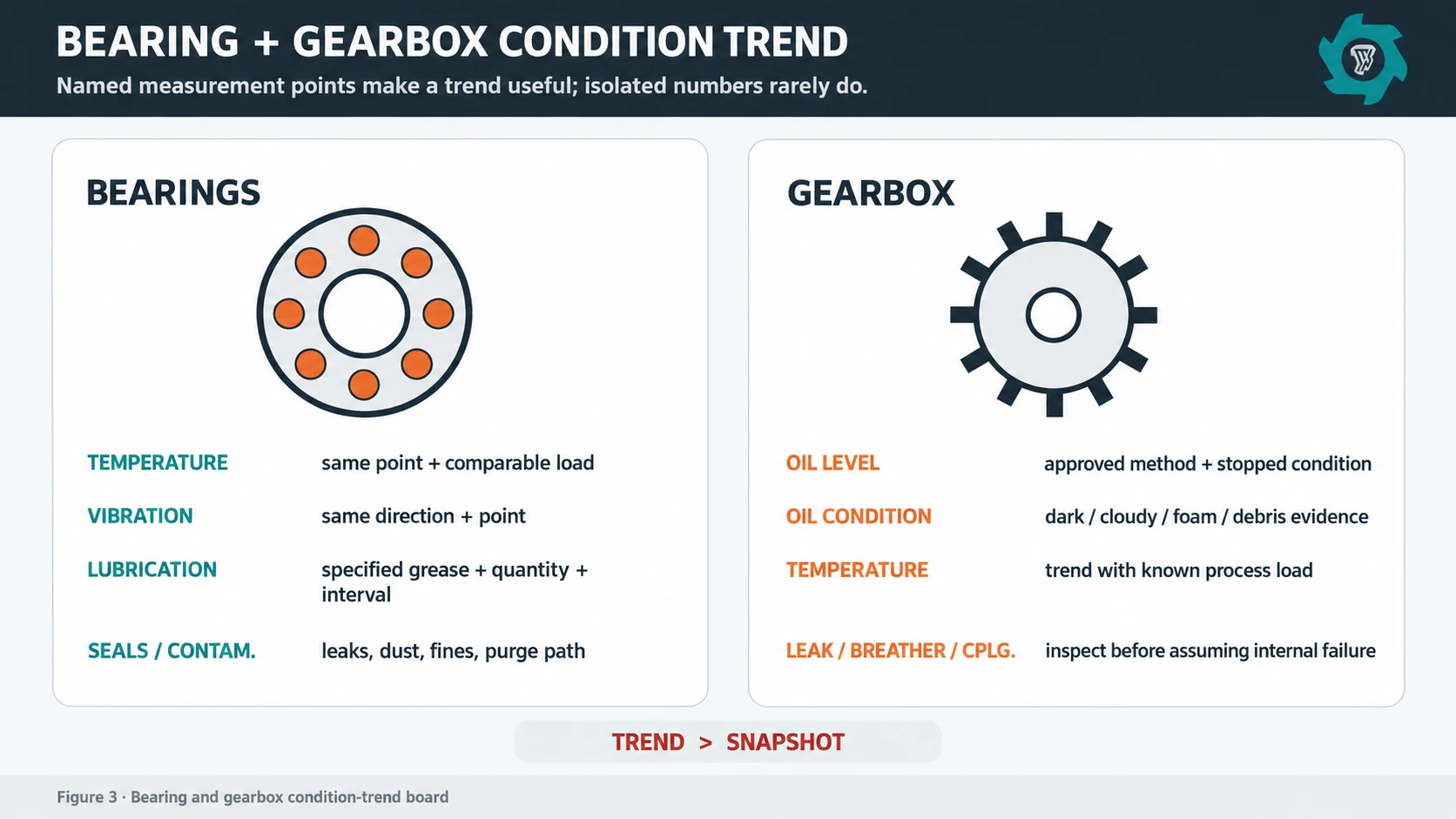
Large shredder bearings see shock, contamination and changing load. One temperature reading is not a diagnosis; trend several indicators from fixed points and investigate changes from the healthy pattern.
Record bearing temperature only after noting operating state, ambient condition and measurement location. A higher reading can be associated with load, lubrication condition, contamination, seal condition, alignment or a developing bearing fault. Vibration adds another view, especially when the same measurement direction and point are repeated. Noise can be useful, but by the time an operator hears a clear abnormal sound, the opportunity for an inexpensive planned intervention may already be shrinking.
Lubrication deserves the same discipline. SKF’s bearing guidance notes that relubrication quantity and frequency depend on factors such as bearing type and size, speed, temperature, grease, surrounding space and operating environment.[3] That is why “grease every Friday” is not enough unless the interval and quantity have been validated for the installed bearing arrangement.
Too little lubricant can reduce protection, while too much can create churning and heat. Control contamination from foam dust, metal fines and service tools; keep fittings clean, use the specified lubricant and inspect seals and purge paths for the actual bearing housing.
What should trigger a bearing investigation?
Use a combination of changes. Examples include a persistent temperature shift at the same operating condition, a vibration trend moving away from baseline, grease leakage that was not previously present, damaged seals, repeated contamination at the housing, increasing shaft movement, abnormal noise, or a change that appears after a cutter strike or drive event.
Before replacing a bearing, check surrounding causes such as misalignment, loose mounting, lubrication, contamination and load transferred from the cutter stack.
Gearboxes: treat oil as evidence, not just a consumable
The gearbox converts motor input into slow, high-torque shaft duty and can accumulate the effects of overload, misalignment, lubrication problems and shock. Its maintenance record should combine external inspection, oil checks and operating trends.
Check for new leaks, loose fasteners, damaged breathers, coupling condition and any change in noise or vibration. Record the oil level using the method specified for that gearbox and machine position. Flender’s current gear-unit maintenance guidance, for example, requires maintenance activities to follow stipulated intervals and describes oil-level checks with the gear unit stopped and the oil allowed to become foam-free.[4] The important lesson is not to copy one manufacturer’s exact sequence onto another gearbox; it is to use the installed gearbox documentation and record the method consistently.
Use the oil grade and specification approved for the drive. Record any top-up or change by product, quantity, date and reason. Unusual darkening, cloudiness, foaming, contamination or debris should be preserved as evidence and investigated instead of being hidden by a refill.
Trend the drive under comparable load
Oil temperature, housing temperature, motor load and vibration are most useful when the process condition is known. A gearbox running hot while the shredder is repeatedly reversing on difficult cabinets is a different case from a gearbox that runs hot on an ordinary batch with normal cutter condition. Link the drive record to feed class and cutter status so the maintenance team can see cause and effect.
Figure 3. Bearing and gearbox checks become more useful when temperature, vibration, lubrication, leakage and operating load are trended against the same named measurement points.
Stop chasing downtime as one number
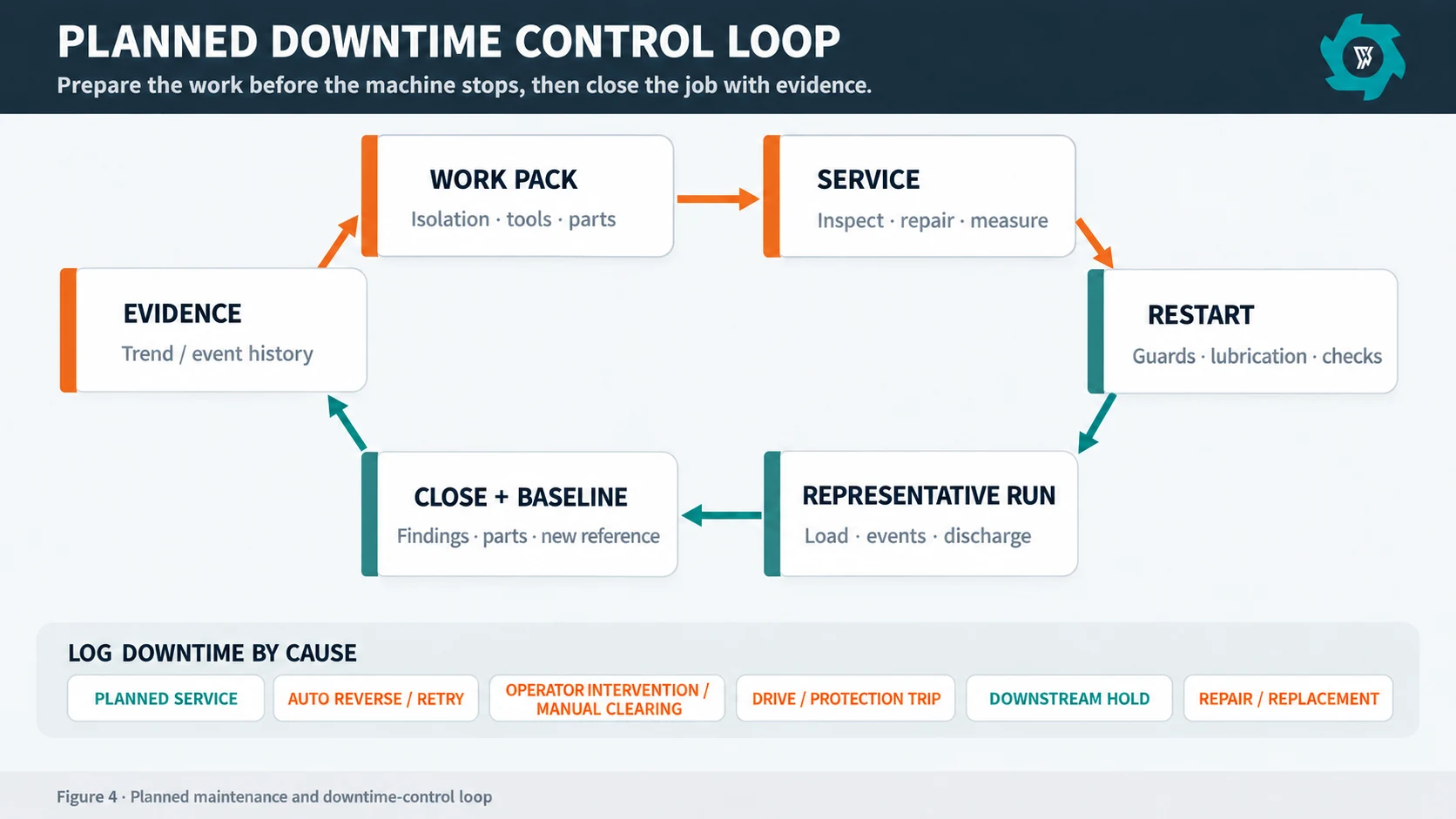
“Downtime” is too broad for maintenance decisions. Split it into event categories that lead to different actions. A ten-minute planned inspection is not the same as a ten-minute emergency clearing event, even though both reduce elapsed production time.
Downtime category
Typical evidence to record
What the record is for
Planned inspection/service
Start, finish, task, parts used, findings
Shows whether preventive work is controlled
Automatic reverse/retry
Count, load before event, feed class
Reveals rising cutting resistance or feed difficulty
Operator intervention/manual clearing
Location, cause found, isolation required
Separates process obstructions from component faults
Drive or protection trip
Alarm code, current/torque, temperature, sequence
Preserves evidence before reset
Downstream hold
Which downstream unit stopped and why
Prevents a blocked discharge from being blamed on the shredder
Maintenance can only fix the downtime it actually causes. A shredder waiting on a full downstream conveyor has a line-balance problem; repeated reversals on the same compliant feed may point toward the cutting system, feed presentation or drive.
For throughput planning, keep running time and elapsed time together. The refrigerator shredder sizing guide uses both units per hour and tons per hour because cabinet mix matters; maintenance records should preserve the same context so availability is not calculated from a changing feed basis.
Build a maintenance matrix around task type
A useful maintenance schedule has three layers: operator checks, planned service tasks and condition-triggered work. The exact interval belongs to the machine manual and the plant’s experience, but the structure can be standardized.
Shift or daily operator checks
Before production, inspect the machine area, guarding, visible leaks, loose or damaged external parts, lubrication-system status if applicable, abnormal material left in the chamber or discharge, and the condition of accessible sensors and cables. During the shift, operators should report changes in sound, load behavior, reversal frequency, discharge pattern, smell, heat or leakage.
At shutdown, record event counts and unresolved abnormalities. Housekeeping around bearing housings, drive ventilation and inspection access is part of reliability because dirt accumulation can hide leaks and make later inspections harder.
Planned service-window tasks
Use planned windows for work that requires isolation, chamber access or guard removal. Typical tasks include detailed cutter inspection, fastener checks to the approved procedure, clearance measurements, removal of wrapped material, inspection of shaft and spacer condition, bearing/seal inspection, lubricant service, gearbox external inspection, coupling checks, and verification of sensors or switches that are part of the machine’s protection logic.
Shorten an interval when evidence justifies it, but do not extend an OEM requirement just because the last inspection looked fine. Component instructions, warranty requirements and actual condition need to agree.
Condition-triggered work
Condition-based maintenance begins when a trend crosses an agreed alert criterion or a new abnormality appears. That criterion can be a supplier limit, a plant alarm based on a proven baseline, a vibration-analysis recommendation, an oil-analysis finding or a dimensional wear limit. Document who can make the run/stop decision and what evidence is required before the machine returns to service.
Use root-cause chains instead of changing the nearest part
Dull cutters may increase bite time, load and reversals, keeping the drive at high torque for longer and eventually changing bearing or gearbox trends as output becomes less consistent. The visible slowdown may look like a drive problem even though the first change occurred at the cutting interface.
A downstream blockage can hold material at the shredder discharge. The chamber stops clearing normally. Load rises and reversals appear. If the event log does not show the downstream hold, the cutting system may be blamed for a problem it did not create.
This is why maintenance data should share a time basis. Alarm history, operator notes, feed lot, service actions and condition measurements should be traceable to the same shift or run. Do not rely on separate notebooks that cannot be reconciled later.
Spare parts should be selected by consequence and lead time
A spare-parts list is a risk decision. For each part, consider likelihood of need, procurement lead time, whether safe operation is possible without it, and production lost while waiting.
Typical refrigerator shredder planning may include cutter or cutter-stack parts, spacers, approved fasteners, shaft seals, bearing-related service items, lubrication components, gearbox seals or breathers, coupling elements, sensors, proximity switches and other protection components specific to the design. The exact list should come from the final machine bill of materials and service documentation.
For long-lead critical parts, record the exact drawing or part number. A bearing described only by outside diameter, or a cutter described only by thickness, is not a reliable spare specification. If lifting fixtures, extraction tools, hydraulic nuts, heater equipment or special pullers are required for major service, treat those tools as part of the maintenance readiness plan as well.
Maintenance also belongs in the commercial comparison. A lower purchase price can be offset by difficult cutter access, a complete shaft teardown for one damaged element, long imported-part lead times or a drive arrangement that requires extensive dismantling. Those lifecycle items are part of the broader cost logic discussed in the fridge shredder price guide.
Plan the shutdown before the machine stops
For planned cutter or drive work, define the job boundary, isolation points, people, lifting plan, tools, parts, consumables, inspection measurements and restart checks before production is released to maintenance.
Use an open-chamber service window to document spacer condition, shaft surfaces, seals, accessible bearing interfaces and evidence of rubbing or packed material. Collecting evidence does not mean replacing everything; it can avoid another shutdown just to inspect the same area.
After reassembly, verify guards, fasteners, lubrication status, sensor connections, rotation or synchronization as applicable, and the approved no-load checks before introducing material. Then use a controlled representative feed to confirm stable operation.
Figure 4. Planned maintenance reduces lost production when the team prepares the job, parts and evidence in advance, then closes the work with a controlled restart and a new baseline where needed.
What maintenance evidence should be required at handover?
Buyers should ask for maintainability information before the shredder ships. The handover package should identify lubrication points and lubricant specifications, inspection locations, cutter drawings and service limits, recommended spare parts, special tools, lifting requirements, gearbox and bearing documentation, tightening procedures where applicable, alarm descriptions and the safe access method for routine service.
The supplier should demonstrate the practical service route: chamber opening with surrounding conveyors installed, lifting clearance for removable parts, access to bearing and gearbox inspection points, and visibility of oil-level and lubrication points after guards and platforms are fitted.
For U.S. refrigerator projects, the feed boundary also needs to remain compatible with EPA safe-disposal requirements. EPA states that household refrigerators and freezers entering the waste stream are subject to refrigerant-recovery requirements before final disposal.[5] Maintenance teams should not be placed in a position where opening a machine exposes them to appliances or components that were supposed to be removed or controlled upstream.
A practical maintenance KPI set
A useful maintenance review combines production, condition and intervention data: planned and unplanned maintenance time, event count by category, restoration time for significant repairs, cutter service interval by processed mass, bearing/gearbox trend exceptions, spare-part stockouts and recurrence after service.
Processed mass is especially useful for cutters because operating hours can include empty running, waiting and low-load periods. Keep cabinet count as a second context variable. A tonne of small domestic cabinets is not mechanically identical to a tonne of larger, reinforced units, so the feed class should stay attached to the wear record.
A short planned stop that prevents a shaft, bearing or gearbox failure is not bad performance. The purpose of the numbers is to show where time is going and whether the plant is learning from repeated events.
Frequently Asked Questions
How often should refrigerator shredder cutters be replaced?
Use the cutter material and geometry, approved wear limits, processed feed, load trend, reversal history, clearance and output condition together. Inspect on the supplier’s required schedule, then replace or restore cutters when the measured condition reaches the approved service limit or performance evidence shows that the cutting function is no longer being maintained.
What bearing temperature is too high for a refrigerator shredder?
Use the bearing and machine manufacturer’s limits rather than a generic temperature number. Record temperature at the same measurement point under comparable load, and investigate persistent movement away from the healthy baseline together with vibration, lubrication, seal condition, alignment and operating events.
What should be checked on the shredder gearbox?
Check the items required by the gearbox manual, typically including oil level and specified lubricant, leakage, oil condition, temperature, breathers, mounting, coupling condition, vibration or abnormal noise, and the service history. Link any change to the shredder load and cutter condition before assuming the gearbox itself is the root cause.
How can a plant reduce unplanned refrigerator shredder downtime?
Separate downtime by cause, trend cutter, bearing and gearbox condition, keep critical long-lead spares and special tools ready, prepare planned work packs, and close each repair with a controlled restart and evidence check. Also record downstream holds and feed-related events so maintenance is not asked to solve problems outside the machine.
What maintenance documents should a buyer request from the shredder supplier?
Request the machine maintenance manual, lubrication schedule and specifications, cutter drawings and service limits, bearing and gearbox documentation, spare-parts list with exact part numbers, special-tool and lifting requirements, alarm descriptions, isolation and access information, and the recommended inspection points used to establish a condition baseline.
Get a Refrigerator Shredder Maintenance Review
Send your refrigerator cabinet photos, prepared feed condition, machine configuration, shift pattern, current maintenance records and the downtime events you want to reduce. We can review the shredder duty, service access, wear-part plan and line interfaces against the complete recycling process.
David focuses on industrial shredding and recycling equipment,including material evaluation,shredder selection,process configuration,and recycling line planning.
Speak To Our Shredder Machine Expert
Get in touch with our nice team today to get a price estimate for a shredder machine.