Commercial cabinets are not simply larger household refrigerators
A recycling plant that already processes household refrigerators may look ready for supermarket merchandisers, reach-in coolers and refrigerated display cabinets. Mechanically, some of them can share the same primary shredder. Procurement becomes risky when the buyer treats every cooling cabinet as the same feed. A tall two-door reach-in, a six-door beverage merchandiser, an open multideck case and a remote refrigerated fixture can differ in width, glass area, frame construction, remaining refrigeration hardware and the way the cabinet arrives at the recycling site. Those differences change pre-treatment, feed presentation, peak load and what the downstream line must separate.
The useful selection question is therefore not “What horsepower shreds a commercial refrigerator?” It is “What named commercial cabinet families, in what prepared condition, must this line accept without unsafe manual handling or unstable downstream flow?” The complete waste refrigerator recycling line provides the broader process context: inspection and depollution come before cabinet shredding, while foam, ferrous metal, non-ferrous metal and plastic handling sit downstream. This guide narrows the decision to commercial refrigerators and display cabinets, where feed classification matters more than a generic appliance label.
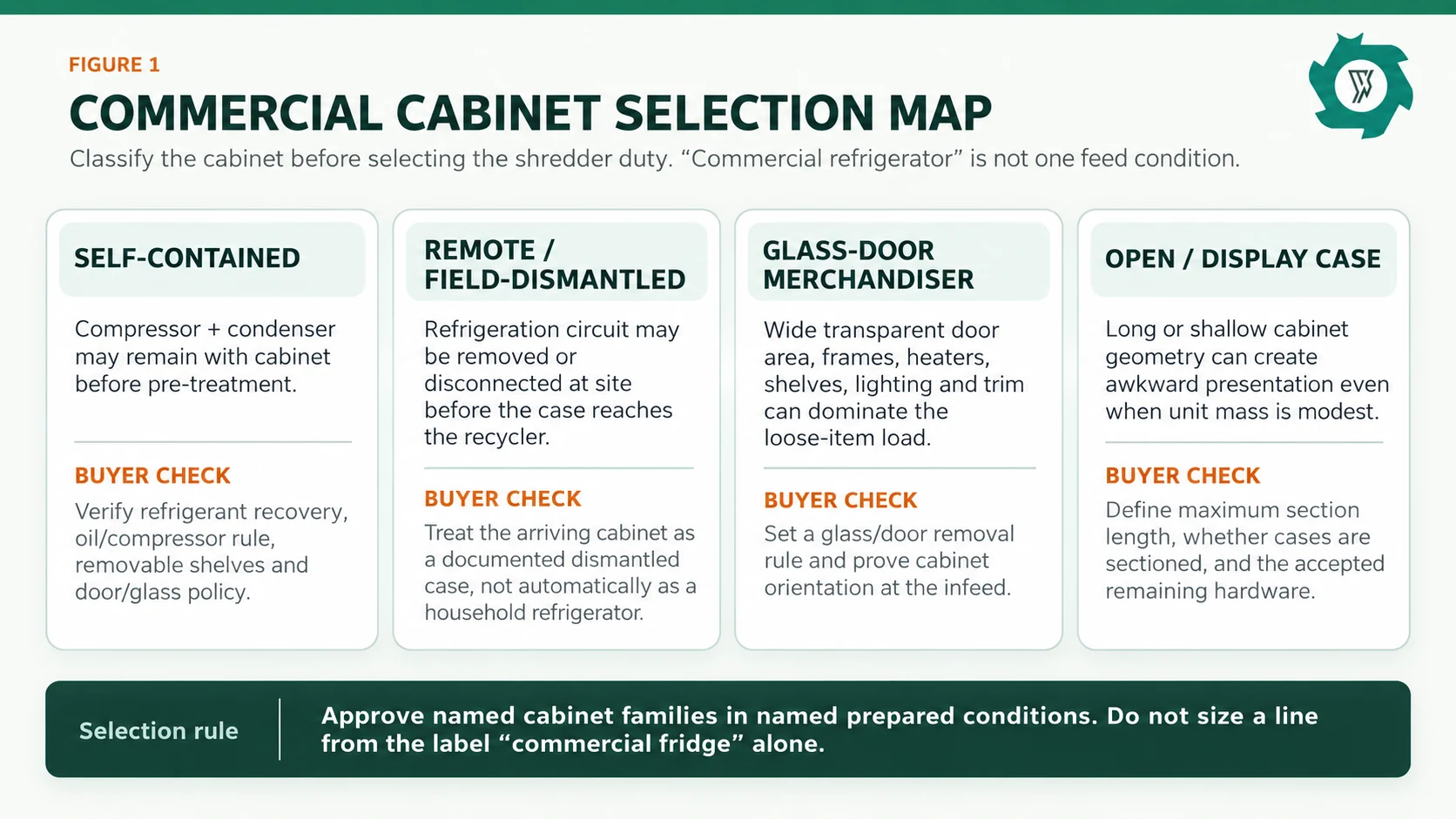
Figure 1. Commercial refrigeration covers several cabinet architectures. Classify the feed before setting the mechanical duty.
Start by separating five commercial cabinet families
The U.S. Department of Energy defines commercial refrigeration broadly enough to include equipment with transparent or solid doors, hinged or sliding doors, combinations of those doors, and equipment with no doors. The definition also covers equipment connected to either a self-contained condensing unit or a remote condensing unit.[1] That definition is useful for recycling because it explains why “commercial refrigerator” is too broad for an RFQ.
1. Self-contained reach-in refrigerators and freezers
These are usually the easiest commercial units to relate to household refrigerator processing because the refrigeration package is part of the cabinet. The similarity ends at the general process boundary. Commercial reach-ins may have heavier stainless panels, thicker frames, multiple doors, larger compressors, fan packages and removable interior hardware. The buyer should specify whether the compressor, condenser, evaporator, fans and wiring are removed before shredding or remain within an approved prepared-cabinet condition. A machine proven only on thin domestic shells has not automatically proved this denser local construction.
2. Glass-door merchandisers and beverage coolers
Glass-door merchandisers create a different preparation problem. Door glass, door frames, anti-sweat wiring, lighting, shelves and signage can represent a large amount of removable material before the insulated cabinet is reduced. A supplier demonstration that leaves this policy undefined is hard to interpret: one test may use stripped shells while the buyer later receives complete doors and shelves. Write the door and glass rule into the feed specification and verify it at receiving.
3. Open multideck and open display cases
An open case can be long and relatively shallow. Its mass may not look extreme, but its geometry can be awkward for a short infeed or narrow cutting chamber. Long sheet-metal rails, shelf supports and trim can also change the way a case bridges or rotates during presentation. Some projects are better served by controlled sectioning before the shredder rather than buying a much larger chamber for an infrequent cabinet length.
4. Serve-over counters, island freezers and specialty display fixtures
These units can combine curved or flat glass, stainless work surfaces, foam panels, structural frames and service components in shapes that do not resemble an upright refrigerator. The correct question is whether they belong in the normal feed, an edge-compliant feed class, or a separate preparation route. Their inclusion should be deliberate because a specialty case can force the entire feed conveyor and shredder opening to accommodate a geometry that represents only a small share of annual tonnage.
5. Remote refrigerated display cases
Remote cases deserve their own category because the condensing unit is not integral to the case. EPA distinguishes refrigeration equipment typically dismantled on-site—retail food refrigeration is one example—from equipment that commonly enters the waste stream with its refrigerant charge intact. For equipment dismantled on-site, refrigerant recovery is handled under the servicing requirements before disposal.[2] A recycler receiving the stripped display case therefore needs documentation of the upstream work and a clear statement of what coils, lines, valves, wiring, doors, glass and insulation remain.
Freeze the pre-treatment boundary before selecting the shredder
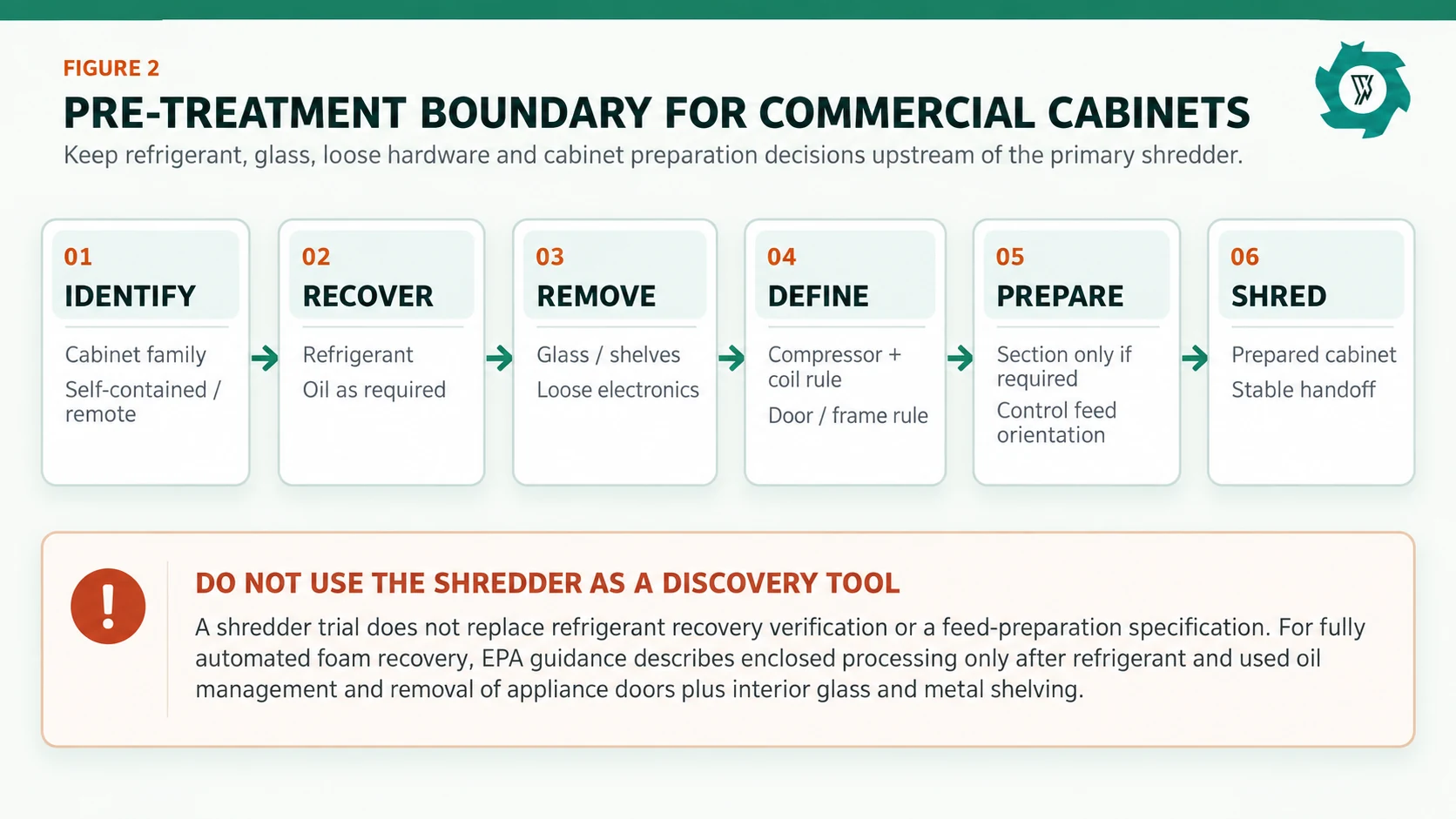
The shredding system should receive a defined mechanical feed, not an unknown refrigeration asset. EPA describes appliance recycling as refrigerant recovery and removal or management of hazardous components before evacuated appliances are shredded.[3] For commercial equipment, the exact legal and operational route depends on the appliance type, how it reaches the recycler and the applicable jurisdiction. The engineering implication is simpler: do not use the shredder to discover whether the cabinet still contains a refrigeration circuit, loose glass or components that should have been managed earlier.
A practical receiving specification identifies the cabinet family, whether it is self-contained or remote, the refrigerant-recovery status, the compressor and oil rule, door and glass policy, interior shelving rule, electronics and lamp policy, maximum dimensions, maximum unit mass and any prohibited components. Photograph difficult units and retain those examples for supplier review. If the recycler accepts both fully stripped display cases and more complete self-contained cabinets, treat them as separate feed classes even when they later converge on one conveyor.
EPA’s Responsible Appliance Disposal guidance explains that fully automated foam recovery systems process appliance bodies in enclosed equipment after refrigerant and used-oil management and removal of appliance doors plus interior glass and metal shelving.[4] The article is not prescribing that exact method for every commercial case; it shows why the buyer must state whether foam remains in the cabinet and what containment or downstream foam handling belongs inside the quoted line.
Figure 2. Selection starts with a controlled prepared cabinet. Refrigerant, glass and loose component decisions belong upstream of the shredder.
Select the primary shredder by ingestion duty, not catalog motor power
Once the feed is prepared, the primary shredder has a focused job: grip a bulky cabinet, open the structure and convert it into a controllable stream for the next conveyor or liberation stage. For many cabinets, a low-speed, high-torque twin-shaft arrangement is a sensible starting point, but the shaft count is not the proof. Cutter geometry, chamber width, shaft strength, drive protection, hopper shape and feed control have to match the approved commercial cabinet envelope.
The existing refrigerator shredder machine selection guide covers general shredder architectures and specifications. For commercial cabinets, concentrate on the ingestion details that are easy to miss in a generic comparison.
Chamber width must follow the loading orientation
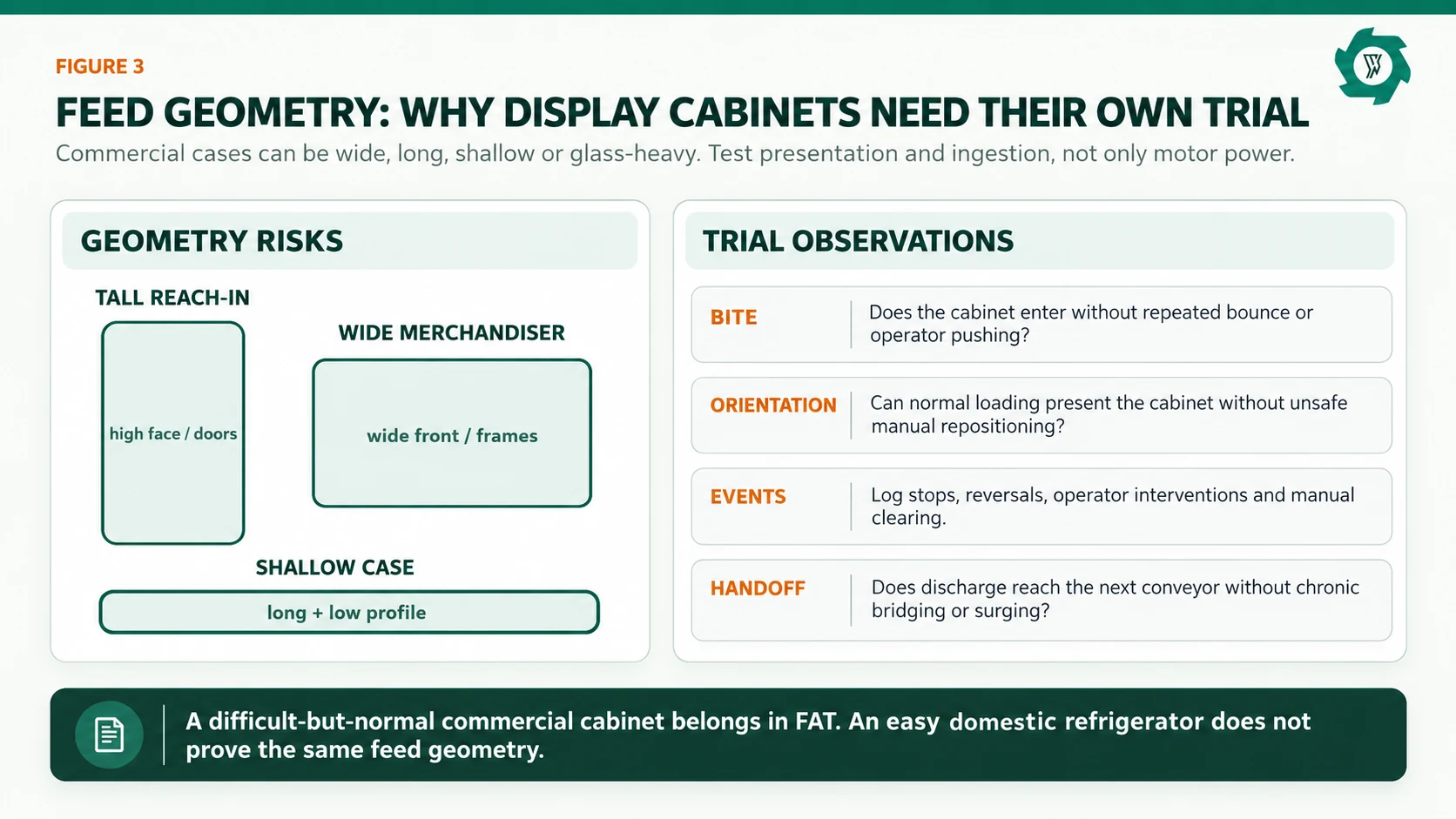
A wide cabinet does not always require a chamber wider than the full front face. Some units can be presented on the side or at a controlled angle; others cannot be rotated safely or consistently by the site’s loader. The RFQ should show the intended orientation and the available mechanical handling method. If a supplier assumes manual turning while the site intends forklift or conveyor loading, the quoted opening may be technically possible but operationally wrong.
Hopper geometry matters for shallow and long cases
Long display fixtures can bridge across a hopper even when the cutting chamber itself has enough width. A steep-sided hopper, pusher, hold-down or guided infeed may be needed depending on cabinet shape. Do not add devices by default; ask what problem each feature solves. The best evidence is a representative trial where the case is loaded using the same orientation and handling method planned for production.
Peak torque comes from local construction, not average unit mass
A commercial cabinet can be light for its external volume yet contain concentrated frames, hinges, stainless worktops, motor brackets or bundled hardware that produce short high-load events. Average kilograms per cabinet cannot describe that. The test set should include difficult-but-normal units with the densest permitted structures. Log reversals and stops instead of treating automatic reversal as invisible normal operation.
Do not make manual clearing part of the production rate
A supplier may still achieve an attractive tonnes-per-hour figure if operators repeatedly rearrange cabinets, pull out wrapped material or clear a bridge while the stopwatch continues in a convenient way. Define the time basis before testing and record operator interventions and manual clearing as events. A machine that accepts commercial cabinets only with frequent human recovery is not proving stable commercial duty.
Commercial cabinet geometry changes the feed-system decision
For household refrigerators, a buyer may already know the normal height, width and mass range. Commercial cases widen the envelope. The dedicated refrigerator shredder sizing guide explains why dimensions, unit mass, units per hour and tonnes per hour must be considered together. Commercial projects add one more variable: case aspect ratio.
Two cabinets with the same mass can behave very differently if one is tall and narrow while the other is long and shallow. The first may tip cleanly into the chamber. The second may lie across the opening and bridge. A very wide glass-door shell can catch on hopper edges after the doors are removed. Long bottom rails or frame members can rotate and delay ingestion. The feed-system design therefore needs photographs, dimensions and loading trials for each important cabinet family.
Where a rare case is far outside the normal envelope, pre-sectioning can be more economical than scaling every conveyor, hopper and shredder dimension around it. That decision should include labor, safe isolation, tool choice and the percentage of annual feed that needs extra preparation. Sectioning is not “free capacity”; it simply moves part of the size-reduction work upstream.
Figure 3. Wide and shallow display cabinets can create feed problems that do not appear during a household-refrigerator demonstration.
Decide whether commercial cabinets need one or two reduction stages
The primary shredder does not need to make finished saleable particles. Its job is to open the cabinet and stabilize material flow. A secondary crusher or liberation machine is justified only when the primary discharge does not meet a defined downstream requirement. That boundary is covered in more depth in the refrigerator crusher-versus-shredder article; for a commercial-cabinet project, the deciding evidence is the same: inspect the primary discharge and judge whether steel, plastic and foam are sufficiently released for the next separation step.
Commercial cabinets can increase the reason to inspect. Stainless skins, multiple liners, shelf rails and structural frames may leave larger composite pieces than a household refrigerator. Conversely, a well-prepared display case may already open cleanly enough that another crusher adds fines, wear and dust without improving recovery. The required refrigerator shredder output condition should therefore be tied to liberation and separator stability, not a single nominal millimeter target.
Check the handoff at the next machine. If coarse folded panels bridge the transfer conveyor, if foam-rich composites contaminate ferrous recovery, or if conductive non-ferrous pieces remain trapped inside larger assemblies, the system needs more liberation or better preparation. If the next stage accepts the flow and recovered fractions meet the buyer’s requirement, extra reduction may be unnecessary.
Do not mix commercial cabinet capacity claims without a feed recipe
A capacity statement such as “60 refrigerators per hour” is incomplete when the line handles commercial equipment. A test with small single-door reach-ins cannot prove a shift containing wide three-door merchandisers or long display cases. State both units per hour and mass throughput, then attach a feed recipe or class distribution. For example, the commercial campaign might contain a defined percentage of reach-ins, glass-door merchandisers and edge-compliant long cases, each within a named prepared condition.
Running time and elapsed time should both be reported. Running time explains what the machine achieved while operating; elapsed time shows the effect of stops, reversals, feed delays, downstream holds and maintenance interruptions. The distinction becomes important when commercial cabinets require more presentation time or create longer recovery events. Do not let the supplier exclude inconvenient events unless the FAT method explicitly classifies them in advance.
Accepted input and accepted output should also be reported separately. A line may receive a certain mass at the test boundary but divert unapproved components, retained material or oversize during the run. The buyer needs to see what entered, what became accepted process output and where the remainder went.
Design downstream separation around what commercial cabinets actually contain
After shredding, the line no longer sees “refrigerators.” It sees mixed steel, stainless or non-ferrous pieces, plastic, foam, wire, fasteners, frame sections and residues from the approved feed. The commercial cabinet mix can change those proportions. Glass-door merchandisers may contribute more door-frame hardware and wiring before pre-treatment. Serve-over cases may use more stainless surfaces. Remote cases may arrive with different coil or piping content depending on dismantling practice.
Magnetic separation is useful only after ferrous pieces have been opened enough to stop dragging excessive plastic or foam. Air separation requires a stable burden and controlled particle condition if light insulation is to be removed without carrying valuable heavier material. Eddy-current separation, where included, works on liberated conductive pieces; it cannot compensate for metal still locked inside large composite panels. In practice, a stable metered feed to the separators is often more valuable than pursuing the finest possible shredder discharge.
Provide safe places to observe the primary discharge, sample before and after any secondary liberation stage, inspect the foam fraction and collect product samples without reaching into moving equipment. When operators repeatedly open guards or work near a jam point, the line has crossed from process inconvenience into a safety design problem.
Safety review: commercial feeds can bring different refrigerants and service histories
Newer commercial refrigeration equipment may use lower-GWP refrigerants, including hydrocarbons in some stand-alone applications. EPA’s SNAP listings identify R-290 (propane) as an A3 refrigerant and list it as acceptable for certain stand-alone refrigeration uses subject to use conditions.[5] The recycling implication is not to guess the refrigerant from cabinet appearance. Receiving and depollution procedures should identify the appliance and confirm the recovery status before mechanical treatment.
Mechanical servicing hazards are independent of refrigerant status. OSHA’s hazardous-energy standard applies to servicing and maintenance where unexpected energization, startup or release of stored energy could injure employees.[6] Commercial cabinet lines often contain multiple conveyors, hydraulic or pneumatic functions, rotating cutters and downstream equipment. The isolation plan should cover the task being performed, including jam clearing and access for cutter, bearing or gearbox work. Guards and safe access should be restored before the machine returns to service.
The existing refrigerator shredder feed-problem guide is useful once a commissioned line begins showing bridging, overload or repeated reversal. During procurement, however, the objective is to prevent those symptoms by testing the commercial cabinet classes and feed orientations that are most likely to cause them.
Write the RFQ around cabinet classes and acceptance evidence
Cabinet families: reach-in, glass-door merchandiser, open display, serve-over, island freezer or other named classes.
Refrigeration configuration: self-contained, remote, or mixed; state what refrigeration hardware may remain at the shredder inlet.
Site boundary: floor area, clear height, loader or conveyor feeding method, electrical supply, dust/air interfaces, maintenance access and product collection.
FAT method: representative test feed, difficult-but-normal units, time basis, event log, mass balance, sampling method and pass/conditional/fail criteria.
Do not let an RFQ convert those fields back into one vague “commercial refrigerator” row. If a supplier excludes long display cases, complete doors or certain cabinet frames, record that as an explicit feed limitation. A clear exclusion is better than an assumed capability that appears only after installation.
Commercial-cabinet FAT: prove the hard normal case
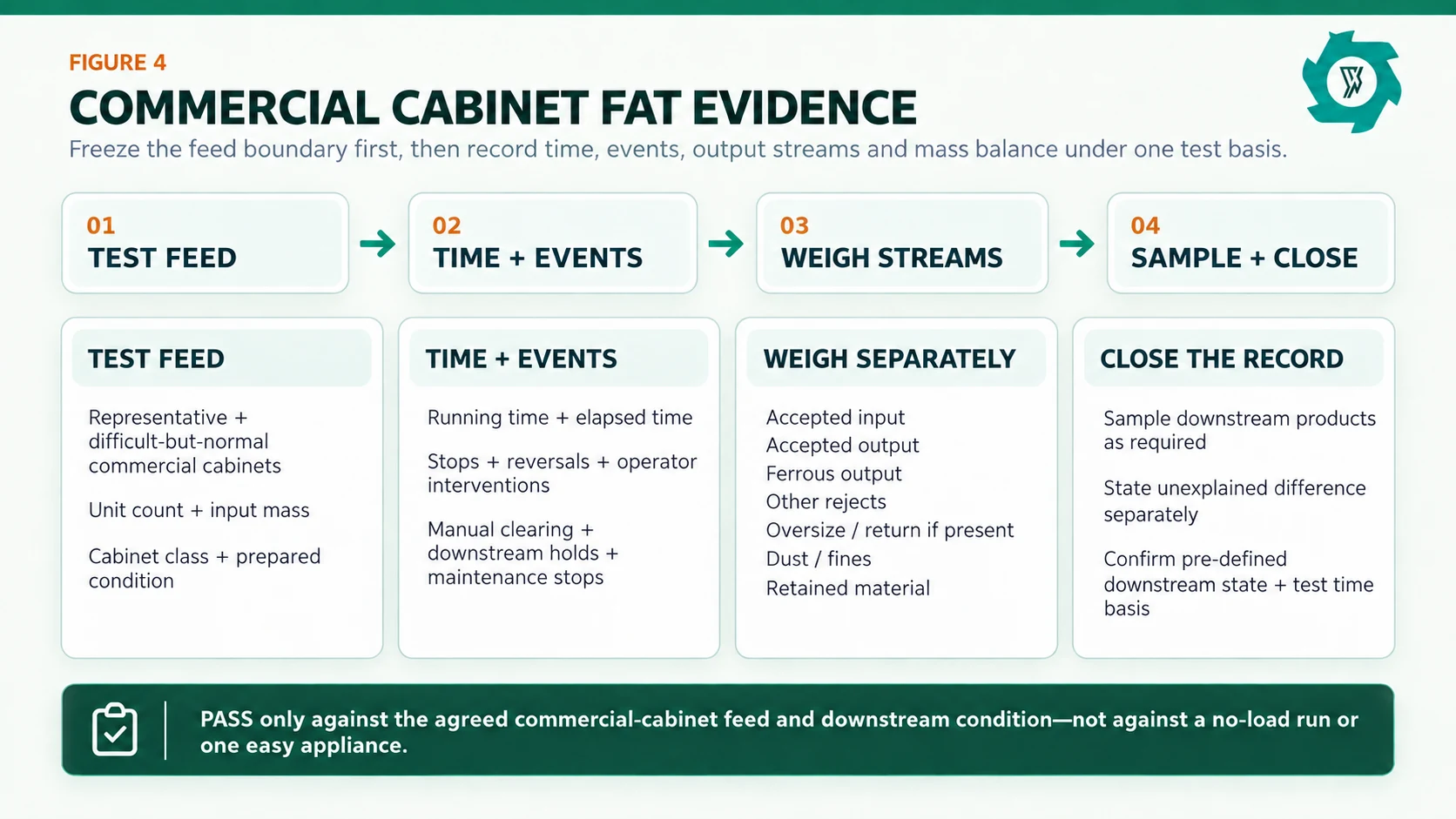
A useful FAT uses the same feed definition that justified the purchase. Include representative cabinets from every approved class and deliberately add difficult-but-normal units within the agreed dimensional and construction boundary. Record unit count and input mass by class. Freeze the downstream state and test time basis before the run so a supplier cannot stop the clock or bypass a bottleneck without leaving an evidence trail.
During the test, record running time and elapsed time. Log stops, reversals, operator interventions, manual clearing, downstream holds and maintenance stops. Note which cabinet class was entering when a meaningful event occurred. That detail is especially useful when an apparently acceptable average hides a repeatable problem with one wide merchandiser or one long display-case family.
For the mass balance, weigh accepted input and accepted output separately. Then weigh ferrous output, other rejects, oversize or return material if present, dust or fines and retained material. If the recorded outputs do not reconcile with the measured input, state the unexplained difference as its own line rather than combining it with retained material. Sample the downstream products that drive the buying decision, and use the same sampling rule for each supplier being compared.
The final decision should combine mechanical stability and downstream value. Passing the test means the approved commercial feed was processed at the agreed time basis, event frequency was acceptable, manual clearing did not become a routine production method, the next stage received a controllable stream, and the material balance and samples supported the promised process result.
Figure 4. Commercial-cabinet FAT should connect feed identity, time, events, separate output weights and downstream samples under one agreed boundary.
Selection checklist for a buyer comparing equipment
Use the following sequence when several suppliers appear to offer similar refrigerator shredding systems. First, reject any comparison that is based only on installed motor power, chamber dimensions or a video of one easy cabinet. Second, normalize the feed: same commercial cabinet classes, same preparation rule and same difficult-but-normal examples. Third, compare how each proposal handles wide or long cases before they reach the cutters. Fourth, check whether a secondary crusher is justified by measured liberation rather than included automatically. Fifth, compare the complete downstream route and product evidence, not only primary shredder throughput. Finally, freeze a FAT method before the purchase order so the test cannot be redesigned around the machine that was already built.
Commercial refrigerator and display-cabinet recycling is manageable when the feed is classified. It becomes unpredictable when every cooled fixture is treated as one appliance type. Define what arrives, what is removed, how the cabinet will be presented, what the shredder must accomplish and what the next stage requires. Then make the supplier prove that exact boundary with representative material.
Configure the line around your commercial cabinet feed
Send cabinet photos, the self-contained or remote configuration, prepared condition, largest dimensions, unit-mass range, target units/hour and tons/hour, loading method, downstream products and workshop information. The equipment proposal can then be built around the actual commercial feed instead of a generic refrigerator specification.
Frequently Asked Questions
Can a commercial refrigerator use the same shredder as a household refrigerator?
Sometimes, but the decision should be proved against the commercial cabinet family. Commercial reach-ins, merchandisers and display cases can be wider, longer, more glass-heavy or built around different refrigeration arrangements. Approve the cabinet type, prepared condition, maximum dimensions, unit mass and loading orientation, then test representative and difficult-but-normal units on the proposed feed system and primary shredder.
Should glass doors and shelves be removed before shredding a display cabinet?
The removal rule should be written into the feed specification. For a buyer-side baseline, remove loose interior glass and define whether complete glass doors or door assemblies are removed before the cabinet reaches the shredder. EPA Responsible Appliance Disposal guidance for fully automated foam recovery describes processing after refrigerant and used-oil management and removal of appliance doors plus interior glass and metal shelving. Local requirements and the selected recycling process still control the final procedure.
What is different about remote refrigerated display cases at end of life?
A remote case may reach the recycler after refrigeration components have been disconnected or dismantled at the site. EPA notes that retail food refrigeration typically dismantled on-site must have refrigerant recovered under the servicing requirements before disposal. The recycler should therefore document what was removed upstream and specify exactly what cabinet, coil, piping, wiring, glass and hardware may remain in the accepted feed.
What should a FAT for commercial refrigerator shredding record?
Use representative and difficult-but-normal commercial cabinets from every approved class. Record unit count and input mass by class, running time and elapsed time, stops, reversals, operator interventions, manual clearing, downstream holds and maintenance stops. Weigh accepted input and accepted output separately, then weigh ferrous output, other rejects, oversize or return material if present, dust or fines and retained material, and state any unexplained mass difference separately. The downstream condition and test time basis should be agreed before the run.
What information should I send with an RFQ for commercial refrigerator or display cabinet shredding?
Send the cabinet families, self-contained or remote configuration, prepared condition, photos, normal and maximum dimensions, unit-mass range, glass and shelf policy, compressor and coil rule, required units per hour and mass throughput, loading method, downstream separation route, target output condition, available floor area and utilities, and the acceptance evidence you expect during FAT. This lets suppliers compare the same process boundary instead of quoting against different assumptions.
David focuses on industrial shredding and recycling equipment,including material evaluation,shredder selection,process configuration,and recycling line planning.
Speak To Our Shredder Machine Expert
Get in touch with our nice team today to get a price estimate for a shredder machine.