Industrial Shredder & Recycling Systems Manufacturer - YUXI

 English


 English

 Fast Delivery
 Reliable
 Certified
 ExperiencedEnglishEnglishFast DeliveryReliableCertifiedExperienced
At the end of a slitter, a narrow strip of paper can keep moving for most of a shift. A few metres away, the same factory may have a damaged jumbo roll sitting on a pallet, waiting for someone to deal with it. Both show up as paper waste. Put them in front of one shredder, though, and they behave nothing alike.
That difference shapes the whole job. This guide follows paper trim and rejected rolls from the converting floor to the point where dry fiber preparation can begin. It looks at roll handling, trim collection, cores, tape joints and the trials that tell you whether a proposed line will work. For the downstream process, see the waste paper cellulose recycling line. Here, the trouble usually starts before the first cutter.
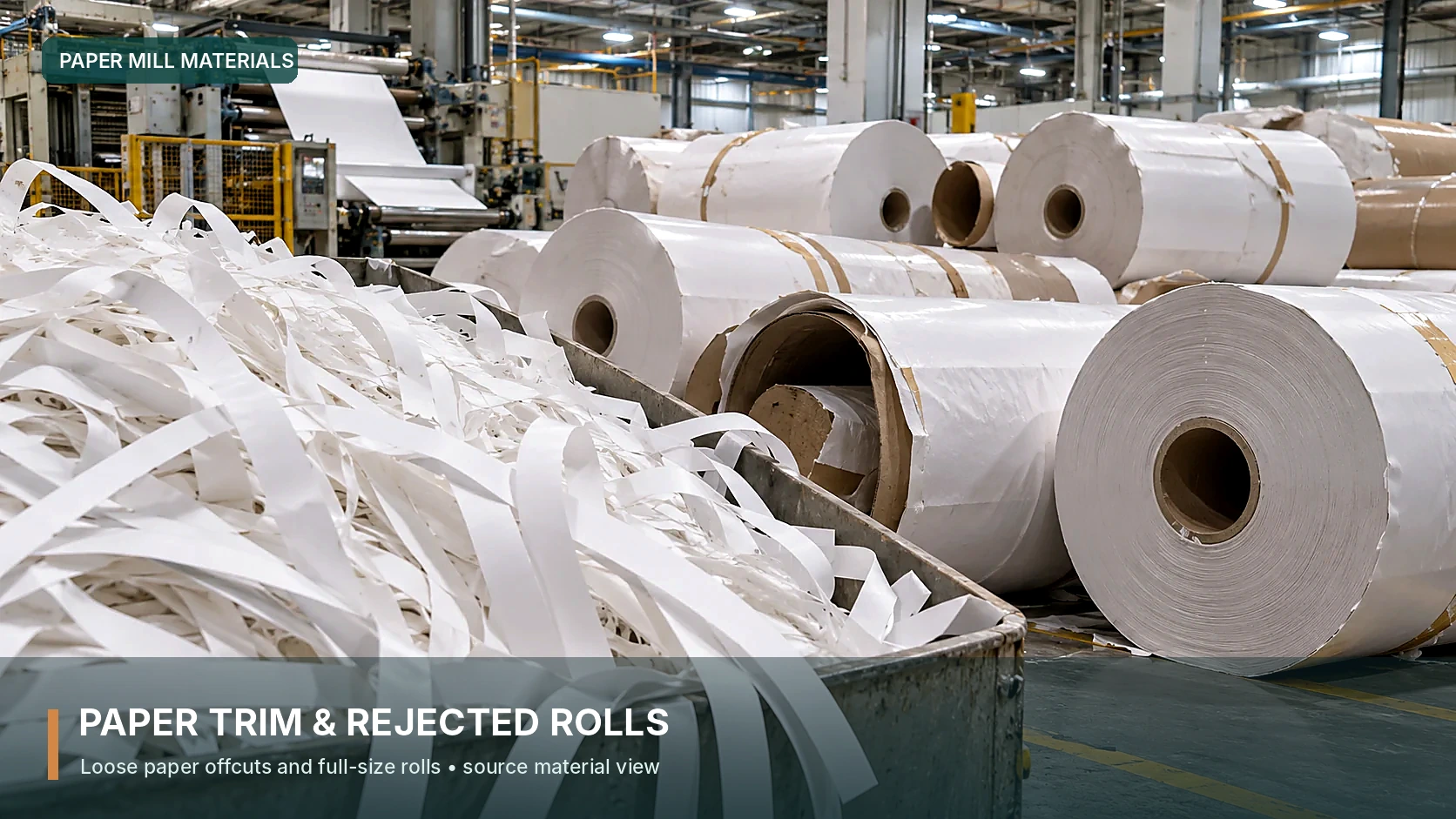
A converter rarely produces one neat pile of identical scraps. There may be long slitter ribbons, loose guillotine cuttings, die-cut skeletons, rejected sheets and entire reels. The waste report may place all of them under “paper scraps.” That label is fine for accounting. It is a poor starting point for equipment selection because the machine has to deal with the shape of each load, not just its fiber content.
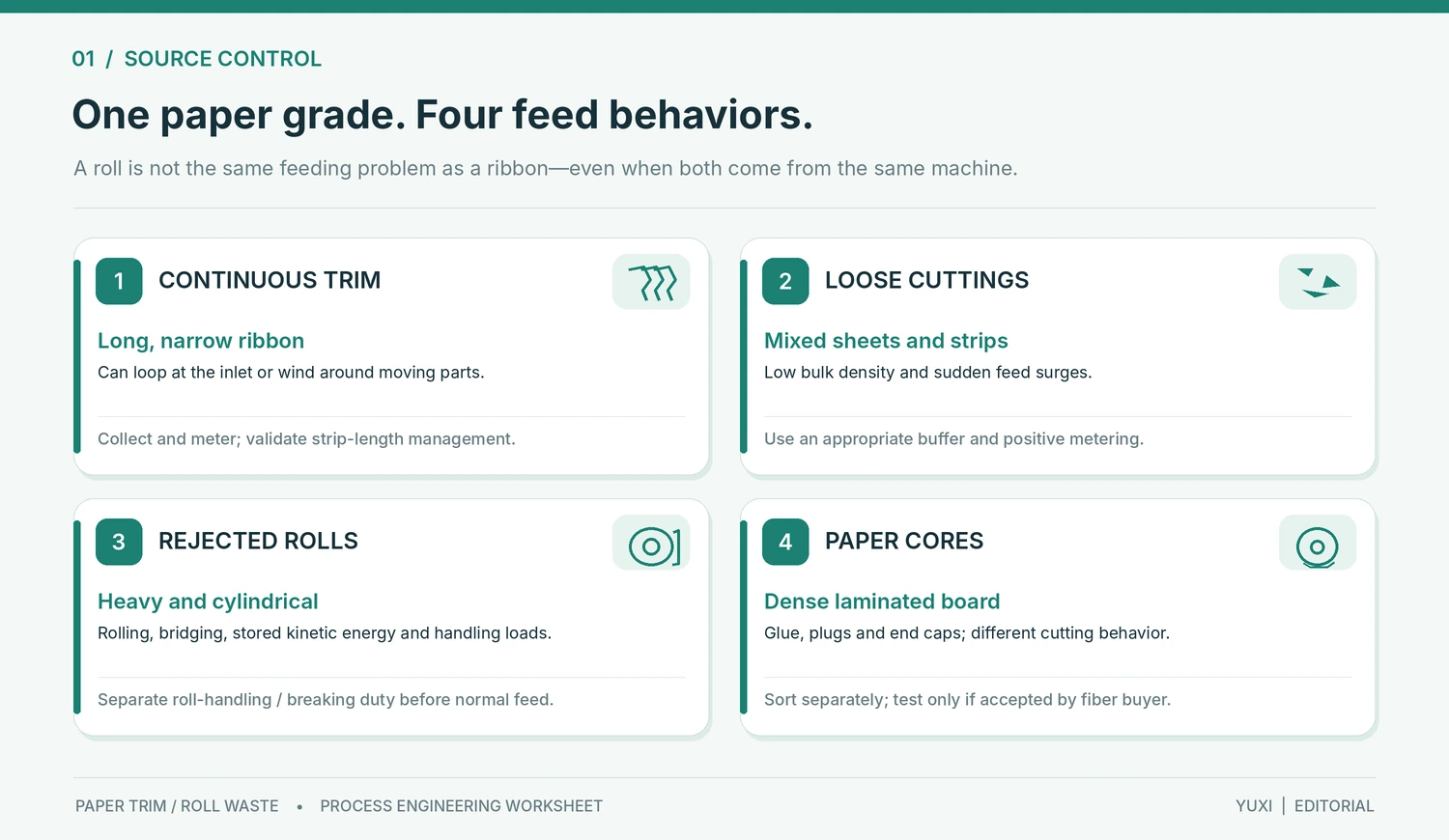
Continuous ribbons can loop around a shaft or catch on a fixed edge. Loose cuttings are light until a whole bin tips into the hopper at once. Rejected rolls concentrate a lot of weight in one object that can turn, slip or refuse to enter the cutters. Paper cores bring dense glued board, and sometimes end plugs, into a stream that may otherwise be fairly clean. Each form needs its own receiving rule.
Start with a sketch of the waste leaving each production machine. Mark where it goes, how it is collected and what the busiest hour looks like. Annual tonnage helps with the business case, but it will not tell you whether a long strip wraps around an inlet or a rejected reel blocks it. One inconvenient roll can interrupt a trim line that has run steadily all morning.
| Waste stream | Likely bottleneck | What to verify before selection |
|---|---|---|
| Narrow continuous edge trim | Length, looping, suction imbalance, low mass per unit volume | Trim width, collection method, cutting location, startup/shutdown behavior |
| Intermittent sheets or cuttings | Bridging, fluffy piles, sudden overfeed | Largest sheet, feeder geometry, available buffer volume |
| Off-spec or damaged roll | Diameter, mass, roll rotation, loss of grip | Roll OD, width, core ID, mass, wrapping, method of restraint |
| Rejected cores and roll ends | Dense board, adhesive, plugs or metal fittings | Core composition and separate acceptance / rejection rule |
A clean-looking roll is not necessarily good feed for dry cellulose fiber. Release paper, wet-strength grades, coated board and film-laminated stock can all leave a converting machine without looking dirty. Their behavior changes when the sheet is torn apart. Some will open readily; others carry coatings, adhesives or other material that the fiber buyer may not want. The grade matters as much as the lack of visible contamination.
The receiving record should name the paper that was being converted. “White paper” is too vague. Untreated printing stock, folding carton board, labelstock and silicone-release liner call for different decisions. Note the basis-weight range and any coating, print, glue or film. For an unknown material, keep a sample and identify the source before adding it to the normal feed. Mixing several grades first and investigating a poor fiber sample later is a frustrating way to run a trial.
The ReMA paper specifications give useful names to recovered-paper grades, including Hard White Shavings, Coated Soft White Shavings, Mixed Flyleaf Shavings and Fiber Cores. Those distinctions help when buying or sorting material. They are not machine-performance ratings. A commercial grade name cannot tell you whether a roll will feed safely or whether its mechanically opened fiber will pass the customer’s test.
Ask the converter one question early: does the trim come from the same paper as the rejected rolls? A slitter may change substrates several times in a day. Untreated white trim from one order can end up next to adhesive-coated rejects from the next. If they are mixed before sampling, you lose the chance to find out which material caused a problem. Separate bins and simple lot labels are often more useful at this stage than a more elaborate machine specification.
Use the largest roll the plant normally rejects as the starting point for the handling discussion. How does it leave the floor: clamp truck, hoist or another lifting device? Where can it be set down without rolling? Can the operator remove wrapping and inspect the ends from a guarded work area? Trace the path right to the cutting zone, including turns, clearances and the space needed to withdraw a jammed load safely. A drawing that shows only the shredder inlet misses half the problem.
Roll size usually decides which preparation routes deserve a trial. Unwinding gives the downstream feeder sheets or strips instead of a heavy cylinder, but someone must manage the unwind station. A purpose-built cutter or roll breaker can turn large reels into sections; that adds lifting, guarding and another transfer. Direct shredding is a possibility only where the proposed infeed can hold and engage the actual roll. None of these routes wins by default. The right choice depends on how often rolls are rejected and how much handling the factory can accept.
A high motor rating says little about the first bite into a tight roll. The reel may turn in the hopper while the cutters barely touch it. A loose tail may snag before the main body engages. Ask for the roll diameter, face width, gross mass, core dimensions and winding condition to be written on the trial sheet. A double-shaft shredder is one primary-opening option for suitable material. The machine still has to demonstrate secure feeding with the buyer’s real reels, rather than a conveniently small sample.
Cutting open a roll often reveals why “all-paper waste” needs a closer look. The outside may be clean stock, while the centre is a thick, glued board tube. Some cores also carry plastic or metal plugs. Even if a cutter tolerates the board, its color and adhesive content can change the fiber blend. For a customer expecting clean white output, that is a product-quality issue before it becomes a maintenance issue.
Choose the core route on paper before the equipment is priced. It might leave with the roll during unwinding, be taken out after a roll-breaking step or go into a separate processing stream. If it is excluded, write down who removes it and where. A quotation that silently relies on manual core removal can look cheaper than one that includes the necessary handling station. The difference tends to surface only when the machines arrive.
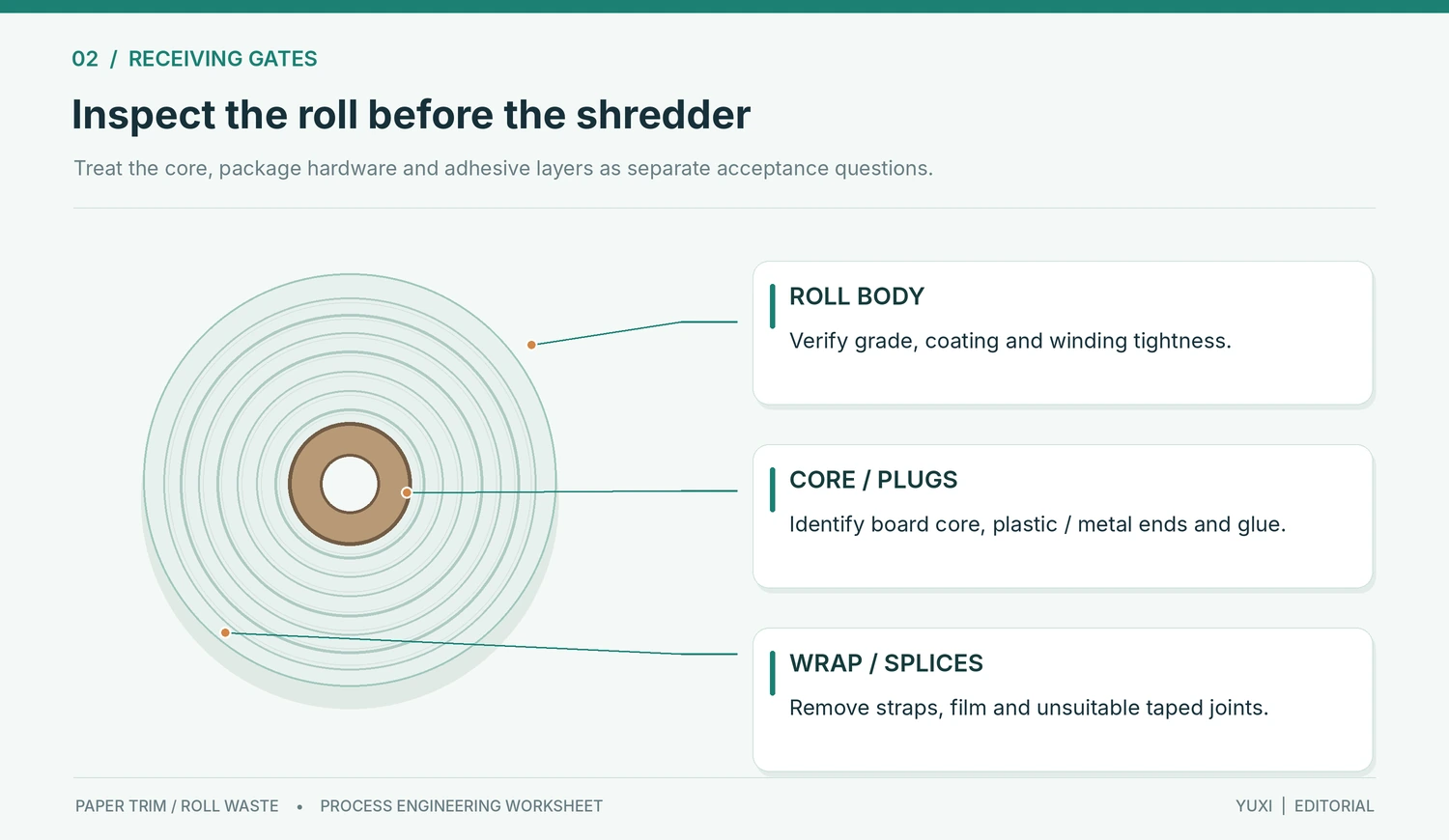
Splicing tape is easy to overlook during a clean-paper trial. Yet a rejected reel may contain several joints, each made with a different tape or adhesive. Some fragments can remain in the fiber; film-backed tape can also collect where material turns or transfers. A magnet will not remove it. Keep typical splices in at least one trial lot and check the resulting fiber. If the buyer’s specification cannot tolerate them, the process needs a removal step or a rule for excluding those rolls.
Shrink film, straps, pallet pieces, labels and corner guards belong at an unpacking station, away from the cutter inlet. That station needs space for safe handling and somewhere to put the removed packaging. Treating de-packing as an informal task beside a running machine creates both a feed-quality problem and an avoidable hazard.
Trim coming straight off a slitter is often already moving in an extraction system. That is a good reason to inspect the existing collection equipment before adding a shredder. Continuous ribbons are a different handling job from bales or piles of loose scrap. Purpose-built systems may chop or convey trim before it ever reaches a bin. For context, paper converting trim systems describe air collection from slitters, sheeters and rewinders. Such collection equipment does not, on its own, make finished cellulose fiber.
If the factory has a dependable trim extractor, keep that advantage. Find a controlled point where the collected paper can leave the air stream and enter a buffer or metering device. Replacing a working extraction route with bags and manual dumping usually adds handling and dust. It can also turn a steady source of scrap into a series of sudden loads. The connection between collection and size reduction deserves its own drawing.
Walk through the trim system during a normal production changeover, not just at steady speed. The key checks are fairly practical: collection at the widest regular trim, what happens when one slitter lane stops, where paper is separated from conveying air, and whether the receiving bin can discharge without bridging. Watch for material returning into the work area or dust escaping at transfer points. A note saying “air conveying included” does not answer any of those questions.
Bagged strips and loose offcuts need a different entry point. A buffer with controlled discharge can smooth out the uneven loads from bins, provided the strips can be fed without wrapping. Where particle size at discharge matters, a single-shaft shredder is worth evaluating. Test the feed pusher, screen behavior and long-strip handling together. A screen specification alone will not tell you whether lightweight trim can reach the cutters consistently.
The difficult period is often the change between orders. A slitter can run with narrow, predictable edge strips, stop for a web change, then produce much wider waste during setup. The mass entering the collection system changes even if machine speed does not. A buffer helps only if it has room for that short surge and a reliable way to empty afterward. Roll rejects should enter through a planned route, not be dropped into the trim hopper whenever production has a bad reel.
Ask the operators what happens during a web break, at startup and when a full waste bin is exchanged. These short events seldom appear in a catalog capacity figure, but they explain many feeding interruptions. Write down the event, the amount of scrap arriving and how the system recovers. That record gives the supplier something concrete to design around.
The two streams need to reach a similar, controlled feed condition before they share downstream equipment. Long ribbons may need collection and cutting. Rolls may need unwrapping, core handling and breaking. Only then does it make sense to discuss a common primary reduction stage and fiberizer. A trim chopper, a roll breaker and a fiberizer all work on paper, but they solve three different problems.
Draw the route from the slitter and the roll-storage area separately. Show the trim separator and its discharge point. On the roll side, show inspection, packaging removal, the lifting device, core treatment and the transfer of prepared sections. Mark the first point where both streams could share a buffer. From there, identify primary reduction, contaminant control, any secondary fiber opening and enclosed transfer. This is a duty drawing; it still needs a site layout and a trial before it becomes a machine arrangement.
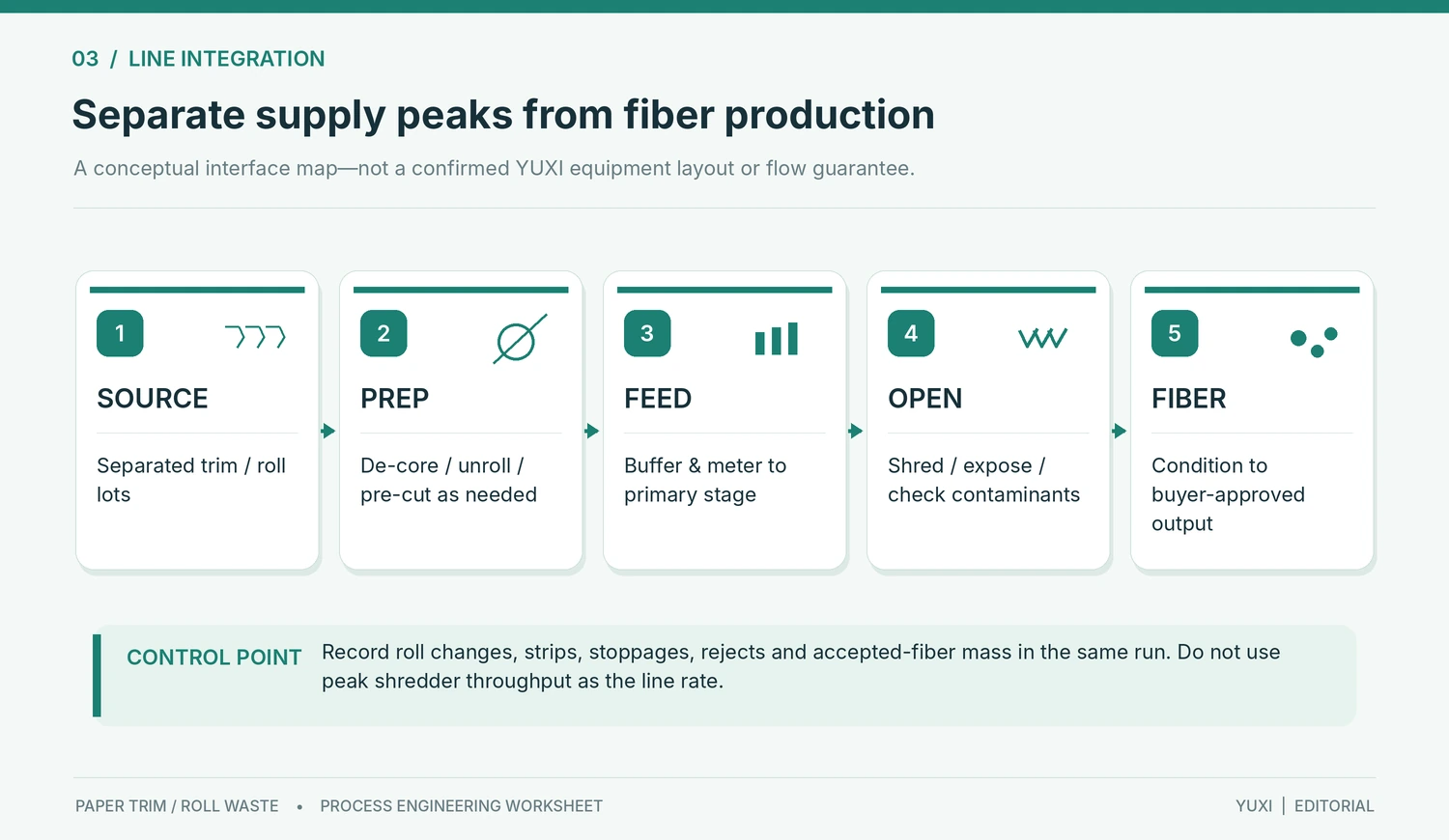
Once the paper leaves primary reduction, the next issue is a steady handoff to the fiberizer. The separate shredder-to-fiberizer handoff guide covers discharge condition, buffering, magnet placement and feed balance. For trim and rolls, concentrate first on the upstream question: can each source arrive at that handoff without long strips, oversize roll pieces or abrupt feed surges?
A shared line is not always the best commercial answer. Clean, single-grade trim may already have a buyer who values its consistency. Rejected rolls can contain mixed substrates, cores, wrap and splice tape. Combining them could lower the value of the cleaner stream, even when the shredder runs well. Put the sales or end-use specification beside the process drawing. It may justify keeping the materials apart.
Two suppliers may both print the same tons-per-hour figure on a quote and still be offering very different projects. One price covers cutting prepared sheets. The other has to start with wrapped reels, bring them through a loading station and produce fiber that passes a buyer’s check. Before comparing numbers, draw a line around the supplier’s responsibility. Does the quoted rate start at the shredder inlet or at the moment the operator picks up a rejected roll?
For rolls, time the whole sequence: receive, unpack, handle the core, position the reel, engage the cutters, clear the discharge and get ready for the next load. For trim, watch whether the extractor, separator and buffer keep pace with the converting machines. Record several mass figures separately: gross waste received, material fed to the cutter, material leaving primary reduction and accepted fiber at the end. One number cannot represent every boundary.
The accepted-fiber figure matters most when revenue depends on a customer’s specification. Packaging, core pieces, unsuitable grades and collected fines can all reduce what is left to sell. Water adds another source of confusion; a tonne weighed at one moisture level is not the same quantity of dry material at another. Keep the moisture basis and reject categories beside every rate claim. A short burst on hand-picked paper is useful demonstration footage, but it is a poor substitute for a timed production run.
Specify three operating situations rather than one ideal hourly rate: a normal trim-only period, a mixed period and a period that includes the largest regularly rejected roll. Add how often each situation occurs. If the large reel appears once a week, a separate preparation station might serve it well. If rejected reels accumulate every shift, the extra handling becomes a daily cost. Frequency changes the answer as much as roll diameter.
The layout needs to work for people and lifting equipment, not just fit machines into a floor plan. Check whether a clamp truck can turn with the maximum reel, whether guards leave room for access and where an extracted core or rejected wrap will be placed. A hopper can be wide enough for the roll but impossible to load from the available aisle. A dimensioned elevation and maintenance-access drawing will catch that before installation.
Clean, unprinted trim offers a useful starting material because its origin is often easier to trace. That does not tell the fiber buyer what to expect. A bright sheet can still carry filler or a surface treatment. Once opened, a mix of paper grades may vary in color, dust level, bulk and the amount of intact sheet left behind. Define acceptance using the intended application and keep reference samples; appearance alone is too subjective.
Put the trial fiber in front of the intended user. Ask them to inspect remaining sheet flakes, tape or film, non-paper pieces, fines, moisture and how the material handles in their next process. Dry mechanical opening is not deinking or wet pulping. Calling the output “pulp” can hide that distinction and lead to the wrong equipment discussion. It also does not make mixed coated waste suitable for insulation or any other end use without application-specific testing.
If secondary opening is required, the paper fiberizer machine guide deals with that stage and its tests. With roll waste, first inspect what is being sent to it. Check for core board, remaining splice tape and coated lots mixed into clean trim. If the fiber changes each time the converting order changes, the source mix may be the cause. Adjusting the fiberizer cannot remove contamination that should have been separated upstream.
A trial based only on one spotless white roll tells you very little about daily production. Include the grammage changes, printed edges and ordinary tape joints the factory actually generates. Label each feed lot. Then keep fiber samples from more than one point in the run. If the clean sample passes but the normal mix does not, that is useful information about the feed specification, not simply a failed machine test.
Before the FAT, agree on the feed condition at the supplier’s gate. Are the rolls intact or already sectioned? Has anyone removed the cores? Will continuous trim arrive directly from a separator or in bags? Set the run duration, sampling method, allowed interruptions and output acceptance rule in writing. Otherwise a smooth five-minute video can look like a pass to one party and an incomplete test to the other.
Choose trial material from ordinary production, including its awkward parts. For many plants that means continuous cuttings, rejected rolls with their normal cores and splices, and one difficult but regularly occurring mix. If a separate machine performs the roll-breaking, make that boundary clear. A shredder running well on pre-cut sections has proved it can process those sections; the test has not established that the purchased machine can accept intact jumbo reels.
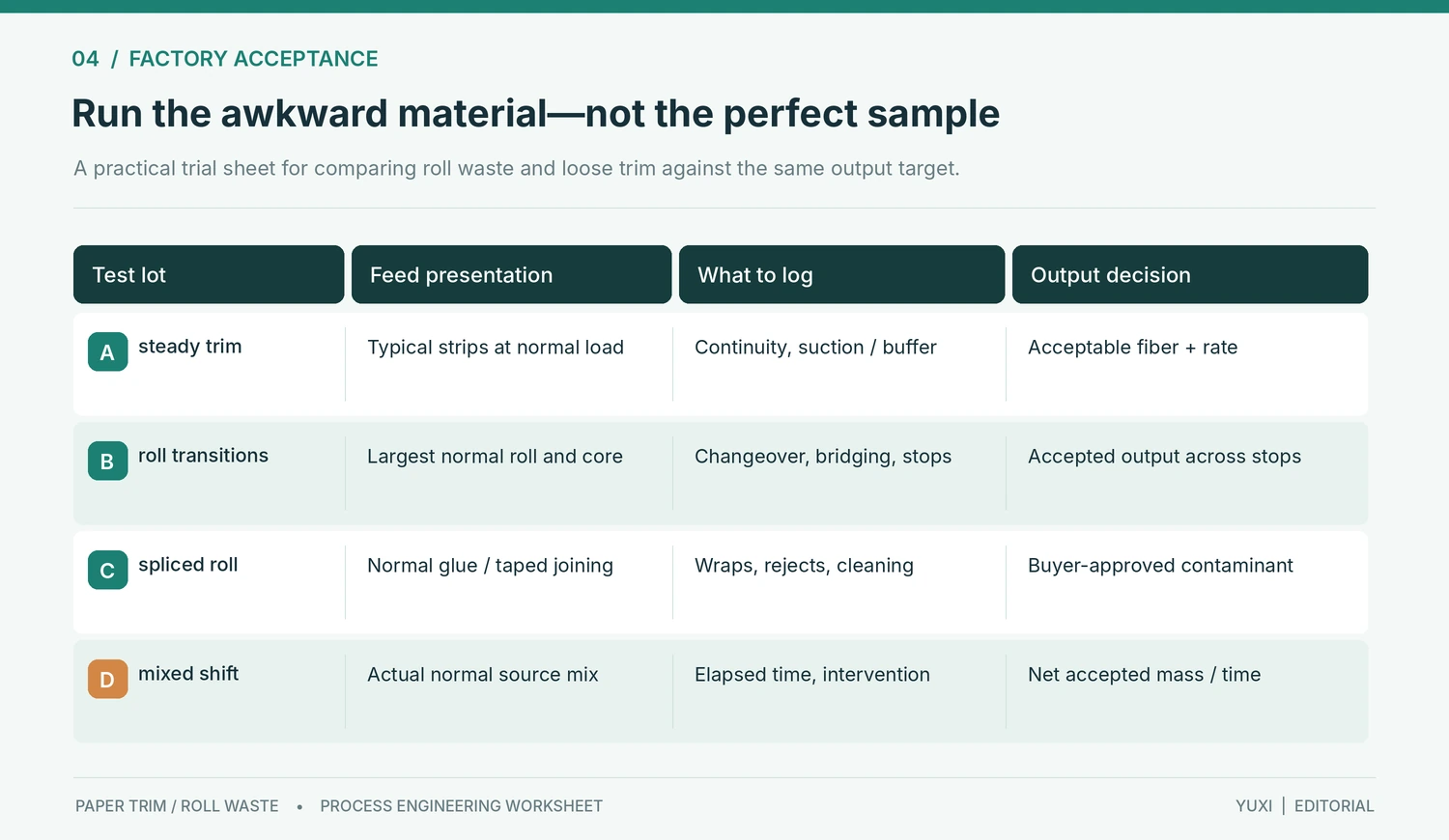
Keep the test log simple enough that someone will actually use it. Note when feeding begins and ends, every loading or changeover stop, reverse-cycle count, material rejection and time lost waiting for downstream equipment. Record any intervention and why it was needed, with the machine safely isolated whenever access is required. Distinguish cutter-running time from the clock time for the complete test. Both matter, but they answer different questions.
Weigh the feed, saleable output and rejects where the trial setup allows it. Check how much material is still inside the machines when the run stops. If dust extraction removes fine material, decide in advance how to account for it. These details can explain a mass-balance gap that might otherwise be mistaken for a recovery problem. A clear set of weights is better than reporting a recovery percentage with no stated boundary.
Take output samples early, midway through the run and near the end. Label the sample with its feed lot, operating condition and time. Test quality at the same setting used to claim throughput. A fast run that leaves coarse pieces and a slow run that makes cleaner fiber are two operating points, not proof of one combined guarantee. If both are possible modes, the quotation should say so.
When something goes wrong, identify the failed duty before changing the machine list. A roll spinning above the cutters points to grip or restraint. Trim wrapping around a shaft points to strip control. Adhesive in otherwise well-opened fiber points back to feed sorting or splice handling. Low output with clean fiber may come from a starved buffer or time lost on changeovers. Each observation sends you to a different part of the layout.
Write the successful feed condition into the acceptance record. If a test passes with roll sections below an agreed size, record that size and how the sections were prepared. The plant may later receive wider or denser rolls. Without a written boundary, an old test can be used to justify a new duty it never covered.
A useful RFQ begins with the waste itself. Send a short video showing trim during normal production and the largest rejected reel during handling. Photograph the core ends, splice tape, wrapping and available loading space. Add dimensions and the frequency of roll rejects. Give every bidder the same feed description; otherwise differences in quoted price may simply reflect different assumptions about preparation work.
Have bidders state exclusions beside the relevant duties. One may include an unwind or roll-breaking station; another may assume all reels arrive pre-cut. One may include separation from trim-conveying air; another may price only the shredder. Compare the missing equipment, labor, controls and dust-management scope before comparing totals. An inexpensive machine can become an expensive line if the interfaces were left out.
Some production scrap already has a good recycling route. Clean, well-sorted trim may be sold or returned as recovered paper for a mill. Dry fiberizing changes the form of that material and adds an operating step. Check the price and specification of the existing outlet before investing in a process that may reduce its value. More equipment is not automatically more recovery.
Highly laminated stock, adhesive-heavy label material and silicone-release grades deserve separate review. For some, the useful route is specialist recovery or separation rather than general dry fiber opening. Wet rolls, dense coated stock and unknown plastic layers also bring difficulties that a larger cutter does not fix. Sort those lots out until a representative test shows both stable processing and an acceptable product.
The intended end product can also rule out this route. If the customer wants deinked stock for making paper again, dry shredding and fiber opening do not replace wet pulping, screening and deinking. Settle that requirement before discussing shredder shafts or motor power. It is a basic distinction, but missing it changes the entire project.
For trim and rejected rolls, the best early question is simple: what reaches the first cutter on an ordinary shift? Once the collection method, roll preparation and feed limits are clear, the fiber trial can tell you whether the output has a buyer. That sequence is less exciting than a headline throughput figure, but it gives the project a much better chance of working as quoted.
Only if the specific machine, feed arrangement and safe handling method have been qualified for that roll’s diameter, width, weight, core and winding condition. Some projects need unwinding or purpose-designed roll-breaking before normal shredding. Do not infer direct-roll capability from a generic paper-shredder rating.
Not by default. Cores can contain dense glued board and plastic or metal end fittings, and they may change the downstream fiber composition. Specify core removal or separate processing unless the receiving customer accepts the resulting material and representative testing confirms suitability.
No. A trim extraction system collects and transfers converting waste. The separated material may still need controlled feeding, primary size reduction, contaminant management and secondary mechanical opening to reach the required dry fiber condition.
Some grades may be mechanically opened, but coating, filler, ink, adhesive, lamination and the receiving user’s requirements determine whether the resulting fiber is useful. Keep unlike grades separate and test the normal material; do not assume that all paper rolls are interchangeable.
Record both productive and elapsed time, including roll changeovers, preparation, jams and other interventions. Report accepted-fiber mass over the agreed test period as well as incoming mass. A short peak shredder rate does not demonstrate the sustained rate of the complete line.
Use representative continuous trim, normal rejected rolls including expected cores and splices, and difficult-but-regular production material. Label feed lots, retain multiple output samples, record rejects and stops, and confirm fiber quality at the same operating condition used for the quoted production rate.
Send actual roll dimensions, core and splice photos, trim width and flow pattern, paper grade, target accepted-fiber condition and workshop layout. YUXI can review whether separate collection, roll preparation and controlled feeding are needed ahead of dry fiberizing.

Get in touch with our nice team today to get a price estimate for a shredder machine.
Contact Us