Industrial Shredder & Recycling Systems Manufacturer - YUXI

 English

 English
 Fast Delivery
 Reliable
 Certified
 ExperiencedEnglishEnglishFast DeliveryReliableCertifiedExperienced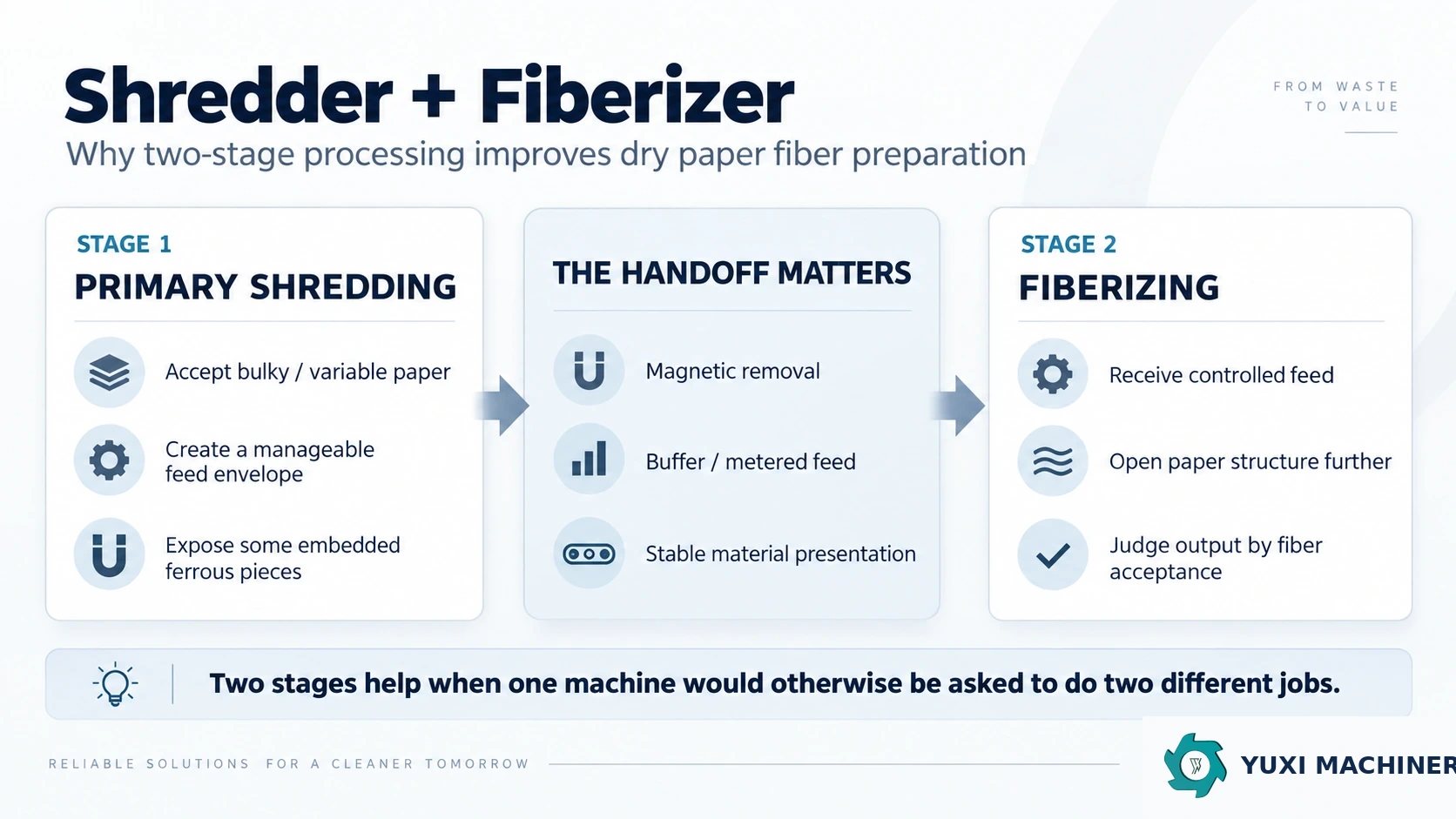
The two stages have different duties, but the interface between them is where line stability is won or lost.
The waste paper cellulose recycling line explains the complete dry mechanical process. This guide deliberately does not repeat the full process flow. It focuses on one narrower buyer and process-engineering problem: what must happen between primary shredding and secondary fiberizing so the connected line can run predictably?
“Shredded paper” is too vague to use as an interface specification. The downstream stage does not only receive a nominal particle size; it receives a changing combination of piece geometry, bulk density, moisture, bindings, exposed metal, fines and feed rate.
A useful handoff therefore defines four things: the condition leaving the primary shredder, how exposed ferrous material is presented for removal, how short surges are buffered, and how the fiberizer is metered. If these are not defined, each individual machine can appear correctly selected while the connected line remains unstable.
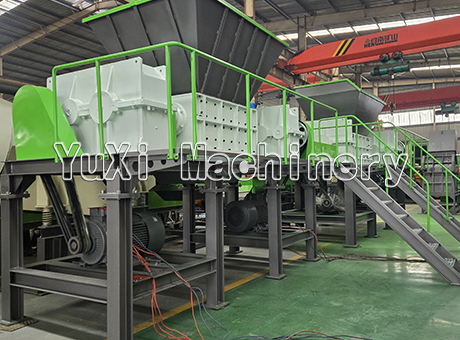
The primary stage should create a feed that the separation and transfer system can handle. It should not be asked to create finished fiber. For bulky books, cartons, tubes or irregular paper, a double shaft shredder may be evaluated as the rough opening stage, but the required discharge should be defined from the downstream interface rather than from a generic “smaller is better” target.
| Handoff item | What to define | Why it matters downstream |
|---|---|---|
| Largest normal pieces | Maximum regular strip, clump, book section or carton piece after primary reduction | Oversize pieces can bridge transfer points or enter the fiberizer irregularly |
| Long flexible pieces | Whether long strips or bindings remain after shredding | Long pieces can wrap, bridge or disturb metered feeding |
| Bulk behavior | Loose, fluffy, compacted or spring-back behavior | Bulk behavior affects conveyor depth, buffer volume and feeder consistency |
| Exposed contaminants | Staples, clips, wire or other ferrous pieces that become visible after opening | Magnetic separation only works on material presented effectively to the field |
| Moisture / difficult grades | Normal and worst regular moisture, coatings, glue and laminates | These can change flow, wrapping, loading and the final fiber condition |
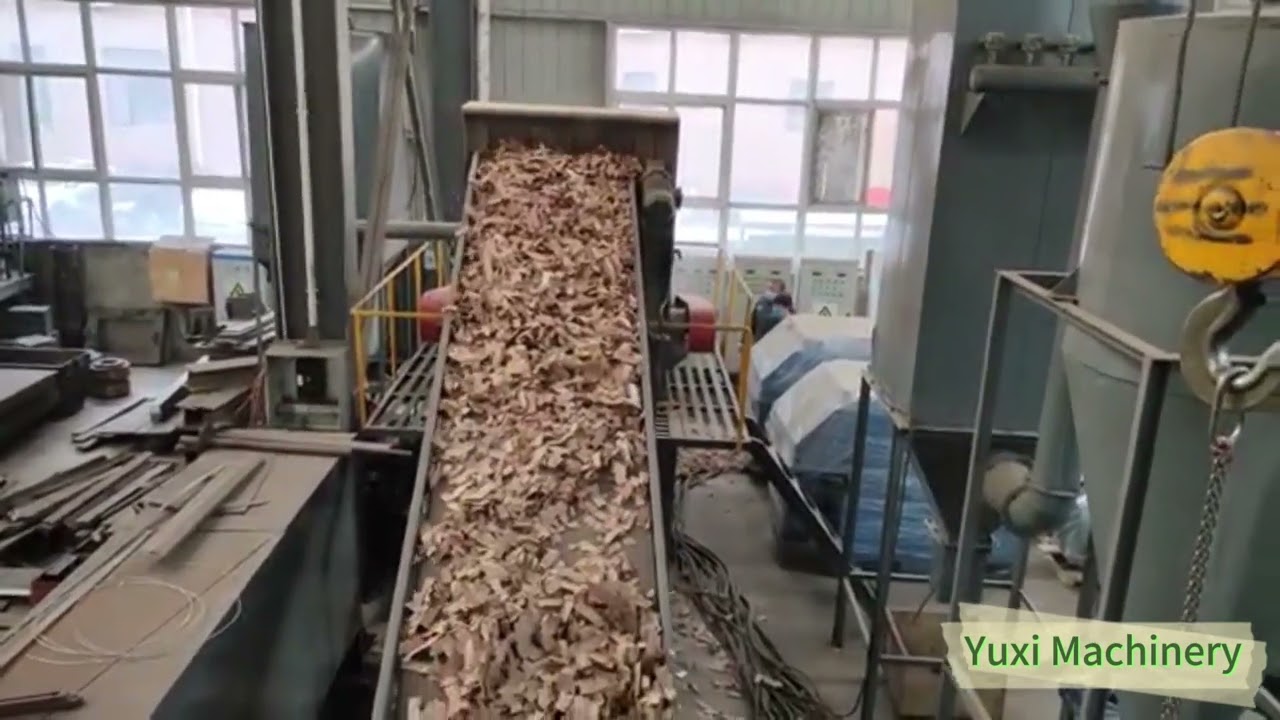
Putting a magnet between machines is not enough. The material must arrive in a condition that exposes ferrous pieces instead of burying them in dense paper clumps. Primary opening, conveyor depth and material spread all affect magnetic presentation.
This is also why the primary stage should not be judged only by discharge size. A slightly coarser but well-opened stream can be easier to inspect and separate than a dense, uneven stream that contains smaller pieces but poor presentation.
Paper feeding is rarely perfectly steady. Books, loose sheets, cartons and compacted bundles can create short changes in mass flow even when the operator feeds consistently. A buffer can absorb those short fluctuations so the fiberizer is not forced to follow every upstream surge.
A larger buffer is not a substitute for line balance. It only buys time. If the average primary discharge exceeds the sustained fiberizer acceptance rate, the buffer will eventually fill.
The fiberizer should receive a controlled stream inside its practical feed envelope. The separate paper fiberizer machine guide covers the secondary opening duty in more detail; at the interface level, the key requirement is repeatable loading rather than alternating starvation and overload.
Useful controls can include a variable-speed feeder, buffer-level feedback, upstream pause/restart logic and alarms for abnormal accumulation. The exact control architecture is project-specific, but the operating objective is the same: keep the secondary stage inside a stable working range long enough to evaluate true fiber quality and sustained output.
A connected line cannot sustain more than its limiting stage or interface. Compare the stages using the same material and the same test period. Do not compare a shredder peak-rate claim with a fiberizer accepted-output rate measured under different conditions.
| Record during the test | What it reveals |
|---|---|
| Primary feed rate | How much representative paper enters the connected line |
| Buffer level trend | Whether upstream and downstream rates are actually balanced |
| Fiberizer feed condition | Whether material arrives continuously, in surges or with starvation periods |
| Accepted fiber output | The rate that meets the agreed downstream fiber criteria |
| Interruption time | Losses from bridge clearing, wrapping, contamination, screen service and other stops |
If the secondary technology itself is still being selected, use the separate fiberizer vs. hammer mill comparison for that decision rather than mixing machine-type selection into the handoff specification.
A practical RFQ should turn the interface into measurable conditions. The supplier should know what arrives at the first stage, what may remain after primary shredding, how the material will be separated and buffered, and what the fiberizer must ultimately accept.
| RFQ field | Information to provide | Useful acceptance evidence |
|---|---|---|
| Representative feed | Normal paper grades plus the worst regular books, cartons, tubes, bindings, tape, coatings and moisture | Photos, dimensions and representative material sample |
| Primary discharge | Acceptable piece envelope and long-piece / wrapping limits | Observed discharge during connected test |
| Ferrous removal | Expected staples, clips or wire and where they become exposed | Material presentation at the magnet plus removed contaminant inspection |
| Buffer & metering | Expected surge behavior and required control response | Buffer trend and stable downstream feed during sustained run |
| Fiber acceptance | Residual paper pieces, fines, visible contamination, moisture and bulk behavior | Approved representative fiber sample and accepted-output record |
| Site interface | Workshop route, service clearance, voltage and frequency | Approved layout and electrical/interface list |
Dry paper size reduction and fiber opening can also generate fine combustible material. For U.S. projects, review process-specific dust capture, housekeeping and ignition control with the actual layout and applicable requirements; OSHA includes paper and pulp among materials that can create combustible-dust hazards. See OSHA combustible dust guidance.
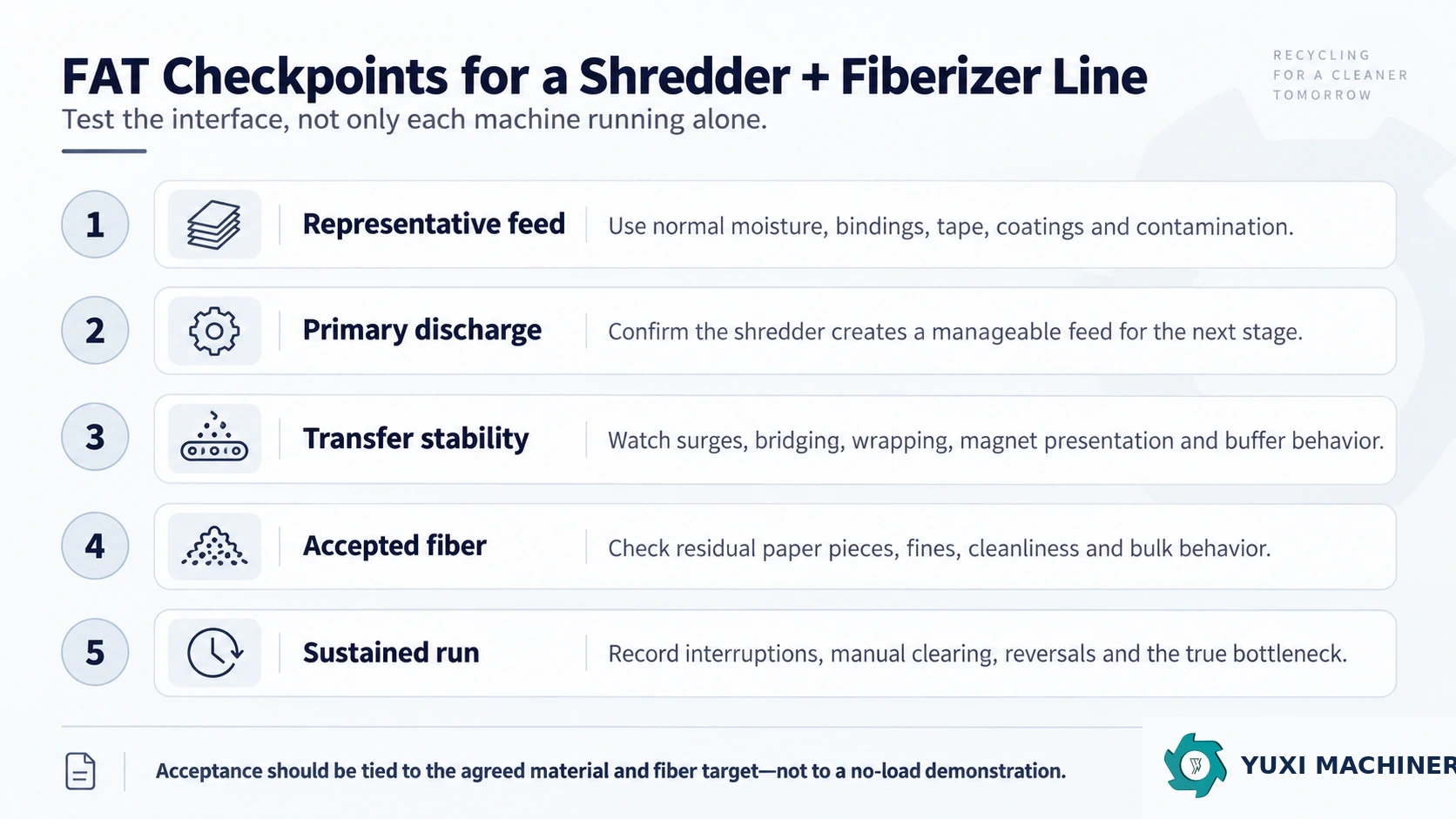
A connected-line FAT should prove the interface under representative material, not only show that each machine can run alone.
Include the normal range of moisture, bindings, tape, coatings and contamination. A clean hand-picked sample is useful for commissioning checks but weak evidence for production stability.
Check whether the material leaves the shredder in the agreed feed envelope and whether ferrous pieces are actually exposed to the separator. Record wrapping, bridging and abnormal clumps instead of treating them as operator issues.
A stable buffer should cycle inside a working range. A continuously rising or falling trend is evidence of stage mismatch, feeder-control problems or unstable upstream loading.
Record whether the secondary stage receives a continuous metered feed. Repeated starvation, surges or manual pushing should be captured as test observations because they affect both accepted output and final fiber condition.
Do not report only a short peak rate. Record accepted fiber, run time and interruptions over the same test period so the bottleneck is visible.
| Observed symptom | Likely interface question |
|---|---|
| Fiber quality changes every time feed form changes | Is the fiberizer receiving a sufficiently controlled feed, or is upstream geometry directly changing its loading? |
| Buffer continually fills | Is the downstream acceptance rate lower than the sustained primary rate? |
| Fiberizer repeatedly starves | Is the feeder, sensor logic or upstream discharge intermittent? |
| Magnet removes little metal although staples are known to be present | Are ferrous pieces exposed and spread effectively before separation? |
| Manual clearing is frequent at transfer points | Are long pieces, wrapping material, conveyor geometry or access creating the real bottleneck? |
If paper already arrives uniformly prepared, free-flowing and within the fiberizer’s practical receiving envelope, adding a separate primary shredder may provide little benefit. Two-stage processing is justified by a real duty split—not by the idea that more machines automatically mean more throughput or better fiber.
The primary discharge should be within a defined feed envelope that the transfer system, magnetic separation and fiberizer can accept consistently. The goal is stable presentation to the next stage, not the smallest possible paper pieces.
There is no universal buffer volume. It should absorb normal short-term feed variation without becoming a storage point that hides a chronic capacity mismatch. The correct size depends on the real paper form, surge pattern, conveyor control and fiberizer acceptance rate.
Metered feeding reduces alternating starvation and overload. A more repeatable feed rate gives the secondary stage a better chance to maintain a stable operating condition and makes the true bottleneck easier to identify during testing.
Match them using sustained connected-line data rather than isolated machine ratings. Record primary feed rate, accepted fiber output, buffer level behavior and interruption time. The practical line rate is limited by the stage or interface that cannot sustain the agreed operating condition.
A FAT should run representative paper through the connected stages and verify primary discharge condition, ferrous-removal presentation where used, buffer and metering behavior, fiberizer feed stability, accepted fiber output and interruptions over a sustained test period.
Send representative paper photos or samples, the worst regular feed form, expected contaminants, required fiber condition, sustained output target, workshop constraints and local electrical information. YUXI can then evaluate the primary discharge, magnetic separation, buffering, metering and secondary-stage interface as one connected process.
Technical boundary: this guide does not guarantee throughput, energy consumption, fiber quality or suitability for a finished downstream product. Final equipment and controls should be confirmed from representative material, the accepted fiber target and the actual site.

Get in touch with our nice team today to get a price estimate for a shredder machine.
Contact Us