Paper Fiberizer vs Hammer Mill: Which Is Better for Recycled Cellulose Fiber?
A paper fiberizer is usually the stronger fit when prepared waste paper already has a controlled size and the remaining job is to open the paper structure into a loose fiber-rich material with as little unnecessary size reduction as practical. A hammer mill is often the stronger candidate when compact pieces or flakes still need aggressive mechanical disintegration and a screen-controlled exit. Neither machine name is a guarantee of the final result. Rotor geometry, impact intensity, residence time, screen design, feed condition and the downstream acceptance rule matter more than the label on the quotation.
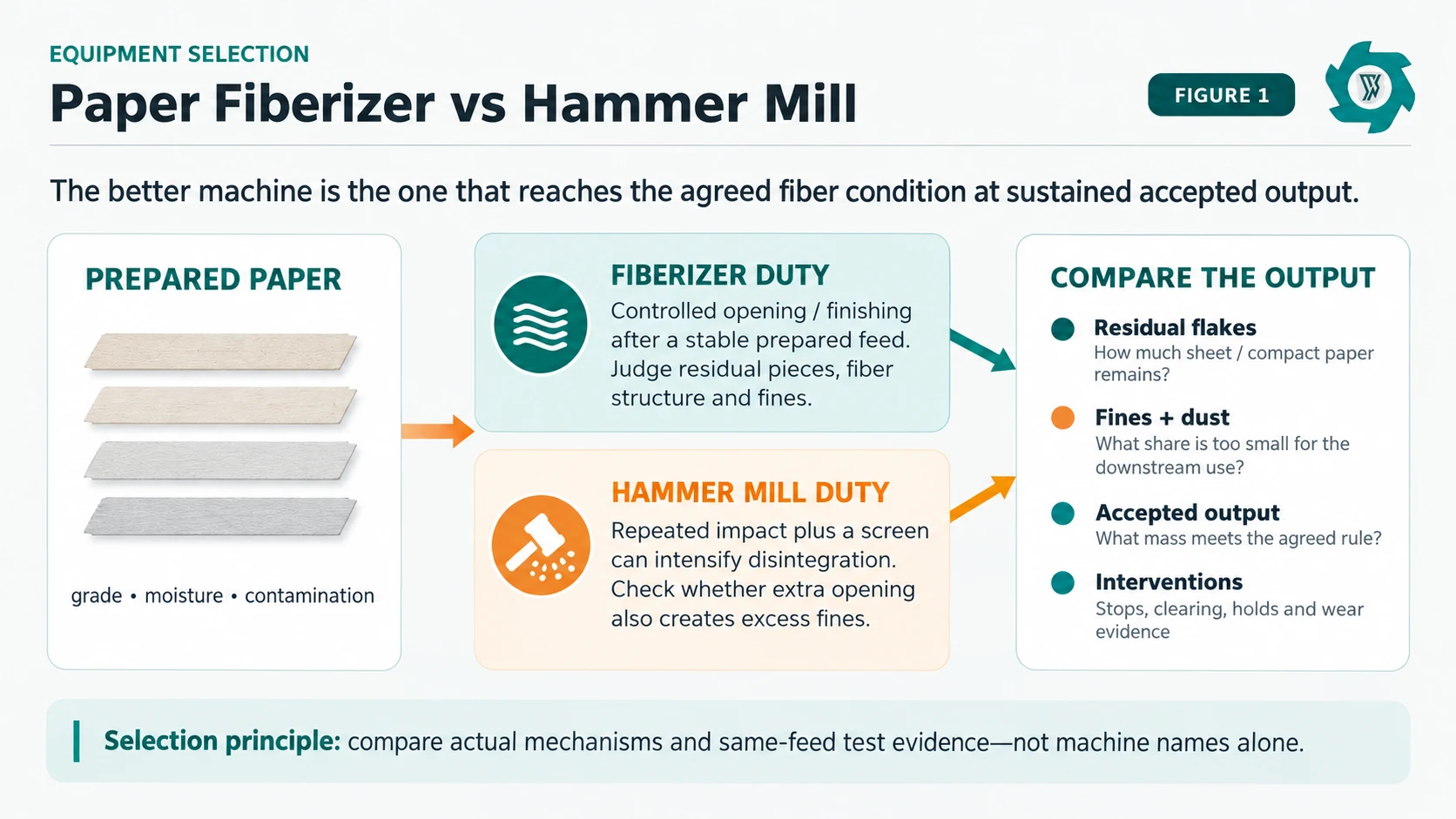
For recycled cellulose projects, the decision should therefore be made with the same representative paper on both candidate machines. Compare accepted output, residual paper pieces, fines or dust, running and elapsed time, operator interventions, wear observations and the condition approved by the downstream user. A machine that makes the fluffiest handful at a low feed rate is not automatically the better production machine.
This comparison sits within a complete waste paper cellulose recycling line, where controlled feeding, primary size reduction, exposed-ferrous removal, secondary opening and contained transfer must work as one process. The question here is deliberately narrower: what should the secondary dry-opening duty look like, and when does a fiberizer or hammer mill make more sense?
Figure 1. Select the machine around the required duty and accepted fiber condition, not around a generic equipment name.
The Machine Name Is Less Important Than the Duty
“Fiberizer” is a broad commercial term. One supplier may use it for a high-speed opening machine, another for a screened secondary mill, and another for a finishing stage after the paper has already been reduced substantially. “Hammer mill” is more descriptive of the impact mechanism, but even hammer mills differ in rotor layout, hammer form, chamber geometry, screen area and the amount of recirculation before material can leave.
That is why a purchase specification should describe the duty first. Start with the incoming paper state. Is it loose newspaper, trimmed sheet, bound printed material, pre-shredded OCC, or a mixture? Define the largest normal pieces, moisture range, coatings, tape, glue and the contamination that is allowed to reach the secondary machine. Then describe the output in terms the receiving process can actually judge: residual sheet or flake, fines, loose bulk behavior, non-paper contamination and any sample that must be approved.
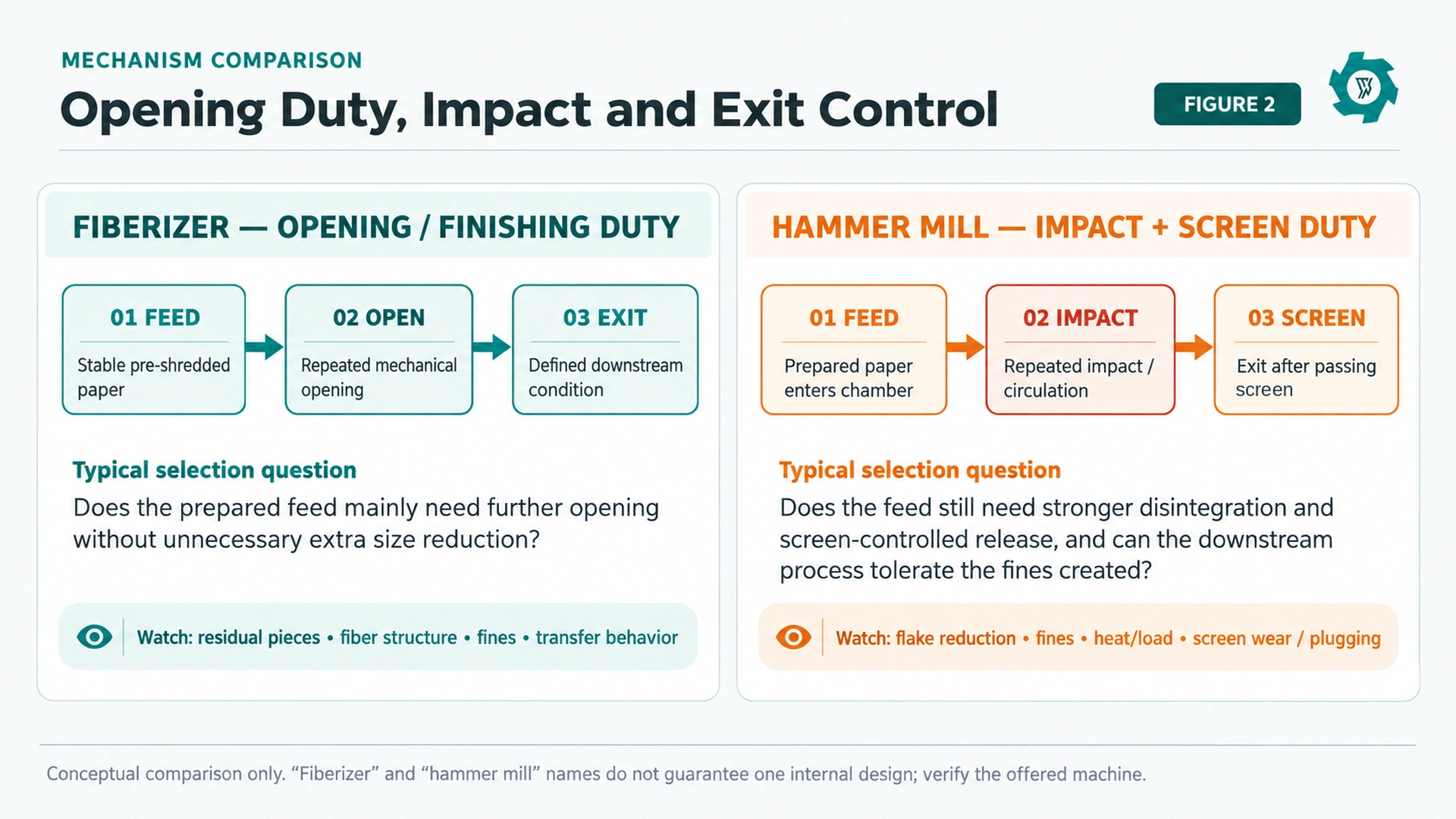
The earlier paper fiberizer machine guide explains how a dedicated fiberizing stage turns prepared paper into loose cellulose-rich material. For this comparison, the useful distinction is operational. A fiberizer should be evaluated as an opening or finishing duty. A hammer mill should be evaluated as an impact-and-screen duty. Some machine designs blur that line, which is exactly why test evidence matters.
What Actually Changes Inside the Paper?
Dry paper fiberization is not simply “grinding paper smaller.” The useful result is an opened structure that the next process can handle. Bonded sheet has to be broken apart, fibers and fiber bundles have to be loosened, and compact fragments have to be reduced enough to satisfy the downstream rule. At the same time, excessive mechanical action can create more small particles, increase airborne dust load and consume wear life without adding value.
A fiberizer configured for finishing typically receives material that has already been stabilized by upstream shredding. The secondary machine can then focus on repeated opening, rubbing, shear or impact rather than accepting the full variation of bulky incoming paper. The exact mechanism must be confirmed from the machine design; the important point is that upstream preparation removes part of the coarse-size-reduction duty.
A hammer mill uses repeated impact and chamber circulation, commonly with a screen controlling when material is able to leave. This can be useful when compact flakes need further disintegration. A 2023 study of dry fiberization compared knife-mill and hammer-mill treatment of old newspaper, OCC and white ledger. In that experimental setup, hammer milling produced better disintegration for OCC and white ledger, with fewer flakes but a higher fines fraction. The authors also reported that performance changed with paper type and treatment conditions, so the result should not be turned into a universal “hammer mill wins” rule.[1]
A separate 2025 study used a hammer mill for dry defibration of relatively homogeneous printing-house paper waste after preliminary evaluation of different mill types. The study found only a modest change in measured fiber length distribution for its particular feed and setup, while noting a slightly higher share of very short material in the dry-defibrated sample.[2] That is useful evidence that hammer milling can perform dry defibration under controlled conditions, but it does not establish the same result for wet mixed paper, heavily laminated stock, books with bindings, or a different screen and rotor.
Figure 2. A fiberizer is commonly evaluated as an opening/finishing duty; a hammer mill adds repeated impact and screen-controlled release. Actual machine design must be verified.
The Main Output Trade-Off Is Residual Flakes Versus Unnecessary Fines
Many dry cellulose projects sit between two failure modes. If mechanical action is too light, recognizable paper pieces or compact flakes remain. The downstream user may reject the material, or blending, dosing and air conveying may become inconsistent. If action is too severe, the machine may make a visually fine sample while shifting too much mass into dust and very small particles.
That trade-off is more useful than asking which machine makes the “finest” fiber. The 2023 dry-milling research is a good example: stronger flake disintegration in the hammer-mill trials was accompanied by a higher fines fraction.[1] A buyer should therefore define both sides of the acceptance window. State how residual pieces will be judged, and also state how fines will be measured when they matter to the product or dust system.
Screen opening should not be mistaken for a complete product specification. Material shape, fiber flexibility, repeated impacts and the way pieces orient at the screen all influence what leaves. A nominal opening can be a useful machine setting, but the accepted sample is the evidence. If the downstream customer cares about fiber length, bulk density, air flow, blend uniformity or another property, include that property in the test.
The same logic applies to a fiberizer without an obvious “hammer-mill” label. If the offered machine uses a screen and high-energy repeated impact, it may behave more like an impact mill than the sales name suggests. Ask for the rotor, wear tools, screen arrangement, exit path and the expected effect of changing those settings.
Feed Preparation Can Change Which Machine Looks Better
Secondary-machine comparisons are only meaningful when both candidates receive equivalent prepared feed. Record the paper grade mix, moisture condition, largest normal piece size and permitted contamination before the test. If one machine receives consistently pre-shredded material while the other receives bulky or damp paper, differences in throughput, residual flakes and fines cannot be attributed reliably to the secondary machine itself.
For both machines, compare the same representative and difficult-but-normal prepared material. Record any difference in moisture, coating, tape, glue or compact pieces because these conditions can affect screen loading, wrapping, fines generation and accepted-output rate.
When a Hammer Mill Is the Stronger Candidate
A hammer mill deserves serious testing when the feed still contains compact flakes that require more energetic disintegration, when screen-controlled release is useful, or when the process must combine further particle reduction with dry fiber opening. It can also be attractive when the supplier has a proven hammer configuration for the exact paper grade and target output.
That does not mean more impact is always better. Hammer velocity, screen area, feed loading and recirculation can change power demand, temperature, wear and fines. If the machine is starved during a demonstration, it may produce a clean-looking sample that does not represent the quoted production rate. If it is overfed, incomplete opening or screen loading may appear. The operating point used for the sample therefore matters as much as the sample itself.
Hammer-mill selection is strongest when the buyer can answer three questions. First, what problem is the impact stage solving that the primary shredder has not solved? Second, what fines level is acceptable? Third, can the same fiber condition be maintained at the required accepted-output rate, not only for a short handful of material?
When a Dedicated Fiberizer Is the Stronger Candidate
A dedicated fiberizer is often the logical route when upstream shredding already creates a consistent secondary feed and the remaining job is controlled opening rather than substantial coarse reduction. That can make the process boundary easier to understand: the primary machine handles bulky size reduction, the magnet removes exposed ferrous material, and the fiberizer is tuned around the fiber condition accepted by the next operation.
The advantage is not the word “fiberizer.” It is the possibility of matching the machine’s mechanical action to a narrower finishing duty. A good proposal should explain what the machine does to residual sheet, how the output is released, what settings influence fines, and how a normal change in paper grade affects the result.
A dedicated fiberizer can also be preferable when the buyer wants separate control over coarse preparation and final opening. If a new paper grade later requires different primary sizing, the opening stage does not necessarily have to absorb that entire change. Conversely, if the upstream feed remains too large or inconsistent, the fiberizer may be forced into a size-reduction job it was not selected to do.
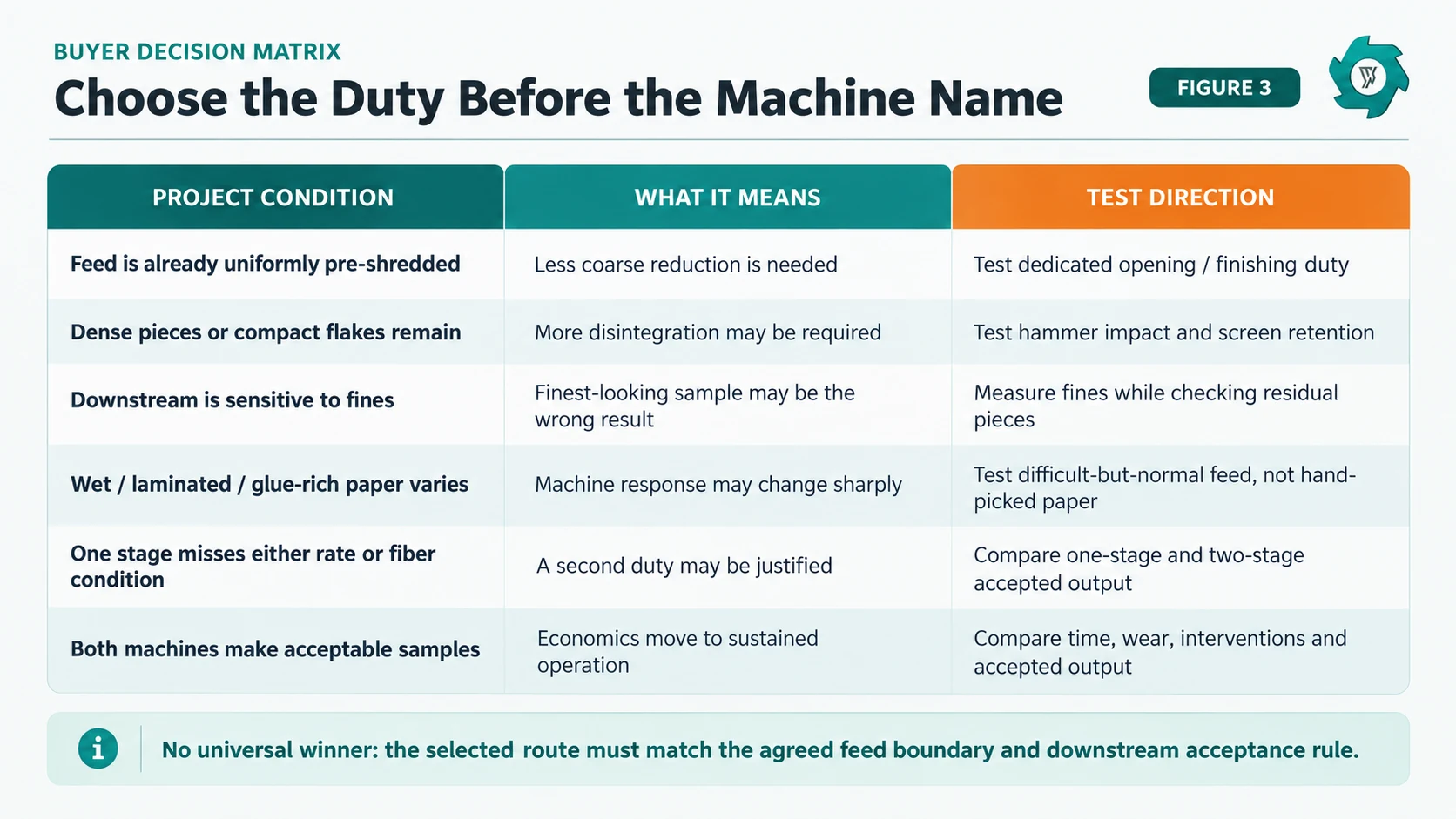
Figure 3. Start from the feed condition and acceptance problem, then decide which machine duty should be tested.
When Two Stages Make Sense—and When They Do Not
Adding a second machine is justified only when one stage cannot meet the required feed preparation and fiber condition at a practical production rate. A typical dry route may already use a primary shredder followed by one secondary fiberizing machine. That is a two-duty process even if the secondary machine alone is being compared as “fiberizer versus hammer mill.”
A further hammer-plus-fiberizer sequence may make sense when the first secondary stage is needed to break compact flakes and the final stage performs gentler finishing or conditioning. It may also help when one machine cannot simultaneously reach the required throughput and residual-flake limit without creating too many fines.
Every added stage brings transfer points, controls, wear parts, floor space, maintenance and dust interfaces. It can also create extra fines. If a primary shredder plus one correctly selected secondary machine already meets the downstream requirement, an additional stage adds cost without proving more value.
Capacity, Energy and Wear Should Be Compared on Accepted Output
A quoted feed rate says little if part of the discharge fails the fiber rule or must be returned for another pass. For an equipment comparison, define accepted input and accepted output separately. Accepted input is the material allowed across the agreed test boundary. Accepted output is the product that passes the agreed downstream rule. Then report both running time and elapsed time so repeated stops, manual clearing or downstream holds do not disappear from the capacity figure.
Impact tools, knives, screens, bearings, liners and conveying components see different loads depending on contamination and processing intensity. Ask what parts are expected to be inspected, adjusted or replaced, what evidence can be observed after the material trial, and how access is provided.
The waste cardboard recycling plant capacity guide makes the same distinction at line level: a peak equipment number is not the same as stable accepted production. For recycled cellulose fiber, the stronger quotation links its throughput statement to the tested paper grade, moisture, feed preparation, output rule and downstream state.
Dust and Fire Risk Are Part of Machine Selection
Dust generation should be compared under the same accepted-output condition, not assumed from the machine name. A hammer mill may generate more fines when aggressive impact is used to reduce residual flakes, while a fiberizer can also generate significant fine particulate when treatment intensity is high. During the same-material trial, compare collected fines, visible dust behavior and the dust-control demand at the production rate required by the project.
OSHA’s combustible-dust guidance explicitly includes paper among materials that can form combustible dust and notes that fibers, fines, flakes and other small particles may present a fire or deflagration hazard when suspended under the relevant conditions.[3] The practical conclusion for procurement is not to select a collector from a generic airflow number. Dust characteristics and applicable local requirements need project-specific engineering.
The Downstream Use Can Reverse the Decision
Dry-opened recycled cellulose fiber is not one universal product. A receiving process may prefer a loose, open structure with limited residual pieces. Another may tolerate a different fines fraction. A third may require a defined bulk behavior for dosing or pneumatic transfer. Equipment should be selected against that receiving condition.
This is also why dry fiberization should not be confused with conventional wet paper recycling. AF&PA describes paper recycling at a mill as a water-based pulping process followed by screening and cleaning before the recovered fiber is made into new paper products.[4] The dry pulping versus wet pulping guide explains the process boundary in more detail. A hammer mill or fiberizer used for dry mechanical opening is serving a different duty from a repulper.
Insulation is another boundary that needs careful wording. The ASTM standard for loose-fill cellulose insulation covers chemically treated, recycled cellulosic-fiber loose-fill thermal insulation.[5] A dry paper fiberizing line can prepare recycled fiber feedstock, but it does not by itself establish the treatment, formulation, testing or building-performance compliance of a finished insulation product.
A Practical Selection Table for Buyers
Project condition
Fiberizer route: what to verify
Hammer-mill route: what to verify
Feed is already pre-shredded and stable
Can the machine finish opening at the required accepted-output rate?
Does additional impact improve the output enough to justify its fines and wear?
Compact flakes remain
Can the offered opening mechanism break them without overloading?
Does impact plus screen retention reduce flakes without excessive fines?
Downstream is fines-sensitive
Measure fines while checking whether residual pieces still pass.
Do not accept better flake reduction without quantifying the fines penalty.
Feed varies in moisture or coating
Run representative difficult-but-normal material and document the feed boundary.
One stage misses rate or quality
Test whether a staged route improves accepted output enough to justify another machine and transfer point.
Both make acceptable samples
Compare elapsed production, interventions, wear access, dust load, energy evidence and downstream approval.
How to Run a Same-Material Comparison Test
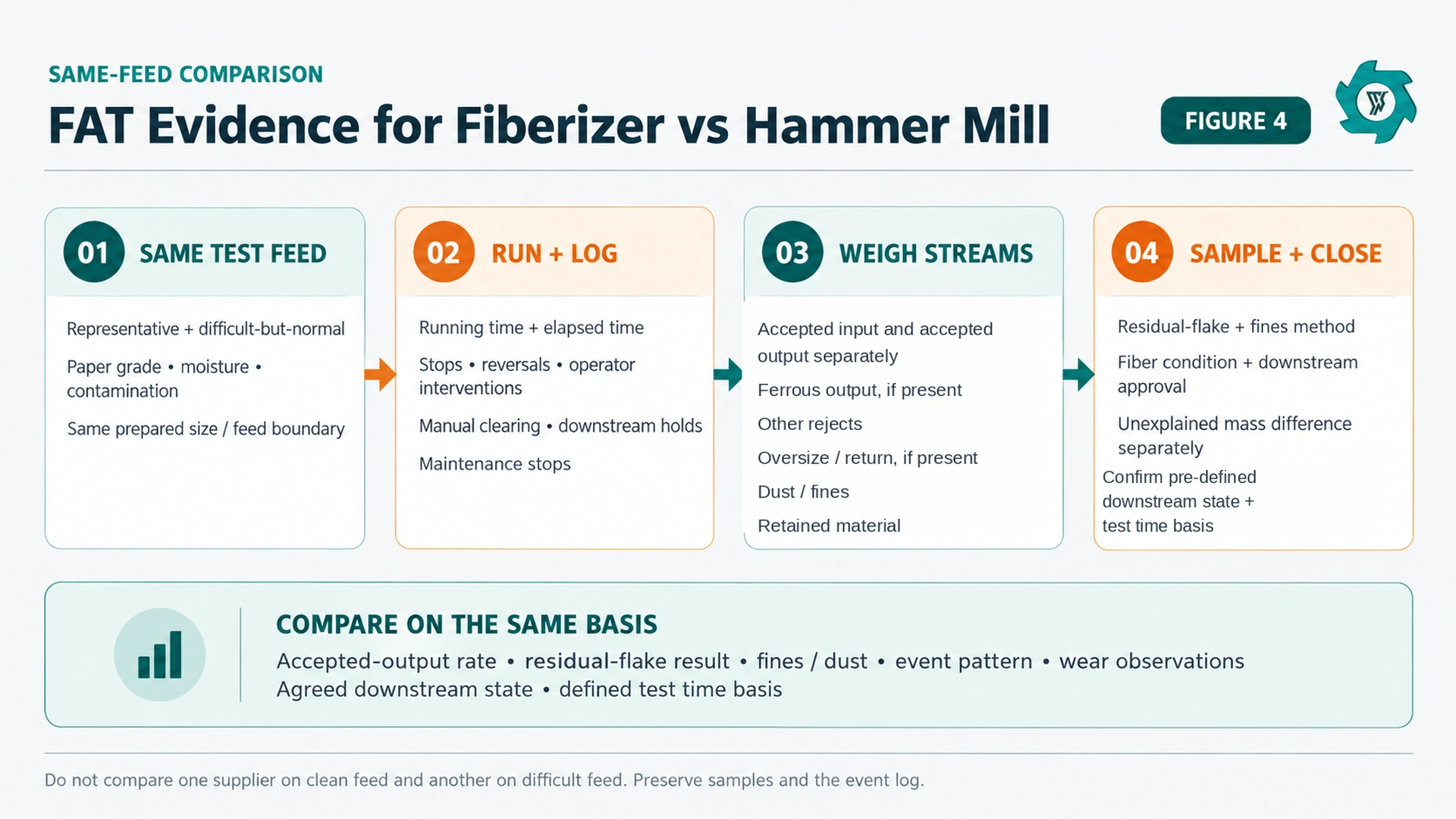
A useful FAT or supplier comparison starts before the machines run. Divide enough representative paper so each candidate receives the same grade mix, normal moisture and normal permitted contamination. Include difficult-but-normal material rather than a special “worst case” that would never be accepted in production. Record the pre-shredded size or preparation state so the secondary machines start from the same boundary.
During the run, record running time and elapsed time. Log stops, reversals where applicable, operator interventions, manual clearing, downstream holds and maintenance stops. These events show whether the apparent feed rate is sustainable. If a screen plugs or material wraps around a rotor, preserve the event instead of deleting that period from the report.
Weigh accepted input and accepted output separately. Where present, also weigh ferrous output, other rejects, oversize or return material, dust or fines, and retained material. State any unexplained mass difference separately rather than combining it with retained material.
Then sample the accepted output using the method agreed before the run. Check residual flakes, fines and any downstream property that determines acceptance. Preserve representative samples from both machines. If the downstream user needs to approve the fiber, do that before declaring a winner based on appearance.
Finally, compare the machines at the same test time basis and downstream state. If one line is stopped because the receiving conveyor or dust collector cannot keep up, record that condition. The procurement decision is about a production system, not a rotor running in isolation.
Figure 4. A fair comparison uses the same feed boundary, event log, separate stream weights and an agreed output-sampling method.
Common Buying Mistakes
Choosing by motor power. A larger installed motor does not prove better fiberization, more accepted output or lower energy per unit of saleable product.
Comparing different feed preparation. A fiberizer receiving clean, uniformly shredded paper and a hammer mill receiving larger mixed pieces are performing different jobs.
Using “fiber size” as the only output rule. Residual flakes, fines, bulk behavior, contamination and downstream approval may matter more than one nominal size.
Ignoring the fines penalty. Stronger disintegration can improve flake reduction while increasing very small material. Measure both sides of the trade-off.
Adding a second stage without evidence. If one secondary machine already meets the accepted-output target at the required rate, another machine adds transfer, wear, controls and dust interfaces.
Accepting a short demonstration as capacity proof. A few minutes of clean running can hide screen loading, wrapping, intervention frequency and downstream bottlenecks.
Calling fiberized paper a finished insulation product. Fiber preparation is only one production step; treatment and compliance remain application-specific.
RFQ Checklist: What to Send Before Asking for a Recommendation
Representative photos, plus a sample that includes normal difficult material.
Moisture condition and seasonal variation.
Metal, tape, film, laminates, coatings, glue and other contamination.
Upstream preparation already available, including target pre-shred condition.
Required sustained accepted-output rate rather than only gross feed rate.
How residual flakes and fines will be judged.
Downstream use and any sample-approval requirement.
Dust-control and material-transfer scope, plus available workshop space and utilities.
Required FAT evidence: time basis, event log, stream weights, samples and retained records.
A supplier can then decide whether the project needs a dedicated fiberizer, a hammer mill, or a staged arrangement.
Frequently Asked Questions
Is a paper fiberizer the same as a hammer mill?
“Fiberizer” is a broad functional name for equipment that opens prepared paper, while a hammer mill describes an impact mechanism that commonly works with a screen. Some commercial designs overlap, so the offered rotor, chamber, screen and test result should be checked rather than relying on the name alone.
Does a hammer mill always create more fines?
Research on several waste-paper grades found that hammer milling could reduce flakes while increasing the fines fraction under the tested conditions. The actual result depends on paper grade, screen, rotor, feed rate and treatment intensity, so fines should be measured on the proposed machine.
Do I need both a hammer mill and a fiberizer?
Only if one secondary stage cannot meet the required fiber condition and accepted-output rate. If primary shredding plus one correctly selected secondary machine already meets the downstream specification, another stage is usually unnecessary.
Can either machine produce finished cellulose insulation?
They can prepare dry recycled cellulose fiber, but finished insulation requires the appropriate chemical treatment, formulation, testing and compliance for the intended market. Fiberizing alone does not establish finished-product performance.
What is the fairest way to compare the two machines?
Use the same representative prepared paper, record running and elapsed time plus interventions, weigh accepted input and accepted output separately, account for rejects and fines, and sample the output using one agreed acceptance rule.
Choose the Process From the Material, Not the Label
Send representative paper photos or samples, feed form, moisture and contamination, the required sustained accepted-output rate, target fiber condition and downstream use. With those boundaries defined, the secondary opening duty can be tested as a fiberizer, hammer mill or staged process instead of being selected from a generic machine name.
David focuses on industrial shredding and recycling equipment,including material evaluation,shredder selection,process configuration,and recycling line planning.
Speak To Our Shredder Machine Expert
Get in touch with our nice team today to get a price estimate for a shredder machine.

 English



 Fast Delivery
 Reliable
 Certified
 Experienced