Industrial Shredder & Recycling Systems Manufacturer - YUXI

 English

 English
 Fast Delivery
 Reliable
 Certified
 ExperiencedEnglishEnglishFast DeliveryReliableCertifiedExperienced
A dry paper fiberizer is supposed to open prepared waste paper enough for the next process. It is not supposed to keep reducing the material simply because a finer sample looks more completely processed. That distinction matters in a waste paper cellulose recycling line, because the fiberizer sits inside a connected system: feeding, primary size reduction, ferrous removal, secondary opening, transfer, and dust collection all have to operate at a compatible duty.
The warning sign is not “there is dust.” Dry mechanical opening can generate fine particles even at a suitable operating point. The useful question is whether additional mechanical work is still improving accepted fiber—or whether it is mainly converting already acceptable material into smaller fragments and increasing the burden on extraction, collection, housekeeping, and downstream handling.
Over-fiberizing is a process condition, not a universal particle size. It begins after the material has already reached the condition required by the receiving process, but it remains in the working zone, is recirculated, or receives additional impact, shear, rubbing, or repeated passes. The same machine can therefore be correctly operated for one product and over-process the material for another.
This is why a buyer should define both sides of the output window. One side limits under-processing: too many recognizable sheets, compact flakes, or poorly opened bundles. The other side limits unnecessary degradation: excessive fines, dust, loss of useful loose-fiber structure, or a side stream that the downstream user does not want. The earlier paper fiberizer machine guide explains the opening duty itself; this article focuses on deciding when that duty has gone far enough.
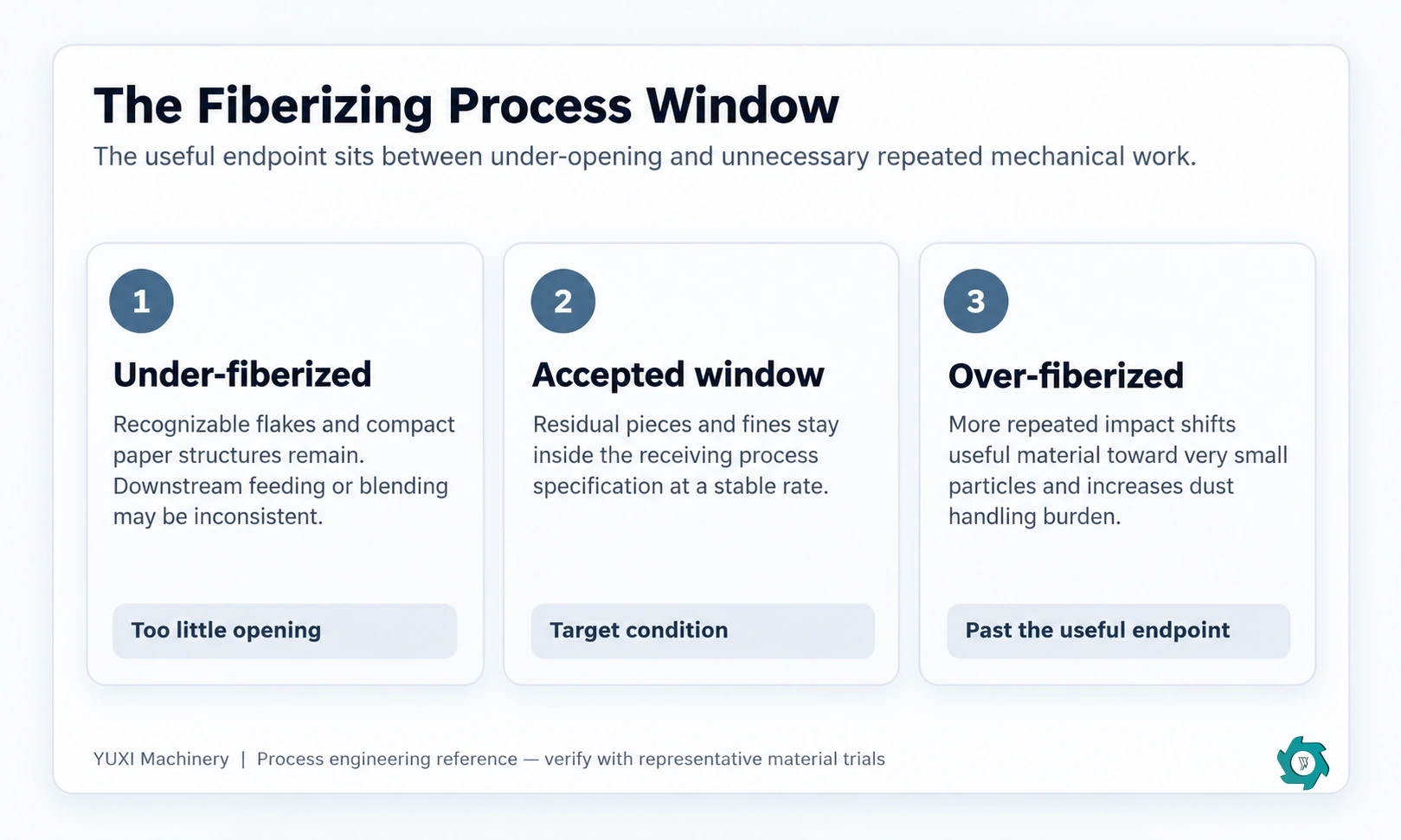
Paper entering a secondary dry-opening stage is not a uniform block. It contains sheets, bonded layers, fiber bundles, individual fibers, fillers, coatings, printing components, adhesive residues, and sometimes non-paper contaminants. Early mechanical work can be productive because it breaks compact structures and releases material that is still visibly under-opened. As treatment continues, however, the machine increasingly acts on material that has already been opened.
A 2023 study of dry fiberization of old newspaper, OCC, and white ledger compared knife-mill and hammer-mill treatment. Under the tested conditions, hammer milling produced fewer remaining flakes for OCC and white ledger but a higher fines fraction. The authors also found that results varied with paper type and treatment conditions.[1] That evidence supports a trade-off; it does not establish one universal rotor, screen, speed, or fines limit for every commercial line.
Four mechanisms can push a line past the useful endpoint. First, restrictive discharge can keep already-opened material in the chamber longer. Second, low or unstable feed can change chamber loading so individual pieces receive a different amount of work. Third, deliberate or accidental recirculation can expose conforming fiber to another processing cycle. Fourth, worn, damaged, or mismatched working parts can change how energy is transferred, leading operators to compensate with more residence or repeated passes.
The separate fiberizer screen-size guide deals with aperture and discharge restriction in detail. The key point here is broader: screen size is only one contributor to treatment intensity. If fines rise, changing the screen before checking feed, recirculation, tool condition, air balance, and downstream restriction can treat a symptom rather than the cause.
“Fines” is a product-quality term only when the project defines how the fine fraction will be measured. “Dust” is often used operationally for airborne or collected fine material. A plant can see more visible dust because more fine material is being generated, because extraction airflow changed, because a transfer point is leaking, or because useful lightweight fiber is being pulled into the collector. Those are different problems.
Do not use dust-collector weight alone as a fiber-quality test unless the sampling boundary and airflow are controlled. A stronger pickup system may collect more material without the fiberizer itself generating proportionally more fines. Conversely, a weak extraction system can make the collector look “better” while leaving more dust in the process area. The production trial should therefore connect product sampling with a mass balance and an air-system check.
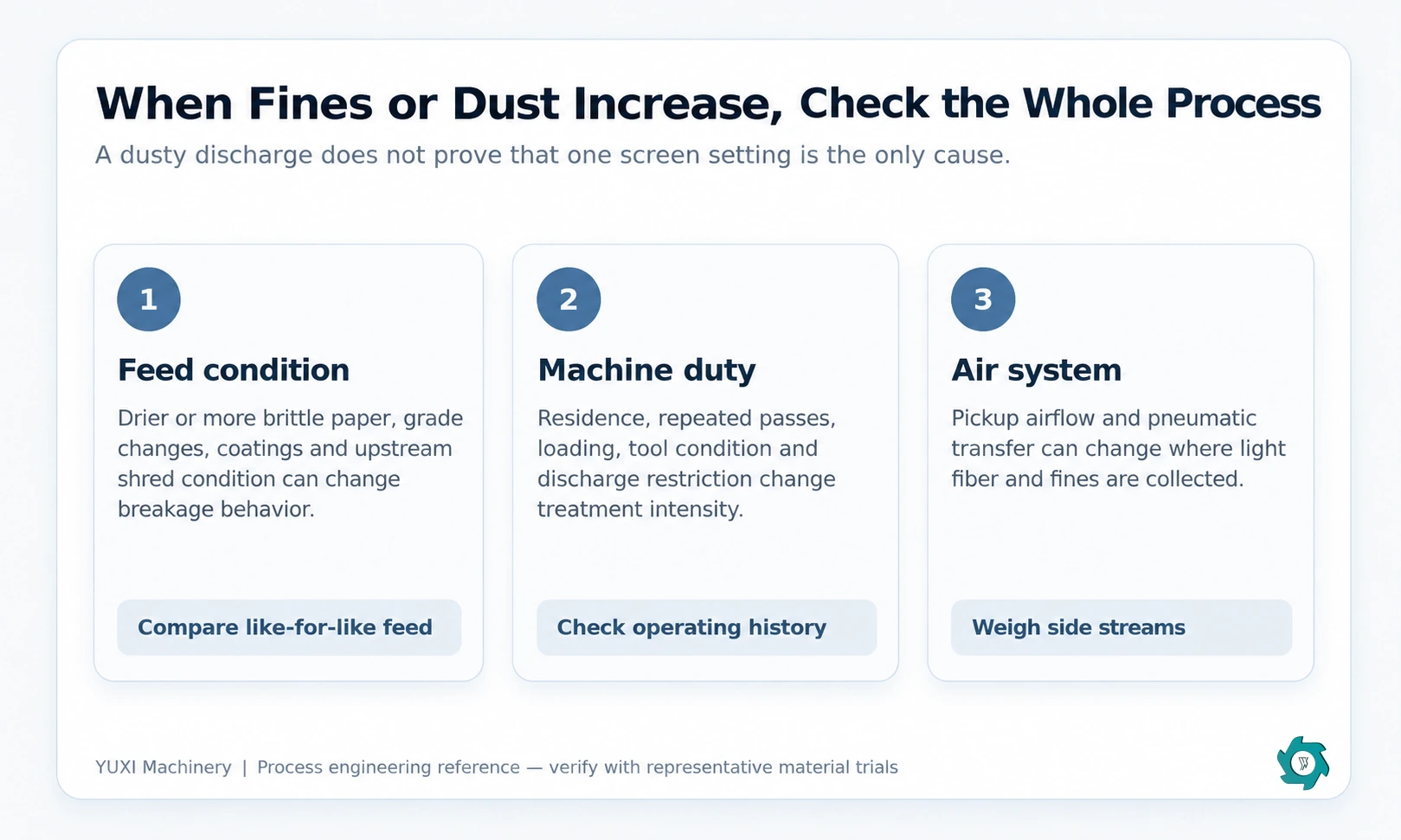
This is the clearest process signal. Compare two controlled conditions using the same representative feed. If additional treatment produces little meaningful improvement in the agreed residual-piece criterion but noticeably increases the fine fraction, the extra work is difficult to justify unless another downstream property improves.
A fluffy handful is not a specification. A receiving process may care about metering consistency, loose bulk behavior, air transport, blending, absorbency, reinforcement, or another application-specific property. If a finer-looking sample bridges, separates, becomes harder to meter, or creates a larger dust burden, visual appearance has become a misleading optimization target.
Gross feed rate can hide over-processing. More material may be diverted to fines collection, retained in the machine, recirculated, or rejected. Track accepted output rather than only what entered the line. A stable tonnage at the feed conveyor does not prove that the same amount of saleable or downstream-approved fiber is leaving.
If pickup points, ducts, filters, or collection containers approach their practical limit after a change in fiberizing duty, the air system may be revealing that the mechanical process has shifted. Do not simply enlarge extraction to preserve an unnecessarily aggressive setting. First determine whether the extra fine material is required by the product.
More retained material and repeated impact can increase work performed inside the chamber. The exact wear and energy effect is machine- and material-specific, so it should be measured rather than assumed. Still, if the plant records more screen inspection, tool attention, plugging, cleaning, or recirculation while the accepted product does not improve, the operating point deserves review.
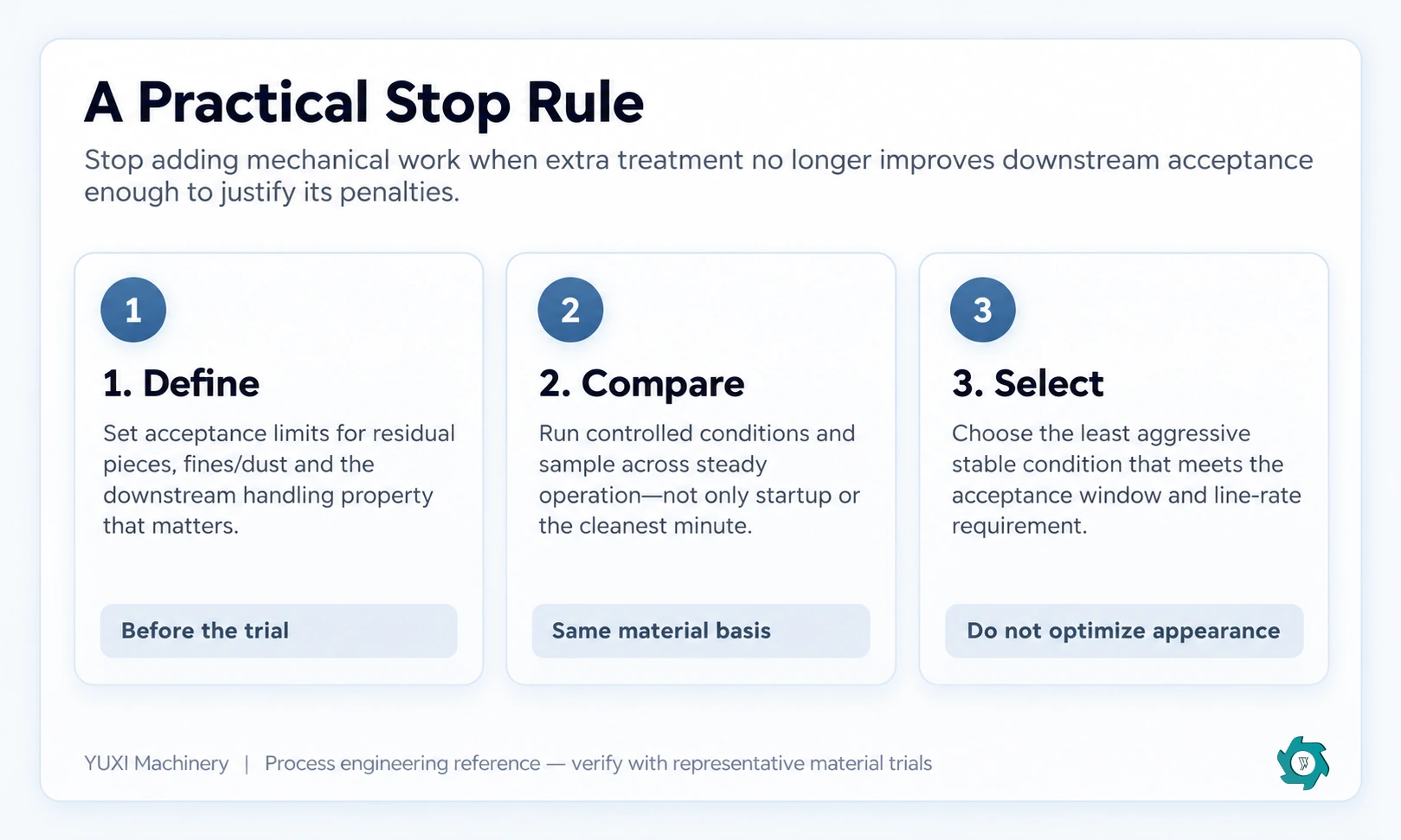
This rule forces the buyer and supplier to define “good fiber” before the trial. At minimum, agree on the feed boundary, residual-piece criterion, how fines will be sampled, what contamination is acceptable, the required accepted-output rate, and any downstream handling property that can reject the material. For specialty applications, an approved retained sample may be more useful than an invented universal millimeter target.
A secondary machine can appear too aggressive when the real problem begins upstream. Large feed-size variation, dense clumps, intermittent surges, or poor metering can force the fiberizer to operate across a wide loading range. Operators may respond by using a restrictive condition that guarantees the worst pieces are opened, even though normal material then receives more work than necessary.
The shredder-to-fiberizer handoff guide addresses this interface. For an over-fiberizing investigation, compare the fiberizer inlet during stable and dusty periods. Record upstream piece condition, feed interruptions, buffer level, metering rate, and any return stream. A stable inlet often gives more room to operate the secondary stage near its useful endpoint.
A factory acceptance test should not be a short demonstration built around the cleanest paper and a visually impressive handful. Use representative material, including difficult-but-normal variation inside the agreed feed boundary. Then compare at least two sensible operating conditions if the supplier is trying to establish the process window.
| Record | Why it matters | Do not substitute |
|---|---|---|
| Feed identity and mass | Keeps the comparison on the same material basis. | “Mixed paper” without grade/form detail. |
| Moisture condition | Paper condition can change breakage, mass, cohesion, and dust behavior. | A capacity number with no feed condition. |
| Running and elapsed time | Shows both processing rate and production impact of stops. | Only the best uninterrupted minute. |
| Accepted fiber mass | Connects throughput to material that actually meets the output rule. | Gross feed tonnage. |
| Fines/dust side stream | Shows whether more feed is being converted into an unwanted fraction. | Collector appearance alone. |
| Residual pieces | Confirms whether added treatment is still improving opening. | A single staged sample. |
| Events and interventions | Reveals plugging, recirculation, clearing, and unstable interfaces. | Ignoring stops as “operator issues.” |
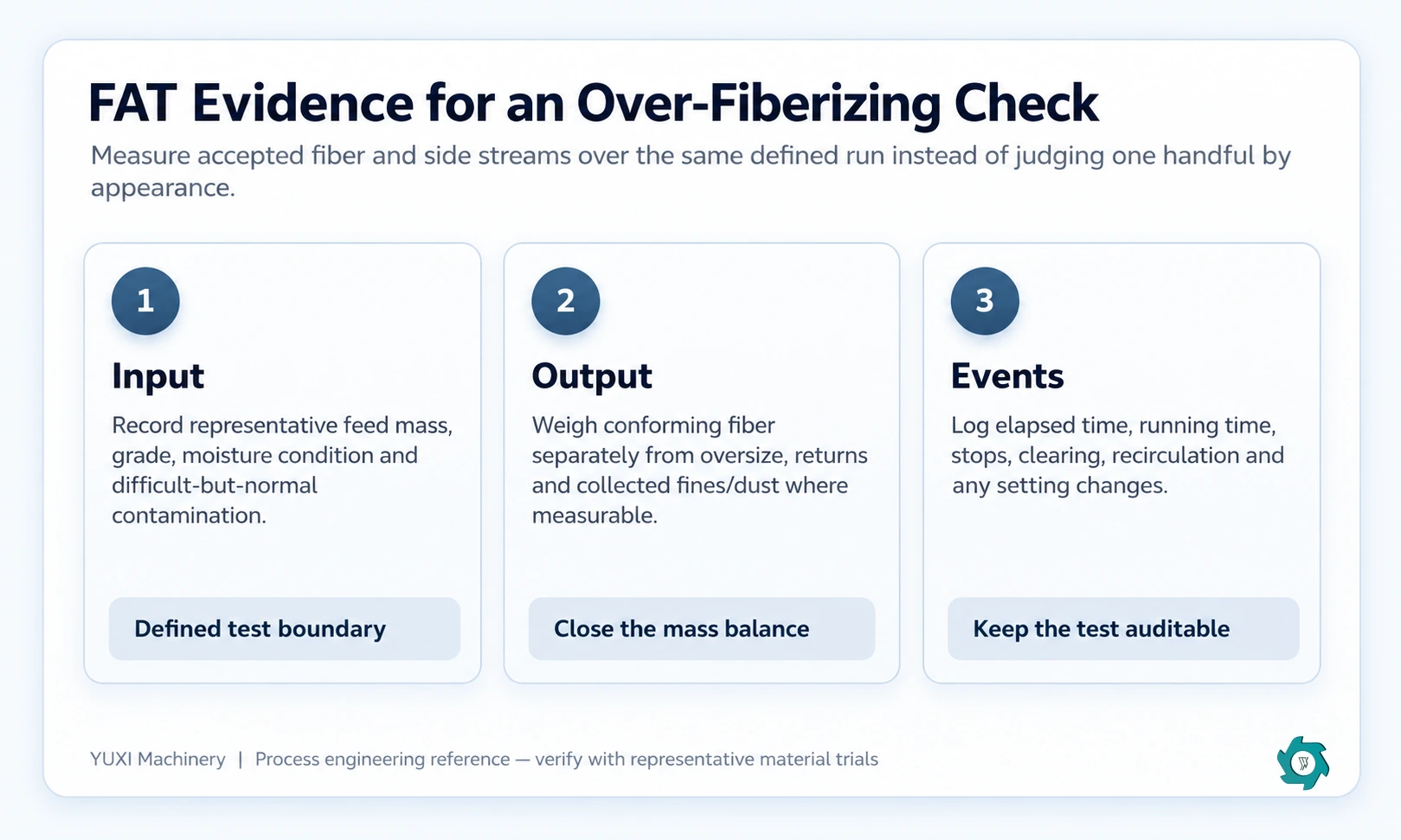
Close the mass balance as far as practical: accepted fiber + measured fines/dust + oversize/return + rejects + retained material should be reconciled against the defined input, with any unexplained difference reported rather than hidden. The purpose is not laboratory perfection. It is to prevent a “higher capacity” or “finer fiber” claim from ignoring where material went.
| Observation | Checks | Possible next action |
|---|---|---|
| More dust after a feedstock change | Paper grade, dryness, coatings/fillers, brittle trim, contamination. | Re-establish the operating window with representative new feed. |
| More dust with the same nominal settings | Screen condition, tool wear/damage, blocked effective open area, feed-rate stability. | Restore mechanical condition before retuning. |
| Collector mass rises after air-system work | Pickup airflow, damper positions, leaks, pneumatic velocity, useful fiber carryover. | Check air balance and collected-material composition. |
| Fines rise after recirculation is introduced | Return ratio and whether already-acceptable fiber is being sent back. | Separate true oversize from conforming fiber before return. |
| Output gets finer as accepted rate falls | Residence, discharge restriction, downstream backpressure, plugging. | Compare accepted output—not gross feed—at a less aggressive condition. |
| Dusty periods follow feed surges | Buffer level, metering, upstream shred discharge and instantaneous loading. | Stabilize the handoff before changing the fiberizing endpoint. |
OSHA states that finely divided combustible material can become explosible when suspended in air under suitable conditions and includes paper and pulp among example materials.[2] OSHA guidance also notes that actual behavior depends on properties such as particle size and moisture, and that sample-specific characteristics matter.[3]
That does not mean every dry paper fiberizing line has the same hazard or requires the same protection. The installed system needs a site- and material-specific assessment covering capture points, housekeeping, ignition sources, collector and duct arrangement, and applicable local requirements. From the process side, the important principle is simpler: do not intentionally create an unnecessary fine fraction and then treat a larger dust system as the only solution.
Over-fiberizing should not be used as an argument against fine output. Some downstream formulations may legitimately require a more intensively opened or finer material. In that case, the extra treatment is not “over” processing if it is necessary to meet a verified receiving specification. The project simply needs to account for the resulting accepted-output rate, air handling, wear, maintenance, and product-quality trade-offs.
Likewise, a dry mechanical line should not be pushed to imitate wet paper-mill stock when the real requirement is water-based fiber separation and cleaning. The dry vs wet pulping guide explains that process boundary. Choosing the correct process route is often more effective than forcing additional dry mechanical work onto material whose downstream requirement belongs to wet stock preparation.
Instead of requesting “very fine cellulose fiber,” send a representative material sample or photos, normal and difficult feed conditions, moisture information, prepared feed condition, required sustained accepted-output rate, downstream application, residual-piece acceptance rule, fines/dust measurement method if relevant, and the intended transfer or storage method. Ask the supplier to state which settings were used during the trial and which side streams were included or excluded from capacity.
This makes quotations easier to compare because it separates a machine’s ability to process paper from its ability to produce the fiber condition your project actually needs. It also gives commissioning teams a reference point: production can be checked against an accepted sample and recorded test condition rather than against a vague instruction to “make it finer.”
It is continued dry mechanical treatment after the paper has already reached the fiber condition required by the downstream process. Extra impact, rubbing, residence, or repeated passes may then create more fines and dust without a useful improvement in accepted output.
No. A more restrictive screen can increase residence and repeated work in some machines, but over-fiberizing depends on the complete operating condition, including feed, rotor/tool duty, screen condition, recirculation, loading, and the downstream acceptance target.
Define a repeatable sampling method and compare the fine fraction with the downstream acceptance requirement. The limit should come from the receiving process or a validated product specification, not from a universal percentage invented for all recycled paper.
No. Visible or collected dust can change because of feed dryness, paper grade, mechanical duty, leakage, pickup airflow, or pneumatic transfer. Product sampling, operating records, and a mass-balance check are needed to identify the cause.
First determine why the load increased. If the product already meets its acceptance window and extra treatment is mainly creating unwanted fines, reducing unnecessary mechanical work may be appropriate. If the fine output is required, the air and dust-control system must instead be engineered for the verified duty.
Record representative feed, moisture condition, input mass, running and elapsed time, accepted fiber mass, residual pieces, measurable fines/dust and reject streams, recirculation, stops, clearing, and the operating settings used. Retain representative output samples for comparison.
Send representative waste-paper material, your required accepted-output rate, downstream use, and the fiber condition the receiving process will approve. YUXI can evaluate the shredding, fiberizing, transfer, and dust-control interfaces around that target.

Get in touch with our nice team today to get a price estimate for a shredder machine.
Contact Us