Industrial Shredder & Recycling Systems Manufacturer - YUXI

 English


 English

 Fast Delivery
 Reliable
 Certified
 ExperiencedEnglishEnglishFast DeliveryReliableCertifiedExperienced
A plastic purge cake can look manageable in a photograph. Place it beside the hopper of a standard granulator, though, and the problem changes. The block may be heavier than expected, wider than the feed opening, or shaped so that it spins instead of reaching the knives. Even after it breaks, a large chunk can keep circulating while smaller pieces pass through the screen. For a production facility trying to recover startup waste, those interruptions matter more than a headline motor rating.
A plastic lump shredder is used to reduce bulky, dense plastic scrap into pieces that can be handled, sorted, or fed into further recycling equipment. Typical inputs include injection-molding purges, extrusion startup blocks, thick runner clusters and rejected molded sections. The right setup depends on the particular scrap. There is no reason to put small, clean sprues through a heavy-duty shredder when an appropriately sized granulator can handle them directly.
This guide deals with the awkward material: oversize purge masses, heavy blocks and changing production scrap that cannot be treated as ordinary flake. It explains how to decide between direct granulation and primary shredding, what makes a material trial meaningful, and where a machine should be ruled out before purchase.
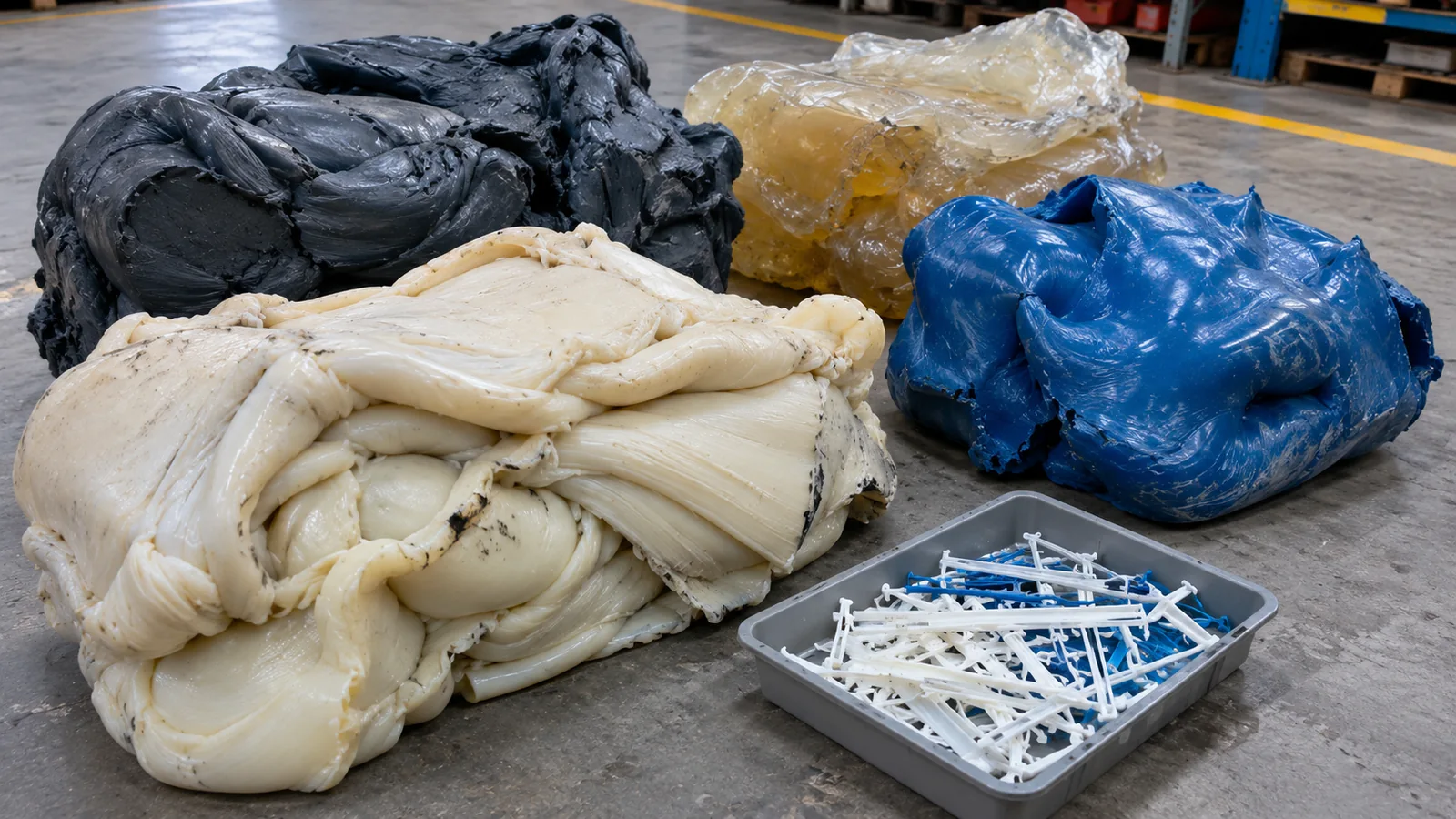
“Plastic lumps” is a broad purchasing term. An extrusion line may discharge a heavy strand mass during startup. An injection-molding plant may collect solid purgings from a color change. Another factory may be asking about sprues, runners or defective parts. Those streams can share a resin name and still require completely different handling.
Before asking for a quotation, identify the largest normal piece, not only the average. Measure its length, width and thickness. Weigh several representative pieces and record the heaviest. If the lump has deep folds, voids or an uneven bottom, take photographs from more than one direction. A rotor does not engage a three-dimensional object the way it engages a tidy cube drawn on a specification sheet.
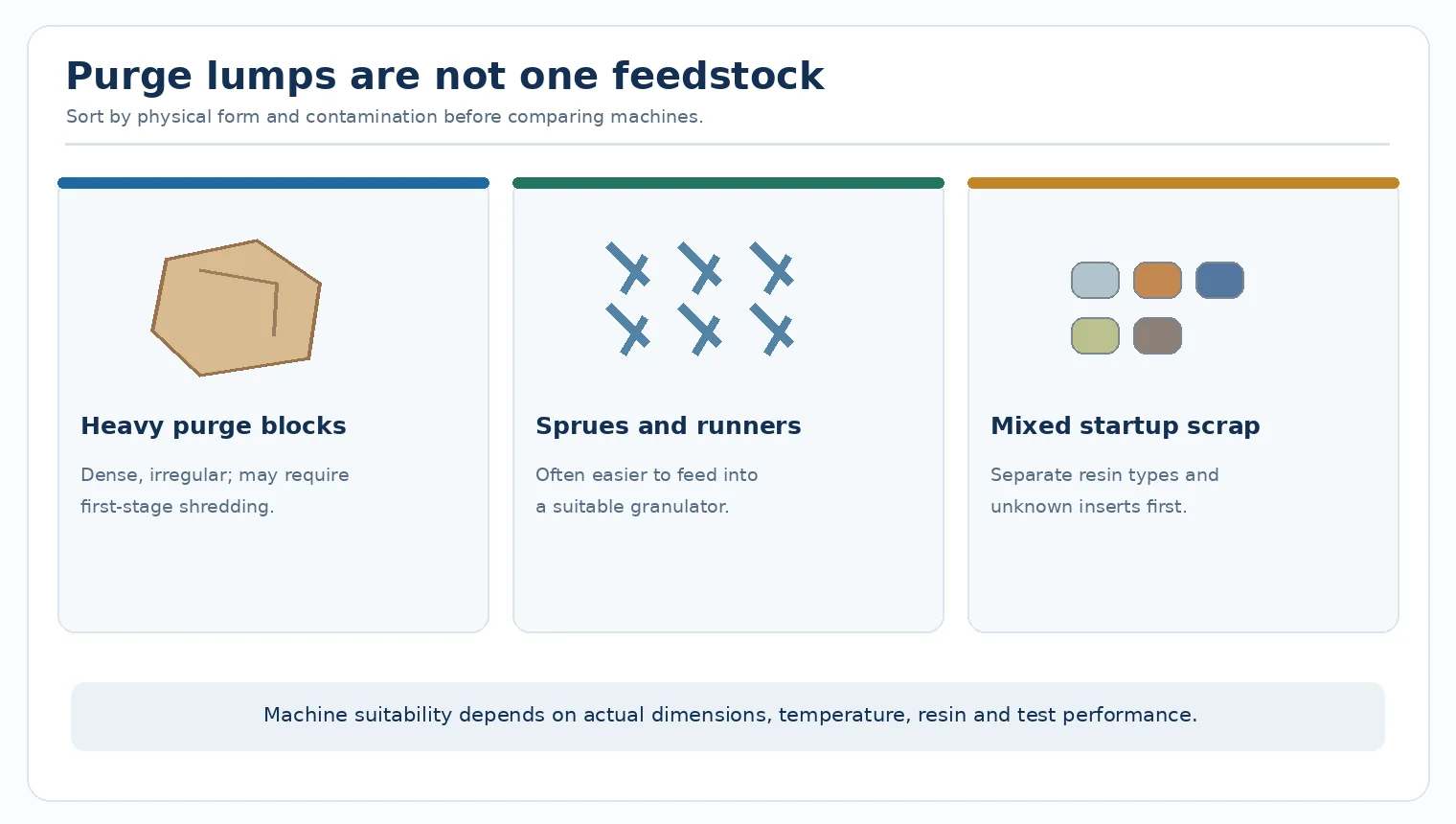
Resin identification matters just as much. Clean, segregated PE or PP production scrap is a different recycling proposition from a mixed block containing several polymers, glass fiber, pigments, adhesives or degraded material. Color alone cannot establish composition. Where production records are uncertain, material identification needs to come before claims about pellet quality or reuse.
YUXI lists plastic lumps and injection-molding scrap among the materials considered for its single shaft shredder. The published arrangement uses a cutting rotor, stationary knives, a hydraulic pusher and a discharge screen. That architecture can help present awkward rigid pieces to the rotor and retain oversize fragments for further cutting. It does not, by itself, verify a specific maximum lump weight, resin hardness, sustained throughput or final screen size for this application.
Dense pieces demand deliberate feeding. A smooth, heavy block can settle in the chamber without offering an easy edge to the knives. Another shape may bridge across the hopper or catch once and then rotate out of reach. Pusher travel, pressure control, cutting geometry and usable hopper dimensions must be evaluated together. The answer is not always “more force.” An aggressive feed setting can repeatedly overload the cutting system if the knives cannot take a stable bite.
For a plant collecting large purge cakes in bins, a properly configured first-stage shredder may be the practical route. It can produce coarse pieces for inspection, controlled conveying or a downstream granulator. When the required output is smaller and more consistent, the shredder–granulator two-stage process offers a useful way to think about the handoff. The primary machine reduces the problem to manageable feed; the secondary machine takes responsibility for the finer regrind specification.
Do not confuse the screen under a single-shaft shredder with an automatic guarantee of uniform pellets or ready-to-use regrind. Screens set an important discharge constraint, but actual piece shape, fines, heating and throughput depend on the material and cutter arrangement. A line designed to produce regrind for extrusion may need inspection, separation, metal detection and additional quality control.
Not every purge requires pre-shredding. A batch of small, cooled chunks may pass safely through a correctly sized cutting chamber. So might short runners or defective molded parts. A direct granulation route avoids another machine, conveyor, transfer point and maintenance schedule. For a factory with relatively uniform scrap and limited floor space, that simplicity can be a significant advantage.
The limit is the feed itself. A nominal chamber opening is not permission to place any object of a smaller measured width into the machine. A long protrusion, unstable shape or unusually dense piece can catch, bounce or cause large impact loads. Operators must not be expected to force material past guarding or repeatedly reach into a feed chute to make an unsuitable machine work.
YUXI’s plastic shredder and crusher equipment page describes a range used for plastic size reduction, including production scrap. Its published YX-G configuration is closer to a knife-type crusher or granulator than a large, low-speed primary shredder. Buyers should confirm the exact model, usable infeed and approved feed material instead of assuming the product name covers every solid purge block.
For a more general list of materials that can enter a granulator directly, the site’s plastic crusher materials guide is useful. This application page stays narrower: it is about awkward, dense purges and the point at which a first-stage shredder adds value.
| Feed condition | First route to investigate | Key limitation |
|---|---|---|
| Short, clean sprues and small molded rejects | Direct granulation | Check throat fit, knife suitability and regrind quality |
| Heavy, irregular, cooled purge blocks | Primary single-shaft shredding, then granulation if needed | Verify bite, pusher behavior, peak load and screen discharge |
| Mixed startup lumps of uncertain composition | Segregate and identify material before sizing equipment | Shredding cannot recover an unknown polymer specification |
| Hot or tacky extrusion waste | Controlled cooling and safe handling first | Do not assume hot feed is acceptable in a standard shredder |
| Solid blocks with inserts, metal or hard contamination | Remove contamination or isolate for separate assessment | Machine damage and product contamination may dominate the project |
This table is a starting point for screening options, not a machine performance promise. There are compact purpose-built lump shredders that use a different feed arrangement from a ram-fed industrial single-shaft shredder. Small, uniform purges may not justify the larger machine. The decision must come from an actual feed sample and the desired next operation.
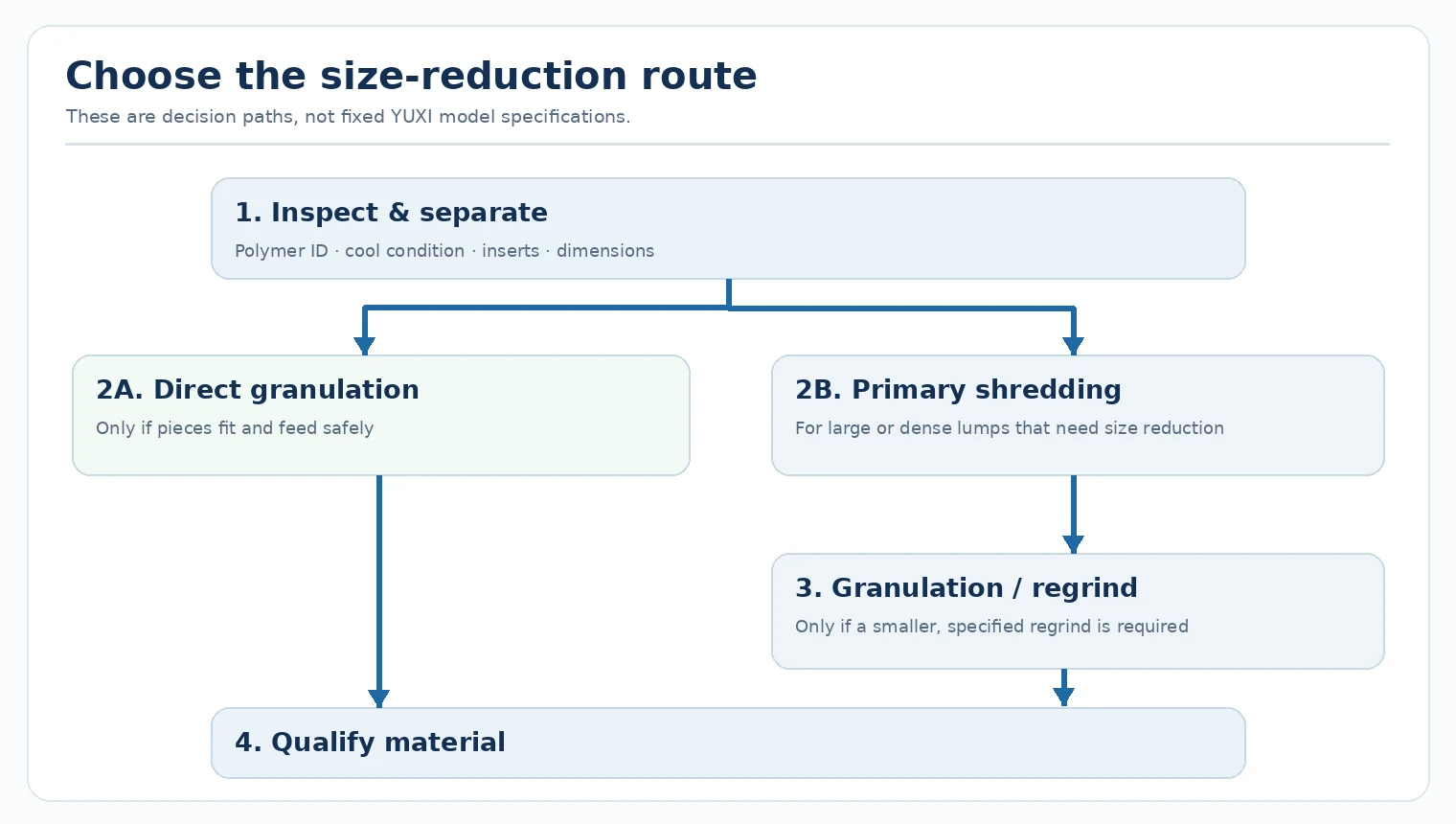
Some waste arrives long after it has cooled in a storage bin. Other material comes from the end of an extrusion line while it is still warm or sticky. Those should not be priced as interchangeable feeds. A hot purge can deform, adhere or smear rather than fracture cleanly; it may also create contact and handling hazards. Cooling conditions and material temperature should therefore be part of the RFQ, not a detail discovered during commissioning.
Previously melted plastic has a processing history. Multiple heat and shear cycles may change material properties, and additives, pigments or fillers can complicate later reprocessing. Researchers studying repeated mechanical recycling of polyolefins have documented material-property changes across processing cycles. That is a reason to establish incoming material quality and the intended reuse standard, not a reason to assume all regrind is unsuitable.
If the factory’s objective is closed-loop production, the downstream quality team should define what evidence is required: resin identification, contamination limits, color requirements, melt-flow behavior where relevant, and acceptable blend ratios. The shredder can help prepare material for those tests. It cannot certify the recycled resin or erase degradation from previous processing.
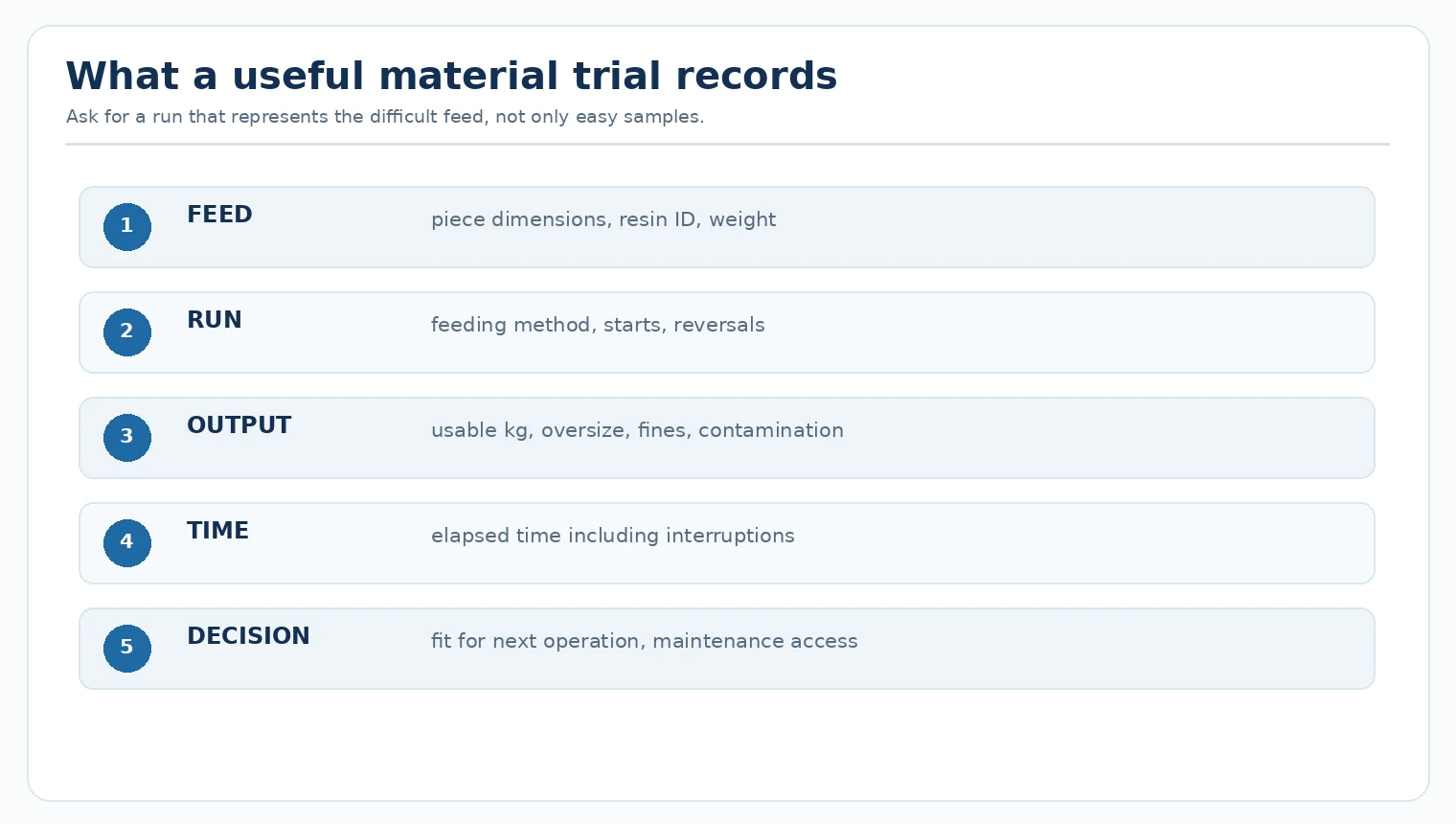
Capacity numbers are easy to misunderstand when the feed is irregular. Suppose a machine processes several easy-to-bite pieces quickly, then spends the next portion of the test reversing, waiting for manual feed preparation or circulating one stubborn block. Reporting only the minutes during which the knives were cutting gives an optimistic picture. The buyer pays for the entire operating cycle.
Ask the supplier to record the quantity of acceptable output over elapsed time, with feed interruptions and reversal events included. Separate the shredder’s output from material that remains in the chamber or is rejected as oversize. If the next granulator is the actual bottleneck, report the combined line’s net rate as well. These are different measures and they should not be presented as if they were one number.
A relevant material trial also reveals where pieces accumulate. Does the hopper require manual repositioning? Do smooth blocks skate across the rotor? Is the screen plugging? Does discharge pile up at the outlet? Are operators repeatedly clearing the same piece? Such observations lead to design changes that will never appear in a simple power-versus-throughput comparison.
The best first email is not a demand for a particular motor size. Send a concise description of the scrap and how it was produced. A useful package contains dimensions and weight of the largest pieces, representative photographs, polymer and filler information, temperature at the point of feeding, expected quantity per shift, and the required downstream output.
Include the end use. Material being reduced for off-site transport may need only coarse, manageable pieces. Scrap intended for a local granulator needs a shape that enters the next machine reliably. Material expected to return to molding or extrusion must also meet the factory’s quality criteria. These are not interchangeable purchase specifications.
Ask the supplier to show the proposed feed path in a simple layout: loading method, hopper, pusher or other feeding mechanism, cutting stage, discharge, metal protection if needed, and connection to the next operation. The layout should include access for cleaning and knife service. A cutter assembly that looks adequate on paper can become a daily problem if the maintenance crew has no practical route to remove a trapped block.
A meaningful demonstration needs representative material, including the inconvenient pieces. Sending only small, clean samples tells the supplier how the machine behaves under easy conditions. Set aside a mix that reflects normal scrap generation, and identify any extreme pieces separately so both sides agree whether they are within the proposed scope.
Write down the acceptance method before the test begins. Weigh the incoming batch. Measure the elapsed run time, including normal reversals and operator stops. Weigh accepted discharge, oversize material and anything left in the chamber. Photograph output after the machine, then check how it feeds the next stage. If fine regrind is a requirement, the downstream granulator’s results should be tested rather than inferred from the coarse shredder alone.
Inspect the cutting system after the run, with the machine safely isolated. The check should consider unusual cutter damage, smearing, trapped material, screen fouling and ease of access. One test cannot establish long-term blade life, but it can expose a mismatched feed mechanism or an unrealistic duty cycle before shipment. For unfamiliar filled polymers, request a longer representative trial or documented limitations rather than accepting a precise lifetime estimate based on a short demonstration.
A larger motor does not fix a bad infeed geometry, an overloaded knife arrangement or a screen that retains dense pieces too long. Review the rotor, cutter bite, feeding method and overload controls as one system. A model that looks powerful may still need substantial manual preparation to process the real material.
Short trials are useful for proving initial cutting behavior, but they cannot establish stable daily output without realistic feed variability and elapsed-time accounting. Ask how much of the claimed capacity was accepted discharge, how often the machine reversed and what operators had to do between batches.
Shredding changes size, not resin chemistry. Mixed colors, incompatible polymers, unknown fillers and contaminated stock can prevent a material from meeting a buyer’s quality specification. The recycling outlet should be verified before money is spent on size reduction capacity.
If most scrap is short runners and only a small percentage consists of large purge cakes, buying a heavy-duty machine sized for the rarest piece may be inefficient. The plant may instead segregate large blocks, change their handling route or contract out occasional oversize pieces. Evaluate the actual scrap distribution before specifying a permanent line.
A separate first-stage shredder may be unnecessary where nearly all scrap already fits a safe granulator infeed and the existing machine meets the required regrind specification. It may also be premature where the plant cannot identify the resins, has not decided whether recycled material can be reused, or has no workable route for contaminated fractions.
There is another limit: some blocks are too large, too hot, too heavily filled or otherwise unsuitable for the proposed standard configuration. Those are not cases for adding an unsupported capacity claim to the quotation. They call for pre-cutting, cooling, a different feeding system, a dedicated machine or a decision to reject the feed.
For plants comparing material-specific application pages, the industrial shredding applications directory provides a broader starting point. Here, the decision should remain tied to dense plastic purgings and realistic handling conditions.
Share representative photos, maximum block dimensions, resin type, quantity per shift and the output your next process needs. We can review whether direct granulation, pre-shredding or a different route should be evaluated.
Only when the pieces fit the approved infeed and the machine is designed for their weight, shape and cutting load. Large dense blocks may need pre-cutting or primary shredding before a granulator.
No. Small, clean, manageable purges and runners may be processed more simply by a suitable granulator. A single-shaft shredder becomes worth evaluating when heavy or irregular feed makes direct granulation impractical.
Do not assume so. Confirm the actual material temperature, whether it is tacky, the safe handling procedure and the manufacturer’s approved feed limits. Cooling or another preparation step may be necessary.
Start with what the downstream operation can accept. Coarse pieces may be enough for conveying or a second-stage granulator; finer regrind needs a separate, testable quality and size specification.
Use a representative weighed batch and report acceptable discharged mass over elapsed time, including routine stops and reversals. Record oversize, residual material and whether the output runs through the next machine.
Not by itself. Shredding only reduces piece size. Polymer identity, contamination, additives and prior processing history determine whether the material can meet a downstream reprocessing specification.

Get in touch with our nice team today to get a price estimate for a shredder machine.
Contact Us