Industrial Shredder & Recycling Systems Manufacturer - YUXI

 English


 English

 Fast Delivery
 Reliable
 Certified
 ExperiencedEnglishEnglishFast DeliveryReliableCertifiedExperienced
The trouble with buying a plastic film shredder starts before anyone switches on the motor. Two suppliers can quote for “LDPE film” and be talking about completely different work. One pictures loose, clean offcuts dropping from a film line. The other expects a dense bale that has been stored outdoors, held together with straps, and picked up by a loader. Both contain polyethylene. They are not the same feeding job.
That distinction decides whether the first machine should cut, pull, open, or simply meter material into equipment that is already on the line. It also explains why a film shredder can look convincing in a brief demonstration and still become an awkward bottleneck in routine production.
This page is about that first decision. It covers LDPE and LLDPE packaging film, stretch wrap, production rolls and film bales, with a practical look at feeding, wrapping, output and the evidence worth requesting before you buy.
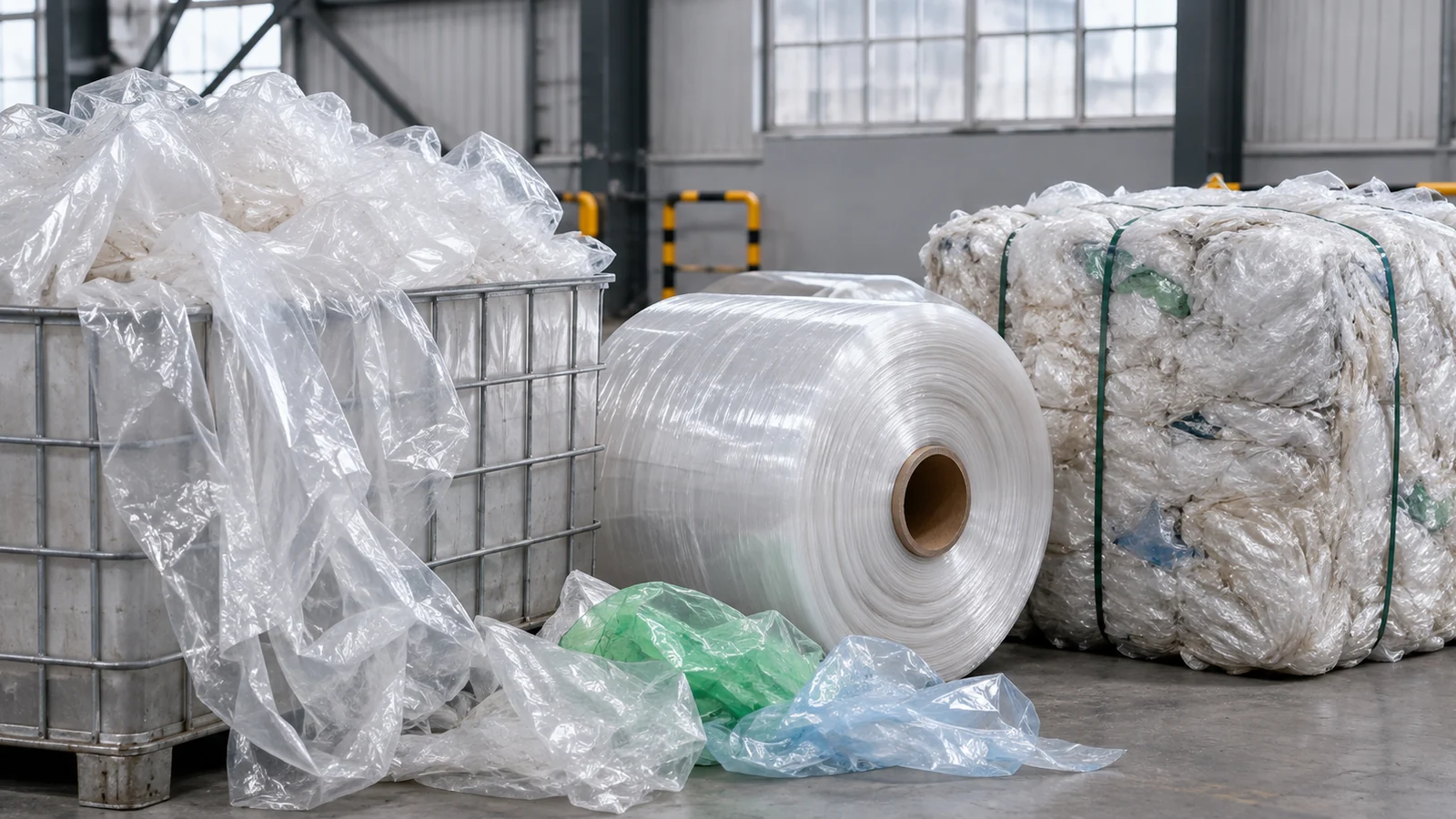
“We process PE film” is a starting point, not a useful machine specification. Is the material fluffy, folded, wound tightly around a core, or compressed into blocks? Does it come off one production line or from several collection points? Can operators keep the feed reasonably clean?
A quick photograph of the material alongside a scale or known-sized object often resolves more questions than a long equipment brochure. For rolls and bales, dimensions and weight matter. For loose scrap, the most revealing detail may be how quickly a hopper empties when the flow is interrupted.
| Film arriving at the plant | What tends to cause difficulty | What to check before selecting equipment |
|---|---|---|
| Loose LDPE or LLDPE offcuts | Light pieces may bridge across the hopper or enter the rotor unevenly. | Metering, pusher behavior, infeed opening, discharge and whether a separate shredding step is needed. |
| Stretch wrap and long film strips | Long, flexible strands can wind around shafts or other rotating parts. | Cutting geometry, anti-wrapping provisions, cleanout access and the proposed feed rate. |
| Edge trim or full rolls | A roll may unwind, spin, or feed in an uncontrolled manner. | Roll diameter, width, mass, core type and whether controlled roll feeding is supported. |
| Compacted film bales | Dense, tied material may need opening before finer cutting or washing. | Bale dimensions and density, strapping removal, pre-opening duty and downstream separation. |
| Collected or agricultural film | Soil, sand, moisture, labels and mixed polymers change the job. | Sorting and washing plan, blade wear exposure, drainage and contaminant limits. |
There are plenty of mixed cases. Clear stretch wrap can be delivered in bales. A factory may produce clean trim but also reject full rolls. Do not average them into one vague “film” category when requesting a quote. The least convenient material can determine whether the line needs a second feed arrangement.
Before comparing shaft designs, decide what you need the first machine to accomplish. A purchasing specification is much clearer when it names one of these jobs.
A bale opener or pre-shredder breaks a compressed mass into a form that can be conveyed, sorted and washed. It is not necessarily trying to deliver small, uniform pieces. A fine screen at this stage can be the wrong priority; the upstream problem is still getting dense material through the system without large surges.
Specialized equipment exists for this duty. Genox, for example, describes film pre-shredders used ahead of washing lines for compacted and contaminated material. That establishes an available process route, not proof that any standard shredder will accept intact bales.
Clean production scrap may need to be reduced so a granulator or extruder feeding system can accept it. Here, consistency matters more than the visual neatness of individual cuts. A single-shaft shredder with suitable feeding and screening can be useful, particularly if the scrap arrives irregularly or in large pieces.
YUXI lists PE film among the materials considered for its single shaft shredder. The published product description includes a hydraulic pusher and a screen-controlled discharge. That makes it a relevant machine type to evaluate. It does not, by itself, confirm performance on every roll, bale or contamination level.
Some factories do not need a stand-alone shredder. If offcuts are already narrow and predictable, an inline cutter, a dedicated trim-handling arrangement, or direct feeding into a suitable reclaim unit may be simpler. Adding another cutting chamber brings maintenance, noise, dust management and energy use. A machine should earn its place in the layout.
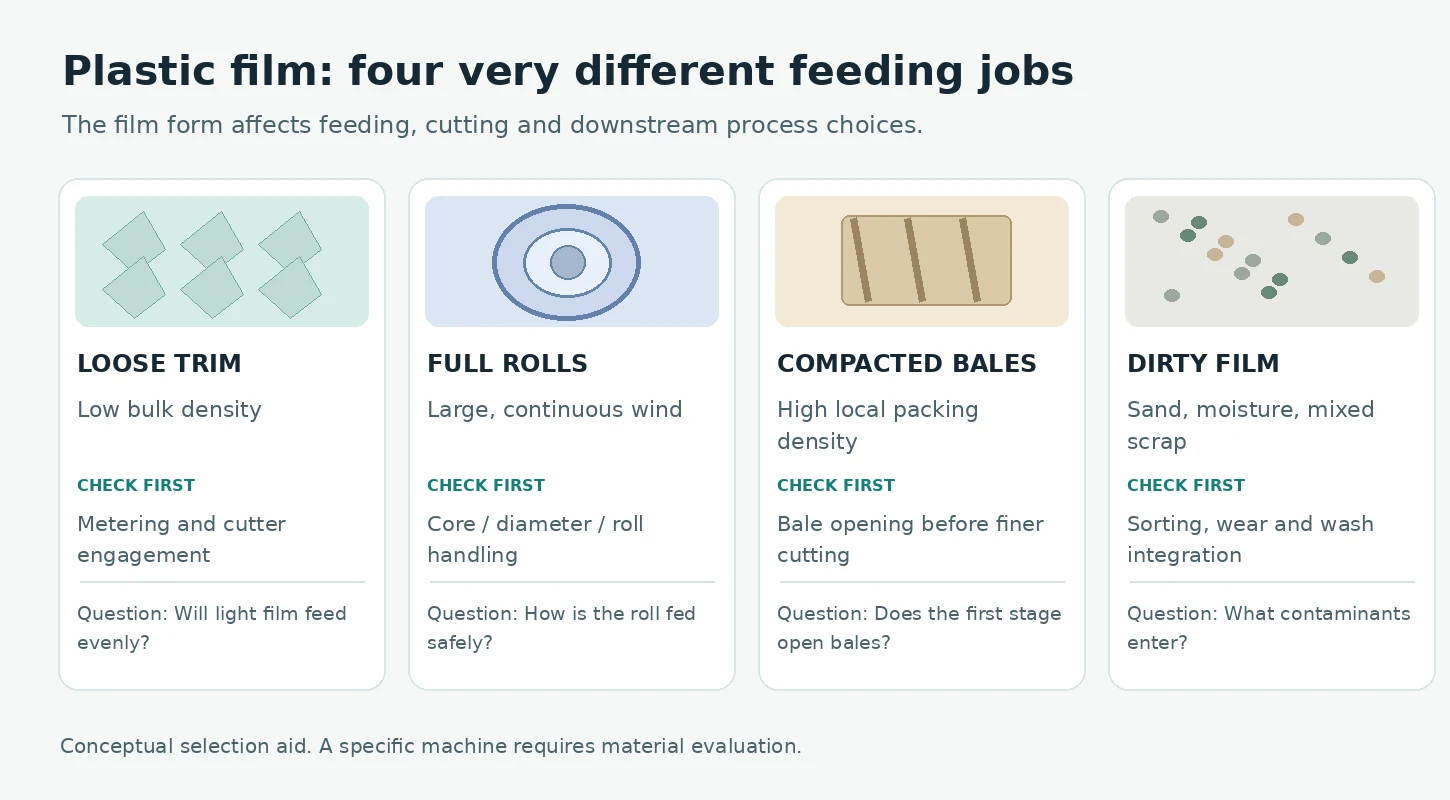
A thick plastic part stays roughly where it lands. Film does not. It folds, clings, stretches and slides. A light blanket of material can bridge the mouth of a hopper even while the cutting chamber underneath is nearly empty. The operator sees a full hopper; the rotor is waiting for work.
More aggressive pushing is not automatically the answer. Pressure can compact light material into a pad instead of helping it enter the knives. A suitable pusher control sequence has to match the cutting action and the volume of material available. Suppliers should explain how the machine recovers when film bunches at the feed opening.
Wrapping is a different problem. Narrow strips or partially cut film can travel around rotating parts rather than leave through the discharge. Once it starts, the problem is not limited to lower output. It can create unwanted friction, require frequent clearing and make service access a serious design consideration.
Ask for footage that includes normal feed interruptions, not only a successful first cut. Watch what happens when the chamber fills, the pusher advances and the machine restarts after a stop. A demonstration with the exact material can show whether feed behavior remains manageable.
Wet and dirty film adds wear and handling questions. Sand is abrasive. Water changes the condition of material leaving the machine and may affect the next conveyor, washing stage or storage method. A shredder does not wash film or remove incompatible layers. Treating size reduction as if it solves feedstock quality will only move the problem downstream.
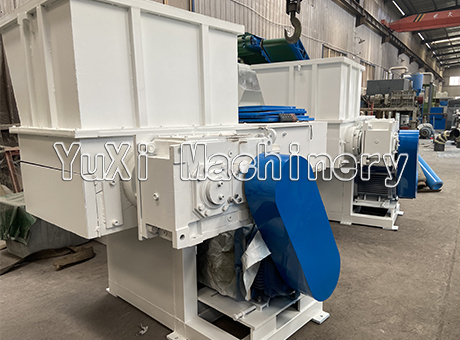
On a conventional single-shaft machine, a rotating cutter works against fixed knives while a pusher presents material to the rotor. Pieces that pass through a discharge screen leave the chamber; material that cannot pass stays in the cutting zone longer. This makes the arrangement attractive when the next stage needs reasonably controlled feed size.
There is a trade-off. A small screen may keep material in the chamber longer, but flexible pieces do not behave like rigid cubes. Film can fold, stretch or pass in irregular shapes. Quoting a screen opening as the “finished flake size” can mislead a buyer who plans to feed a tightly specified washing or pelletizing system.
A larger opening may reduce residence time while leaving pieces too long for the next conveyor or granulator. Neither choice should be made by copying a setting used for plastic lumps. Request a discharge sample and see whether it handles well at the next stage.
For high-volume compressed bales, a separate pre-opening stage may be more sensible than asking one screened shredder to do every job. For full rolls, the issue can be safe and steady unwinding rather than available cutting power. A machine supplied without the necessary roll-feed provision should not be assumed suitable just because its chamber looks wide enough.
Compare the first-stage choices against the actual feed. The site’s plastic shredder equipment page describes another cutting route, but its rotor-and-knife configuration must be matched to the material. The terms shredder, crusher and granulator are not interchangeable technical specifications.
Imagine a washing line that receives tangled sheets faster than it can pull them apart. The shredder may be cutting successfully, yet the conveyor and washer are starved one moment and overloaded the next. The line does not care how impressive the shredder’s nameplate looks. It cares whether material arrives in a manageable form.
For clean in-house film, one practical route is controlled feeding, size reduction where needed, then a suitable agglomeration or extrusion and filtration step. Collected film usually needs more attention to sorting, contamination and washing before melt processing. Details vary with the feedstock and the quality required of the recycled resin.
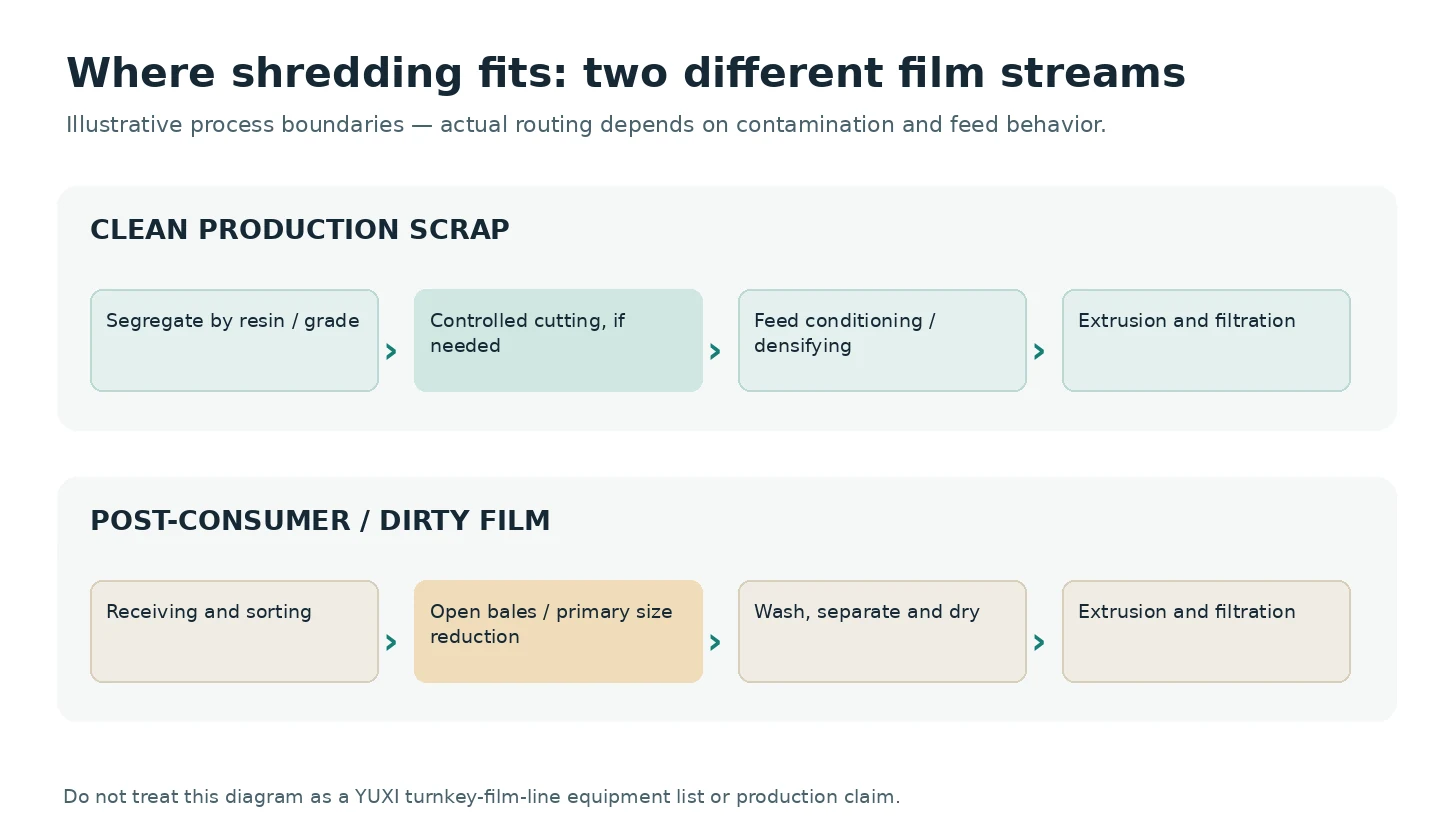
That matters because size reduction does not make mixed polymers compatible. In its 2025 update with APR, ReMA distinguishes several polyethylene film commodity grades. A clean, relatively consistent stream and a mixed film bale are not equivalent feedstocks simply because both pass through a shredder. Research on PE film recycling also shows that pretreatment and melt filtration affect downstream material quality; the appropriate settings depend on the starting material.
It is worth mapping the handoff before choosing a machine: how will material leave the shredder, what can the conveyor carry, will a washer accept the cut form, and what happens if one stage stops? The existing shredder-and-granulator process guide discusses the broader one-stage versus two-stage decision. For film, the difficult part is often the infeed and the handoff, rather than the number of cutting stages alone.
A quote that identifies only motor power and chamber width leaves too many expensive assumptions with the buyer. A better request starts with material evidence and a narrow definition of what the proposed machine is expected to do.
There is a simple question worth adding to the inquiry: Which part of this duty has been demonstrated on the exact proposed configuration, and which part is still an engineering assumption? If the answer is unclear, request a representative trial rather than treating a generic cutting video as an acceptance test.
For rotor and screen decisions that apply beyond film, refer to the single-shaft selection guide. This application page deliberately stays with the particular problems that soft film creates.
Short demonstrations are useful for seeing that the blades can cut a sample. They are weak evidence for sustained performance. What matters on a film line is how the equipment behaves when feed density changes, a roll starts to unwind, or loose material accumulates at the hopper mouth.
For a meaningful trial, use a sample that resembles the material expected in regular production. Include the common variation, not just the cleanest roll. Tell the supplier the planned downstream process before the run begins. If the test uses a different screen, feed accessory or rotor setup from the proposed machine, note the difference.
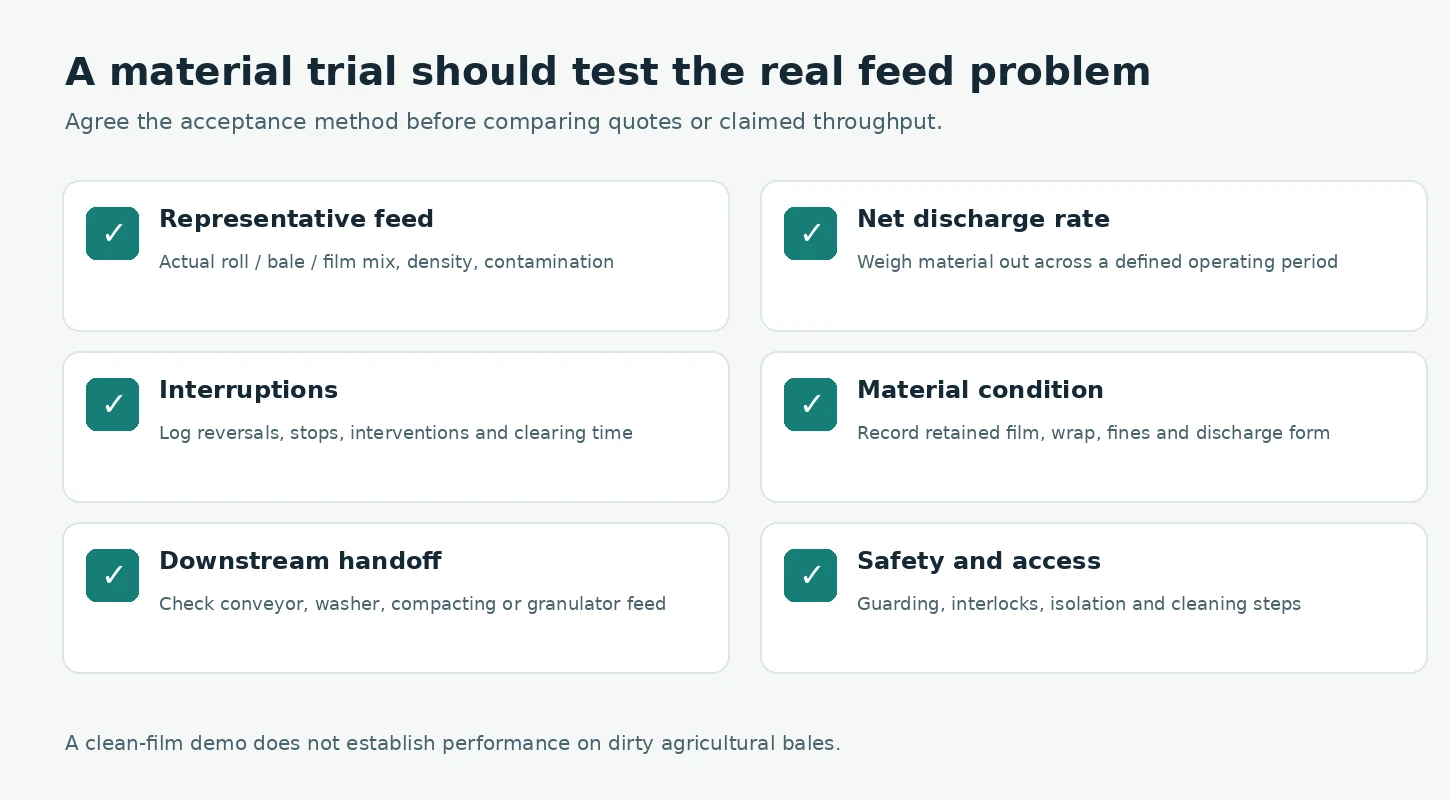
Ask for the total weight fed, weight discharged, duration of the trial, time lost to manual clearing, reversals or other stoppages, and the amount remaining in the machine. Those measurements allow a purchaser to distinguish a brief peak rate from useful net output. They also reveal whether the stated operating rate depends on an operator constantly rearranging material.
Look at the discharge. Is it mostly free-flowing, or does it form long ribbons and clumps? Can the next process accept it without additional manual cutting? Check whether the planned conveyor can handle the same material volume. A shredder that produces acceptable pieces only under hand-fed demonstration conditions is not yet proven for a fully integrated line.
Film wrapping deserves its own observation. The trial should document where material accumulates and how it is cleared safely. The United States OSHA hazardous-energy standard, 29 CFR 1910.147, addresses energy control during covered servicing and maintenance work. The correct guarding, isolation and cleaning procedures depend on the machine and workplace; they cannot be established by a sales video.
There are cases where the better investment is a feed system, a separator or a different process layout.
For another view of material compatibility, the site’s single-shaft material overview covers rigid plastics, textiles, wood and other waste. It should not be used as evidence that any one machine can process every mixed load without a configuration review.
Film recycling projects benefit from a specific answer rather than a broad promise: this is the feed we will accept, this is the first-stage duty, this is how the machine will be supplied, and this is how we will check its output. Once those points are settled, comparing models becomes much easier.
Send YUXI photographs of the film, roll or bale dimensions, contamination details and the equipment that comes next. That information helps narrow the options between a configured single-shaft shredder, controlled pre-cutting and a separate bale-opening stage.
It can be a suitable option for certain LDPE film streams. YUXI lists PE film among its single-shaft applications, but the model and feeding arrangement still need to match the form of the scrap and the required downstream output.
Sometimes. Dense or tightly bound bales may need opening before sorting, washing or finer cutting. A standard screened shredder should not be assumed to accept intact bales without confirming dimensions, density and the infeed design.
Not without checking the roll handling method. Roll width, diameter, weight and core design affect feeding, and controlled unwinding or dedicated roll-feeding equipment may be necessary.
There is no universal answer. The screen must be considered alongside feeding, material wrapping and what the next machine can accept. Flexible pieces can fold or stretch, so an opening dimension is not a guarantee of exact particle length.
No. Size reduction does not remove soil, separate incompatible polymers or replace washing and melt filtration. Those are separate parts of a recycling process, depending on the incoming material and target product.
Request a trial on representative material using the proposed configuration. Record net discharge mass, trial duration, feed interruptions, wrapping, cleanout and whether the output works in the next processing stage.
Manufacturer examples and third-party research provide context for equipment selection. They do not establish a tested production rate, accepted bale size or material quality for a particular YUXI shredder.

Get in touch with our nice team today to get a price estimate for a shredder machine.
Contact Us