Industrial Shredder & Recycling Systems Manufacturer - YUXI

 English


 English

 Fast Delivery
 Reliable
 Certified
 ExperiencedEnglishEnglishFast DeliveryReliableCertifiedExperienced
A pile of short factory pipe offcuts and a bundle of six-meter thick-wall pipes are both called “HDPE pipe scrap.” They are not the same shredding job. The first may already fit a granulator. The second may require a dedicated feed arrangement, restrained handling, or cutting to manageable lengths before it ever reaches a rotor.
That difference is where a useful machine specification begins. For an HDPE pipe shredder, the questions that matter are what enters the machine, how it is presented to the cutting system, and whether the resulting pieces suit the next process. A nominal motor rating tells only a small part of that story.
YUXI includes pipes and profiles among the materials considered for its single shaft shredder. This is a starting point for a material review, not a claim that every listed model can take intact long pipe. Full-length handling, maximum diameter, wall thickness and required throughput must be confirmed for the proposed configuration.
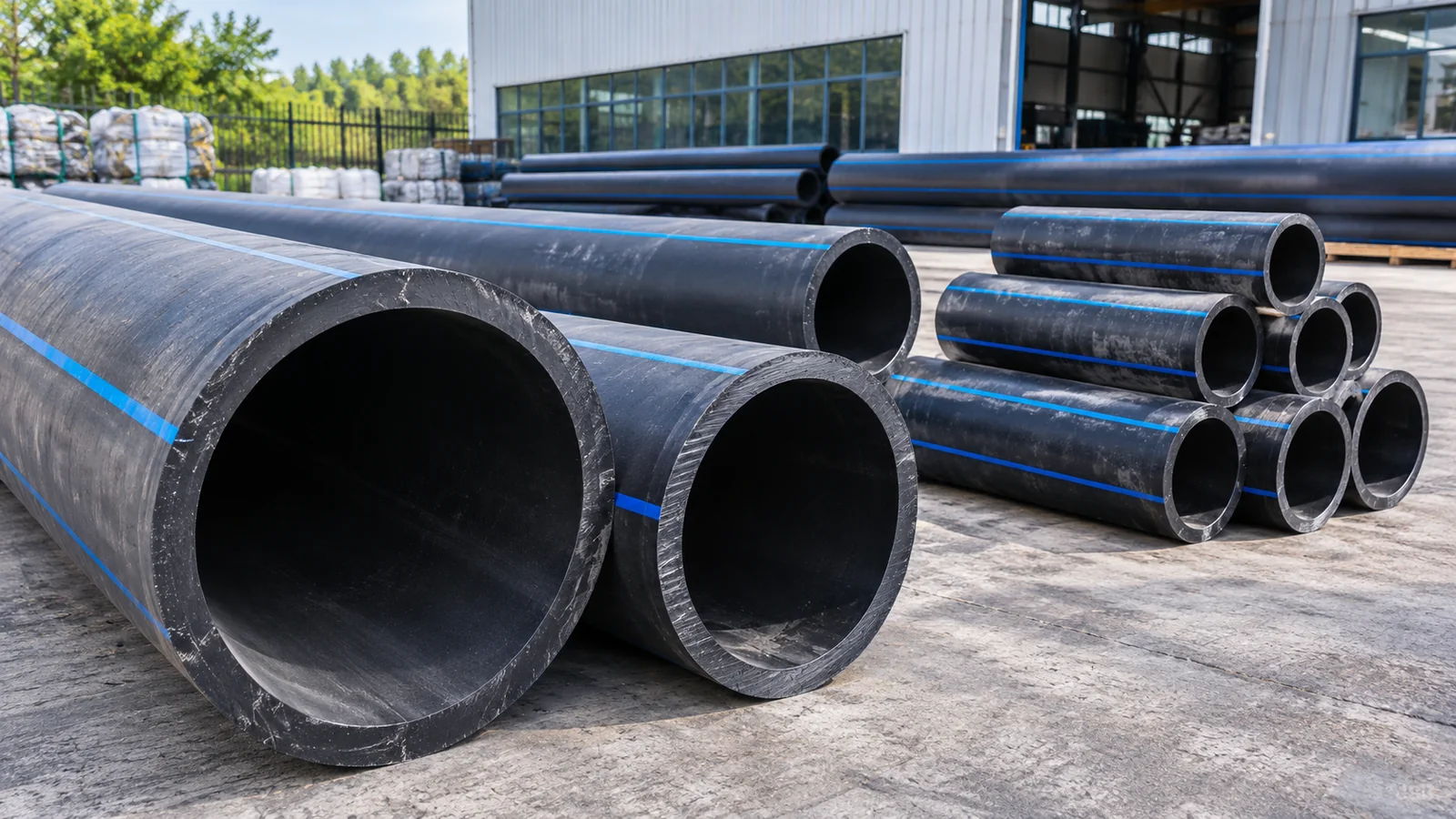
Buyers sometimes send one outside diameter and ask for a price. Diameter matters, but it leaves out several features that determine feeding and cutting behavior. Ask for a photo of the complete piece, not just an end view. Include a tape measure or a clear dimension drawing. If the material is irregular, show the longest, heaviest and least convenient pieces rather than the easiest samples.
Length affects handling and presentation. A piece that fits across a wide hopper may still be difficult to position, restrain or feed steadily. Wall thickness changes the amount of polymer entering each cut and can alter the load on the rotor. Shape matters too: a straight pipe, a coiled length, a ribbed drainage pipe and a nested bundle do not enter a cutter in the same way. Contamination can change the whole process.
For pressure-pipe scrap, an SDR designation can help describe the relationship between outside diameter and wall thickness. But an SDR number is not a shredder setting. The supplier still needs the actual dimensions and representative samples.
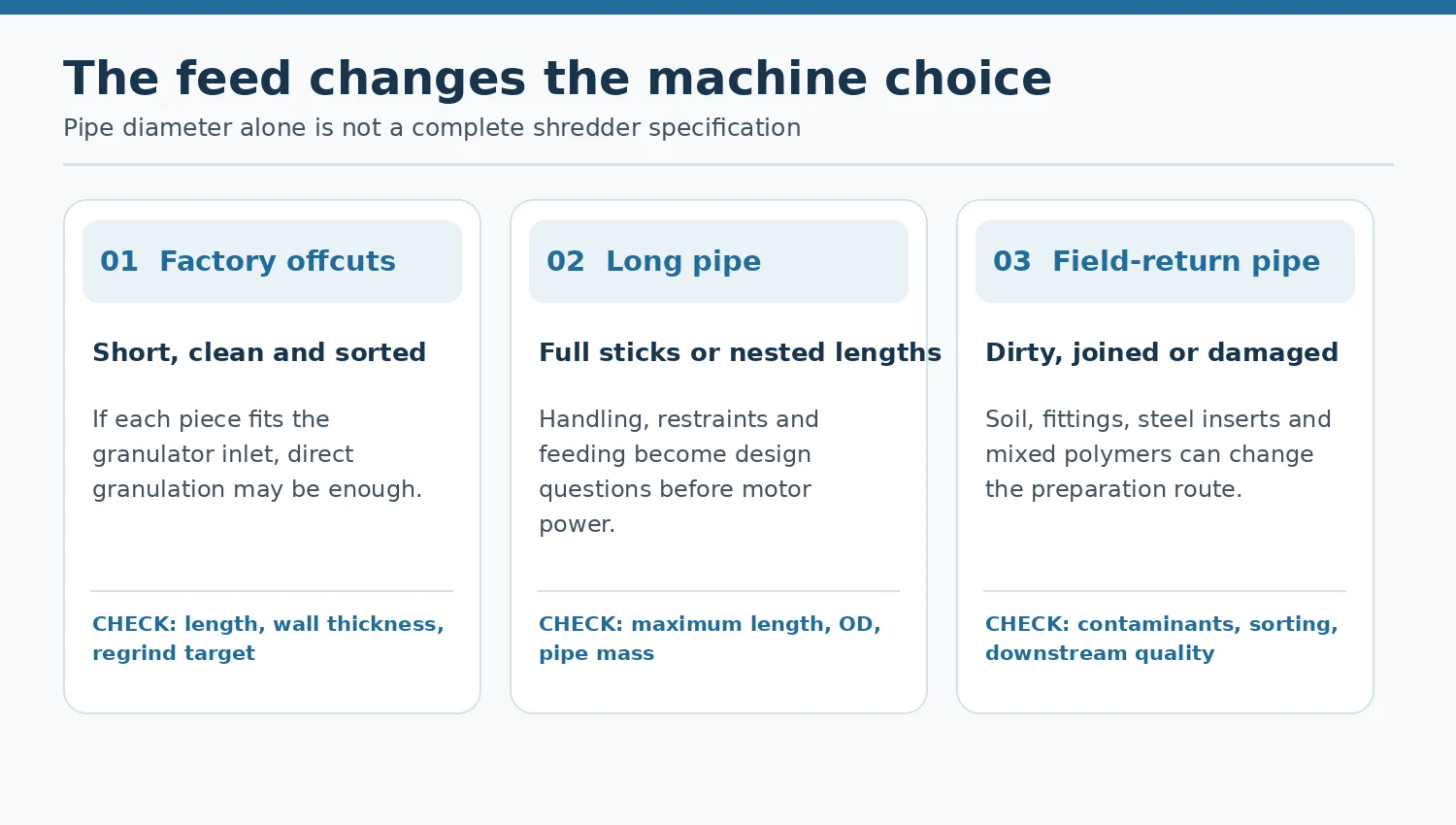
Extrusion start-up pieces, cut-to-length rejects and factory offcuts are generally easier to describe and segregate. They may contain a single known PE grade and fewer foreign objects than recovered pipe from the field. Where pieces already fit the granulator and can be fed safely, direct size reduction can be the simpler choice. Adding a shredder merely because a material is called “pipe” adds cost and another maintenance point without necessarily improving the line.
This is the reason to consider a dedicated pipe-feeding arrangement. Several lengths may be stacked or nested; a single piece may project beyond the chamber or move unpredictably if it is released without restraint. Some purpose-built pipe shredders use long horizontal feeds or other pipe-supporting mechanisms. A standard top-loading hopper should not be assumed to perform the same duty.
The practical design discussion covers the maximum normal length, whether the piece will be pushed or gripped, how it is restrained, how operators are kept clear of moving material and what happens when the machine reverses. A large chamber opening alone does not answer those questions.
Excavated, demolished and returned pipe brings a different set of problems. Dirt and stones can damage the cutting system. Mechanical joints, embedded metal and mixed plastics can be missed in an otherwise black PE pile. The material may need dismantling, draining, visual inspection, metal detection, sorting or cleaning before it reaches a shredder. For a pressure-pipe reuse project, the downstream resin specification also matters; producing small pieces does not turn unknown scrap into a qualified pipe compound.
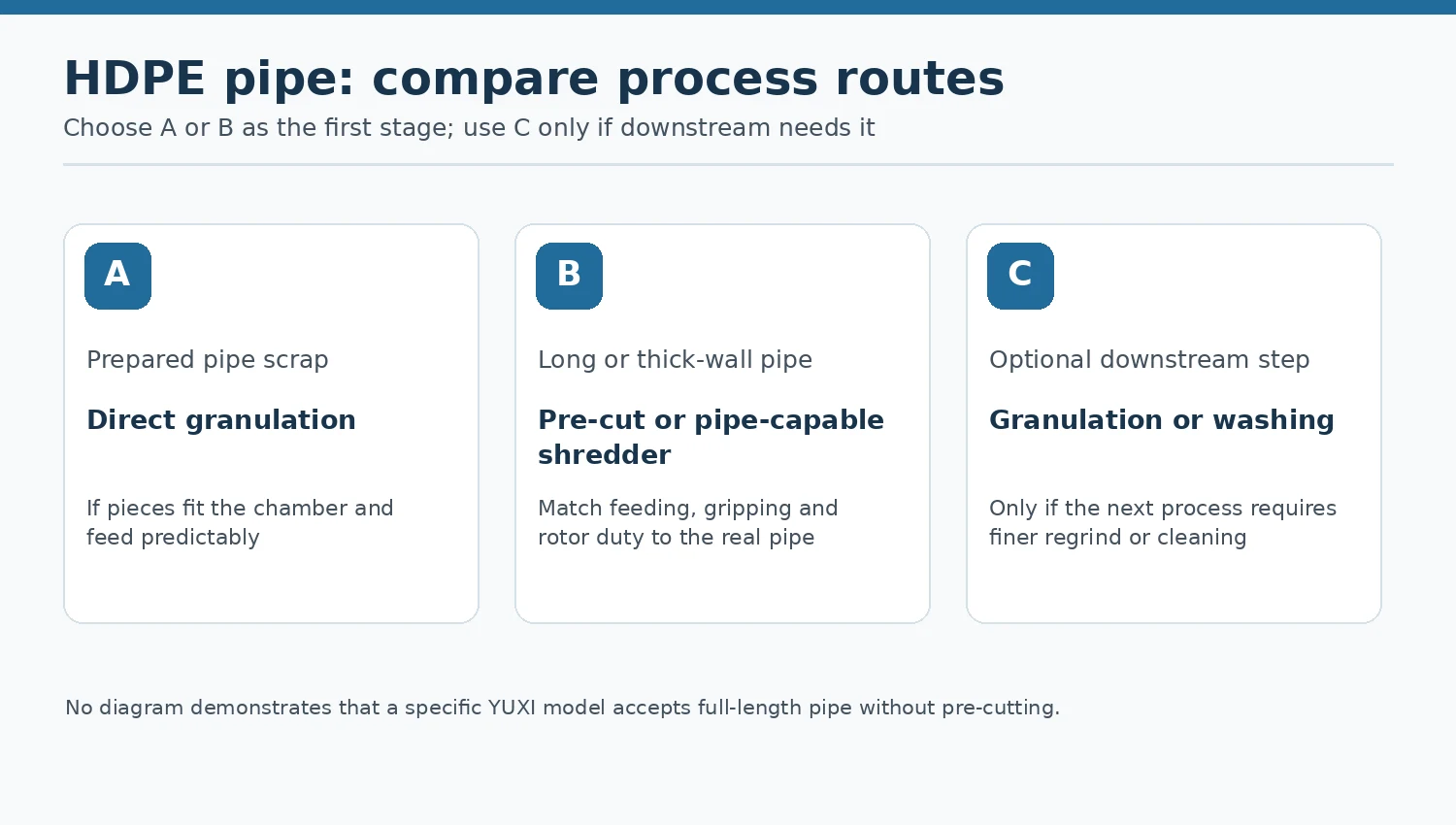
There are three practical choices, and none is automatically right for every plant.
If normal pieces already fit a cutting chamber, enter without bouncing or jamming, and are clean enough for the intended downstream use, a suitably configured plastic shredder or crusher may be all that is required. On scrapshredder.com, the plastic equipment category also includes higher-speed rotor-and-screen machines used for fine size reduction. Their published chamber specifications must not be interpreted as acceptance of arbitrary full-length pipe.
The benefit of a direct route is straightforward: one primary cutting stage, less transfer equipment, and fewer interlocks to maintain. Its limitation is equally clear. If operators must repeatedly hand-cut long pieces or struggle to make them enter the chamber, the seemingly cheaper line may have moved the real work outside the machine.
A primary shredder earns its place when it safely accepts material that is too long, too bulky or too irregular for direct granulation. A screen-equipped single-shaft arrangement may be considered where controlled coarse discharge helps the next process. A double shaft shredder can also be evaluated for rough opening or pre-reduction of prepared bulky plastics, but a conventional two-shaft hopper should not be represented as a dedicated full-length pipe feeder.
For long pipe, ask the supplier to demonstrate the specific feed arrangement in a drawing or with a representative test, including the worst-case length and weight. The question is not only whether cutters can bite into HDPE. It is whether the piece reaches them in a controlled, repeatable way.
Sometimes the sensible solution is to cut an unusually long piece into transportable sections, then feed those sections to a shredder or granulator. That may be more appropriate than buying a specialized long-pipe system for occasional oversize scrap. Pre-cutting still needs a safe procedure and its own time, labor and handling cost in the quotation.
Where the customer needs smaller regrind for washing or extrusion, the primary stage may be followed by granulation. The site’s shredder and granulator two-stage guide explains the overall process distinction. This application page focuses on the pipe-specific feed problems that determine whether that additional stage is justified.
HDPE is often described as “soft plastic” relative to metal or mineral-filled material. That label is misleading at the machine-selection stage. A thick section contains much more polymer per cut than a thin section of the same outside diameter. The pipe can also deform or spring away from the cutter rather than presenting a clean edge. Both behaviors affect how steadily material is fed to the rotor.
For an equipment quote, ask how the proposed cutter geometry grips a curved surface and how the drive responds to load spikes. If a hydraulic pusher is proposed, its job is to present the pipe at a controlled rate; it does not automatically eliminate overloading. The cutter type, rotor design, pushing force and controls must be considered together.
Do not confuse a machine’s maximum opening with a proven maximum processable pipe. A large feed opening can accept the physical envelope yet still leave difficult orientation, poor cutter bite or repeated reversing. If the supplier gives a single “maximum diameter,” ask for the matching wall thickness, length, resin, test material, output size and duty conditions.
Buyers often focus on screen opening, because it is one number that can be put into a purchasing specification. Screen opening matters, but it does not define a guaranteed narrow particle-size distribution. Pipe pieces can leave as irregular chips or strips depending on the cut, the screen and the way material circulates in the chamber.
Start by asking what the next machine will accept. A wash line may need a particular feeding consistency; a granulator needs pieces it can take without stalling; a storage or conveying system has different constraints. Oversize tails may cause more trouble than the average particle size. The main issue is not whether a shredder can produce small pieces during a brief demonstration, but whether the downstream line can operate on the actual discharge hour after hour.
There is also an important commercial boundary: size reduction is not resin qualification. The Plastics Pipe Institute explains that recycled polyethylene can be used in some pipe products only under defined material and product requirements. Peer-reviewed research on recycled pipe compounds likewise evaluates properties far beyond particle size. If the destination is pipe extrusion, agree on allowable contamination, polymer mix and the required material tests with the downstream processor before selecting the shredder.
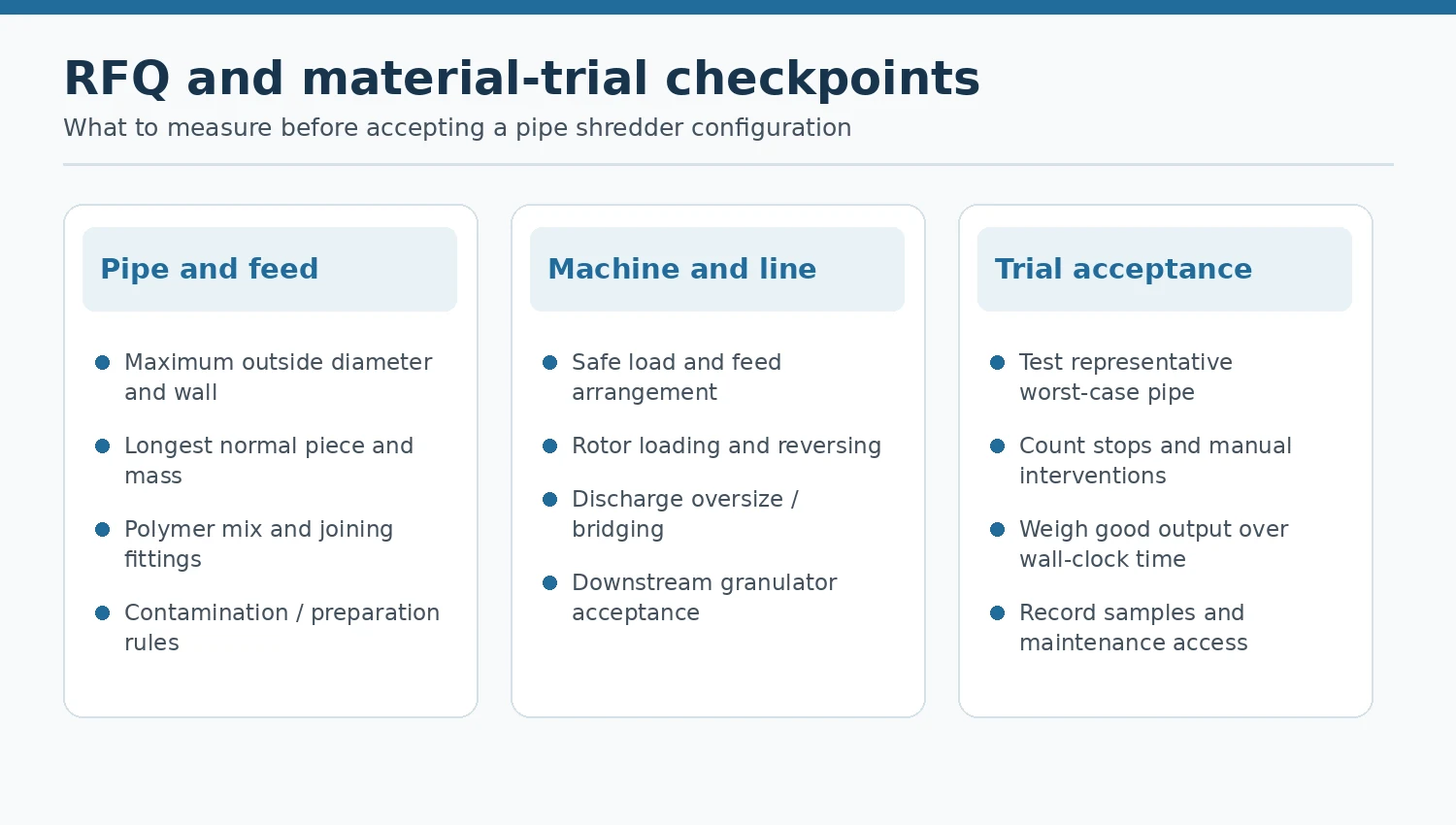
A capacity figure based on short, easy factory offcuts may have little value for a recycler whose daily feed is heavy drainage pipe with fittings. A useful trial should reflect the material the factory will actually receive. Include the longest and thickest normal pieces, not a neatly prepared batch that avoids the problem the machine is being purchased to solve.
Record the total mass of suitable input, the acceptable output collected, and elapsed wall-clock time. Record stops, reverse events, bridging, manual interventions and oversize output. If the trial requires an operator to hand-cut material that the quote said could be fed directly, note the time and labor separately. A gross cutting rate during the smoothest minute is not the same as sustained net production.
Net accepted output rate = accepted discharged mass ÷ total elapsed operating window. Define which stoppages count before testing. A supplier and buyer can both calculate this honestly and still obtain different figures if one excludes routine clearing or material handling.
Make the downstream handoff part of the trial. Put the discharged material on the intended conveyor or run it through a representative secondary machine when practical. Inspect the longest strips, contamination and nonconforming fraction rather than relying only on a sample of attractive-looking chips.
A cleaner shredder output is not necessarily achieved by choosing a sharper knife. For recovered pipe, foreign materials often need to be managed upstream. A load can contain soil in the pipe bore, rocks lodged in a stack, steel couplings, plastic weld fittings, labels or mixed-resin replacements. Each one changes the wear, quality or safety conversation.
If the intention is to sell washed regrind or make pellets, discuss the planned separation and cleaning operations before buying. The site’s plastic crusher materials guide provides a broader material suitability framework; here the issue is specifically how recovered pipe differs from clean extrusion scrap.
There may be a strong reason to separate clean factory production rejects from used infrastructure pipe even if both are marked HDPE. Combining them too early can eliminate a cleaner, higher-value recycling route and make the resulting material harder to characterize. That is a feedstock-management decision, not a claim that shredding itself destroys resin quality.
A useful HDPE pipe shredder quotation is a short process proposal, not just a machine photograph and a motor rating. The buyer should be able to check what the supplier is promising to feed and where responsibility ends.
Space is another easy cost to miss. Long sections need room to unload, stage and feed safely. A machine with a modest footprint can still require a large upstream handling zone. Include operator access and maintenance clearance when reviewing the general arrangement drawing.
Do not buy specialized full-length pipe handling solely because the largest pipe in a brochure looks impressive. It may not make economic sense if oversize pieces appear only occasionally, the buyer can arrange safe pre-cutting, or the material is already short enough for a standard granulator.
Likewise, a shredder is not the right first purchase when the main uncertainty is polymer contamination or whether the recycled material can meet an end-use specification. Sampling, sorting and downstream quality requirements may have to be settled first. A high-capacity shredding stage will not correct an unsuitable feedstock mix.
Finally, jam clearance and servicing must be planned from the outset. The U.S. Occupational Safety and Health Administration’s hazardous-energy standard sets requirements for controlling unexpected startup and stored energy during covered servicing and maintenance activities. A reversing function or emergency stop is not a substitute for a documented, applicable isolation procedure.
Five well-chosen pieces of information often produce a better conversation than a long generic specification: photographs of the normal feed, the largest outside diameter, the longest and heaviest piece, the contamination level, and the desired output and downstream process. If the feed varies by season or supplier, say so. The quote should state whether its proposed machine handles that variation directly or needs preparation ahead of the cutting chamber.
For clean factory pipe, ask whether direct granulation is sufficient. For long and heavy-wall pipe, require evidence of the feeding method. For post-use pipe, start with sorting and cleaning assumptions. That sequence may sound less dramatic than choosing the machine with the biggest motor, but it is more likely to produce a line the plant can actually run.
Send the pipe dimensions, photos, feed condition, expected operating hours and downstream output requirement. YUXI can review whether primary shredding, pre-cutting or additional granulation is a suitable starting point for the project.
Some dedicated pipe shredders are designed for long lengths, but this is not a standard capability of every single-shaft machine. Confirm the model-specific feed channel, maximum length, pipe mass and handling system before making that assumption.
No. Provide wall thickness or SDR, maximum length, approximate mass, resin type and any fittings or contamination. Two pipes with the same outside diameter can load the cutting system differently.
If the pipe is too long or bulky for a granulator, a suitable primary shredder or a safe pre-cutting step may be needed. Already-cut, clean sections that fit the granulator may not need a separate shredder.
No. A shredder reduces size. Reuse in extrusion can require further granulation, sorting, cleaning, drying and melt processing, with separate material quality requirements. Meeting a pipe-grade specification is not established by shredding alone.
Use a representative mixed test load that includes difficult pipe sizes. Measure acceptable output against total elapsed test time, record stoppages and power or load behavior where available, and inspect the downstream feed and product samples.
Segregate and assess it separately from clean factory scrap. Inspect for metal couplers, rocks, mud, trapped fluids and other polymers. The correct route may include draining, dismantling, sorting, washing or pre-cutting before mechanical size reduction.

Get in touch with our nice team today to get a price estimate for a shredder machine.
Contact Us