welcome to Yuxi metal recycling

 English

 EnglishEnglishEnglish
A single shaft shredder is usually a better choice when the project needs controlled output size, screen-based discharge, and stable processing for plastic, wood, textile, paper, or RDF-type materials. A double shaft shredder is usually better when the first job is to bite, tear, and reduce bulky or mixed waste before sorting, incineration pretreatment, or further size reduction.
In real recycling projects, the right choice is not decided by the machine name. It depends on the material, input size, contamination level, required discharge size, hourly capacity, and what happens after shredding. This guide compares the two machines from a project selection point of view, not just from a brochure description.
If you are comparing machines for a recycling line, review both YUXI product pages while reading this guide:
View Single Shaft Shredder View Double Shaft Shredder
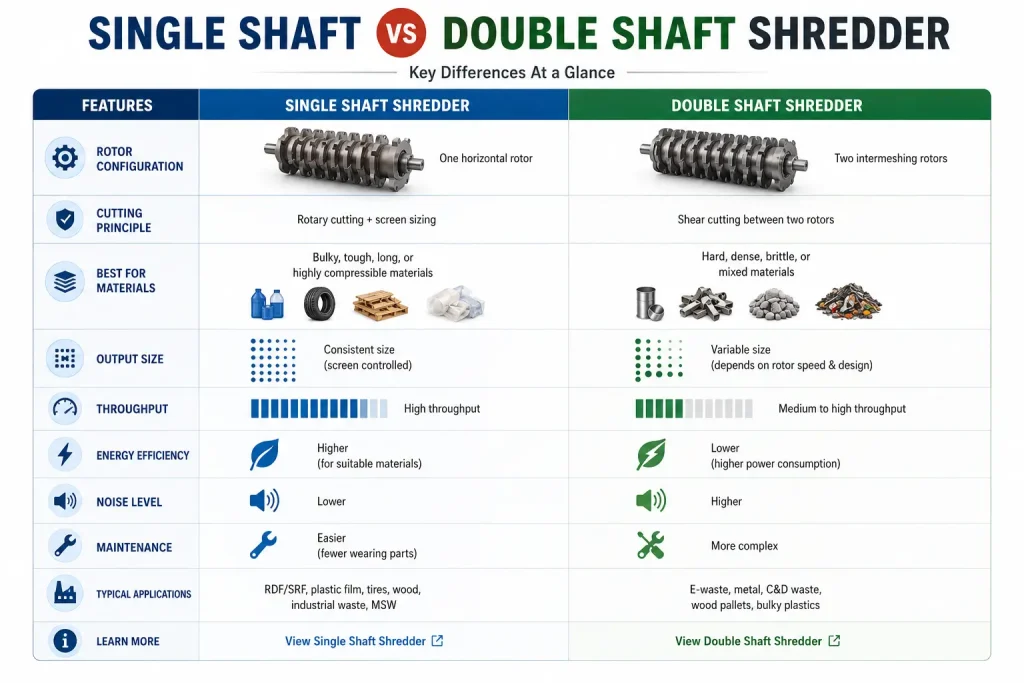
Single shaft shredders are usually selected for controlled output size, while double shaft shredders are often used for high-torque pre-shredding and bulky waste reduction.
The simplest difference is this: a single shaft shredder uses one rotor, fixed knives, a hydraulic pusher, and often a screen to control discharge size. A double shaft shredder uses two counter-rotating shafts to bite and tear bulky material, usually for rougher pre-shredding and volume reduction.
| Item | Single Shaft Shredder | Double Shaft Shredder |
|---|---|---|
| Shaft design | One rotor with cutting knives | Two counter-rotating shafts with blade sets |
| Feeding method | Often uses a hydraulic pusher to press material toward the rotor | Material is grabbed directly by two rotating shafts |
| Output control | Usually controlled by a bottom screen | Usually rougher output, often without screen-based discharge |
| Typical role | Size-controlled shredding before granulation, pelletizing, sorting, or RDF preparation | Pre-shredding, bag opening, bulky waste reduction, MSW and mixed waste handling |
| Common materials | Plastic lumps, film, wood pallets, textile waste, paper rolls, RDF/SRF, light industrial waste | MSW, kitchen waste, cans, drums, paint buckets, e-waste, light metal scrap, mixed waste |
| Maintenance focus | Screen, rotor knives, counter knives, hydraulic pusher, discharge blocking | Blade sets, shafts, gearbox, bearings, overload from hard contaminants |
A single shaft shredder uses a rotating cutter roller and fixed knives to shear, tear, and squeeze material into smaller pieces. On the YUXI single shaft shredder page, the machine is described with a cutter roller assembly, fixed blades, welded housing, motor and reducer, hydraulic pusher, bottom screen, hydraulic system, and electronic control system. The screen is important because it controls when material is small enough to discharge.
This makes the single shaft shredder machine useful when the downstream process needs a more controlled particle size. In a plastic recycling workshop, for example, the shredded material may later go into a granulator or washing line. In RDF preparation, the target output may need to fit the next conveying, drying, or combustion preparation step.
A double shaft shredder works differently. It uses two sets of blades rotating against each other to bite, pull, tear, and shear the material. YUXI describes its double shaft shredder as driven by double motors and double planetary gearboxes, often used for MSW treatment, resource regeneration, and refuse burning pretreatment.
The double shaft shredder machine is usually selected when the first requirement is not a very uniform particle size, but strong material grabbing and volume reduction. It is common in front-end treatment of bulky waste, mixed waste, light metal scrap, cans, paint buckets, e-waste, and similar material streams.
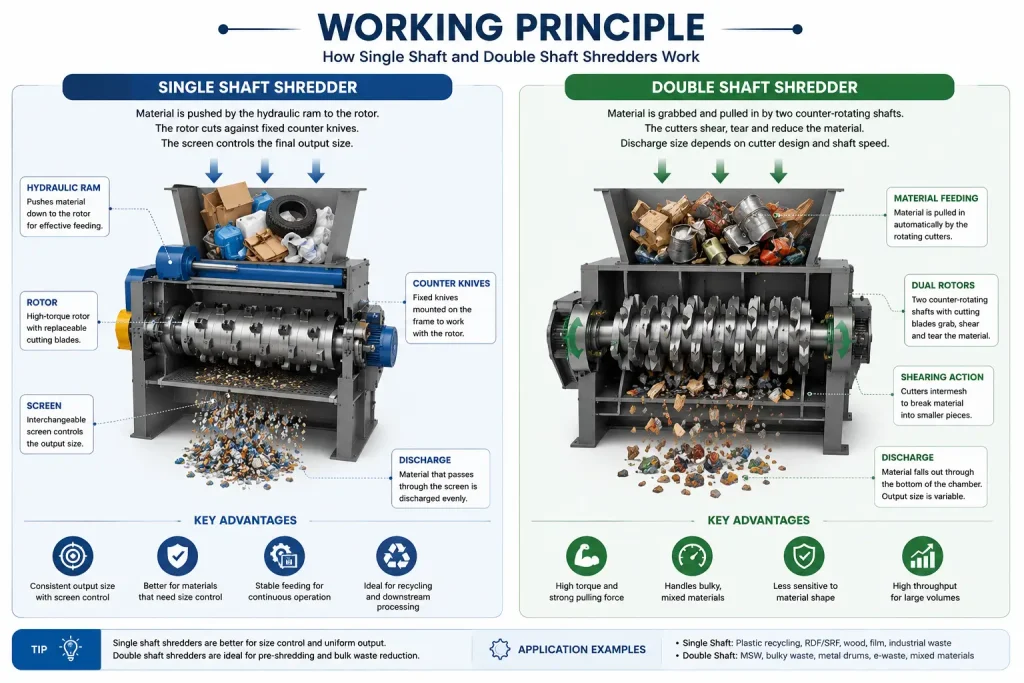
The single shaft design relies on rotor cutting, hydraulic feeding, and screen discharge. The double shaft design relies on two counter-rotating shafts for high-torque tearing.
In a single shaft shredder, material is pushed toward the rotor. The rotor knives and fixed knives cut the material repeatedly. Oversized pieces stay inside the chamber until they are small enough to pass through the screen. This is why single shaft machines are often chosen for projects where particle size matters.
In a double shaft shredder, the two blade shafts rotate toward each other. The material is grabbed and pulled into the cutting area, where it is torn and sheared. This design is usually better for irregular, bulky, mixed, or harder-to-feed materials because the machine can bite the material without relying on a hydraulic pusher.
Several industry references describe the same structural difference: single shaft shredders commonly use one rotor, a hydraulic pusher, and a screen, while double shaft shredders use two counter-rotating shafts and are often used for rougher reduction.
A single shaft shredder usually gives better output size control because the material must pass through a screen before discharge. A double shaft shredder is usually better for rough pre-shredding, but its output is normally less uniform.
This is one of the most important selection points. If the shredded material must feed a granulator, washing line, pelletizing line, sorting system, or RDF/SRF process, the output size requirement should be confirmed before selecting the machine. A single shaft shredder gives more control, but smaller screen size may reduce capacity and increase blade wear.
If the project only needs to open bags, reduce volume, or prepare bulky waste for the next treatment step, a double shaft shredder may be a better first-stage machine. It can reduce large material quickly, but the discharge size is usually rougher and may require secondary shredding or crushing.
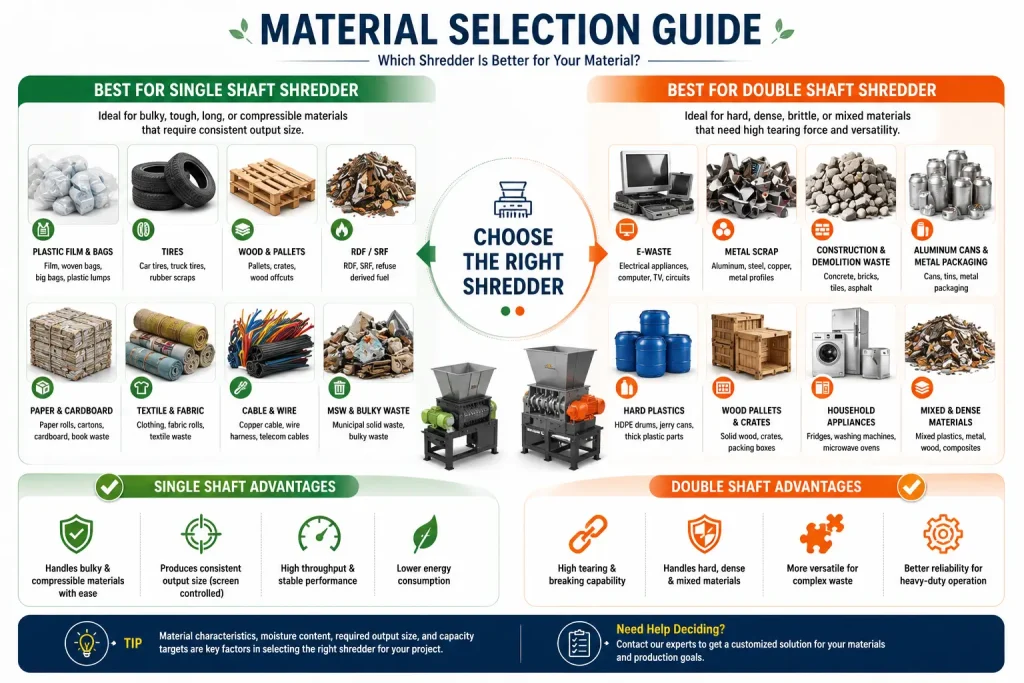
Material behavior, contamination level, and output size requirement are more important than material name alone.
Single shaft shredders are often used for plastic lumps, plastic purgings, film, woven bags, wood pallets, paper rolls, textile scrap, RDF/SRF materials, and light industrial waste. On the YUXI single shaft product page, applications also include plastic drums, pipes, profiles, fishing nets, wood waste, thin metal drums, electronic waste, paper mill waste, paper-plastic composites, and used textile bags.
Double shaft shredders are commonly used for MSW, kitchen waste, wet market waste, plastic bottles, plastic buckets, hard disks, PCB boards, mobile phones, cans, paint buckets, used cartons, old clothes, leather, textile scraps, and similar mixed streams. These are close to the application categories listed on the YUXI double shaft product page.
There are overlaps. For example, textile waste can appear in both machine categories. The final decision depends on whether the project needs controlled output size or rough pre-shredding, whether the material wraps easily, and whether contaminants may damage the cutting system.
Double shaft shredders are often used when high-volume pre-shredding is the main goal. The YUXI double shaft product page lists models from YXS-600 to YXS-2600, with capacities ranging from 2–3T/H up to 25–60T/H and product size commonly listed around 3–10CM. This makes the double shaft line more suitable for large front-end waste treatment projects.
Single shaft shredder capacity is more sensitive to screen size, material density, feeding stability, and required output size. A smaller screen can produce a more controlled discharge, but it can also slow the machine down. In other words, single shaft shredding capacity should be discussed together with the target output size, not separately.
Not always. A medium single shaft shredder for plastic recycling may cost less than a heavy double shaft shredder for MSW. But a large single shaft shredder with special blades, strong hydraulic feeding, a small screen size, and high wear resistance can also become a serious investment. The better question is not which machine is cheaper, but which machine avoids rework, downtime, and wrong output size.
For a deeper cost breakdown, see this related guide: Single Shaft Shredder Price: Complete Cost Guide.
Single shaft maintenance usually focuses on rotor knives, counter knives, screen wear, hydraulic pusher condition, discharge blocking, and overload protection. When working with film, textile, or fibrous waste, operators should also watch for wrapping and feeding instability.
Double shaft maintenance usually focuses on blade thickness, shaft condition, gearbox load, bearing condition, and damage caused by hard contaminants. Because these machines often handle mixed or bulky materials, inspection routines are important.
For machine safety, guarding and access control should never be ignored. OSHA states that machine guarding is used to protect operators and other employees from hazards created by the point of operation and moving parts. OSHA machine guarding overview
If the material is plastic lumps, purgings, film, or woven bags and the next step needs a more consistent size, a single shaft shredder is usually the starting point. The hydraulic pusher and screen help keep the discharge more controlled.
If the first job is to open bags, reduce volume, or prepare mixed waste before sorting, a double shaft shredder is often the safer first-stage choice. It can grab irregular material and reduce it before secondary processing.
RDF/SRF projects may use either machine, or both. A double shaft shredder may be used first for rough reduction, followed by a single shaft shredder when more controlled output size is required. EPA’s sustainable materials management hierarchy emphasizes reduction, reuse, recycling, composting, and other management strategies for non-hazardous materials, which is the broader context behind many recycling and waste processing projects. EPA waste management hierarchy
For light metal drums, cans, paint buckets, and mixed industrial waste, the double shaft shredder is often used as a pre-shredder. If the final process needs smaller and more uniform material, another shredding or crushing stage may be added after it.
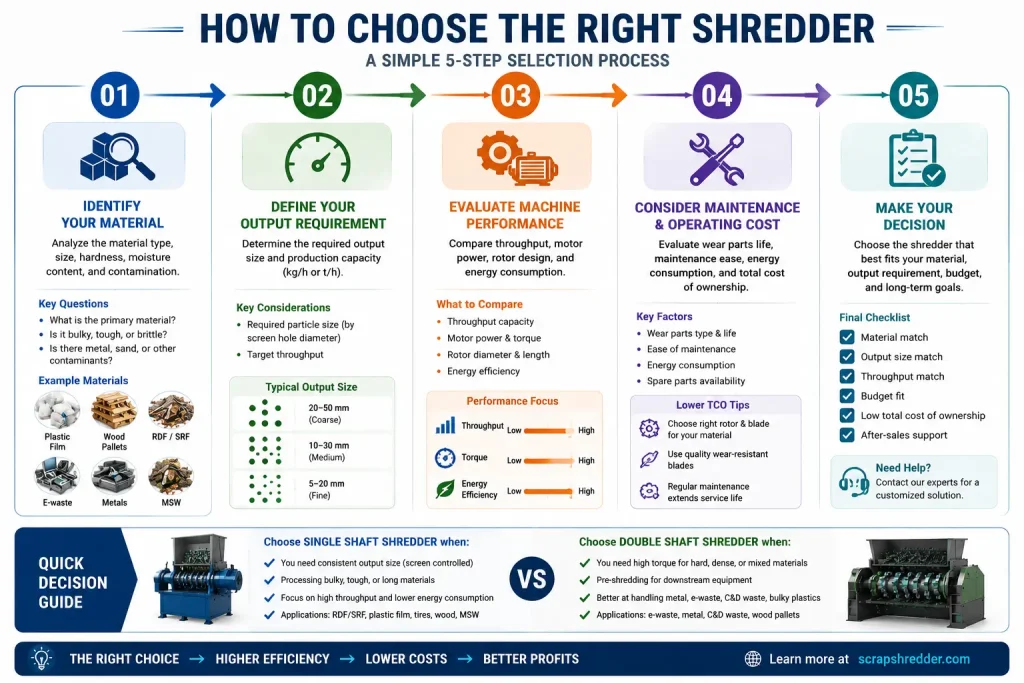
A reliable shredder selection starts with material behavior, target output size, capacity, and downstream process.
Use these practical rules before asking for a quotation:
YUXI supplies single shaft shredders, double shaft shredders, plastic shredders, hydraulic shredders, and recycling systems for metal, tire, paper, plastic, and solid waste processing. If you are choosing between shredder types, send your material details and capacity target for a project-based recommendation.Contact YUXI for Shredder Selection
Not in every project. A single shaft shredder is usually better for controlled output size. A double shaft shredder is usually better for bulky waste, mixed material, and rough pre-shredding.
A single shaft shredder usually gives more uniform output because the material passes through a screen before discharge. Double shaft shredders normally produce rougher output.
For plastic lumps, purgings, film, woven bags, and materials requiring controlled size, a single shaft shredder is often preferred. For bulky plastic containers or mixed waste streams, a double shaft shredder may be used first.
Double shaft shredders are often used for MSW pretreatment because they can bite and tear bulky mixed waste. A second machine may be needed if the final output size must be more controlled.
Some single shaft shredders can process thin metal drums, aluminum profiles, light scrap, or e-waste, but blade material and machine configuration are important. For heavier or more contaminated metal streams, a double shaft shredder is often more suitable.
Some recycling lines use both. A double shaft shredder may handle rough pre-shredding first, and a single shaft shredder may be used later when a more controlled output size is required.

Get in touch with our nice team today to get a price estimate for a shredder machine.
Contact Us


