





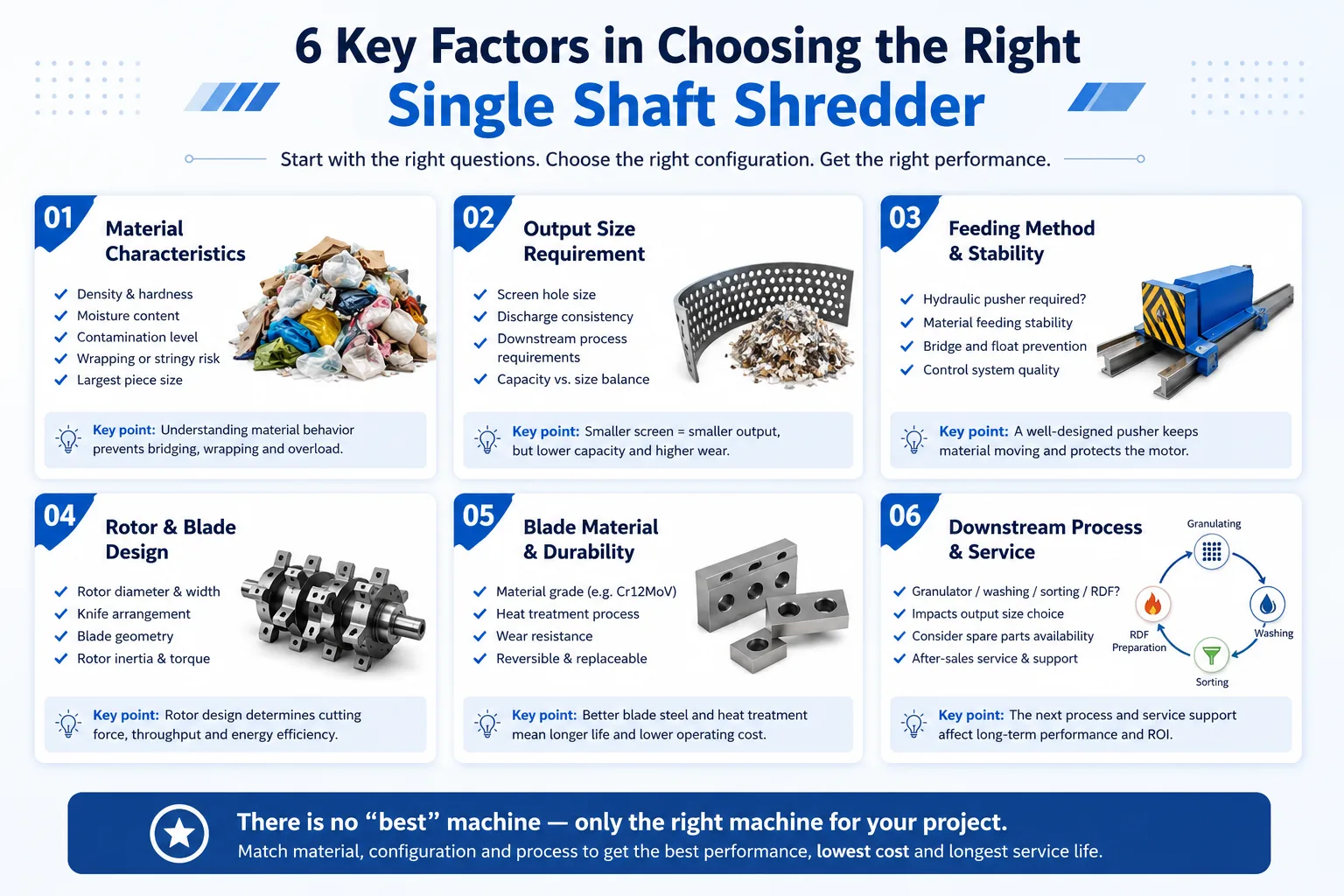
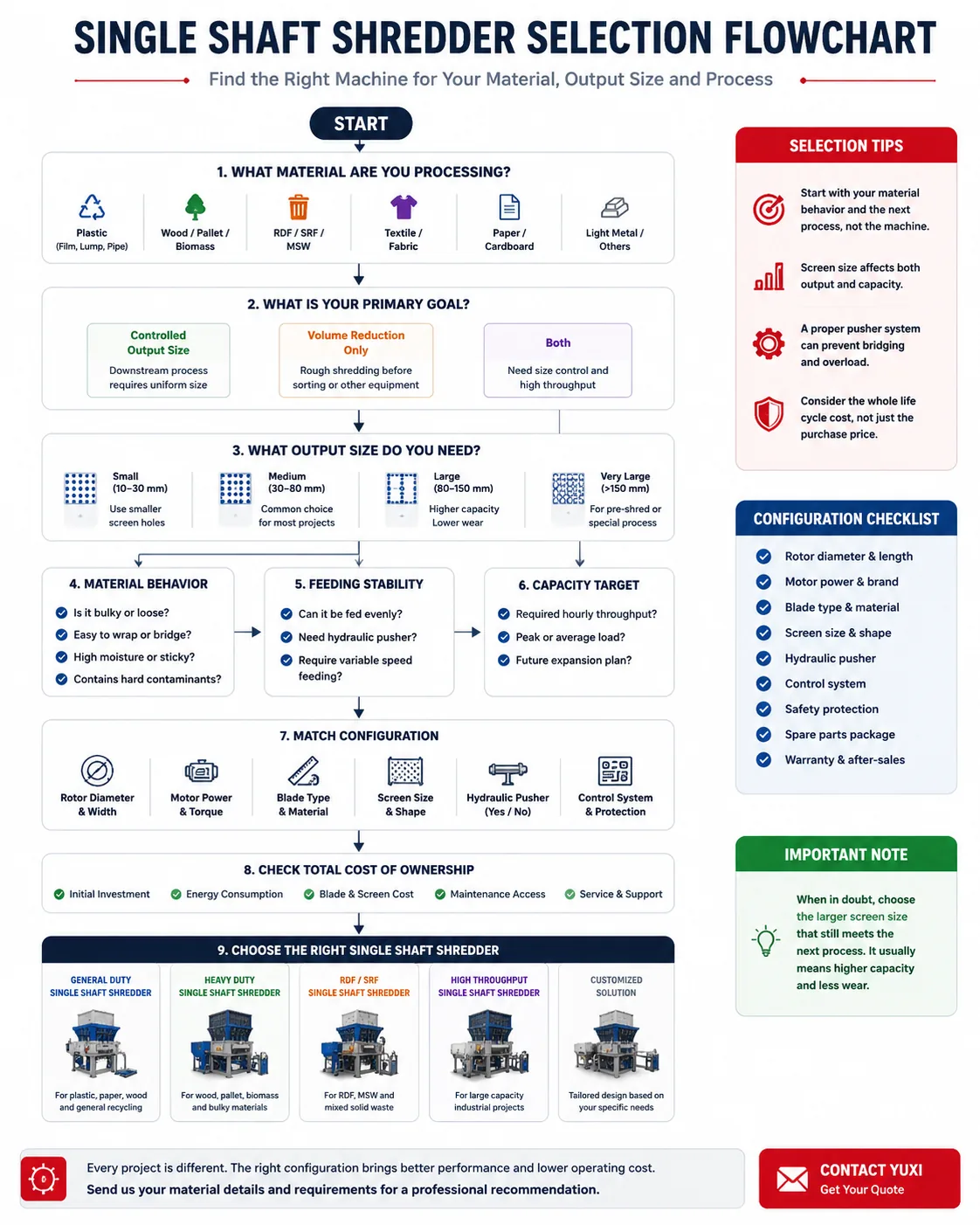
Choosing the right single shaft shredder starts with the material, the required output size, and what happens after shredding. Motor power matters, but it is rarely the first thing an experienced project engineer looks at. A machine with a large motor can still perform badly if the screen is too small, the rotor cannot bite the material, or the hydraulic pusher does not feed steadily.
In most recycling projects, the right machine is selected around a few practical questions: What is the material behavior? Does it wrap, bridge, bounce, or wear blades quickly? What output size does the next machine need? How much material must be processed per hour? This guide explains those decisions in a way that helps buyers avoid choosing a machine only by price, horsepower, or catalog model.
If you already know your material type and output requirement, you can compare your project with the YUXI single shaft shredder product page here:
What Makes a Single Shaft Shredder Different?
A single shaft shredder usually combines one rotor, fixed counter knives, a hydraulic pusher, and a screen under the cutting chamber. This design is useful when the project needs a controlled discharge size instead of only rough volume reduction.
On the YUXI single shaft shredder product page, the machine is described with a cutter roller assembly, fixed blades, welded housing, motor and reducer, hydraulic pusher, bottom screen, hydraulic system, and electronic control system. That structure explains why the machine is often used for plastic drums, pipes, profiles, fishing nets, wood waste, paper mill waste, electronic waste, light metal drums, and paper-plastic composite materials.
The basic working loop is simple: the hydraulic pusher moves material toward the rotor, the rotor knives cut against fixed knives, and the screen holds oversized pieces in the chamber until they are small enough to discharge. Energycle describes the same “push → shear → screen” loop and notes that pusher tuning and screen selection can change output consistency and energy consumption. Energycle component guide
Start With the Material, Not the Machine
Many buyers start by asking for a model list. In practice, a better first step is to describe the material honestly. Two customers may both say “plastic waste,” but one may be processing clean injection molding scrap while the other is handling dirty film, woven bags, or mixed packaging. Those are very different shredding jobs.
| Material behavior | Typical problem in the shredder | What to check before buying |
|---|---|---|
| Plastic film and woven bags | Wrapping, bridging, uneven feeding | Hydraulic pusher design, rotor bite, screen open area |
| Plastic lumps and purgings | High torque demand, bouncing, overload cycles | Rotor diameter, knife layout, gearbox and shock protection |
| Wood pallets and furniture waste | Impact load, nails, uneven pieces | Blade material, rotor strength, contamination tolerance |
| Textile waste | Winding, light bulk density, unstable feed | Pusher control, anti-wrapping design, discharge size |
| RDF/SRF materials | Mixed contamination, variable density, abrasive wear | Wear parts, overload protection, screen access, maintenance plan |
| Light metal or e-waste | Blade wear and hard contaminants | Material testing, blade specification, whether pre-shredding is needed |
There is no shame in sending photos or videos before choosing. In fact, it usually saves time. A short video showing how the material arrives on site often tells more than a long material description.
Why Output Size Matters More Than Many Buyers Expect
Screen size is one of the most important decisions in single shaft shredder selection. Smaller screen holes can produce more controlled output, but they usually reduce throughput, increase internal recirculation, and increase blade wear.
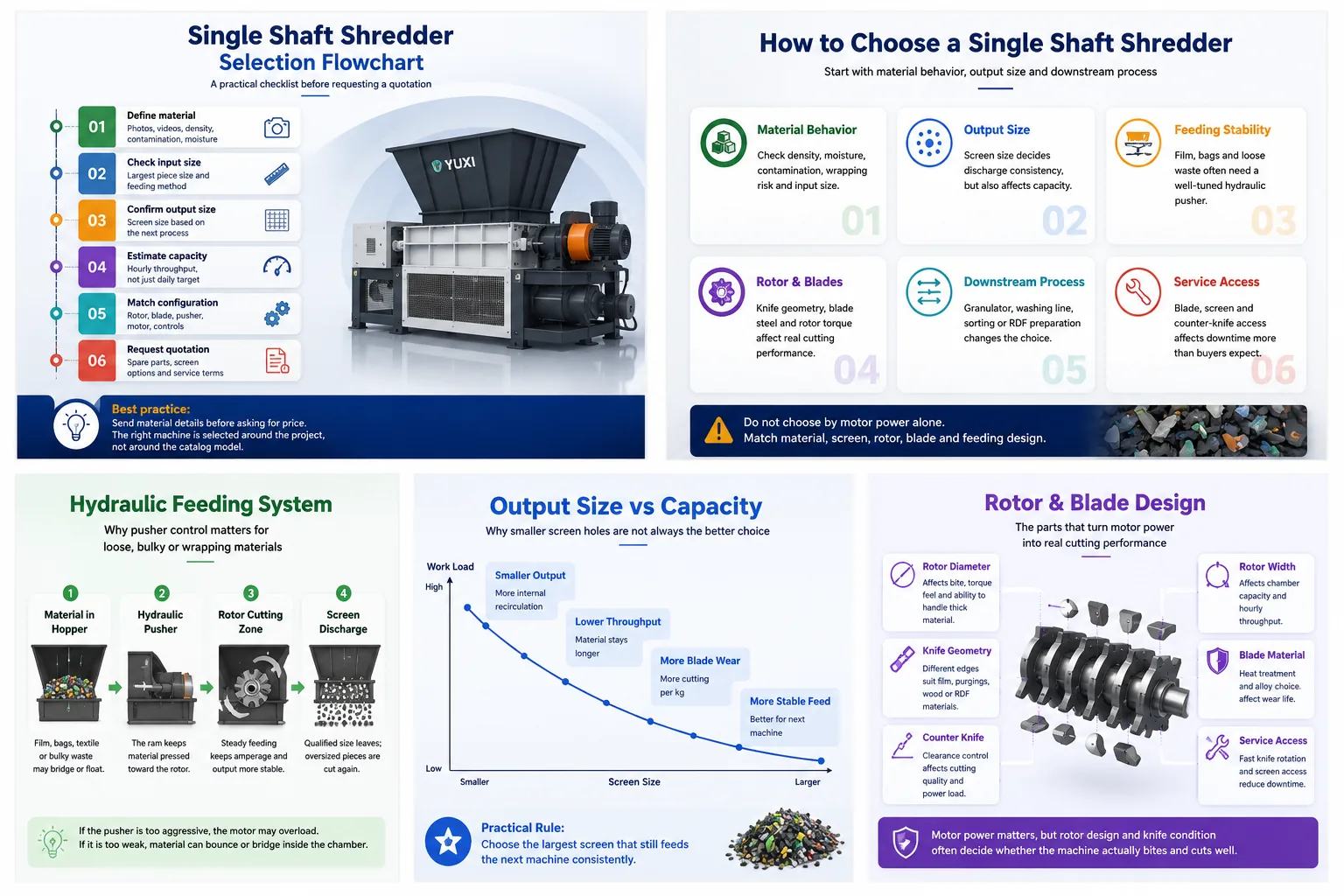
This is a point many buyers underestimate. A smaller screen is not automatically better. If the next machine needs smaller material, the screen has to match that requirement. But if the screen is too small for the material, the shredder may keep recirculating oversized pieces inside the chamber, which raises motor load and reduces throughput.
Hard Recycle’s single-shaft shredder description also emphasizes configurable screen sizes and homogeneous output, while noting the role of the hydraulic pusher in keeping bulky material from floating in the chamber. Hard Recycle single-shaft shredder reference
A practical way to decide is to start from the downstream process. If the shredded material feeds a granulator, washing line, pelletizing line, sorting system, or RDF process, ask what size that process can handle smoothly. Then choose the largest screen that still gives a reliable feed to the next machine.
When Do You Need Strong Hydraulic Feeding?
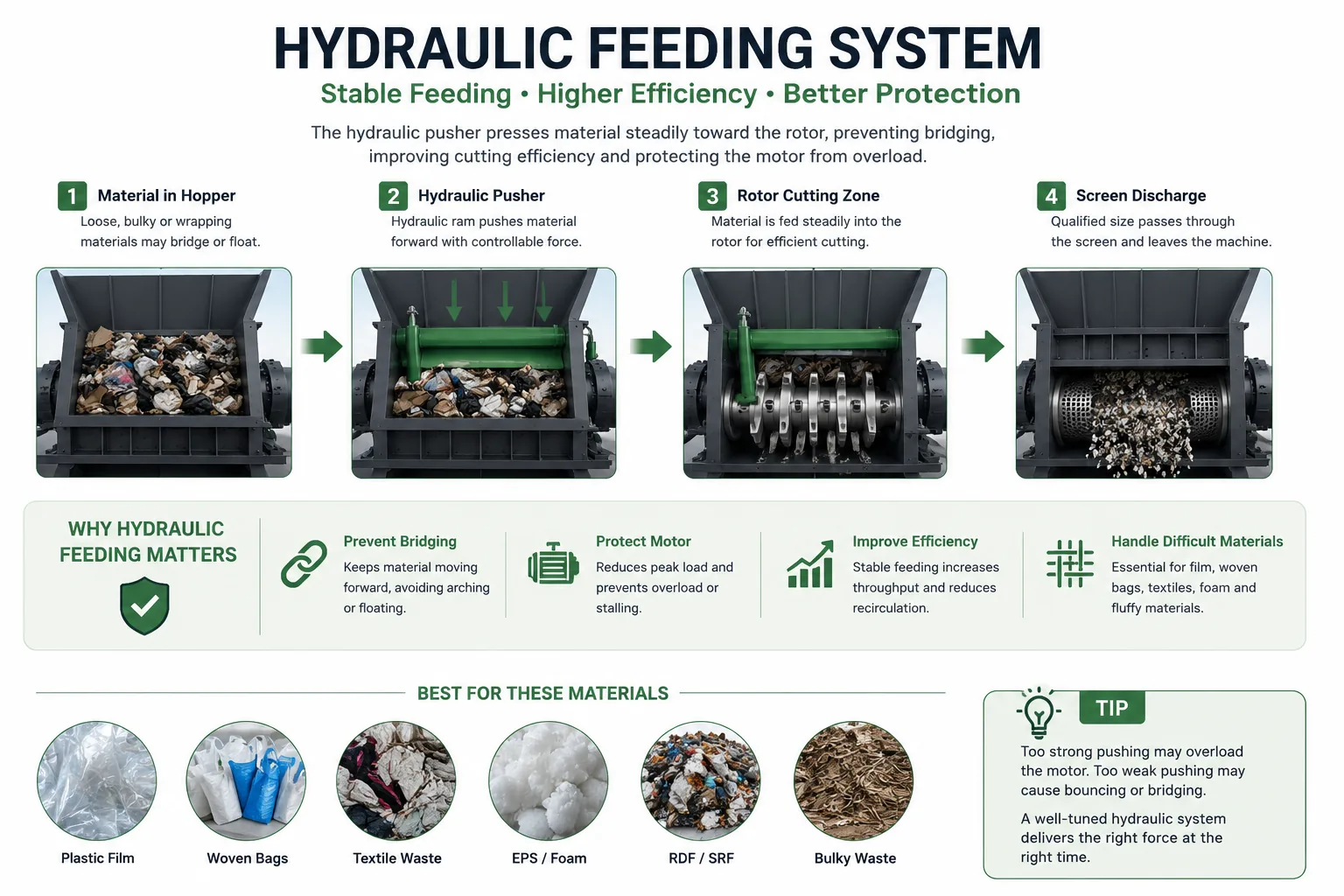
A single shaft shredder does not rely only on gravity. The hydraulic pusher is what keeps material pressed toward the rotor. That matters a lot when the material is loose, light, bulky, or easy to bridge inside the hopper.
Film, woven bags, foam, textile waste, paper rolls, and hollow plastic containers can all behave badly if feeding is unstable. Sometimes the rotor is not the problem; the material simply does not stay engaged with the cutting zone. In those cases, pusher force, pusher stroke, guide wear pads, hydraulic oil cooling, and load-sensing control become real selection points.
One common mistake is assuming a larger motor will solve poor feeding. It often will not. If the pusher cannot feed the material evenly, the motor may run with unstable load: starving one moment, overloading the next.
How Rotor and Blade Design Affect Shredding Performance
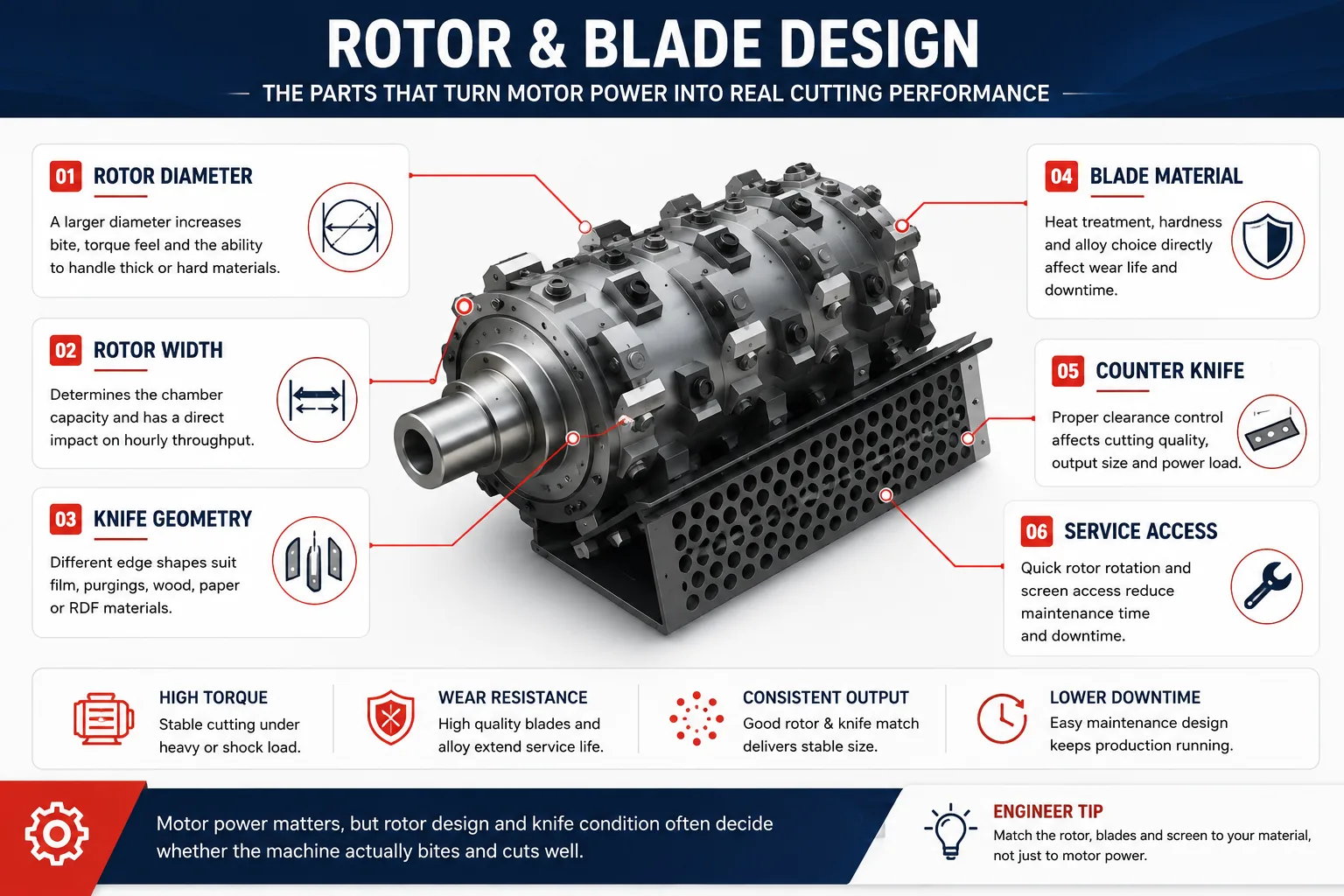
Motor power is easy to compare on paper. Rotor and blade design are harder to compare, but they often matter more in daily operation.
A thick plastic purge lump, for example, does not behave like thin film. The rotor must be able to bite into the material instead of bouncing it around the chamber. Wood waste and RDF materials may need better wear resistance. Textile waste may need a cutting arrangement that reduces wrapping. A buyer should ask how the rotor and blade layout changes for the actual material, not only what the standard model looks like.
IQS Directory describes single shaft industrial shredders as using a rotating shaft with hardened cutting blades, a hydraulic ram or pusher plate, and a screen beneath the cutting chamber. It also notes their use in material size control for plastics, wood, textiles, and light metals. IQS industrial shredder reference
For buyers, the useful questions are quite practical: What blade material is used? Can the knives be rotated or reused? How is the clearance between rotor knives and fixed knives adjusted? How long does it take to change blades and screens? If these answers are vague, downtime may become more expensive than expected.
The Downstream Process Changes Everything
A single shaft shredder is rarely the only machine in a recycling project. It may feed a granulator, washing line, conveyor, magnetic separator, pelletizing line, RDF preparation system, or sorting system. The next machine often decides what the shredder must do.
If the shredded material will enter a granulator, long strips or oversized pieces may cause feeding problems. If it enters a washing line, the size must be suitable for washing, friction cleaning, and conveying. If it is prepared for RDF/SRF, the output size may need to match the next stage of drying, screening, conveying, or combustion preparation.
This is why a machine that works well in one plant may not be right for another. The shredder should be selected as part of a process, not as an isolated machine.
Common Mistakes When Buying a Single Shaft Shredder
Only comparing motor power
A bigger motor may help in some cases, but it does not fix weak feeding, poor blade geometry, a bad screen choice, or an unsuitable rotor design. Ask how the machine handles your material, not only how many kilowatts it has.
Choosing the smallest possible output size
Smaller output may sound better, but it usually means more cutting work, lower throughput, and faster wear. In some plants, operators choose a slightly larger output size because it keeps the whole line more stable.
Ignoring contamination
Small metal pieces, stones, sand, moisture, and dirt can change the maintenance picture. For RDF, wood waste, or mixed industrial waste, contamination should be discussed before the machine is quoted.
Buying without spare parts planning
Blades, counter knives, screens, bearings, seals, and hydraulic parts are not afterthoughts. They decide how quickly the line can recover after wear or damage.
Not checking safety and service access
For industrial equipment, guarding, emergency stops, interlocks, and maintenance procedures should be checked before installation. OSHA’s machine guarding guidance explains the importance of protecting operators from moving parts and points of operation. OSHA machine guarding overview
Typical Project Scenarios
Plastic recycling workshop
If the project handles plastic lumps, purgings, sprues, pipes, or film waste, the main decision usually comes down to output size and feeding stability. A single shaft shredder is often used before granulation or washing because the screen helps control discharge size.
Wood waste recycling
Wood pallets, furniture waste, and timber offcuts need a machine that can handle impact and occasional contaminants. Blade material, rotor strength, and maintenance access are more important than a polished catalog photo.
RDF/SRF preparation
RDF projects are rarely clean. Material density and contamination change from day to day. The shredder should have good overload protection, accessible wear parts, and a screen setup that matches the downstream process.
Textile waste
Textile waste often looks easy until it starts wrapping or bridging. In this case, hydraulic feeding, rotor knife geometry, and anti-wrapping measures deserve more attention.
Mixed industrial waste
When the material stream is inconsistent, a test run or material analysis is usually worth the effort. A standard configuration may work, but it should not be assumed without checking input size, contaminants, and output requirements.
Questions to Ask Before Requesting a Quotation
| Question | Why it matters |
|---|---|
| What material will be shredded? | Different materials require different rotor, blade, and feeding setups. |
| What is the largest input size? | The chamber and hopper must fit real material size, not only average size. |
| What output size is required? | Screen size affects both output quality and throughput. |
| What happens after shredding? | The downstream process often determines the right discharge size. |
| Is the material contaminated? | Metal, sand, moisture, and dirt affect blade wear and overload protection. |
| What hourly capacity is needed? | Daily target alone does not show peak load or feeding requirements. |
| What spare parts are included? | Blades, screens, counter knives, and wear parts affect real operating cost. |
YUXI supplies single shaft shredders, double shaft shredders, plastic shredders, hydraulic shredders, and recycling systems for metal, tire, paper, plastic, and solid waste processing. If you are choosing a machine for a specific material, send your material details, target output size, capacity requirement, and project layout.
FAQ: Choosing a Single Shaft Shredder
How do I choose the right single shaft shredder?
Start with the material, required output size, hourly capacity, feeding behavior, contamination level, and downstream process. Then match rotor design, blade material, screen size, hydraulic feeding, and control system to those requirements.
What size single shaft shredder do I need?
The size depends on input material size, hourly capacity, chamber width, rotor size, and target discharge size. It is better to provide material photos or videos before selecting a model.
Does screen size affect capacity?
Yes. Smaller screen holes usually improve output size control, but they can reduce throughput and increase blade wear because material stays longer inside the chamber.
Do I need hydraulic feeding?
Most industrial single shaft shredders use hydraulic feeding. It is especially important for loose, bulky, light, or wrapping materials such as film, bags, foam, textile waste, and paper rolls.
Can a single shaft shredder process metal?
Some single shaft shredders can process thin metal drums, aluminum profiles, e-waste, or light scrap, but blade material, contamination level, and machine configuration should be checked carefully.
What affects shredder blade life?
Blade life is affected by material abrasiveness, contamination, blade steel, heat treatment, knife clearance, screen size, and maintenance habits.